
Meta Product Growth Analyst Interview Guide (2025): Process, Questions & Case Tips


Navigating the Meta Product Growth Analyst Interview
With the product analytics market poised to grow by 21% by 2028, companies seek growth analysts who deeply understand consumer needs and shape product strategy through data—and this applies to Meta.
A Meta product growth analyst is uniquely positioned to boost retention and optimize billion-user-scale experiences for Meta’s products, ranging from social media apps to AI experiences. Through analytics, strategy, and experimentation, they can drive impact throughout the product lifecycle and ultimately contribute to Meta’s steadily growing revenue, which now sits between $56 billion and $59 billion.
This guide walks you through what it takes to land the role: the interview process, key expectations, sample questions, and preparation strategies tailored to Meta’s unique culture and scale.
What Makes This Role Different
At Meta, small analytical insights create global-scale impact. With nearly four billion active users, you’ll work with complex datasets spanning diverse demographics, geographies, and product experiences. The hypotheses that you test ultimately shape how billions of people connect, create, and consume content.
Your day-to-day involves designing A/B tests, identifying growth opportunities through data exploration, and partnering with cross-functional teams (PMs, engineers, designers, data scientists) to launch features and optimize product experiences. Unlike traditional analyst roles, you’ll operate with significant autonomy—expected to identify problems, propose solutions, and drive decisions through data storytelling rather than waiting for assignments.
Why Choose This Role
Beyond competitive compensation starting at $133K (with total comp often exceeding $200K+), this role offers accelerated career growth. Product growth analysts often progress to senior/staff roles setting growth strategy for entire product families, or pivot into specialized tracks like monetization analytics, market intelligence, or even product management.
While you won’t have direct reports, you’ll be expected to shape product roadmaps through data and strategic recommendations, thus striking the right balance between ownership and cross-functional influence. Most importantly, you’re offered a front-row seat to how data, AI, and innovation drive some of the world’s most influential products.
Understanding the Meta Product Growth Analyst Interview Process
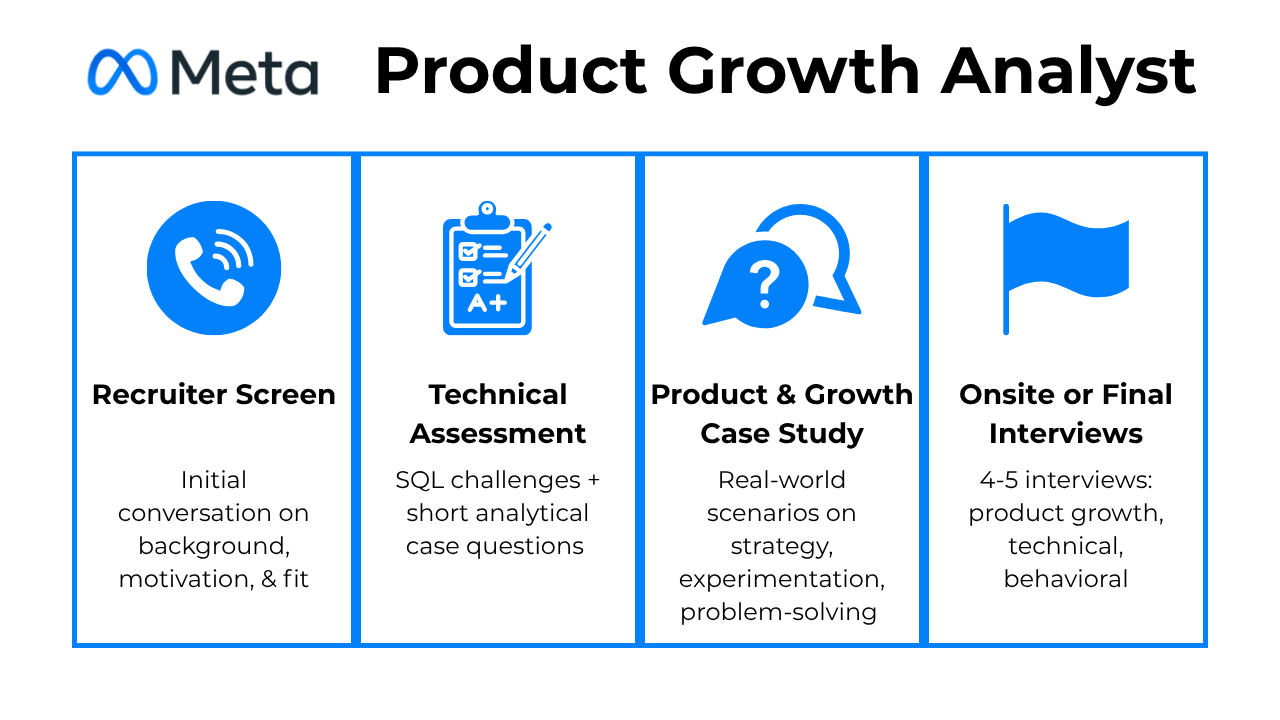
The Meta interview process for Product growth analyst roles typically unfolds across several structured stages designed to evaluate both analytical and strategic thinking. Each stage is designed to simulate the real challenges analysts face at Meta—turning data into growth insights that drive measurable, sustainable impact.
Here’s a closer look at the interview stages candidates must prepare for:
Recruiter Screen
The recruiter screen is an initial 20–30 minute conversation focused on understanding your background, motivation, and overall fit for the Meta product growth analyst role. Expect questions about your experience with analytics tools (SQL, Python, Excel), your interest in Meta’s products, and examples of when you’ve influenced product decisions using data.
Recruiters also assess alignment with Meta’s company culture and growth mindset, so articulate why Meta’s mission of building community and driving meaningful connections resonates with you.
Tip: Prepare a concise story highlighting an analytics project where you made a measurable impact. Use quantifiable results (“increased retention by 10%”) to stand out early.
Technical Assessment
The technical assessment tests your ability to manipulate and interpret large datasets. This typically involves SQL challenges and sometimes short analytical case questions. You might be asked to calculate metrics like retention, engagement, or conversion rates, or write SQL queries involving joins, subqueries, and aggregations.
In some cases, you may complete an online SQL test or take-home analytics exercise using CoderPad. By giving you a dataset with specific business questions, Meta’s goal is to assess whether you can translate data into insights — not just write perfect syntax.
Tip: Focus on query efficiency and clarity. Practice explaining what each part of your SQL query does. Meta interviewers value communication as much as correctness.
Product and Growth Case Study
The technical aspect of the Meta interview process also includes case questions, which evaluate your ability to think strategically about growth problems. You’ll be given a real-world scenario, such as, “How would you increase engagement on Instagram stories?” or “Design an experiment to improve retention for new Facebook users.”
This round assesses your product strategy, experimentation knowledge, and structured problem-solving. Expect to discuss metrics, hypotheses, and the trade-offs of different growth levers. Candidates who stand out are those who can balance high-level thinking with clear, concise responses.
Tip: Use a concrete framework. Define the goal, metrics, hypotheses, and possible experiments. Think aloud and structure your reasoning logically; this mirrors how Meta teams brainstorm growth strategies.
Onsite or Final Interviews
The final interview rounds, often virtual these days, are comprehensive, combining product thinking with deeper technical discussions, behavioral questions, and cross-functional interviews with hiring managers or team leads. This loop includes four to five interviews:
- Product growth rounds are fairly similar to the previous product sense screen, but expect you to go in-depth and be more creative in defining criteria and proposing solutions.
- Technical discussions can revisit data problems or expand on metrics design. Prepare for core SQL concepts like joins, aggregations, and window functions to extract insights from datasets.
- Behavioral interviews test for collaboration, adaptability, and communication for product direction. You might hear, “Tell me about a time you influenced a decision without authority,” or “How do you handle misalignment between data and product priorities?”
Meta’s interviewers look for analytical precision, clarity of thought, and strong storytelling with real trade-offs and outcomes. Your ability to turn complex data into actionable business insights is key.
Tip: For each question, link your answers to measurable business impact. Frame your responses around how your analysis changed a product outcome, not just what analysis you performed.
Post-Interview & Team Matching
After each interview round, it’s a good practice to send a concise thank-you note within 24–48 hours. Express appreciation for the opportunity, restate your interest in the Meta Product Growth Analyst role, and briefly reference something specific you discussed (like a product challenge or data problem). If you haven’t heard back within the estimated interview timeline (usually 1–2 weeks), it’s appropriate to follow up with your recruiter.
Passing all interview rounds also means entering a team-matching phase where potential managers evaluate your fit for open roles. This isn’t a formal interview but a discussion about your interests, working style, and preferred product domains (e.g., Ads, Instagram, or Core Growth).
Meta emphasizes cultural and mission alignment during this phase, so express genuine enthusiasm for how your work can drive growth at scale.
- Review Meta’s recent product launches or quarterly updates.
- Identify one or two product areas where your experience could drive measurable growth.
- Prepare a short story that demonstrates your analytical skills and growth mindset in action.
Tip: Keep your communication consistent — recruiters often share your follow-up messages or notes with hiring managers during team matching.
Offer & Final Decision
If you receive an offer, congratulations — you’ve passed one of the toughest interview pipelines in tech. Meta’s offers typically include base salary, bonus, and restricted stock units (RSUs). Compensation varies by level and location, but you can negotiate the total package depending on experience and team.
When negotiating, don’t just stop at using Levels.fyi or Glassdoor data as salary benchmarks. Emphasize specific expertise in areas highly valued by Meta, such as growth experimentation, retention analytics, or large-scale data insights.
Tip: A thoughtful, data-driven negotiation reflects the analytical mindset Meta looks for. Approach it as you would a growth experiment by gathering data, testing assumptions, and measuring potential outcomes.
Overall, the Meta interview process for product growth analysts is rigorous but designed to identify candidates who blend technical skill, product intuition, and a growth mindset. By preparing for each stage intentionally, you’ll be ready to demonstrate both analytical excellence and business impact. Now that you understand the process, let’s take a look at the type of questions that come up during these interview rounds.
Challenge
Check your skills...
How prepared are you for working as a Marketing Analyst at Meta?
Key Interview Questions for Meta Product Growth Analyst
Breaking into Meta as a Product growth analyst means demonstrating your technical, strategic, and interpersonal strengths across multiple interview rounds. This section covers the most important Meta interview questions, from SQL challenges testing your analytical precision, to product strategy case studies assessing your growth intuition, and behavioral questions revealing your leadership style. Each question below includes sample answers and tips to help you think like a Meta insider and align with the company’s data-driven, impact-oriented culture.
SQL & Growth Analytics Interview Questions
Generate a histogram of comments per post
You’ll write a query that counts how many posts received a certain number of comments, then groups them into frequency bins. This helps visualize engagement distribution across the platform. At Meta, such analysis could reveal content virality patterns or inform ranking adjustments in the feed algorithm.
Tip: Use
GROUP BY post_idfollowed by a second aggregation on comment counts to produce the histogram bins.Find the average rating per search query on a product
This problem involves joining search data with ratings data and computing average satisfaction scores per query. You’ll apply grouping and averaging logic, testing your data integrity handling. Meta PMs use similar techniques to evaluate search quality or ad relevance improvements.
Tip: Include filters to exclude outliers or incomplete data before computing the averages for cleaner insights.
Find the number of daily active users from activity logs
You’ll count distinct users who performed any action within a given day. This is a foundational metric used in nearly every Meta growth dashboard. Precision and efficiency are key, especially when dealing with billions of daily events across multiple products.
Tip: Rely on
COUNT(DISTINCT user_id)combined with indexed timestamp filtering for performant DAU computation.Measure the success of an audio chat feature on Facebook
This question focuses on defining success metrics and writing queries to track engagement for a social audio product. You’ll identify relevant tables—sessions, participants, or duration—and compute metrics like average session length or repeat participation. At Meta, analyzing these metrics helps determine whether new social formats like audio or video chat drive meaningful connections.
Tip: Structure your SQL around event-level granularity and always include both engagement and retention dimensions.
Compare conversion rates by notification type
Here, you’ll calculate how different notification types (push, email, in-app) impact user conversion. The challenge lies in joining user notification data with subsequent user actions and normalizing across exposure volume. Meta leverages similar analysis to optimize its cross-app notification ecosystem between Facebook, Instagram, and WhatsApp.
Tip: Ensure your joins correctly capture post-notification activity and use percentage-based conversion rates for fair comparison.
Product Sense & Growth Strategy Questions
How would you change the Instagram Stories feature to increase engagement?
This question evaluates your ability to balance user needs and growth metrics within a mature Meta product like Instagram. Start by defining target users (e.g., creators vs. casual users), diagnose pain points like story fatigue or low discovery, and propose enhancements such as improved story surfacing, new creative tools, or personalized recommendations.
Tip: Always connect your feature ideas to measurable KPIs — such as watch-through rate, DAU, or retention — to mirror Meta’s metrics-driven decision-making.
How would you promote Instagram in a new market with low user adoption?
At Meta, expanding into new regions requires both product localization and ecosystem leverage. Discuss strategies like influencer-led onboarding, targeted ad campaigns, and using Facebook or WhatsApp integration to jumpstart the network effect. Emphasize testing new funnels and monitoring conversion from install to activation.
Tip: Highlight how you’d set a “North Star” metric — like daily active story creators — to focus growth experimentation around a single, scalable goal.
How would you design a Facebook Job Board to improve user engagement?
This question explores your product sense and ability to design for Meta’s social graph. Start by outlining core user segments (job seekers, employers) and their pain points. Suggest features like job recommendations via mutual connections, group-based job postings, or simplified in-app applications.
Tip: Demonstrate Meta thinking by adding social trust features (e.g., “Friends who work here”) to reinforce network-based engagement loops.
How would you improve search results on Facebook?
Search powers a huge portion of discovery and engagement at Meta. Frame your response around understanding user intent, improving ranking algorithms with engagement feedback, and personalizing results via the social graph. Recommend measuring CTR, time-on-result, and post-click retention.
Tip: Include how you’d structure experiments (A/B tests or multi-armed bandits) to validate ranking improvements at scale.
Why do you think friend requests are going down on Facebook?
This question assesses your ability to diagnose growth slowdowns, which is a key skill for product growth analysts. Start by hypothesizing reasons for the decline, e.g. market saturation or shifting user behavior toward Groups or Reels. Suggest metrics to analyze (e.g., friend request sent/accepted rate by cohort, time to first friend, or friend density over time), then propose tests such as simplifying friend suggestions or revamping the “People You May Know” module.
Tip: Frame your answer around root cause discovery before suggesting solutions — this mirrors how Meta’s growth teams identify scalable levers for recovery.
Want to see how to break down this question step-by-step?
This video dives deeper into how Meta product analysts approach diagnosing engagement drops like a decline in friend requests. It features Jay Feng, co-founder of Interview Query, alongside IQ coach Eshan, an analytics professional with over 9 years of experience. By walking through frameworks, data analysis steps, and prioritization methods, it’ll help you practice how to pinpoint root causes and propose scalable fixes.
Behavioral Questions
Why do you want to work at Meta?
When answering this question, focus on how Meta’s mission, to build community and bring the world closer together, aligns with your personal values and product philosophy. Emphasize your excitement about working on large-scale products that shape social connection and digital interaction. Share a story about how Meta’s products have impacted your work or perspective.
Tip: Tie your motivation to Meta’s core product areas (e.g., AI, Reels, AR/VR, or Messaging) to demonstrate strategic alignment and authentic enthusiasm.
What are your strengths and weaknesses as a product analyst?
Meta looks for self-awareness and growth mindset in product analysts. When discussing strengths, highlight qualities like data-informed decision-making, rapid experimentation, or cross-functional influence. For weaknesses, choose something real but manageable — like delegating too slowly — and discuss how you’re actively improving through structured feedback or peer mentorship.
Tip: Frame your response around Meta’s “Move Fast” and “Be Bold” values, showing how you evolve through iteration and learning.
How do you measure success in your role?
Success at Meta is tightly linked to measurable impact. Discuss how you set clear OKRs tied to growth or engagement metrics, and how you evaluate short-term wins against long-term user value. Use a concrete example of a project where defining success metrics upfront helped guide prioritization and trade-offs.
Tip: Emphasize that success at Meta means driving both user value and business growth — and that you balance intuition with data to define it.
Tell me about a time you presented insights that influenced a team decision.
This question evaluates your ability to use storytelling and data to drive alignment — a critical skill at Meta. Describe how you identified a key insight, crafted a clear narrative supported by data, and tailored your message for a diverse audience (engineers, designers, or leadership).
Tip: Show how you simplified complex data into actionable insights, reflecting Meta’s emphasis on clarity and cross-functional impact.
Describe a time you had to manage communication between conflicting stakeholders.
Meta product growth analysts often balance competing priorities across multiple teams and product surfaces. Share an example where you acted as the bridge between groups with differing goals — like engineering and marketing — by clarifying shared objectives and ensuring transparency in decision-making.
Tip: Demonstrate how you foster alignment without authority — using empathy, data, and structured discussion — a hallmark of effective product leadership at Meta.
Mastering these Meta interview questions requires more than memorization — it’s about connecting data, strategy, and storytelling. Expect to toggle between SQL challenges that probe your analytical depth and behavioral questions that uncover how you collaborate and lead. Review these sample answers, practice structuring your thoughts clearly, and focus on showing how your decisions drive measurable growth — just like a Meta Product Growth Analyst would.
Essential Growth Analyst Skills & How to Demonstrate Them
Succeeding in the Meta product growth analyst interview requires more than just technical know-how — it’s about proving you have the required skills to turn insights into growth strategies. Meta looks for a unique mix of analytical skills, communication skills, and product intuition, all grounded in business impact.
1. Analytical Rigor with Scale Considerations
Meta analysts work with billions of users and petabytes of data. You need to show proficiency with SQL, Python/R, and experimentation platforms while understanding statistical power, sample sizing, and data quality issues at scale.
Demonstrate that you can move beyond quantitative analysis and:
- Design experiments that account for network effects (e.g., how does a Facebook feature change affect both posters and viewers?)
- Handle churned user analysis across apps with different engagement patterns
- Work with Meta’s core growth metrics: DAU/MAU ratios, L7/L28 engagement, and app-specific retention curves
Tip: Reference Meta’s experimentation culture explicitly. Describe an A/B test where you identified a novelty effect or interaction effect between user segments. Mention how you’d use holdout groups to measure long-term impact—a practice Meta pioneered.
2. Cross-Functional Communication and Influence
Meta operates in a matrixed organization where analysts don’t have direct reports but must drive decisions through data storytelling. You’ll partner with PMs, engineers, data scientists, and leadership—often simultaneously across multiple time zones.
Your communication skills are evaluated on clarity, structure, and storytelling, so show that you can:
- Present to higher-level stakeholders with tight, actionable narratives
- Translate technical findings into clear trade-offs for product decisions
- Use data to build consensus when product and engineering have competing priorities
Tip: Describe a scenario where your analysis changed a product roadmap decision or stopped a team from shipping a feature. Meta values analysts who can say “no” with data. Frame your example using the situation-insight-action-impact structure they expect.
3. Product Sense Rooted in User Psychology
Meta wants growth analysts who understand engagement loops, habit formation, and viral mechanics—not just metrics. Analysts who can think like product managers are especially valued since they can complement quantitative data expertise with a qualitative understanding of user psychology.
You should demonstrate knowledge of how social products drive growth through:
- Mutual value creation (how features benefit both content creators and consumers)
- Growth accounting frameworks (new/resurrected/retained/churned users)
- Funnel optimization from awareness → acquisition → activation → retention
Tip: Study Meta’s public product launches (Reels, Stories, Marketplace) and be ready to discuss what growth levers they likely optimized. Discuss a past project where you identified a non-obvious user segment or activation milestone that became a team’s North Star metric.
4. Causal Inference & Incrementality Thinking
Beyond descriptive analytics, Meta expects you to determine causation, not just correlation. You’ll need to distinguish between organic growth and feature-driven growth, especially for ads/monetization work.
Demonstrate familiarity with:
- Difference-in-differences, regression discontinuity, or synthetic control methods
- Incrementality testing for ads or ranking algorithm changes
- Addressing selection bias and confounding variables in observational data
Tip: Prepare an example where simple correlation would have led to the wrong conclusion. Explain how you used instrumental variables, propensity score matching, or another technique to isolate true impact.
5. Bias Awareness & Responsible Growth
Given Meta’s scrutiny around content moderation, misinformation, and user well-being, demonstrate that you think about ethical implications of growth tactics. Meta interviews often probe whether you’d optimize for engagement at all costs.
Show you can:
- Flag when a metric improvement might mask problematic behavior (e.g., engagement driven by outrage)
- Design guardrail metrics for vulnerable populations (teens, mental health considerations)
- Balance short-term growth with long-term platform health
Tip: Reference Meta’s “Meaningful Social Interactions” framework or discuss how you’d incorporate well-being metrics into a growth analysis. This signals cultural fit and awareness of Meta’s public challenges.
To stand out in the Meta Product Growth Analyst interview, showcase the required skills Meta values most: data fluency, clear storytelling, influence without authority, and sharp product instincts. The key is to emphasize examples where you moved fast, iterated based on data, and drove measurable user or revenue growth.
How to Prepare for the Meta Product Growth Analyst Interview
Preparing for the Meta product growth analyst interview goes beyond brushing up on SQL or case frameworks. To ace the interview, master data storytelling, understand Meta’s ecosystem of products, and demonstrate how you can drive measurable impact. Below is a detailed roadmap with interview preparation strategies, curated study resources, and preparation tips tailored specifically for Meta.
Understand Meta’s Products and Growth Levers
Meta’s suite — Facebook, Instagram, WhatsApp, Threads, and Messenger — serves billions of users globally. Each product has unique growth dynamics: retention for Facebook, engagement for Instagram, messaging frequency for WhatsApp, and user acquisition for newer products like Threads.
Tip: Before your interview, spend time using each Meta product and note areas where growth or engagement could be optimized. Reference these observations in your case studies or product strategy answers to show product familiarity.
Master the Technical Foundations
Start your preparation by reviewing core SQL and statistics concepts. Focus on writing clean queries, interpreting A/B tests, and explaining your reasoning. These technical fundamentals often form the backbone of Meta’s case studies and growth analytics problems.
Tip: Practice real SQL problems from sites like Interview Query or LeetCode, and time yourself to simulate Meta’s interview pace.
Study Real Growth Case Studies
Expect structured case studies that simulate real product growth challenges at Meta — such as improving Instagram Reels engagement or increasing retention for Messenger. Interviewers assess your logic, metrics selection, and creativity in designing experiments or hypotheses.
Tip: Practice designing your own growth experiments using frameworks like AARRR (Acquisition, Activation, Retention, Revenue, Referral) — this mirrors Meta’s data storytelling expectations.
Build Strong Data Storytelling Skills
Meta analysts must turn complex data into actionable insights. Developing your data storytelling ability will help you stand out. When preparing for behavioral and strategy rounds, focus on explaining why your analysis matters and how it influenced outcomes.
Tip: Use presentation practice — even short slide decks — to rehearse structuring your insights around goals, metrics, and results. Interview Query’s mock interview sessions can also strengthen both storytelling and confidence through peer practice.
Use the Right Study Resources
For targeted interview preparation, leverage a mix of resources:
- Courses: Interview Query (SQL & analytics), DataCamp, SQLBolt.
- Books: Cracking the PM Interview for product strategy, Storytelling with Data for data visualization, and Lean Analytics for product case studies.
- Practice Tools: Mode Analytics, Kaggle, and Google Colab for hands-on analysis.
Tip: Schedule your prep time around the Meta interview stages — 1 week for SQL, 1 week for product cases, 1 week for mock interviews. Simulate by taking one Meta product and walk through how you’d diagnose a growth slowdown using SQL, metrics, and product experiments.
The best Meta Product Growth Analyst interview preparation blends technical depth, product intuition, and storytelling clarity. Don’t just memorize answers; demonstrate how your analytical mindset aligns with Meta’s mission to “build community and bring the world closer together.”
Average Meta Product Growth Analyst Salary & Negotiation Tips
Understanding Meta’s salary structures helps candidates set realistic salary expectations and approach salary negotiation with confidence. Compensation for product growth analysts varies by location, experience, and performance, but Meta’s packages are among the most competitive in tech.
Typical Salary Ranges
The average salary for Meta Product Growth Analysts generally falls between ~$190K to $310K in the U.S., depending on location, level, and experience. This often includes base salary, bonus, and equity. Meanwhile, the average base salary is ~$164K per year. (Glassdoor)
Meta uses a leveling system (IC3 for entry-level, IC4 for mid-level with 2-4 years experience, IC5 for senior) that determines your compensation band. For a more specific range based on role level or years of experience:
- Entry to mid-level (1-2 years): Total compensation often starts in the $150K-$200K/year range.
- Mid-level (2-4 years): Many reports show total compensation in the $200K-$280K/year+ range.
- Senior (>7 years): Some reported totals exceed $300K/year, depending on stock/bonus and location.
For candidates in major tech hubs, expect higher compensation combos than national averages.
For example, Meta product analysts in New York earn an average annual total pay range of ~$190K to ~$310K while those in San Francisco, CA, earn ~$200K to ~$310K. Menlo Park, CA, offers the highest total pay, ranging from ~$210K to ~$330K per year.
Average Base Salary
Average Total Compensation
Tip: When researching Meta salary benchmarks, use platforms like Levels.fyi and Glassdoor to compare total compensation, not just base pay. Restricted stock units (RSUs) at Meta also form a significant portion of long-term compensation. Ask about vesting schedules, performance reviews, and potential mobility between teams.
Factors That Influence Your Compensation
Competing offers: Meta will match or beat credible competing offers from Google, Amazon, Apple, or other top-tier tech companies. Having a written offer from a peer company significantly strengthens your position.
Specialized skills: Experience with experimentation platforms at scale (Optimizely, Meta’s internal tools), causal inference methods, or growth-specific SQL patterns (cohort analysis, funnel optimization) can command premium compensation.
Team fit and urgency: If you’re interviewing for a high-priority role (e.g., supporting Reels monetization or AI product launches), Meta may offer above-band to secure talent quickly.
Location flexibility: Meta’s remote work policies have evolved post-pandemic. If you’re willing to relocate to Menlo Park or accept a tier-1 location, you’ll have stronger negotiating power than remote-only candidates.
Tip: If you’ve driven measurable impact on core metrics (e.g., “increased 7-day retention by 8% through activation experiment redesign”), quantify this in your discussions. Meta’s recruiters respond to concrete impact stories.
Effective Salary Negotiation Strategies
Approach your salary negotiation with preparation and confidence. Meta is known for structured compensation bands but often leaves room for negotiation in signing bonuses or RSUs.
Here’s a list of strategies you can incorporate into the negotiation process of the Meta product growth analyst interview.
1. Delay anchoring until after the full loop
Don’t share current compensation or expectations until you’ve completed final rounds. Meta recruiters will ask early—respond with: “I’d prefer to understand the full scope of the role and level before discussing compensation. I’m confident we can find a package that works if the role is the right fit.”
Tip: Once you have an offer, Meta’s initial proposal is rarely their best. Expect 15-25% negotiation room, especially in signing bonus and RSU components.
2. Anchor your counter to data, not feelings
Use verified sources like Levels.fyi, Glassdoor, and Blind to research comparable Meta offers at your level and location. Frame your counter as: “Based on IC4 product analyst offers in the Bay Area, I was expecting total comp closer to $240K. Can we discuss adjusting the RSU grant or signing bonus to bridge this gap?”
Tip: Avoid vague statements like “I was hoping for more.” Specificity signals preparation and seriousness.
3. Leverage competing offers strategically
If you have a Google, Amazon, or startup offer, share the breakdown transparently: “I have an offer from [Company] at $250K total comp with this structure [base/bonus/equity]. I’m more excited about Meta’s growth culture and scale, but I need the compensation to be competitive.”
Tip: Meta will often match peer offers, but only if you provide written documentation. Verbal claims carry less weight.
4. Ask for level justification
If Meta slots you at IC3 but you have 3+ years of experience, push back: “Based on my experience designing growth experiments at [Company] and driving [specific metric] improvements, I was expecting IC4 leveling. Can you walk me through the IC3 decision and what would be needed to reach IC4?”
Sometimes recruiters will re-evaluate after this conversation. An IC3→IC4 bump can increase your offer by $50K+.
Tip: Don’t negotiate via email only. Schedule a call with your recruiter to discuss—tone and relationship-building matter.
5. Consider the 4-year RSU cliff
Meta’s RSUs fully vest over 4 years with no cliff, but refreshers (additional RSU grants) depend on performance ratings. Ask your recruiter: “What does the typical IC4 analyst receive in year-2 refreshers based on ‘Exceeds Expectations’ performance?”
Tip: Model realistic long-term compensation beyond the initial grant. Meta’s RSU structure means years 2-4 matter enormously, so a higher RSU grant compounds more than a larger signing bonus.
Strong negotiation is part of the growth mindset Meta values. Understanding Meta salary structures, setting realistic salary expectations, and approaching salary negotiation with evidence-based confidence can help you secure an offer that reflects your impact and expertise.
FAQs: All About the Meta Product Growth Analyst Interview
How hard is it to become a Meta Product Growth Analyst?
Becoming a Meta product growth analyst is highly competitive. Most successful candidates have 2-4+ years of analytics experience (consulting, tech, or high-growth startups), a quantitative degree, and a portfolio of projects showing measurable business impact. However, if you have relevant experience and prepare strategically—mainly by mastering growth metrics like DAU/MAU ratios, studying Meta’s products deeply, and practicing experimentation design—then the role is attainable.
How many rounds are in the Meta Product Growth Analyst interview?
The Meta Product Growth Analyst interview typically consists of four to five rounds, including a recruiter screen, a technical assessment, case study rounds, and final behavioral or cross-functional interviews. Each stage evaluates your analytical, product, and communication skills.
What technical product analyst skills are most important to apply at Meta?
The most critical technical skills include SQL, data analytics, and A/B testing fundamentals. Some roles may also touch on Python or data visualization tools like Tableau or Power BI. Meta places strong emphasis on analytical rigor and data storytelling.
How should I prepare for Meta product strategy case studies?
Meta’s product strategy case studies assess your ability to identify growth levers and experiment-driven insights. Review Meta’s extensive product portfolio and familiarize yourself with the features and growth dynamics. You might be asked to increase engagement on Instagram Reels or boost retention for Facebook Groups.
What are common behavioral questions in Meta interviews?
Expect behavioral questions that explore your collaboration style, curiosity, and impact-driven mindset, such as “Tell me about a time you used data to influence a product decision” or “Describe a project where your analysis led to measurable growth.” Use the STAR method (Situation, Task, Action, Result) and quantify your results whenever possible.
How can I negotiate my offer with Meta?
Meta encourages open and fair negotiation. Let Meta present the initial offer first, then counter with specific, data-backed requests focusing on signing bonus and RSUs, which have more flexibility than base salary. If you have competing offers from peer companies like Google or Amazon, share written documentation—Meta will often match or exceed them. Lastly, consider asking for level justification if you believe your experience warrants a higher IC tier, as a level bump can increase total comp by $50K+.
What is Meta’s company culture like for analysts?
Meta’s culture for analysts emphasizes impact, curiosity, and collaboration. Teams work cross-functionally with engineers, designers, and PMs, and analysts are empowered to drive product insights that shape real-world decisions. Don’t hesitate to ask hiring managers about current data challenges to gain more insight into how to influence product direction.
Can I become a Meta Product Growth Analyst in 2 weeks?
Most successful candidates spend 2-3 months preparing: mastering advanced SQL, learning experimentation design and statistical concepts, studying Meta’s products and growth strategies, and practicing 20-30+ case studies and behavioral questions. If you already have strong analytics experience and are simply refreshing technical skills, you might compress preparation to 3-4 weeks with intensive daily practice. Rushing preparation typically results in rejection and a 6-12 month cooldown period before you can reapply, so invest adequate time upfront.
How long does the interview process usually take?
The Meta interview timeline typically spans 3–5 weeks, depending on scheduling and role level. The recruiter screen usually happens within the first week, followed by technical and case rounds over the next two to three weeks. Use downtime between rounds for targeted prep — review your weaker areas from earlier interviews and strengthen your examples.
Level Up Your Meta Interview Prep with Interview Query
Cracking the Meta Product Growth Analyst interview takes more than technical know-how. It requires structured preparation, real-world practice, and personalized feedback, and that’s where Interview Query comes in.
Explore Interview Query’s specific Learning Paths for tailored prep in SQL, product metrics, and A/B testing — focus areas typically tested during the interview rounds. Sign up for a personalized Coaching Session to gain insider tips, confidence boost, and realistic practice of your analytical rigor and data storytelling skills.
Whether you’re learning how to frame a growth hypothesis or optimize retention metrics, Interview Query provides the structure and insights you need to stand out in Meta’s competitive hiring process.
Meta Interview Questions
| Question | Topic | Difficulty | ||||||||||||||||||||||||||
|---|---|---|---|---|---|---|---|---|---|---|---|---|---|---|---|---|---|---|---|---|---|---|---|---|---|---|---|---|
SQL | Medium | |||||||||||||||||||||||||||
Write a SQL query to create a histogram of the number of comments per user in the month of January 2020. Note: Assume bin buckets class intervals of one. Note: Comments that were created outside of January 2020 should be counted in a “0” bucket Example: Input:
Output:
| ||||||||||||||||||||||||||||
SQL | Easy | |||||||||||||||||||||||||||
SQL | Easy | |||||||||||||||||||||||||||
SQL | Easy | |
Machine Learning | Medium | |
Statistics | Medium | |
SQL | Hard | |
Machine Learning | Medium | |
Python | Easy | |
Deep Learning | Hard | |
SQL | Medium | |
Statistics | Easy | |
Machine Learning | Hard |
Discussion & Interview Experiences