
Tesla Interview Guide (2025)


Introduction
Tesla is renowned for its innovations in autopilot, electric vehicles, and sustainable energy solutions. The company prioritizes innovation and speed over perfection, encouraging rapid development and calculated risk-taking. If you’re preparing for a Tesla interview, you may be curious about their rigorous hiring process. Tesla places a strong emphasis on mission alignment and consistently competes for top talent, often making decisions within a week after each interview round.
Guided by Elon Musk’s “first principles” thinking—breaking complex problems down to their fundamentals and rebuilding from the ground up—Tesla empowers employees to think independently and move fast. The company seeks dedicated, high-performing individuals who can adapt quickly and push the boundaries of what’s possible.
This guide covers everything you need to prepare for a Tesla interview—including the hiring process, common question prompts, mission-alignment tips, and salary insights. Whether you’re applying for a software, data, or product role, you’ll find actionable prep strategies to help you stand out.
Why Work at Tesla?
Make a Global Impact on Sustainable Energy and Transportation
If you’re driven by purpose and wondering why working at Tesla could be right for you, consider the scale of its mission. Tesla is accelerating the world’s transition to sustainable energy through electric vehicles, solar products, and energy storage systems. Every role at Tesla, from engineering, data science to operations, contributes directly to reshaping global transportation and energy infrastructure. This is not just a job—it’s a chance to create tangible, planet-scale impact.
Advance Quickly in a Hyper-Growth Environment
Wondering why Tesla stands out as a workplace for ambitious professionals? The company moves with exceptional agility, turning bold ideas into real-world innovations faster than most can plan them. Working at Tesla means being surrounded by high performers and learning fast. Hierarchies are flat, responsibilities are vast, and career growth happens not on a timeline, but on merit. It’s a place where those who rise to challenges are rewarded with rapid advancement and high-impact opportunities.
Enjoy Ownership and Unique Perks
Tesla’s mission-driven culture extends beyond daily work—it’s built into how the company rewards employees. In addition to competitive salaries, Tesla offers equity that lets you share in the company’s long-term success. Thinking about why work at Tesla over other tech or automotive giants? Consider the extras: employee discounts on vehicles and energy products, wellness programs, and the pride of owning a part of a brand that’s reshaping the future.
If you’re inspired by Tesla’s mission and ready to contribute to innovations that move industries forward, the next step is understanding how to get in. Knowing the structure and pace of Tesla’s hiring process will help you prepare strategically and stand out at every stage.
Let’s take a look at Tesla’s hiring process and the types of questions you can expect.
Challenge
Check your skills...
How prepared are you for working at Tesla?
What’s Tesla’s Interview Process Like?
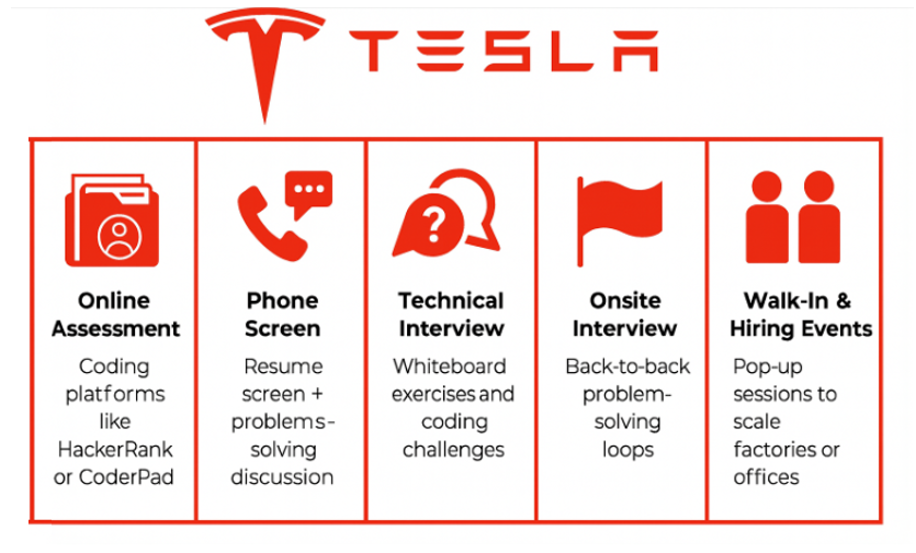
Tesla interview process is known for being both rigorous and fast-paced. It typically spans 4 to 6 weeks, with feedback provided within a week after each round.
Online Assessment (OA)
Tesla OA is a critical first step in the technical screening process. Tesla coding interview questions are typically delivered through platforms like HackerRank or CoderPad, depending on the specific role.
Candidates are assessed not only on whether their code runs correctly, but also on code efficiency, clarity, problem-solving approach, and readability. For technical positions—especially in software, data, or automation—expect algorithmic challenges or practical scenarios inspired by real Tesla problems. Writing clean, well-documented code and clearly explaining your logic are key to performing well. Check out Tesla Software Engineer Interview Questions & Process and Tesla Data Engineer Interview Questions + Guide for more OA coding questions!
Phone Screen
Tesla phone interview questions can vary depending on whether you’re speaking with a recruiter or a technical team member. The first step is often a recruiter screen, where you’ll be asked to walk through your resume and discuss how your skills and experience align with the role and Tesla’s mission. Be prepared to highlight leadership experience or impactful projects that demonstrate initiative and cultural fit.
The technical phone screen is typically a 30-minute call, which focuses on your problem-solving approach and thought process. You may be asked to work through a real-world dataset or scenario, often using live coding on platforms like CoderPad. Clear communication of your reasoning and an ability to think independently under time pressure are critical in this stage.
Technical Interview Rounds
Tesla technical interview questions are designed to assess your depth of knowledge, analytical thinking, and problem-solving under pressure. These rounds often include a mix of whiteboard exercises, live coding sessions, and case-based analyses, depending on the role. Tesla interviewers are looking for candidates who can break down complex problems, think from first principles, and communicate clearly under tight constraints. See our Tesla Software Engineer Interview Questions & Process for more preparation tips!
Onsite Interview
Tesla’s onsite interview typically consists of 3 to 5 back-to-back interview loops, often involving analysts, hiring managers, and cross-functional team members. This stage is designed to simulate real-world work scenarios and assess your problem-solving, communication skills, and cultural fit.
One key component is a mission alignment discussion, where interviewers gauge how well your values and motivation align with Tesla’s purpose-driven environment. For technical roles, expect to present your solution or metrics to a non-technical audience, such as a manager or stakeholder, highlighting your ability to explain complex ideas in simple, actionable terms. Strong performance here shows not just technical competence, but also your readiness to thrive in Tesla’s fast-paced, collaborative culture.
Walk-In & Hiring Events
Tesla occasionally hosts pop-up hiring days or Tesla walk-in interview events, especially when rapidly scaling teams at factories, service centers, or new offices. These events are typically announced through Tesla’s career site, social media, or through direct outreach from recruiters.
At a Tesla walk-in interview, candidates can expect on-the-spot resume reviews, brief technical or problem-solving assessments, and rapid interviews with hiring managers. Some events are open to the public, while others are invite-only, targeting candidates who have already passed an initial screen or matched specific hiring criteria.
While the format is faster-paced than the standard process, Tesla maintains the same high bar—evaluating for mission alignment, technical strength, and adaptability. Each role may have unique twists in the hiring process and interview questions, so it’s essential to prepare accordingly. See our Tesla company interview guide for detailed role breakdowns and what to expect in each position-specific interview process.
Most Common Tesla Interview Questions
Explore tailored insights for each position in our Tesla technical interview questions, designed to help you prepare for the challenges and expectations unique to each role:
Role-Specific Interview Guides
- Software Engineer – Focuses on core algorithms, problem-solving, and system design in high-performance environments. → Tesla Software Engineer Interview Questions & Process (2025)
- Data Engineer – Emphasizes SQL proficiency, ETL development, and scalable data pipeline architecture. → Tesla Data Engineer Interview Questions + Guide in 2025
- Data Scientist – Covers experimentation frameworks, A/B testing, and applied machine learning case studies. → 21 Tesla Data Scientist Interview Questions + Guide in 2025
- Data Analyst/Business Analyst – Tests SQL, data interpretation, and the ability to extract business insights from real-world scenarios. → Tesla Data Analyst Interview Questions + Guide in 2025
- Machine Learning Engineer – Centers on deep learning, model deployment, and Tesla’s autonomy-focused tech stack. → Tesla Machine Learning Engineer Interview Questions + Guide in 2025
- Product Manager – Evaluates end-to-end product thinking, user impact, and decision-making in high-speed innovation cycles. → Tesla Product Manager Interview Questions + Guide in 2025
Mission & Values Questions
When interviewing for Tesla roles, expect behavioral questions that explore your alignment with the company’s sustainability mission and your ability to apply first-principles thinking. Interviewers often ask:
- “Tell me about a time you challenged a widely accepted assumption to solve a problem.”
- “Describe a situation where you had to move fast, take calculated risks, and learn as you go.”
- “How have you contributed to sustainability or innovation in your previous roles?”
These questions assess not only your passion for Tesla’s impact but also your capacity to think independently, adapt quickly, and drive meaningful change.
Example:
“Why do you want to work at Tesla, and how does our mission resonate with you?”
Start with Tesla’s mission to accelerate the world’s transition to sustainable energy as your foundation. Connect it to your personal or professional experiences—for example, optimizing energy systems, improving efficiency in data workflows, or building scalable technology that reduces waste. Emphasize your belief in first-principles thinking and how Tesla’s culture of innovation and sustainability aligns with your problem-solving approach.
Tip: Avoid generic statements like “I love electric cars.” Instead, reference a tangible link, such as a past project in renewable tech, automation, or system optimization, and tie it directly to Tesla’s pursuit of sustainable innovation at scale.
Coding & Online-Assessment Questions
When preparing for Tesla coding interview questions, expect a strong focus on problem-solving fundamentals in your OA or live coding rounds. Common topics include:
- Arrays & Strings (e.g., two pointers, sliding windows): “Given a list of battery charge levels, find the longest increasing subsequence representing optimal efficiency.”
- Dynamic Programming (e.g., memoization, recursion): “Compute the minimum charging cost for a car traveling between stations with varying rates.”
- SQL (e.g., joins, window functions, aggregations): “Write a query to find the top 3 regions with the highest vehicle delivery growth month-over-month.”
Tesla values clean, efficient code and a structured problem-solving approach, so practicing medium to hard LeetCode problems in these areas can give you a strong edge.
Example:
Find the missing number from an array spanning from 1 to N
Solve this with either the summation formula or an XOR-based method for O(n) time and O(1) space complexity. Consider edge cases like duplicates, empty arrays, or unsorted input. This type of thinking is key to error detection in large datasets. At Tesla, such optimizations align with maintaining accuracy across performance-driven systems.
Tip: Prefer XOR to avoid overflow: res = 0; for i in 1..N: res^=i; for a in arr: res^=a. Watch edges: N=1, empty array, and arrays already complete.
Problem-Solving Depth Questions
Tesla interviews often include open-ended technical scenarios that test your analytical thinking, creativity, and engineering insight.
- Highlight open-ended engineering challenges (manufacturing scale-up, supply-chain).
- Use synonyms of “technical depth” rather than exact queries.
You might be asked to solve challenges such as:
- “How would you design a system to scale battery production by 10x without increasing cost?”
- “If supply-chain disruptions delay a critical component, how would you restructure the sourcing strategy?”
- “How would you reduce latency in a data pipeline collecting real-time vehicle telemetry?”
These questions don’t have single correct answer. Instead, Tesla looks for structured reasoning, trade-off analysis, and an ability to break complex systems into solvable parts.
Example:
Start with a real-time demand forecasting model to predict ride requests in each city zone using features like time of day, events, traffic, and weather. Layer this with a dynamic pricing and bonus system that increases incentives in zones where predicted demand exceeds available drivers. Add reinforcement learning to adapt payouts based on driver response rates and fulfillment efficiency. Incentive optimization problems like this are common at Tesla, where systems must balance supply-demand dynamics under real-world constraints.
Tip: Focus on balancing driver motivation with operational efficiency over-incentivizing can cause supply spikes elsewhere. Demonstrating awareness of system feedback loops and equilibrium dynamics will show Tesla-style, data-driven thinking.
Tips When Preparing for a Tesla Interview
To stand out in a Tesla interview, combine technical precision with mission-driven thinking. Here are a few targeted tips, with Tesla-aligned strategies and examples.
Study first-principles examples from prior projects
Be prepared to explain how you approached problems from the ground up—focusing on fundamentals instead of assumptions. Tesla looks for a first-principles mindset, where you strip a problem down to its core components, understand the mechanics, and rebuild an efficient, scalable solution.
How to frame your answer:
When describing your work, emphasize how you thought rather than just what you did. Instead of saying, “I optimized supply chain costs,” break it down into the logical steps that drove your decision-making.
Example 1—Supply Chain Optimization:
- “I started by breaking down lead time into its elemental drivers—supplier capacity, transit time, and order batching. From there, I modeled each component separately to design a reorder policy that cut costs by 12%. This approach aligns with Tesla’s principle of tackling efficiency challenges from the ground up.”
Example 2 — Predictive Maintenance:
- “In a predictive maintenance project, I avoided generic anomaly detection models and instead analyzed the physical causes of system failures—vibration, temperature, and pressure variations. By modeling each independently, I reduced false positives by 25%, reflecting Tesla’s physics-first, data-backed problem-solving mindset.”
Tip: Whenever possible, connect your examples to Tesla’s core values—efficiency, sustainability, and innovation. Show that your thinking isn’t just technical, but aligned with how Tesla approaches real-world engineering problems.
Time-box algorithm drills to match 45-minute sessions
Tesla’s coding interviews are fast-paced, requiring sharp problem-solving under time pressure. Practice in 45-minute sprints to mirror real interview pacing, focusing on clarity, structure, and efficiency.
Key topics to prioritize:
- Data structures: Arrays, hash maps, linked lists, stacks, queues
- Algorithms: Sorting, binary search, greedy strategies, recursion
- Optimization problems: Dynamic programming, graph traversal (BFS/DFS), shortest path
- Practical applications: Scheduling, route optimization, load balancing, and resource allocation
Example drill:
- Prompt: “Given an array of charging station locations along a highway and a car’s max travel distance on a single charge, determine the minimum number of stops required to reach the destination.”
- Approach: Use a greedy algorithm and always drive to the farthest reachable station before refueling. Practice implementing and explaining this logic within 45 minutes.
Tip: Highlight Tesla-style thinking—practical, optimization-driven, and rooted in real engineering trade-offs.
Read recent earnings calls and product updates
Tesla wants candidates who are not only technically capable but also deeply aware of the company’s trajectory. Review quarterly earnings calls, investor updates, and product announcements to connect your answers back to Tesla’s roadmap.
Quick focus areas:
- Energy storage & Powerwall expansion
- FSD & AI training advancements
- Optimus robot development
- Global Gigafactory scaling
How to incorporate in answers:
If asked about problem-solving, you might say:
- “Just like Tesla uses vertical integration to control costs and speed, I structured my project workflow so dependencies were minimized. This ensured delivery two weeks ahead of schedule.”
Tip: Reference Tesla’s language and strategy to show that you’ve done your homework and see yourself in their ecosystem.
Practice mission-fit stories
When answering “Why Tesla?”, use the STAR framework (Situation, Task, Action, Result) to link your personal experiences to Tesla’s sustainability mission. This approach keeps your story structured, impactful, and authentic.
Use the STAR framework to keep your story structured.
Example strong answer:
- Situation: “In my last role, I noticed our data centers consumed excessive idle power.”
- Task: “I was tasked with optimizing performance without adding new hardware.”
- Action: “I restructured data processing pipelines and introduced scheduling logic that cut redundant compute usage.”
- Result: “This reduced energy costs by 15% annually. It was a small step, but it aligned with my conviction that technology should minimize waste.”
- Link to Tesla: “That’s why Tesla’s mission resonates so strongly with me—scaling sustainable solutions that make a real difference.”
Tip: Keep your story concise to about 90 seconds, and emphasize impact over intent. Quantify results when possible and end by clearly linking your values or achievements to Tesla’s broader mission of sustainability and innovation.
Mock an OA on CoderPad or HackerRank
Tesla’s online assessments are usually live coding sessions with limited IDE assistance—no autocomplete, no debugger, and strict time constraints. To prepare effectively, recreate this setup as closely as possible.
Here’s how to simulate the OA:
- Choose the right platform: Use CoderPad, HackerRank, or LeetCode playground—they mirror Tesla’s testing setup with simple editors and real-time execution.
- Limit yourself intentionally: Turn off autocomplete, avoid copy-pasting solutions, and set a strict 60–75-minute timer to mimic OA constraints.
- Use a whiteboard or notepad: Sketch logic, edge cases, and test data manually before coding, just like you’d do in an actual interview.
- Practice out loud: Explain your thought process and assumptions while coding. Tesla interviewers value clear reasoning as much as correct solutions.
- Iterate and test: Write code in small chunks, test incrementally, and handle edge cases early, reflecting Tesla’s “debug under constraints” culture.
Example Tesla-style OA prompt:
- “Implement a simplified scheduler that assigns Tesla Supercharger slots to incoming vehicles, ensuring no car waits more than X minutes.”
Tip: Focus on clarity, structure, and resilience under pressure, not just passing all test cases.
Salaries at Tesla
Most data science positions fall under different position titles depending on the actual role.
From the graph we can see that on average the Product Manager role pays the most with a $153,667 base salary while the Business Analyst role on average pays the least with a $94,262 base salary.
Tesla offers competitive pay packages that combine base salary, performance bonuses, and long-term equity. Compensation depends heavily on role, experience, and impact, but overall salaries remain strong across technical and analytical functions. For detailed compensation insights by level and location, explore our Tesla role-specific interview guides.
Below is a breakdown of estimated Tesla salary ranges across key positions (base + total compensation), based on aggregated data:
Software Engineer (SWE)
- Base Salary: $114K–$262K
- Total Compensation: $130K–$538K (Levels.fyi)
- Structure: Strong equity component; total compensation grows sharply at senior levels (P4–P5) through RSUs and milestone-based performance bonuses.
Data Engineer (DE)
- Base Salary: $110K–$149K
- Total Compensation: $128K–$189K (Levels.fyi)
- Structure: Mix of base, equity, and project-based incentives. Higher levels often tie bonuses to data system uptime and efficiency metrics.
Data Scientist (DS)
- Base Salary: $94K–$200K
- Total Compensation: $102K–$299K (Levels.fyi)
- Structure: Equity-heavy; pay scales with model performance, deployment success, and experimentation outcomes.
Machine Learning Engineer (MLE)
- Base Salary: $120K–$180K
- Total Compensation: $243K–$339K (Levels.fyi)
- Structure: Strong equity and performance-based pay; bonuses often tied to autonomy, FSD, and AI efficiency milestones.
Product Manager (PM)
- Base Salary: $107K–$167K
- Total Compensation: $113K–$366K (Levels.fyi)
- Structure: Base plus performance-based incentives tied to launch timelines, cost optimization, and cross-functional delivery success.
Data Analyst/Business Analyst (DA/BA)
- Base Salary: $85K–$100K
- Total Compensation: $115K–$126K (Levels.fyi)
- Structure: Moderate equity component; performance bonuses linked to impact on reporting automation, data accuracy, and KPI visibility.
Tesla’s total compensation strongly rewards performance and innovation. Roles in AI and software engineering (particularly MLE and SWE) tend to command the highest pay, while data-focused roles maintain competitive packages with meaningful growth potential through stock options and delivery-linked bonuses.
FAQs
How long does the Tesla interview process take?
The Tesla interview process is known for being both rigorous and fast-paced, typically spanning 2 to 6 weeks from initial contact to final decision. Most candidates receive feedback within a week after each interview round. Timelines can vary based on role urgency, number of interview rounds, and team coordination.
Do Tesla interviews include a take-home or OA for every role?
Tesla OA is a standard step for most technical roles, particularly for software engineers, data scientists, and machine learning engineers. However, non-technical roles (e.g., business analysts, product managers) may skip this step and instead go straight to phone interviews or case-based evaluations, depending on the position.
What happens after a Tesla onsite interview?
Following a Tesla onsite interview, the interview team conducts a formal debrief, where each interviewer shares feedback on your performance. Tesla emphasizes alignment with the company’s mission, technical depth, and adaptability. If consensus is reached, you may receive an offer within a few days. In some cases, an additional reference check or executive review may follow before a final decision is made.
Can you re-apply if rejected?
Yes, you can re-apply to Tesla after being rejected, but there is typically a ****cooling-off period—commonly around 6 months. This time is meant for candidates to strengthen their skills, gain more experience, or better align with Tesla’s expectations. When reapplying, it’s helpful to update your resume and portfolio to reflect new projects, certifications, or leadership experience that demonstrate growth since your previous application.
Is a walk-in interview worth attending?
Attending a Tesla walk-in interview or pop-up hiring event can be a great opportunity, especially for technical and hands-on roles like service technicians or factory engineers. These events often allow you to meet recruiters and hiring managers directly and may lead to on-the-spot interviews or fast-tracked applications.
Pros include faster feedback, personal interaction, and a chance to stand out. Cons are limited time to prepare and high competition. To make the most of a walk-in, bring printed resumes, research Tesla’s mission and products, and be ready to speak confidently about your skills and motivation.
Conclusion
Interviewing at Tesla means navigating a structured yet fast-paced process that prioritizes technical excellence, alignment with the company’s mission, and the ability to solve complex problems from first principles. Each role comes with its own unique interview nuances, so targeted preparation is key. For a deeper dive, check out our interview guide for tailored question lists, prep tips, and detailed salary insights.
Ready to take the next step? Explore Interview Query’s Tesla question bank to practice real interview problems and level up your prep.
Discussion & Interview Experiences