


Shopify Growth Marketing Interview Guide (2025)


Introduction
Shopify is home to one of the most data-driven growth teams in tech. As the platform continues to scale globally, the demand for growth marketers who can drive measurable merchant acquisition, activation, and retention has never been higher. Whether you are optimizing paid campaigns, building lifecycle journeys, or experimenting with onboarding flows, the Shopify growth marketing manager role sits at the intersection of creativity and performance.
This guide breaks down everything you need to know to succeed in the interview process, from understanding Shopify’s async culture to preparing for the growth case study. It covers key stages, sample questions, and preparation tips to help you land the role with confidence. Expect a focus on experimentation, conversion metrics, and values-based leadership throughout.
Role overview and culture
A Shopify growth marketing manager is expected to lead cross-functional experiments that unlock new merchant growth. This includes scaling paid acquisition channels, fine-tuning lifecycle campaigns across email and push, and collaborating closely with product growth squads to ship product-led growth experiments. You will often work across data, engineering, and creative teams, building feedback loops that are fast, iterative, and highly measurable.
Shopify is a digital-by-default company, meaning your squad may span several time zones but operates with shared autonomy. Every decision is rooted in data, with teams empowered to test, learn, and scale what works. The ability to think independently, make sharp prioritization calls, and communicate clearly in async documents is just as important as a performance marketing toolkit.
Why this role at Shopify?
Growth marketing at Shopify gives you a front-row seat to shaping how millions of entrepreneurs scale their businesses. It is a rare blend of creativity, analytical rigor, and product strategy that lets you directly influence GMV growth while building a career that compounds in value over time.
You start by owning campaigns, channel experiments, and performance metrics that impact merchant acquisition and activation. As you progress, your scope expands to multi-quarter growth bets that integrate across lifecycle, retention, and product-led growth. Senior growth marketing managers collaborate with data scientists, engineers, and product leaders to shape experimentation roadmaps and unlock new revenue levers.
At the principal or lead level, the focus shifts toward strategic orchestration. You will guide portfolio-level decisions, mentor other marketers, and design systems for experimentation that scale across countries, channels, and merchant segments. Many senior growth marketers eventually transition into roles such as Head of Growth, Director of Product Marketing, or GM for New Markets, depending on their interests in leadership or product strategy.
Shopify also provides strong horizontal mobility. Growth marketing managers often rotate through international expansion, ecosystem partnerships, or product-led growth teams to deepen their commercial understanding. Some even pivot into product management or strategy roles once they build fluency in experimentation, lifecycle design, and revenue modeling.
Career progression typically follows Shopify’s marketing levels from M4 to M6, where each step represents broader cross-functional influence and ownership of key merchant outcomes. The company’s digital-by-default structure means your growth is defined by impact, not headcount.
The skill compounding is significant. You will refine your expertise in data analytics, SQL, lifecycle automation, LTV modeling, and creative testing, while strengthening executive communication and strategic storytelling. These skills position you not only for leadership within Shopify but also for high-impact growth roles in global tech and commerce companies.
Ultimately, a growth marketing role at Shopify is not just about scaling merchants; it is about scaling your own ability to lead through experimentation, strategy, and measurable business impact.
What is the interview process like for a growth marketing manager role at Shopify?
The Shopify interview process is structured to evaluate how you think, prioritize, and execute growth strategies across data, creativity, and cross-functional collaboration. It is known for being transparent and fast-paced, mirroring the company’s async and autonomy-driven culture. Most candidates complete the process within several weeks, although timing can vary by level and region.
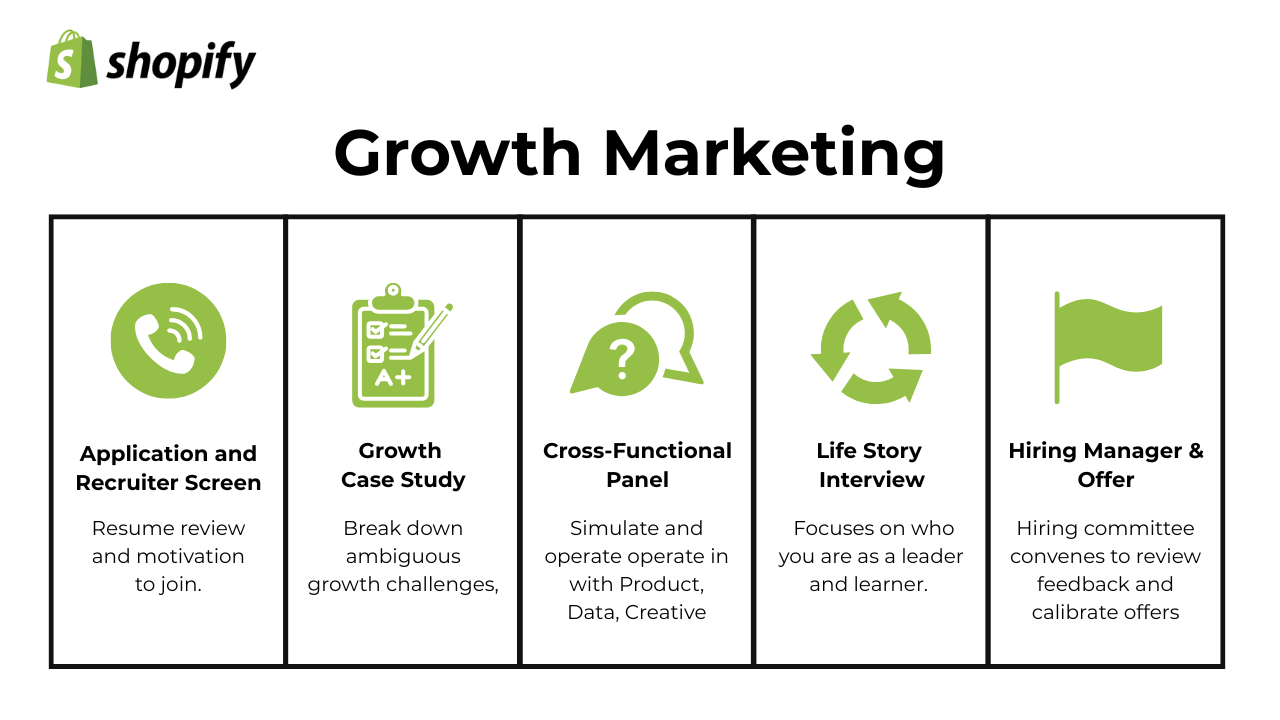
Application and Recruiter Screen
The process begins with the recruiter screen, where Shopify evaluates both your track record and alignment with its mission. Recruiters look for marketers who can demonstrate ownership, curiosity, and measurable impact rather than vanity metrics. They want to see evidence that you’ve led meaningful experiments, such as improving activation rates, boosting retention, or scaling a new market, and that you can clearly articulate how those results tie back to business outcomes.
An ideal candidate communicates results with precision, showing both strategic insight and the ability to move quickly without losing analytical rigor. You should be able to explain why you made certain decisions, not just what you did.
Tip: Treat this round as a concise pitch. Prepare a short, metrics-driven story that summarizes your last major growth achievement and how it affected a north-star KPI like GMV, CAC, or retention.
Growth Case Study
Next comes the case study round, which tests your structured thinking and problem-solving approach. Shopify evaluates how you break down ambiguous growth challenges, form hypotheses, prioritize tactics, and communicate recommendations clearly. The goal is not to find the “right” answer but to reveal how you think through trade-offs between impact, cost, and execution speed.
An ideal candidate demonstrates analytical clarity and business intuition, framing solutions around measurable impact rather than broad marketing language. You are expected to explain your reasoning, define success metrics, and show you understand Shopify’s unique ecosystem of merchants and products.
Tip: Anchor every recommendation to a quantifiable outcome. For example, instead of saying “launch lifecycle emails,” say “launch a three-part reactivation sequence targeting dormant users, expected to recover 8–10% of inactive GMV.” This turns strategy into accountability.
Cross-Functional Panel (Product, Data, Creative)
This stage assesses how you operate in Shopify’s collaborative, asynchronous environment. You’ll meet stakeholders from product, data, and creative teams who evaluate your ability to partner across disciplines and influence decisions without direct authority. Expect open-ended prompts that test your ability to reason from data, communicate clearly, and find common ground when priorities conflict.
An ideal candidate demonstrates structured communication, intellectual humility, and a willingness to iterate fast. You should show that you can translate marketing insights into product or design decisions and that you respect experimentation as a shared language between teams.
Tip: Practice explaining one of your past experiments in two styles—one for a data audience and one for a creative team. This helps you adjust tone and clarity on the fly, which is exactly what Shopify interviewers look for.
Want to practice real case studies with expert interviewers? Try Interview Query’s Mock Interviews for hands-on feedback and interview prep. Book a mock interview →
Life Story Behavioral Interview
The life story round is unique to Shopify and focuses on who you are as a leader and learner. Interviewers want to understand how your experiences have shaped your approach to growth, ownership, and decision-making. They are not just looking for success stories—they also value vulnerability, reflection, and evidence of personal growth.
An ideal candidate is introspective, grounded, and able to connect lessons from past challenges to how they lead today. You should show that you make decisions guided by principles rather than ego and that you can navigate ambiguity with composure.
Tip: Prepare two or three pivotal career moments: times you made a tough call, recovered from failure, or built something from scratch. Tie each to a concrete outcome, such as a measurable funnel lift or team transformation. Clarity and self-awareness often outweigh perfect storytelling polish.
Offer and Compensation Call
If you advance to this stage, Shopify has already determined that you are a strong technical and cultural fit. The offer call focuses on role leveling, compensation, and next steps. Shopify uses a transparent leveling framework (typically M4 to M6 for growth managers) and often discusses long-term career pathways during this conversation.
At this point, the company evaluates professional alignment, whether your growth ambitions match the scope and impact of the role. The ideal candidate engages openly, asking smart questions about how the role scales over time and showing genuine curiosity about impact, not just compensation.
Tip: Approach this call as a two-way conversation. Research the market range beforehand, know your priorities (cash vs. equity vs. growth scope), and be ready to discuss how you envision contributing in the first 90 days. Confidence, preparation, and professionalism leave a strong final impression.
Challenge
Check your skills...
How prepared are you for working as a Marketing Analyst at Shopify?
What questions are Asked in a Shopify Growth marketing manager interview?
Shopify’s interview questions test whether you can think strategically, execute methodically, and lead with empathy. While questions vary by level, most candidates encounter a mix of case prompts, experimentation scenarios, and values-based discussions.
Growth case study questions
Many candidates receive one or more Shopify growth prompts to simulate real strategic challenges. You may be asked to design a 90-day plan for launching in a new market, revamping onboarding for freelancers, or re-engaging churned merchants at scale.
The strongest answers demonstrate structured thinking, data-first prioritization, and an understanding of Shopify’s merchant segments. Candidates should be prepared to justify trade-offs and connect recommendations directly to measurable outcomes such as GMV growth or LTV expansion.
-
Start by checking denominator effects (fast new-user growth diluting averages), mix shifts (more lurkers vs posters), and seasonality. Segment by tenure, cohort, platform, and acquisition channel to see if engagement is falling for existing users or merely averaged down by newcomers. Inspect funnel (views → opens → comments), feature changes, content supply, spam/quality filters, and notification deliverability.
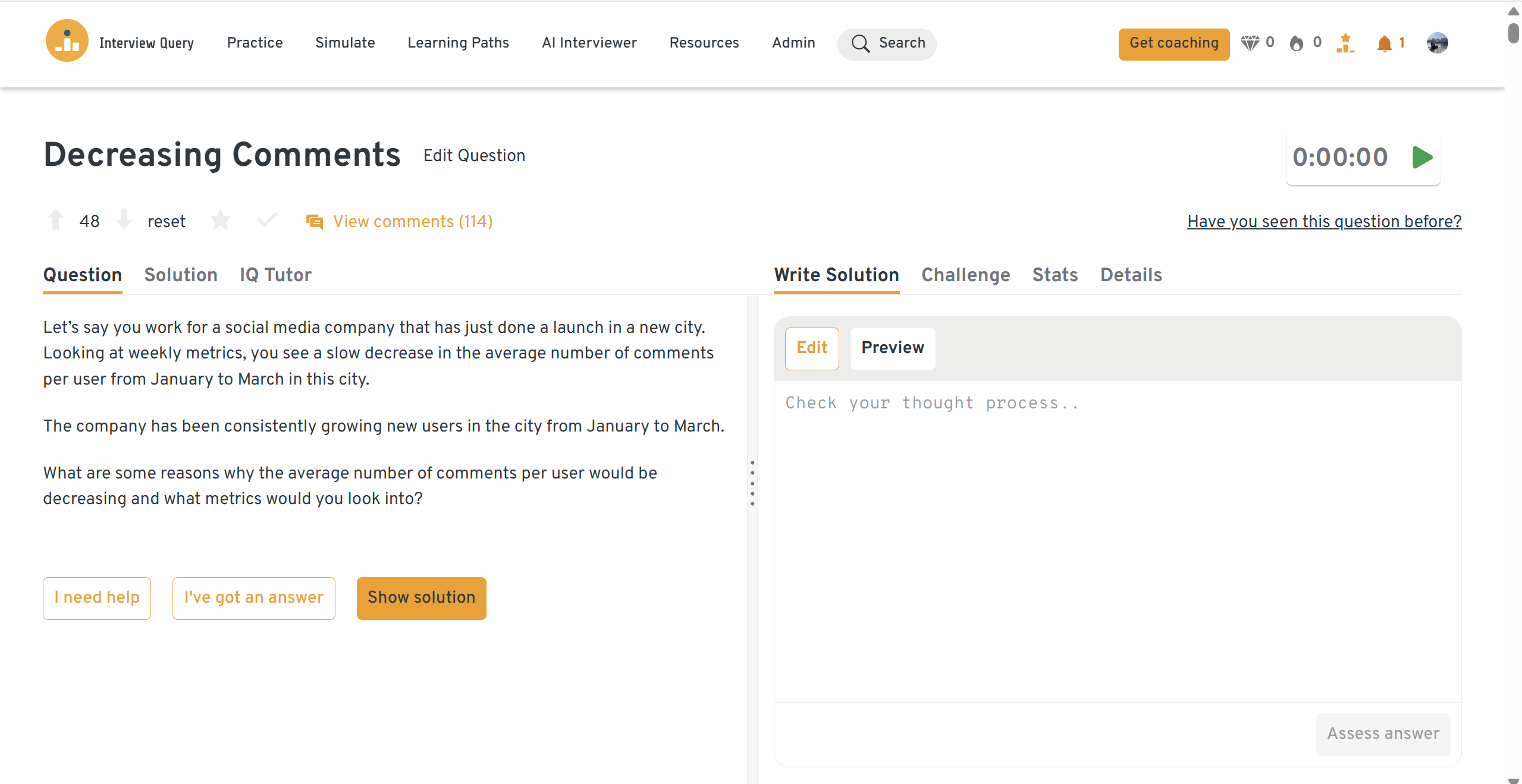
Metrics: cohort comments/user, median vs mean, percent of users commenting, session depth, time-to-first-comment for new users, and comment latency after exposure. Validate with holdout geos and regression discontinuities around product or policy changes.
-
Decompose revenue into orders × AOV and then into price, quantity, and mix effects by category/subcategory. Build a waterfall: category mix shifts, discounting intensity, margin compression, traffic vs conversion vs repeat rates by channel. Use cohort analyses (first-purchase cohorts, repeat cohorts), channel incrementality (geo or time-based holdouts), and price–volume elasticity estimates to separate policy from demand. Check inventory stockouts, page speed, and funnel breakpoints. Quantify each driver’s contribution (e.g., Oaxaca/Kitagawa-style decomposition) and translate into actions: reduce non-incremental discounts, reallocate budget to positive-ROAS channels, fix high-drop pages, and restock long-tail winners.
Design a referral program to acquire new Shopify merchants. What would you launch first, how would you prevent fraud, and how would you measure lift?
Define clear incentives (credit against subscription/app fees), qualifying actions (store launched, payments enabled, first transaction), and fraud checks (identity verification, device/IP heuristics, payout delays). Start with a simple single-sided reward MVP and tight event instrumentation. Measure causal lift via geo or invite-code randomization, track CAC, payback period, and downstream quality (12-week retention, GMV, app attach). Add guardrails: fraud rate, support tickets, abuse cases. Iterate on incentive size using price testing and propensity modeling.
Paid search CAC is rising while on-site conversion is flat. How do you diagnose and fix this?
Audit keyword mix (brand vs non-brand), match types, negative lists, and RSA asset performance. Check auction dynamics (competitor bids), geography/device shifts, and landing-page quality score inputs (ad relevance, speed). Run incrementality tests (geo split or PSA) to separate cannibalization from true lift. Reweight budgets to high-margin cohorts, expand exact-match winners, throttle low-intent queries, and improve landing speed/content. Monitor CAC, MER, blended ROAS, and LTV:CAC by channel/keyword cluster.
You’re asked to extend the free trial from 14 to 30 days to boost activation. How would you predict impact and design the experiment?
Map leading indicators (setup completion, theme publish, payment connect) to downstream conversion (first subscription, first GMV). Build a trial survival model to forecast added conversion from extra days vs increased support burden. Test with a controlled rollout (geo or traffic split), include guardrails (fraud, free-rider share), and measure net lift in paid conversions and 90-day GMV per signup. Analyze heterogeneous effects by vertical and acquisition channel to decide on targeted vs universal rollout.
Tip: Start with the goal and the target KPI, then list two or three hypotheses ranked by impact and effort. Outline the first experiment you would run, the metric to judge success, and the guardrails to protect margin and brand. Close with a next-step tree, for example scale, iterate, or kill, so your plan reads like an execution roadmap, not a wishlist.
Data & experimentation questions
You’ll be assessed on your approach to A/B testing, north-star metric selection, and post-test analysis. Shopify values marketers who can design experiments that are statistically sound but also easy to implement and iterate on.
Your manager ran an A/B test with 20 variants and claims one is significant. Is anything fishy here?
Yes, this screams multiple-comparisons risk. With 20 variants, the chance of a false positive rises sharply if you use a plain 0.05 threshold. Ask whether the test plan pre-registered a single primary metric and hypothesis, whether corrections were applied (e.g., Bonferroni/Holm or Benjamini–Hochberg FDR), and whether they validated via a holdout or follow-up replication. Also check for p-hacking (peeking, mid-test metric switching), sample ratio mismatch, underpowering, and novelty/seasonality. The right next step is to re-run with fewer, hypothesis-driven variants or use a multi-armed bandit with a pre-defined FDR policy and confirmatory follow-up.
-
Start with a clean QA: invariant checks (traffic balance/SRM), bot filtering, exposure/eligibility rules. Define primary and guardrail metrics up front (e.g., PDP→checkout CTR, conversion rate, AOV, refund rate, contribution margin). Compute effect size and confidence intervals, and confirm your minimum detectable effect and power. Segment by shipping-eligible vs ineligible items, new vs returning users, and traffic source; expect heterogeneous effects. Watch for “AOV down, CR up” trade-offs.
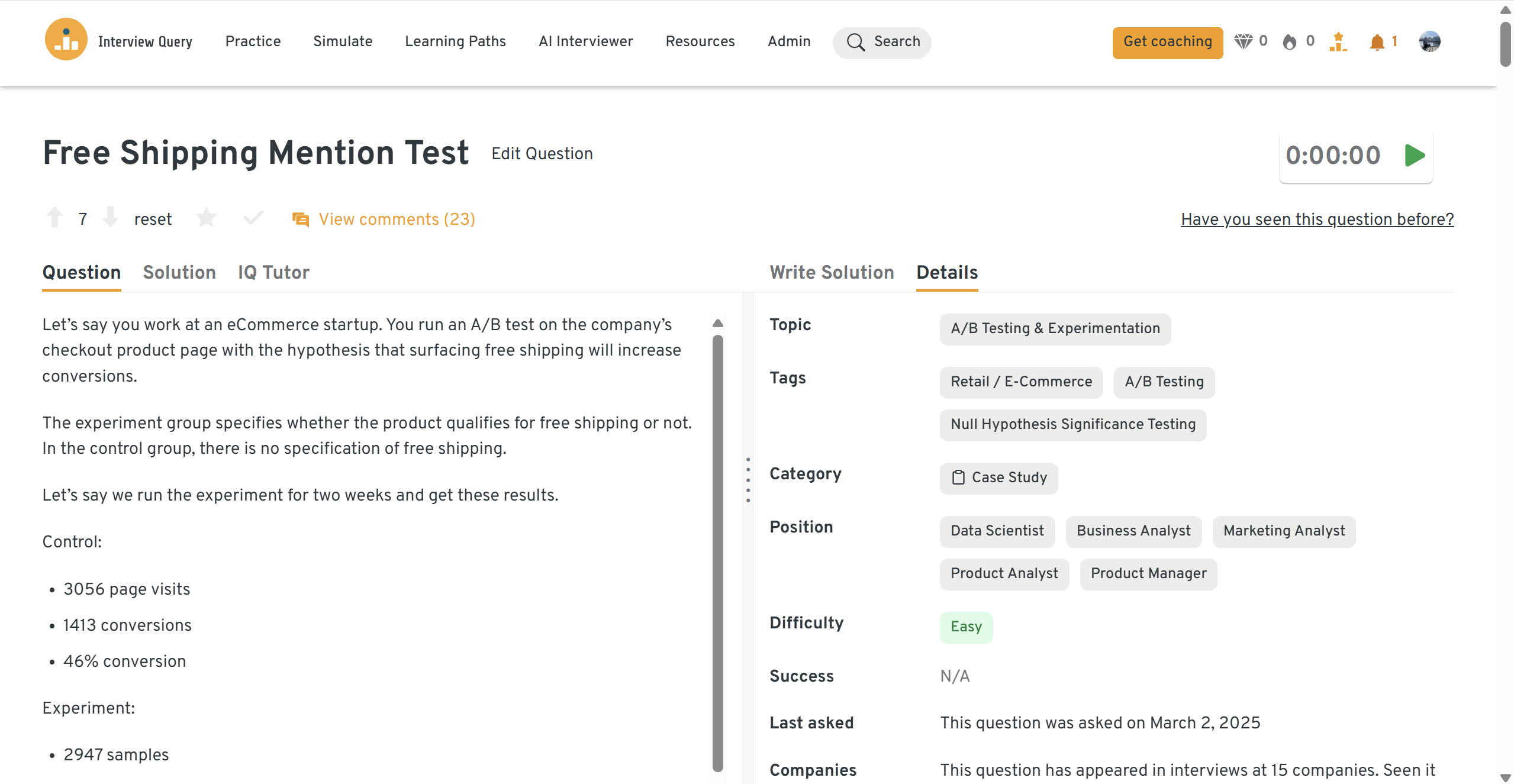
Focus on contribution margin, not just orders. If the lift is promising, validate in a replication or a geo-ramp; if margins worsen, test copy variants (thresholds, clarity) or constraint the badge to profitable SKUs.
Your weekly active users jump during the test window, and Variant B looks positive. How do you rule out external confounders and confirm causality?
Triangulate with placebo metrics and synthetic controls. Compare effect sizes across unaffected pages, run a difference-in-differences against matched non-exposed traffic, and examine pre-period parallel trends. Check channel mix shifts, promos, inventory, and latency regressions. If possible, use geo-split or time-based staggering to isolate the treatment. Only green-light if uplift holds under these robustness checks and replication.
You need to choose between a classic fixed-horizon A/B test and a sequential/Bayesian test for a high-traffic funnel. Which do you pick and why?
If you need strict Type-I error control and a single readout date, use fixed-horizon (or group-sequential with alpha spending). If you value early stopping and continuous decision-making, pick sequential or Bayesian with pre-declared stopping rules. Either way, pre-register metrics, define MDE, handle peeking correctly, and document stopping criteria. For monetization features with fat-tailed revenue, consider variance-reduction (CUPED, covariate adjustment) and robust metrics (winsorized revenue per session).
A prior test showed a tiny but significant win (+0.3% conversion). How do you decide whether to roll it out globally?
Translate effect into dollars: uplift × baseline volume × margin, minus costs (engineering, support, potential returns). Validate durability via holdout or switchback to detect novelty decay. Check subgroups for negative impacts (e.g., mobile latency, accessibility). Confirm operational readiness (experimentation guardrails, alerting) and run a phased rollout with real-time monitoring and kill-switch thresholds. If impact is within noise of seasonal variability, prioritize replication or bundle with related wins to justify complexity.
Tip: Pre-register the primary metric, the MDE, and the sample split before you talk tactics. State how you will handle power, variance reduction, and multiple comparisons. Run invariant checks for SRM, then report effect sizes with confidence intervals. Always translate a win into dollars and risk, for example contribution margin lift, support load, deliverability health, so the decision is clear.
Behavioral & leadership Questions
Shopify places a high premium on cultural fit. You’ll be asked to reflect on your decision-making style, how you handle ambiguity, and ways you’ve helped your team grow. Questions often map to core values like Act Like an Owner or Be Merchant Obsessed.
To prepare effectively, build at least two strong stories for each common theme: ownership, failure, ambiguity, and collaboration. Having multiple examples allows you to rotate depending on the flow of conversation and ensures you do not repeat yourself across different interviewers. Each story should follow a clear structure (situation, challenge, action, result) and tie back to measurable outcomes like GMV impact, funnel lift, or campaign ROI.
Describe a data project you worked on. What were some of the challenges you faced?
Pick a growth-focused project (e.g., onboarding funnel, lifecycle reactivation, paid channel efficiency). Walk through the goal, your hypothesis, and the data model you built. Call out challenges like attribution noise, event-tracking gaps, identity resolution across devices, consent/privacy limits, or data sparsity in cohorts. Explain how you unblocked each issue, partnered with eng/analytics, and the measurable impact (lift, CAC/LTV shift, retention bump).
Sample answer: In my previous role, I led a data project to improve onboarding conversion for SMB merchants. The hypothesis was that drop-offs happened because we were under-prioritizing certain setup tasks that correlated strongly with activation. The challenge was messy event tracking; we had inconsistent definitions across teams and gaps in cross-device attribution. I partnered with our analytics lead to rebuild a clean funnel model in Looker, standardizing events like “store created” and “first checkout.” Once we had reliable data, we ran targeted email and in-app nudges for merchants who stalled in the setup phase. This increased our onboarding completion rate by 12% and improved Day-30 GMV by 8%. The key lesson was that before optimizing, you need to ensure your measurement foundation is trustworthy.
What are some effective ways to make data more accessible to non-technical people?
Frame this around self-serve growth analytics: a consistent metric layer (one definition of “activation”), role-based dashboards with plain-language annotations, lightweight experiment readouts, and weekly narrative summaries. Mention guardrails (source-of-truth datasets, data quality SLAs), onboarding/training, and templates for campaign briefs and postmortems so marketers can make decisions without ad-hoc SQL.
Sample answer: When I joined my last company, the growth and creative teams relied heavily on analysts for every data pull, which slowed decisions. I introduced a self-serve analytics model. We created a single “source of truth” dashboard that visualized activation, retention, and CAC using consistent metric definitions. To make it usable, I added plain-language tooltips and short Loom walkthroughs explaining how to interpret each graph. I also held a short data literacy session every Friday for the first month. Within a quarter, 80% of campaign teams were running their own analyses without analyst support, cutting reporting time by half and allowing faster experiment iteration. The biggest takeaway: democratizing data isn’t just about dashboards; it’s about clarity, ownership, and consistent definitions.
-
Choose strengths tied to growth marketing like hypothesis-driven testing, clear comms, and funnel diagnostics. Share one authentic weakness that’s low-risk but real (e.g., over-indexing on perfect significance) and show your remediation (sequential tests, pre-registered metrics, decision logs). Tie it back to outcomes like faster test velocity without eroding decision quality.
Sample answer: My manager would say that I’m analytical, reliable, and calm under pressure. My key strengths are structured problem-solving, clear communication, and being deeply metrics-oriented; I rarely propose an idea without a test plan. A constructive criticism they’ve shared is that I can sometimes overanalyze before deciding, especially when experiments have unclear data signals. To improve, I started documenting pre-test decision rules and using Bayesian testing frameworks so we can act faster with confidence intervals instead of waiting for perfect significance. That adjustment helped us increase testing velocity by 30% without sacrificing decision quality. I’ve learned that “good enough” decisions made quickly often outperform delayed perfection.
Talk about a time when you had trouble communicating with stakeholders. How did you overcome it?
Use a cross-functional example (brand vs. performance, product vs. CRM). Describe the misalignment, how you reframed the problem in shared KPIs (incremental revenue, subscriber health), created a simple decision doc, and iterated on a pilot. Close with results and what you changed in your comms cadence afterward.
Sample answer: While leading a lifecycle reactivation project, I initially struggled to align with the brand marketing team. They were hesitant to approve direct-response messaging because it felt too promotional for our voice. To bridge the gap, I reframed the discussion around a shared metric (reactivated GMV) and ran a small A/B pilot comparing brand-style copy versus performance-driven copy. The results showed the performance version lifted reactivation by 9% without harming unsubscribes or brand perception. Once they saw the data, they supported scaling the test learnings into our broader lifecycle strategy. It taught me the value of translating growth outcomes into a shared language, one rooted in measurable impact rather than creative preference.
-
Anchor on Shopify’s mission to empower entrepreneurs and the lever you’d own (activation, paid efficiency, partner ecosystem). Map your experience to Shopify’s growth loops (merchant referrals, app partners, channels) and name a metric you’d improve (e.g., merchant Day-30 GMV, trial→paid, CAC/LTV). Show you value long-term brand and merchant trust, not just near-term spend.
Sample answer: I’ve admired Shopify for how it empowers entrepreneurs to scale globally; that mission resonates deeply with me. I’m looking for a role where I can apply data-driven experimentation to unlock long-term merchant growth, not just short-term campaign spikes. My background in lifecycle growth and paid optimization aligns closely with Shopify’s ecosystem: increasing trial-to-paid conversion, expanding LTV, and activating merchant referrals. I’m especially excited about the opportunity to work in cross-functional growth pods where data, creative, and product collaborate on scalable experiments. I believe my experience in designing growth loops and optimizing onboarding funnels makes me a strong fit to help drive Shopify’s next wave of merchant expansion.
Tell me about a time you balanced rapid experimentation with brand or deliverability risk in lifecycle channels (email, push, SMS).
Explain the tension (test velocity vs. unsubscribes/spam flags), the guardrails you set (fatigue caps, audience splits, send-time policies), and how you quantified risk (complaint rate, domain reputation) alongside revenue lift. Highlight the decision framework you used to keep learning fast without harming channel health.
Sample answer: At my previous company, we wanted to increase email-driven revenue before a major holiday campaign. Our team was pushing to double the send frequency, but I was concerned about deliverability risk. I proposed running a tiered test: one segment received daily sends, while another stayed at our standard cadence. I also implemented stricter fatigue caps and monitored complaint and unsubscribe rates in real time. When the campaign ended, we saw a 15% revenue lift from the higher-frequency segment but also an elevated spam rate. We then applied a moderated cadence, every other day, which sustained 10% revenue lift with no deliverability penalties. That experience reinforced my belief that speed and caution can coexist if you build clear guardrails into every experiment.
Describe how you diagnosed and reversed a growth plateau when top-line signups were flat despite continued spend.
Outline your forensic approach: channel saturation curves, incrementality tests, iOS privacy impacts, creative fatigue, funnel step drop-offs, and segment mixes (geo/device/intent). Share the bet(s) you placed (new audience seeds, creative pivots, mid-funnel education, or pricing/offer tests) and the before/after metrics that proved it worked.
Sample answer: When our acquisition growth stalled, we initially assumed we had saturated our paid channels. Instead of immediately increasing budget, I ran a full funnel audit. I found that mobile landing pages had slowed load times after a recent redesign, increasing bounce rates by 20%. We fixed the performance issues, then refreshed creatives that had hit fatigue and launched a new mid-funnel education series explaining our value proposition for first-time merchants. Within six weeks, signup rates rebounded 18%, CAC dropped 12%, and downstream activation rose 9%. The main lesson was to diagnose before you scale, performance issues often hide behind the metrics you’re trying to optimize.
Tip: Use short STAR stories that end with a metric and a lesson you reused later. Show how you aligned creative, data, and product using a shared KPI and a one-page decision doc. When you discuss mistakes, name the safeguard you added afterward, for example fatigue caps, stage gates, or a test review. This signals ownership, judgment, and repeatable process.
How to prepare for a growth marketing manager role at Shopify
Succeeding in the Shopify interview means showing that you are not only a skilled performance marketer but also a structured thinker who experiments, iterates, and delivers merchant-first outcomes. The company looks for candidates who balance analytical depth with creative problem-solving and who can lead through influence across product, data, and creative teams. The following steps will help you prepare effectively for every stage of the process.
Reverse-engineer successful growth loops
Study how leading SaaS and commerce companies drive sustainable acquisition, activation, and retention, especially among small and medium businesses. Look for examples of referral systems, onboarding improvements, and product-led loops that compound over time. Shopify pays particular attention to candidates who understand growth mechanics such as network effects, funnel velocity, and lifetime value.
Tip: Create a short “growth loop tear-down” document on a company you admire. Outline what powers their retention and what weak links could be optimized. This practice helps you walk into case interviews with a habit of structured growth thinking that Shopify values.
Need 1:1 guidance on your interview strategy? Interview Query’s Coaching Program pairs you with mentors to refine your prep and build confidence. Explore coaching options →
Craft hypothesis-driven experiment plans
Shopify’s growth team relies on clear hypotheses, measurable KPIs, and disciplined experimentation. When tackling case studies, break your answers into testable hypotheses and connect them to quantifiable outcomes. Interviewers want to see that you can prioritize based on expected impact and feasibility rather than ideas that simply sound interesting.
Tip: Practice designing one end-to-end experiment per week. Write the hypothesis, success metric, guardrail metrics, expected lift, and next steps if results are inconclusive. The more you train this muscle, the more confidently you can discuss trade-offs in the interview.
Rehearse “prompt” responses in 30 minutes
The growth prompt exercise tests how well you think on your feet. Candidates often receive an open-ended question and are expected to propose a structured plan quickly. Shopify is not evaluating for the “right” answer but for logical reasoning, prioritization, and communication under time pressure.
Tip: Set a timer for 30 minutes and simulate answering one prompt from this guide out loud. Record yourself, then review how well you organized your thoughts, used numbers to support arguments, and stayed within time. This builds your ability to think clearly when the pressure is high.
Brush up on SQL and Tableau
Shopify expects growth marketers to be data fluent. You should be able to self-serve metrics, pull funnel reports, and translate findings into next steps. SQL is particularly useful for slicing activation, retention, or GMV data by segment. Knowledge of Tableau, Looker, or Mode will help you visualize results effectively.
Tip: Recreate Shopify-like scenarios in practice datasets. For example, write a SQL query that measures merchant conversion from trial to paid over time, then visualize it as a cohort chart. This gives you ready-made examples to reference in the interview.
Test your skills with real-world analytics challenges from top companies on Interview Query. Great for sharpening your problem-solving before interviews. Start solving challenges →
Polish life-story narratives
The life-story interview at Shopify is deeply reflective. You will be asked to walk through your journey, decisions, and lessons. Interviewers are assessing both your maturity and your ability to connect past experiences to future impact. The best candidates tie their stories to quantifiable outcomes and show clear self-awareness.
Tip: Prepare two strong narratives: one about a success that demonstrates ownership and another about a failure that shows resilience. Rehearse how you would summarize each in under three minutes while still conveying context, emotion, and measurable results.
Master async communication and writing clarity
Shopify is a digital-by-default company that relies heavily on written communication. Many interviewers will assess how clearly and concisely you can present growth strategies in written or async formats. The ability to structure memos, growth briefs, and experiment summaries is as critical as verbal presentation skills.
Tip: Practice rewriting your case study responses as a one-page doc or Notion-style memo. Use bullet hierarchies, crisp headers, and short sentences. This shows that you can communicate impactfully in the async format Shopify uses every day.
Build data storytelling and visualization skills
Shopify’s culture values marketers who can interpret complex data and turn it into clear, persuasive insights for cross-functional teams. You should be able to explain metrics like GMV lift, retention cohorts, or CAC payback in simple terms that guide action.
Tip: Pick a past growth campaign and turn it into a mini “data story.” Include a goal, chart, insight, and action taken. Practice explaining it as if presenting to a creative or product audience with no analytics background. This skill directly translates to what interviewers expect.
Stay informed about Shopify’s ecosystem
Shopify’s growth marketers are expected to understand the ecosystem they operate in: merchant segments, partner apps, channels, and new feature rollouts. Familiarity with recent launches, competitive dynamics, and regional expansion efforts helps you connect your recommendations to Shopify’s real-world context.
Tip: Before your interview, review Shopify’s newsroom, recent earnings call, and blog posts about product updates. Prepare one specific reference, such as “Shopify Audiences 3.0” or “Shop Pay expansion,” and link it naturally into your answers to show up-to-date awareness.
Practice synthesis under ambiguity
Growth marketing at Shopify often involves solving problems where data is incomplete and priorities conflict. Interviewers look for candidates who can synthesize multiple signals, make a decision, and communicate rationale clearly.
Tip: Take a messy business problem, such as declining activation with multiple causes, and practice summarizing it into a three-line insight, a two-line recommendation, and a one-line next step. Clarity under ambiguity is one of the strongest differentiators in Shopify’s interviews.
FAQs
What is the average salary for a growth marketing manager at Shopify?
As of 2025, Growth Marketing professionals at Shopify in the United States earn competitive salaries that increase sharply with seniority. Annual total compensation typically ranges from US$119,000 for Level 6 (Marketing Manager) to US$325,000 for Level 8 (Director-level roles), with the median package around US$253,000 per year. (Levels.fyi)
- L6 (Marketing Manager): ~US$119,000 per year — about US$112,000 base and US$6,500 in stock
- L7 (Senior Manager): ~US$221,000 per year — about US$190,000 base, US$30,000 in stock, and US$1,700 in bonus
- L8 (Director): ~US$325,000 per year — about US$193,000 base and US$132,000 in stock
These figures highlight Shopify’s equity-heavy compensation model, where senior marketing leaders are rewarded for driving measurable growth and revenue impact. Directors and senior managers typically receive substantial stock allocations linked to long-term company performance, emphasizing ownership and strategic value creation over short-term incentives.
Average Base Salary
Average Total Compensation
Are there current Shopify growth marketing manager job postings?
Visit the Interview Query job board and search for “Shopify” and “growth” to see the latest openings. You can also set alerts to be notified when new roles go live.
How long does the Shopify interview process take?
The typical process lasts four to six weeks from application to offer, though timing may vary by location and role seniority. Shopify is known for its structured but transparent hiring flow, and candidates often receive feedback between stages. You can expect one to two weeks between the recruiter screen, case study, and panel interviews. Use this time to refine your case frameworks and rework your growth metrics stories based on feedback.
How difficult are Shopify growth marketing interviews?
Shopify’s interviews are moderately difficult but fair. The challenge lies in combining data fluency with creative problem-solving. Candidates are evaluated not just on technical accuracy but on clarity of reasoning, structured communication, and their ability to align with Shopify’s merchant-first values. Practicing real prompts on Interview Query helps you get familiar with the analytical rigor and business framing expected in growth interviews.
What skills should I focus on before interviewing?
Prioritize SQL, data visualization tools (Tableau, Looker, Mode), and A/B testing design. Beyond analytics, focus on storytelling — the ability to translate data into actionable narratives that influence product and creative teams. Interviewers also value hands-on familiarity with paid channel metrics, funnel diagnostics, and lifecycle marketing experimentation.
Tip: Build one “mini-portfolio” document summarizing 2–3 experiments you’ve run, their hypotheses, test setup, and results. Referencing this during interviews makes your experience tangible.
How can I stand out from other candidates?
Shopify looks for people who can connect marketing experiments to long-term merchant success. The best candidates show that they think beyond acquisition and care about activation, retention, and customer lifetime value. Demonstrate that you understand Shopify’s ecosystem — from app partners to payments to merchant journeys — and back your ideas with data-driven reasoning.
Tip: In your final interview, mention one recent Shopify initiative you admire, such as Shopify Audiences, Shop Pay Installments, or Markets Pro, and briefly explain how you’d amplify its impact through experimentation or growth loops.
Ready to Take the Next Step?
Breaking into a Shopify growth marketing manager role is not about pitching flashy campaigns. It is about showing a rigorous, KPI-driven approach to scaling value for merchants. Align your preparation with Shopify’s focus on outcomes, embrace iteration, and be ready to walk through experiments from hypothesis to measurable impact.
To go deeper, try an AI-powered mock interview, simulate a full case with our live mock sessions, or dive into our growth learning path. Thousands of candidates, including Keerthan Reddy, have used Interview Query to land roles at top companies through structured preparation. You can do the same.
Shopify Interview Questions
| Question | Topic | Difficulty | ||||||||||||||
|---|---|---|---|---|---|---|---|---|---|---|---|---|---|---|---|---|
SQL | Hard | |||||||||||||||
We’re given a table of bank transactions with three columns, Write a query to get the total three-day rolling average for deposits by day. Note: Please use the format Example: Input:
Output:
| ||||||||||||||||
SQL | Medium | |||||||||||||||
SQL | Medium | |||||||||||||||
SQL | Easy | |
Machine Learning | Medium | |
Statistics | Medium | |
SQL | Hard | |
Machine Learning | Medium | |
Python | Easy | |
Deep Learning | Hard | |
SQL | Medium | |
Statistics | Easy | |
Machine Learning | Hard |
Discussion & Interview Experiences