

Pure Storage Business Analyst Interview Questions & Hiring Process (2025 Edition)


Introduction
Preparing for business analyst interview questions at Pure Storage means stepping into a role at one of the fastest-growing innovators in enterprise data. Pure Storage helps global companies modernize their infrastructure with all-flash storage and AI-ready platforms, and analysts here operate at the intersection of technology, product, and strategy.
In this guide, you’ll get a clear picture of what the Pure Storage Business Analyst role entails: from gathering requirements and analyzing data pipelines to facilitating cross-team workshops. We’ll break down the interview process step by step, walk through common technical and behavioral questions, and share prep strategies designed to sharpen the interview questions business acumen hinges on. Whether you’re aiming for your first BA role or moving into enterprise tech, this guide is your roadmap.
Role Overview & Culture
Life as a Pure Storage Business Analyst centers on making data actionable in a company that fuels enterprise cloud and AI adoption. A typical day might involve gathering requirements from product teams, analyzing data from customer usage dashboards, or running SQL queries to track storage efficiency across global clients. Analysts often facilitate stakeholder workshops, probing for insights that influence both product design and go-to-market strategies.
Culturally, Pure Storage is built on innovation and bottom-up input. Teams operate in agile squads where analysts, engineers, and product managers collaborate to test ideas and iterate quickly. What sets Pure Storage apart is its customer-first ethos: analysts are expected to not just crunch numbers, but to translate them into insights that help Fortune 500 customers modernize their data infrastructure. It’s a culture where clarity, adaptability, and curiosity are valued as much as technical skills.
Why This Role?
The Pure Storage Business Analyst role stands out for its mix of technical depth and strategic reach. Analysts here influence product roadmaps that shape how companies handle petabytes of data, scale their cloud adoption, and prepare for AI-driven workloads. The impact is tangible: Pure Storage processes billions of data interactions daily, giving analysts unique exposure to enterprise-scale datasets.
On the career side, the runway is compelling. Many BAs grow into product analytics, operations strategy, or even customer success leadership within two to three years. Beyond pay, the role offers global visibility: Pure Storage operates across more than 40 countries, giving analysts the chance to collaborate with diverse teams and customers. If you want a role that blends analytics with enterprise transformation, this is a rare opportunity.
What Is the Interview Process Like for a Business Analyst Role?
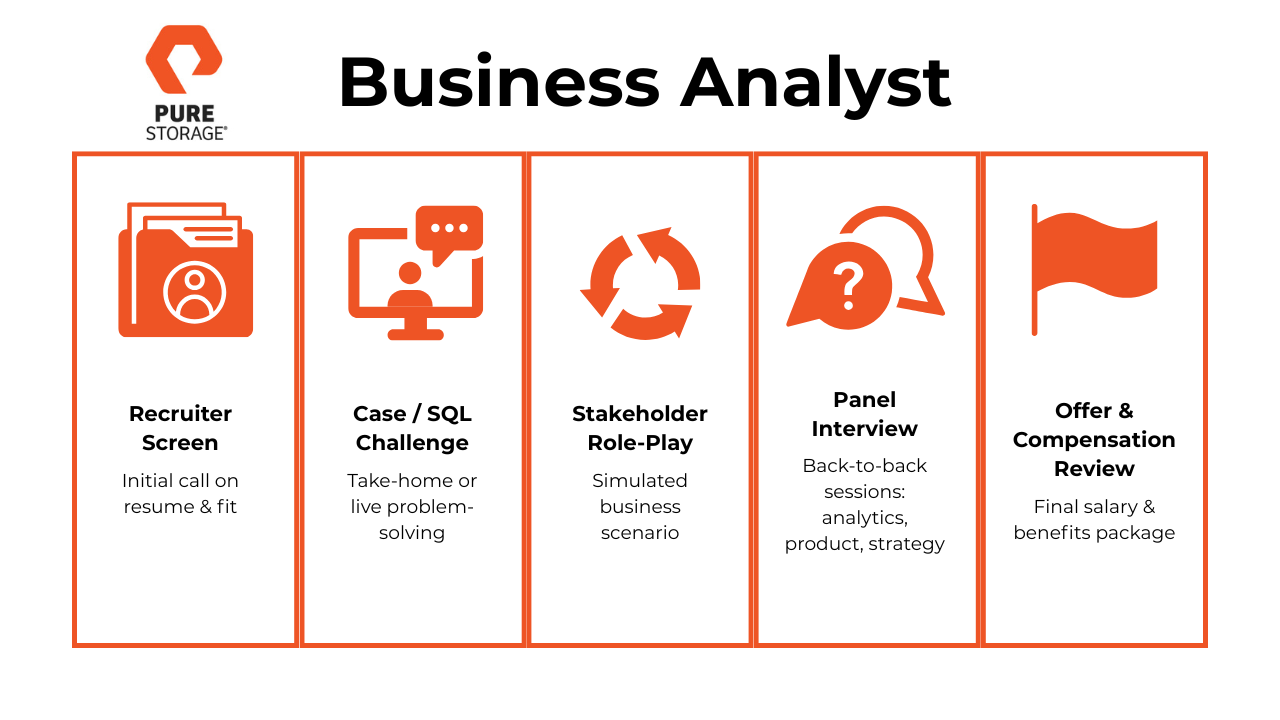
Recruiter Screen
This initial call focuses on resume walkthrough, interest in the company, and high-level fit. Expect questions about your business intuition, past project experience, and comfort with ambiguity. Be prepared to explain your decision-making process and what types of teams you’ve collaborated with.
Tip: Tie your answers back to Pure Storage’s mission of simplifying data and driving innovation. Recruiters are listening for enthusiasm, clear communication, and a genuine connection to the company’s customer-first culture.
Case/SQL Challenge
This round combines data analysis with strategic reasoning, often presented as a take-home case or a live SQL challenge. You might be asked to analyze sales trends, funnel performance, or customer segmentation using sample datasets.
Expect 1–2 SQL queries followed by a business acumen interview question like: “What would you recommend to improve customer retention based on this data?” You’ll be evaluated on logic clarity, stakeholder framing, and data literacy. You can review the ultimate SQL cheat sheet to brush up on SQL functions and ace any problems.
Tip: Don’t just query correctly. Explain why the metrics matter. Frame your SQL results in terms of customer outcomes or business efficiency, since Pure Storage values insight that translates into action.
Stakeholder Role-Play
In this round, you’ll be asked to simulate real-world communication scenarios, such as clarifying ambiguous requirements or prioritizing conflicting stakeholder needs. The goal is to assess how you navigate business conversations, resolve tension, and translate data into clear recommendations.
Tip: Practice active listening. Restating the stakeholder’s concern before offering a solution shows empathy and prevents misalignment, exactly the skill Pure Storage looks for when analysts bridge business and technical teams.
Panel Interview
For the Pure Storage Business Analyst position, the panel interview usually lasts 2 to 3 hours and is structured as a series of back-to-back sessions rather than one continuous group meeting. Candidates typically face 3 to 4 rounds with interviewers from analytics, product management, and strategy.
Each session blends technical problem-solving with behavioral and business-focused questions, giving interviewers a holistic view of your skills. The format is designed to test not just analytical ability, but also how well you communicate insights, adapt to different stakeholders, and collaborate across functions under time pressure.
Tip: Treat each interviewer as unique. Tailor your responses by emphasizing collaboration with product managers in one round, then technical rigor with analytics in another. Consistency matters, but so does adaptability. You can schedule a mock interview on Interview Query to prepare your answers and get personalized feedback from professionals.
Offer & Compensation Review
After the panel, interviewers convene to compare feedback and align on level, scope, and team match. The final package often includes base salary, annual bonus, and professional development resources. Most candidates receive an update within a week, including tips for onboarding or cross-team fit if applicable.
Tip: When discussing compensation, anchor on industry averages but also ask about career mobility. Showing interest in growth beyond salary signals long-term commitment.
Behind the Scenes
After the panel, interviewers submit structured feedback within 48 hours. The hiring manager then leads a sync to finalize decisions on level, team placement, and overall fit. The evaluation balances three factors: your technical strength, your ability to add business value, and how effectively you communicate.
Tip: Treat feedback as a roadmap. If you’re moving forward, reference how you’ve already applied suggestions during onboarding to show growth. If you don’t advance, use the insights to sharpen your prep for the next opportunity. It signals resilience and a commitment to improvement.
Challenge
Check your skills...
How prepared are you for working as a Business Analyst at Pure Storage?
What Questions Are Asked in a Pure Storage Business Analyst Interview?
Coding/Technical Questions (SQL, Excel, Data Wrangling)
Business analyst interview questions often begin with SQL or Excel challenges to evaluate your ability to work with data. These technical questions test your proficiency in querying, transforming, and interpreting raw datasets to extract insights.
Select the top 3 departments with at least ten employees by average salary
To evaluate your use of
GROUP BY, aggregation, filtering withHAVING, and sorting. UseGROUP BYon department, filter withHAVING COUNT(*) >= 10, thenORDER BY AVG(salary)andLIMIT 3. Highlight awareness of nulls and performance on large tables.Tip: Mention how you’d optimize this query with indexes on
department_idorsalaryfor large datasets. Interviewers want to see awareness of scale.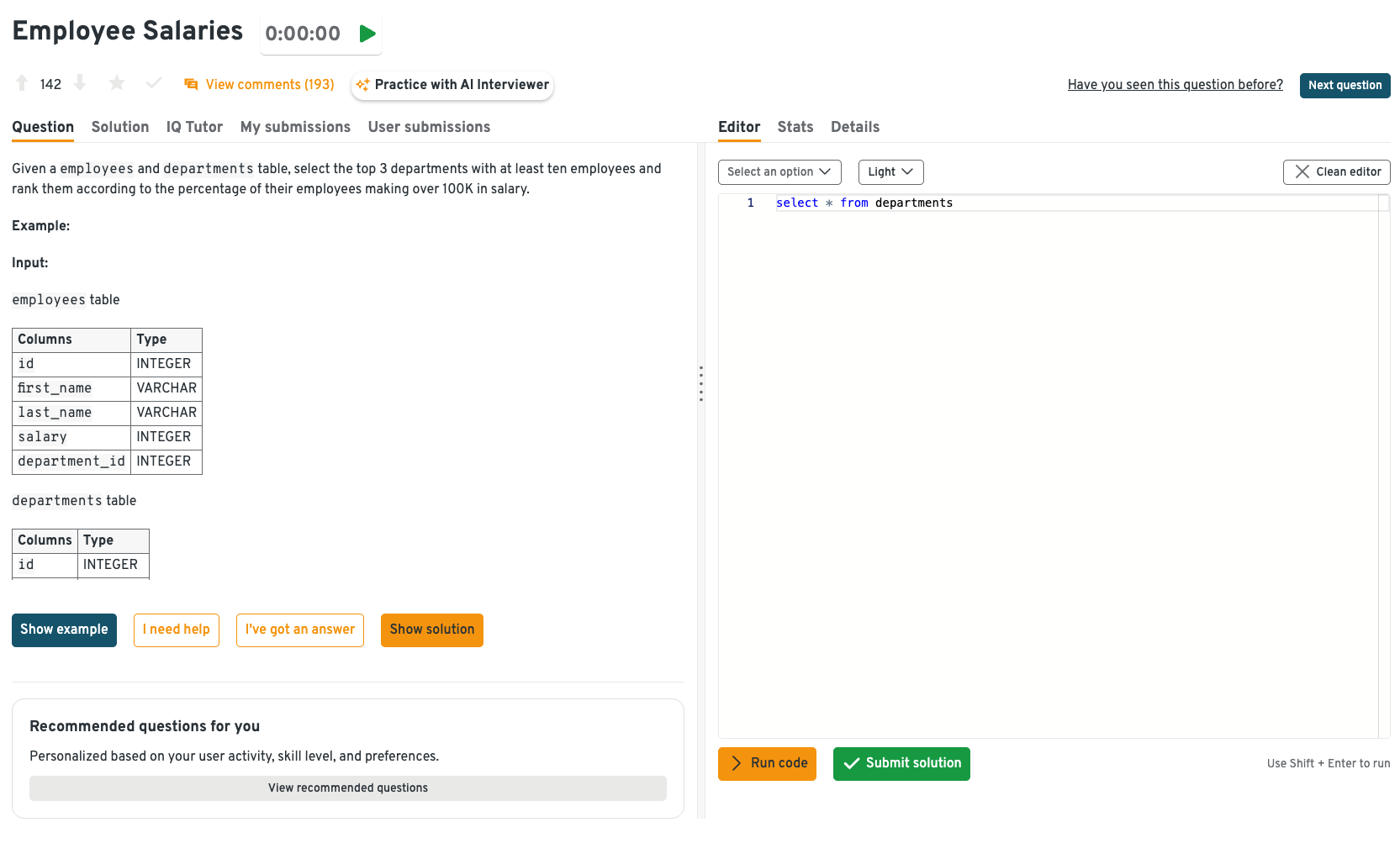
You can practice this question on Interview Query dashboard, where you will see the schema, problem statement, and an integrated SQL editor to write and test queries in real time. Features include solution hints, user-submitted answers, and tips for optimization, like when to use indexes for large datasets. This setup can help you move beyond theory by practicing in an interactive, interview-simulated environment that builds both speed and confidence.
Write a query to count users who made additional purchases after their initial transaction
To test your ability to segment by user and use window functions or self-joins. Identify each user’s first purchase using
MIN(date)orROW_NUMBER(), then count users with additional later transactions. It checks logic and time-series data interpretation.Tip: Clarify edge cases: what if a user has only one transaction? Showing awareness of real-world data irregularities adds depth to your answer. You can read this article to review window functions in SQL and avoid any common mistakes when coding.
Calculate the first touch attribution channel from a user’s journey data
Attribution is a core part of product and marketing analytics. Use window functions to rank channels by timestamp per user. Select the first-ranked channel per user to attribute their conversion or signup.
Tip: Tie your SQL solution to a business use case, like marketing ROI. Linking queries back to decisions shows both technical and business acumen.
Calculate average number of swipes per user per day
This tests grouping, date functions, and averages. Use
GROUP BY user_id, date, then calculateCOUNT(swipes)/COUNT(DISTINCT date)to get per-day activity. Highlights whether you can normalize activity across different user lifespans.Tip: Call out data quality issues. Some users may have missing days. Explaining how you’d handle gaps shows strong analytical thinking. You can review on how to use GROUP BY in SQL to brush up on your skill.
Find the third purchase for every customer
Designed to check ranking and filtering with window functions. Use
ROW_NUMBER()partitioned byuser_idordered bypurchase_date, then filter forrow_number = 3. Tests knowledge of ranking functions and handling sparse data.Tip: Point out what happens if customers don’t have three purchases. Adding a guard clause or NULL handling shows robustness in your query design.
Forecast project budgets and flag those over limit
Evaluates ability to combine aggregation and conditional logic. Calculate
SUM(expenses)grouped by project, then compare tobudgetwith aCASE WHENto flag projects. Checks business framing of cost overruns and financial reporting skills.Tip: Translate results into actionable business insights. e.g., suggesting which projects need budget reallocation. This shifts you from query-writer to decision-support partner. This article helps you review how to use SQL CASE WHEN with multiple conditions.
Identify the Top 5 Products Driving Monthly Revenue Growth
Tests ability to combine aggregation, window functions, and sorting.
-- Assumed schema:
-- orders(order_id, product_id, revenue, order_date)


WITH monthly_revenue AS (
  SELECT
    product_id,
    DATE_TRUNC('month', order_date) AS month,
    SUM(revenue) AS total_revenue
  FROM orders
  GROUP BY product_id, DATE_TRUNC('month', order_date)
),
growth AS (
  SELECT
    product_id,
    month,
    total_revenue,
    LAG(total_revenue) OVER (PARTITION BY product_id ORDER BY month) AS prev_revenue
  FROM monthly_revenue
)
SELECT
  product_id,
  month,
  total_revenue - COALESCE(prev_revenue, 0) AS revenue_growth
FROM growth
ORDER BY revenue_growth DESC
LIMIT 5;
Tip: Interviewers like when you mention that growth should ideally be percentage-based, not just absolute, for comparability across products.
8. Find Users Who Churned After 90 Days of Inactivity Tests joins, date arithmetic, and filtering.
-- Assumed schema:
-- logins(user_id, login_date)
WITH last_login AS (
  SELECT
    user_id,
    MAX(login_date) AS last_login_date
  FROM logins
  GROUP BY user_id
)
SELECT
  user_id,
  last_login_date
FROM last_login
WHERE last_login_date < CURRENT_DATE - INTERVAL '90 days';
Tip: Mention how you’d parameterize “90 days” for flexibility (e.g., a variable or config table). Also note that business definitions of churn vary, sometimes it’s 30/60/90 days depending on the product. You can review functions when comparing dates in SQL in this article, which cover essential techniques along with interview tips and practice problems.
Product/Business Acumen Questions
Interview questions business acumen test how you reason through ambiguous, high-level business problems. These often involve trade-off thinking, KPI selection, market sizing, or root cause analysis.
Identify reasons and metrics for decreasing average comments per post
Start by confirming whether the trend is platform-wide or isolated to specific cohorts (e.g., new vs. long-time users). Examine engagement metrics such as DAU, CTR on notifications, session length, and post frequency. Consider product-level shifts, such as was there a change to feed ranking that de-emphasized posts likely to drive comments, or did a new feature (like reactions or polls) cannibalize comments? To validate, run a cohort analysis by signup month or compare engagement before and after product changes. Propose controlled A/B testing for any recent design updates.
Tip: Show that you can zoom out from metrics to user behavior. Interviewers want to see you tie quantitative drops to qualitative user stories.
Describe how to measure the success of Instagram TV
Define success criteria before picking metrics: is the goal user growth, creator adoption, or ad revenue? If it’s creator retention, focus on KPIs like repeat posting rate and average views per creator. If it’s engagement, track watch time per user, completion rates, and DAU uplift. For monetization, measure ads served, CPM, and incremental revenue. Benchmark against baseline video features (like Stories) and use pre/post analysis to see whether IGTV drove unique incremental engagement rather than cannibalizing other features.
Tip: Always anchor your answer with the goal → KPI → measurement chain. It shows structured thinking and prioritization.
Identify potential flaws in VP’s assumption that insurance leads dropped due to economic downturn
Challenge the assumption by exploring alternative explanations. Was there a funnel change (landing page redesign, form drop-off)? Did marketing channels shift spend allocation, reducing quality leads? Were pricing models updated, making the product less attractive? External factors like seasonality or competitor promotions could also explain the decline. To validate, analyze conversion funnels, compare channel attribution over time, and segment leads by geography to control for economic variance. Suggest experiments such as A/B testing different landing experiences to isolate internal vs. external drivers.
Tip: Show you can challenge leadership respectfully. Strong candidates balance skepticism with proposed methods to validate or refute assumptions.
Estimate the TAM (total addressable market) for a new storage analytics tool
Define target customers (e.g., enterprises with >1PB of data). Estimate market size by multiplying potential buyers × average spend on analytics solutions. Use industry reports or public company filings to triangulate.
Tip: Clarify your assumptions out loud. Interviewers care more about your structured reasoning than the exact number.
How would you determine the root cause of a 20% drop in premium subscriptions?
Break down the funnel: sign-ups, activations, payment failures, cancellations. Segment by geography, device, and user cohort. Look for spikes in churn reasons—pricing changes, competitor launches, or internal bugs (like failed renewals).
Tip: Use the “metrics tree” approach: start at the KPI (subscriptions) and cascade down until you isolate the drop-off node.
If marketing ROI dropped, how would you diagnose it across paid and organic?
Decompose ROI into revenue uplift vs. spend. Check CAC by channel, conversion rate changes, and attribution models. For organic, measure SEO traffic trends, brand mentions, and referral engagement. Compare channel efficiency year-over-year to see if spend is being allocated optimally.
Tip: Emphasize cross-functional collaboration. Show that you’d pull data from finance, marketing, and product to get a holistic view.
Behavioral/Stakeholder Management Questions
You may also be asked a business acumen interview question focused on how you communicate insights or drive decisions across teams. Expect scenarios involving ambiguity, conflict, and influence without authority.
Tell me about a time you had to explain a complex analysis to a non-technical stakeholder
Use the STAR method. Situation: stakeholder misunderstood an A/B test; Task: clarify results; Action: used analogies, visuals, and simplified metrics; Result: they supported the right decision. Emphasize empathy and clarity.
Example: In a campaign performance review, the marketing director was confused by p-values and uplift percentages from our A/B test. I reframed the results using a simple analogy: “Think of this like testing two store layouts. Layout A drove 15 more customers per day.” I paired visuals with business impact projections, which led her to confidently shift budget toward the winning strategy.
Tip: Translate analysis into the stakeholder’s language, which is business impact, not statistical jargon.
Describe a time you faced pushback on a recommendation
Situation: you proposed deprecating a feature; the stakeholder resisted. Action: brought user data, reframed the impact in business terms, and found compromise. Shows maturity in navigating tension.
Example: When I recommended sunsetting a low-usage dashboard, the sales team pushed back because they liked referencing it in pitches. I presented usage data showing only 3% adoption and proposed creating a lighter summary report that met their needs. This compromise freed engineering time while keeping sales enabled.
Tip: Show that you don’t treat pushback as conflict but as an opportunity to refine solutions collaboratively.
Give an example of influencing without authority
Share a case where you rallied cross-functional support through storytelling, data, or a prototype. Demonstrate how you create alignment. This is key for business analysts who work across PM, marketing, and eng.
Example: During a churn analysis, I noticed retention was dropping for new users after week two. Without being on the product team, I created a simple cohort chart and mock-up emails showing re-engagement flows. By telling the story visually, I got buy-in from marketing and PMs to launch a reactivation campaign that improved 30-day retention by 12%.
Tip: Influence comes from preparation and storytelling, making it easy for others to see your vision.
How do you handle conflicting stakeholder priorities in a project?
Emphasize setting shared goals, prioritizing by impact, and regular communication. If needed, escalate with data. It tests your ability to facilitate rather than dictate.
Example: On a reporting project, product wanted more detail while finance wanted speed. I organized a joint workshop to align on the overarching business goal, which is faster revenue reporting. We agreed to ship a minimal version for finance first, then add product features in phase two. Both sides felt heard, and the project stayed on schedule. Tip: Use data and shared outcomes as a neutral ground to resolve competing priorities.
Tell me about a time you had to manage an ambiguous project requirement
Ambiguity is common in BA roles. Interviewers want to see whether you freeze when goals are unclear or whether you proactively create clarity.
Example: I was assigned to build a “customer insights dashboard” with no detailed spec. I scheduled interviews with sales, marketing, and product to gather use cases. Through workshops, we agreed on three core KPIs: NPS, churn rate, and pipeline health. The final dashboard satisfied all teams and reduced ad-hoc reporting requests by 40%.
Tip: Demonstrate that you don’t freeze in ambiguity, but proactively clarify and create alignment.
How do you prioritize multiple ad-hoc data requests from leadership?
This question highlights time management, use of prioritization frameworks, and transparent communication. Leaders want to know that you won’t just scramble. You’ll make trade-offs visible and rational.
Example: At one point, I received urgent requests from three VPs. I used an impact vs. urgency framework, quickly aligned with my manager, and communicated timelines to each VP. By showing transparency and rationale, I managed expectations and delivered the most critical analysis first without burning out the team.
Tip: Show you use structured prioritization frameworks (RICE, impact/effort) instead of saying “I just work harder.”
How to Prepare for a Pure Storage Business Analyst Role
Map JD Verbs to Business Acumen Skills
When you review the job description, pay close attention to verbs like “synthesize,” “prioritize,” or “drive insight.” Each maps directly to the competencies you’ll need to showcase. For example, “synthesize” signals strong storytelling and data-to-insight translation; “prioritize” highlights judgment in ambiguous situations; “drive insight” reflects commercial awareness. Write these out and prepare short stories that align with them. You’ll likely use them in case studies, stakeholder interviews, and behavioral rounds.
Tip: Treat verbs as hidden prompts. Build a mini STAR story for each so you’re ready when they come up. Here are 7 best business analytics projects to add on your resume to showcase your skills.
Drill 30 SQL-mins/day
SQL is often the gatekeeper in analyst interviews. Commit at least 30 minutes daily to solving SQL problems. Focus on joins (INNER vs. LEFT), aggregations (COUNT, SUM, GROUP BY), and window functions (RANK, ROW_NUMBER, LAG/LEAD). These patterns show up in dashboards, ad-hoc analysis, and metric checks. Pure Storage interviewers often look for both syntax speed and analytical reasoning, so talk through why you structure a query a certain way. Even fluency with basic SELECT queries can give you confidence to handle more complex prompts.
Tip: Narrate your reasoning out loud when practicing SQL. It builds the muscle you’ll need for verbal SQL interviews. Read this article to avoid any common SQL interview mistakes.
Practice Articulating Assumptions in Market Sizing
In business-focused questions, like estimating TAM/SAM/SOM or forecasting adoption, you’ll be evaluated less on accuracy and more on structured thinking. Always state your assumptions clearly (e.g., “I’ll assume enterprise adoption rate of X% in Year 1 based on typical SaaS ramp-up”). Show how you balance rigor and practicality under time pressure. This thinking style mirrors real business analyst interview questions where teams must make quick calls using imperfect data.
Tip: Keep a short list of benchmark numbers (e.g., smartphone penetration, SaaS churn rates) in your back pocket to ground your assumptions quickly. You can read about the top 12 business intelligence case studies to help you prepare for your next interview.
Record Mock Stakeholder Role-play Calls
Much of the BA role involves framing insights for non-technical partners. Rehearse mock conversations where you explain tradeoffs (e.g., “we can ship faster but with fewer features”), navigate ambiguity, or push back diplomatically. Recording and replaying helps you hear filler words, refine tone, and tighten structure. Interviewers often simulate “stakeholder role-plays” to test composure and communication, so practicing aloud can be a major differentiator.
Tip: After listening back, rewrite your answers into 2–3 sentence “soundbites”. That’s the level of clarity stakeholders expect. You can schedule a mock interview on Interview Query with industry professionals and get tailored feedback to help you better prepare.
Build a One-Page KPI Teardown of a Familiar Product
Choose an app or product you know well, such as Spotify, LinkedIn, or even Pure Storage’s own offerings, and create a one-page KPI framework: what metrics define success, how they ladder to business goals, and which leading indicators to track. This not only sharpens your analytical lens but also gives you a concrete artifact you can reference in interviews. Bringing this to a panel session can spark conversation, demonstrate initiative, and showcase how you think like a business partner rather than just a data executor.
Tip: Print your KPI teardown and practice presenting it in under 90 seconds. It shows you can be both concise and strategic.
FAQs
H3: What Is the Average Salary for Business Analysts at Pure Storage?
Pure Storage business analyst salary varies in level. Here’s a quick breakdown:
- Overall: The average business analyst total compensation in United States at Pure Storage ranges from $138K to $201K per year.
- Senior Business Insights Analyst: Total salary range for senior position ranges from $135K to $203K per year, with 77.8% of base pay, 7.6% of bonus and 14.6% of stock.
Are there business analyst job postings on Interview Query?
Yes! See the latest openings and get insider tips from our Jobs Board. You will also see roles across top tech companies.
What does a Pure Storage business analyst do?
A Pure Storage business analyst partners with product, sales, and engineering teams to turn raw data into insights that guide decisions. Typical tasks include gathering requirements for reporting tools, writing SQL queries on customer usage data, building KPI dashboards, and framing recommendations for leadership. Analysts also facilitate workshops to align stakeholders and ensure analytics support Pure Storage’s customer-first strategy.
How to get into a business analyst role with no experience?
If you’re starting without direct BA experience, focus on transferable skills: Excel/SQL for data handling, communication skills for stakeholder management, and business judgment from internships or coursework. Build a portfolio project, such as a KPI teardown of a SaaS product, to demonstrate applied thinking. Many Pure Storage analysts enter from operations, finance, or data internships and grow into the role by showcasing problem-solving ability rather than a BA title on their resume.
What are the required Pure Storage business analyst skills?
The role blends technical and business skills:
SQL & Excel: querying and wrangling large datasets.
Visualization tools: Tableau, Power BI, or internal dashboards.
Business acumen: understanding KPIs like churn, ARR, and utilization.
Stakeholder management: aligning competing priorities.
Analytical reasoning: breaking ambiguous problems into structured solutions.
These skills map directly to Pure Storage’s culture of data-driven, customer-focused decisions.
What does an entry-level business analyst do?
Entry-level analysts spend much of their time cleaning and analyzing data, creating reports, and supporting senior analysts with ad-hoc requests. At Pure Storage, junior BAs often manage recurring dashboards, QA data pipelines, and prepare materials for cross-functional meetings. The emphasis is on learning the business model, developing SQL fluency, and practicing clear communication with non-technical teams. You can learn more about the career path, salary and key skills as a business analyst from this article.
Conclusion
Succeeding in a Pure Storage Business Analyst interview isn’t just about memorizing SQL; it’s about sharpening your business acumen, handling ambiguity, and telling clear stories with data. The sample questions in this guide are only the beginning.
Ready to take the next step? Start practicing with Business Analyst interview questions to drill SQL, Excel and case problems that mirror the real loop. Then, deepen your prep with the Pure Storage Business Intelligence Analyst Interview Guide for role-specific insights.
Want personalized coaching? Schedule a 1-on-1 mock loop and get direct feedback from experts before your actual interview.
Pure Storage Interview Questions
| Question | Topic | Difficulty |
|---|---|---|
Data Structures & Algorithms | Easy | |
Given a string, write a function to determine if it is palindrome or not. Note: A palindrome is a word/string that is read the same way forward as it is backward, e.g. Example: Input: Output: | ||
Business Case | Medium | |
SQL | Easy | |
SQL | Easy | |
Machine Learning | Medium | |
Statistics | Medium | |
SQL | Hard | |
Machine Learning | Medium | |
Python | Easy | |
Deep Learning | Hard | |
SQL | Medium | |
Statistics | Easy | |
Machine Learning | Hard |
Discussion & Interview Experiences