
EPAM Interview Questions and Hiring Process Guide for 2025


Introduction
If you’re searching for EPAM interview questions or curious about the full EPAM interview process, you’re already thinking ahead—and that’s exactly what EPAM looks for. EPAM Systems is more than just a global tech consultancy. It is a transformation partner trusted by Fortune 100 companies across industries like financial services, healthcare, energy, and telecom. Their clients expect not just code, but strategy backed by AI, data, and real engineering insight. That is why their interview process isn’t just about passing tests. It’s about showing how you think, collaborate, and solve problems in complex, high-impact environments.
In 2025, EPAM’s 11.7% revenue growth and award-winning AI innovations prove that they aren’t just keeping pace. They’re shaping what digital consulting looks like across the world. As you prepare, remember—this isn’t just about landing a role. It’s about stepping into a career where your ideas can drive transformation on a global scale.
Why Work at EPAM?
Are you considering joining EPAM? Here’s why thousands search for EPAM interview questions and want to be part of this global tech leader.
Global analytics projects
If you’ve ever searched how to evaluate the IT services company EPAM on analytics, you’re not alone. Many aspiring candidates want to know how EPAM contributes to global digital change, and the answer lies in the scale and scope of its analytics engagements. You could find yourself contributing to strategic cloud migrations for global retailers or powering AI-driven logistics solutions that improve sustainability across supply chains. EPAM doesn’t just talk data—they operationalize it. These high-profile analytics projects influence enterprise decision-making across finance, healthcare, and energy, giving you a seat at the table where strategy meets execution.
Data-driven client impact
The phrase data-driven client impact isn’t just a buzzword at EPAM. It defines the company’s project philosophy. For example, their advanced analytics teams have enabled global life sciences firms to reduce R&D cycles and streamline clinical trials by integrating predictive models. If you’re aiming for a role that combines AI, cloud architecture, and business strategy, start by exploring EPAM’s Data Scientist career guide. It highlights exactly how your work can make a measurable difference, whether you’re building recommendation engines or automating supply chain flows using real-time analytics.
Continuous learning & English upskilling
From day one, EPAM makes it clear that learning never stops. Your onboarding often includes the EPAM English test, which isn’t just a screening tool but a gateway to their deep investment in language and communication growth. Whether you’re learning Python, improving project communication, or mastering client presentations, EPAM’s internal training platforms, funded courses, and mentorship programs keep you on a growth trajectory. You don’t just improve your tech stack—you enhance your global readiness, ensuring you’re equipped to work with cross-continental teams and clients.
Remote-first flexibility
Work-life balance is not a luxury—it’s a design principle at EPAM. Their remote-first flexibility lets you choose your work mode based on what suits your lifestyle and the project’s goals. Whether you’re collaborating from a co-working space in Bangalore or leading sprint calls from your home office in Warsaw, you’ll have the freedom to decide how and where you’re most productive. This adaptive model reflects real employee feedback and balances autonomy with accountability. You stay connected without compromising your well-being or your impact.
Thrive in a supportive, growth-focused culture
At EPAM, you’re part of a culture built for progress. The company fosters curiosity and mentorship, backed by a strong ethical foundation and community impact initiatives. Whether you’re leading a cross-border engineering team or volunteering in a global outreach program, your growth is intertwined with shared purpose. EPAM’s recognition as a top employer isn’t just about perks—it’s about trust, inclusion, and the real opportunities they provide for career acceleration and meaningful work.
Challenge
Check your skills...
How prepared are you for working at Epam Systems?
What’s EPAM’s Interview Process Like?
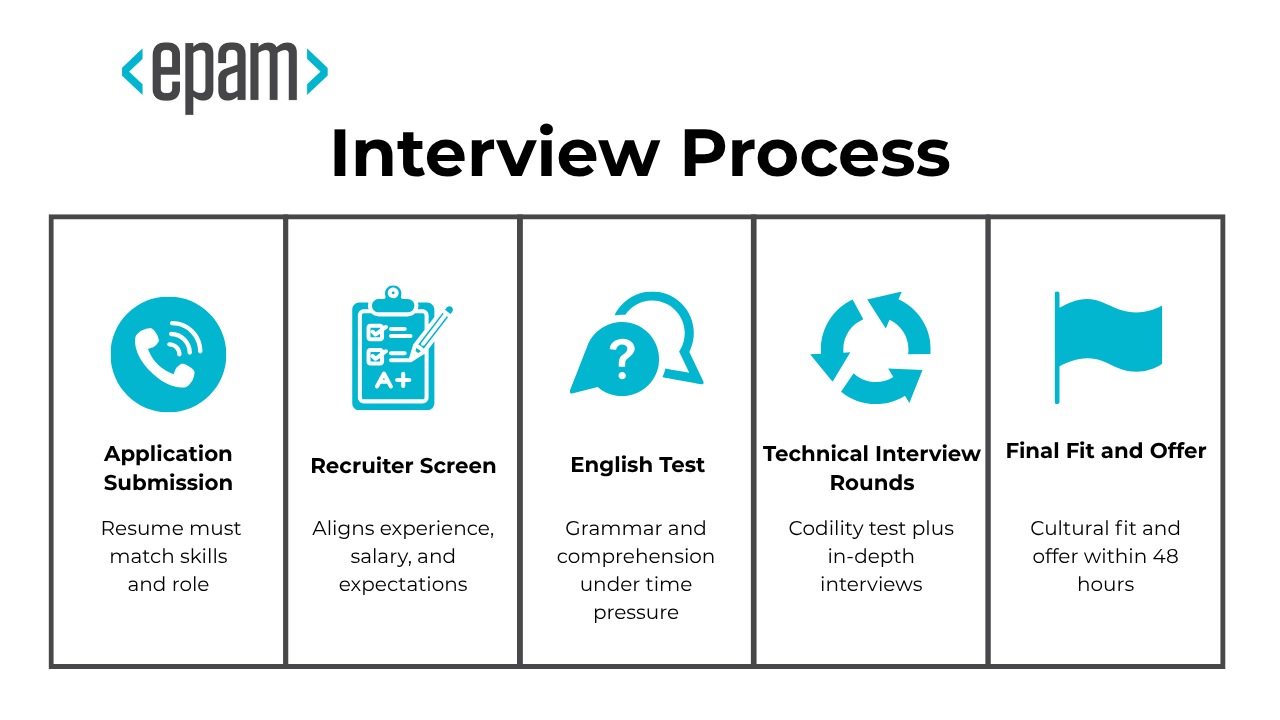
The EPAM interview process in 2025 is designed to identify individuals who bring both deep technical ability and business-oriented communication skills. Whether you are a fresher or an experienced professional, the selection is rigorous but rewarding. Candidates typically go through five stages that evaluate skill, mindset, and cultural fit.
- Application Submission
- Recruiter Screen
- English Test
- Technical Interview Rounds
- Final Fit and Offer
Application Submission
The first step in your journey starts with an online application through EPAM’s career portal, campus platform, or a certified recruitment agency. This stage might seem simple, but your resume directly influences the interview content. EPAM uses automated and manual screening to check for technical keywords, relevant experience, and clarity of focus. If you list a skill, be ready to demonstrate it. EPAM looks for alignment between your academic record—typically requiring at least 60% in 10th, 12th, and graduation—and the role’s core demands. This stage determines how accurately your background fits EPAM’s fast-paced, project-driven model. A polished and well-targeted application can immediately push you ahead in the candidate pool.
Recruiter Screen
Your first human interaction in the process comes via a 30 to 60-minute call with EPAM’s Talent Acquisition team. Here, they verify your skill set, understand your past experience, and align expectations around the role, location, and salary. It is not just a checklist. The recruiter is trained to identify long-term fit, which includes understanding your career motivations and readiness to engage in a consulting environment. They often highlight what’s ahead in the interview sequence, giving you an internal roadmap. A strong recruiter call sets a tone of mutual transparency—if you clearly articulate your strengths and interests, you’ll stand out even before technical rounds begin.
English Test
Integrated into EPAM’s initial online assessment, the EPAM English test evaluates how well you communicate in a global delivery setting. Rather than being a standalone step, it includes 25 to 30 multiple-choice questions focused on grammar, vocabulary, and comprehension. Communication is also evaluated during the group discussion and final interview stages. Some candidates search for EPM English test answers, but the real value lies in your natural ability to express ideas clearly under time pressure. EPAM’s continued investment in English upskilling reflects how essential language fluency is for team collaboration and client communication. Your performance here could influence project assignments and career mobility inside EPAM.
Technical Interview Rounds
The EPAM technical interview questions are built to assess not just what you know, but how you apply it. You’ll begin with a proctored coding test—typically through platforms like Codility—covering three algorithmic challenges, plus MCQs on Java, DBMS, networking, and OOP concepts. Success in this test qualifies you for group discussions and one-on-one interviews. These sessions go deep into your resume, coding logic, database expertise, and framework knowledge. For advanced roles, a second round might explore architecture, system design, or cloud strategy. These interviews are meant to simulate real delivery environments. Demonstrating structured problem-solving and clean communication is key to advancing further.
Final Fit and Offer
The last stage of EPAM’s process is a behavioral and culture-fit round, where the emphasis shifts to values and goals. You’ll be asked about your family background, career aspirations, and alignment with EPAM’s mission. Salary discussions and onboarding logistics also take place here. Once you’ve reached this step, your chance of getting an offer is extremely high—historically above 99%. Offers are often released within 48 hours of your final round, with full packages delivered within a week. For those who accept quickly, bonus incentives may be included. The entire process usually completes in under three weeks, but your clarity and preparation can accelerate it even more.
Most Common EPAM Interview Questions
Understanding the most frequent EPAM interview questions helps you focus your preparation on what really matters across roles, skill levels, and hiring stages.
Role‑specific Guides
- EPAM Systems Data Engineer Interview Questions
- EPAM Systems Business Analyst Interview Questions
- EPAM Systems Data Scientist Interview Questions
- EPAM Systems Software Engineer Interview Questions
- EPAM Systems Product Manager Interview Questions
- EPAM Systems Business Intelligence Interview Questions
- EPAM Systems Data Analyst Interview Questions
- EPAM Systems Growth Marketing Analyst Interview Questions
- EPAM Systems Machine Learning Engineer Interview Questions
- EPAM Systems Product Analyst Interview Guide
Mission and values questions
EPAM evaluates cultural fit using structured behavioral prompts—these EPAM general interview questions help uncover how well your personal values align with EPAM’s client-first, innovation-led culture:
1. Why do you want to work with us?
This is one of the most common EPAM general interview questions, used to assess cultural alignment and motivation. Interviewers want to see that you’ve researched EPAM’s mission, values, and consulting focus. Tailor your response to show interest in EPAM’s global AI initiatives, growth in digital engineering, or collaborative culture.
2. What are your strengths and weaknesses?
EPAM looks for reflective professionals who understand their skill profile and learning approach. Use strengths that align with consulting, client delivery, or data-driven problem-solving. For weaknesses, show self-awareness and a clear plan for improvement that reflects adaptability—something highly valued across EPAM roles.
3. Tell me about a time you handled ambiguity on a project.
Consulting roles at EPAM often involve unclear or evolving client requirements. Use this question to show how you bring structure, communicate with stakeholders, and adapt priorities. Interviewers are evaluating whether you can remain effective in dynamic environments.
4. Describe a situation where you had to learn something new quickly.
This question is often used to assess learning agility and readiness for EPAM’s rapidly evolving project environments. Focus on how you identified gaps, found resources, and applied new knowledge under time constraints. The ability to upskill independently is especially important for roles involving AI, cloud, or data engineering.
5. Describe a time you worked in a collaborative team environment.
This is another common entry in EPAM interview questions, especially for roles where consulting and cross-functional collaboration are essential. EPAM assesses whether you contribute to team success beyond your individual tasks. Use a STAR response to explain a situation where you led or contributed to a team project, emphasizing communication, ownership, and client focus. For example: “In a past project, I helped implement a data migration pipeline under tight deadlines. I coordinated across engineering, QA, and client-facing teams. That experience taught me to lead with empathy and agility—both of which I know are integral to EPAM’s global delivery model.”
Technical depth questions
To succeed in the EPAM technical interview, you’ll need to be ready for hands-on coding, systems thinking, and data handling—this section includes typical EPAM coding interview questions by theme:
6. Write a query to find the engagement rate for each ad type
To solve this, filter users who have interacted with at least three different ad types in the last 48 hours. Then, calculate the engagement rate for each ad type using the formula (number of clicks / number of impressions) * 100. Finally, sort the results by the highest engagement rate.
7. How would you formulate a query to calculate the average annual retention for each subsequent year?
To calculate annual retention, the query uses multiple Common Table Expressions (CTEs) to process subscription data step-by-step. It identifies active subscriptions at the end of each year, flags new subscriptions, and calculates retention rates by comparing active subscriptions in year (T) with those in year (T-1). The final query computes the percentage of retained subscriptions for each year.
8. Count the number of users that like each user
To solve this, perform an INNER JOIN on the likes table where the liker_id matches the user_id. Then, group by the liker_id and count the distinct liker_id values from the second table to get the number of liker’s likers.
To solve this, join the page_sponsorships, recommendations, and users tables to associate pages with users and their postal codes. Use a CASE WHEN statement to count recommendations where the postal codes match, divide this count by the total recommendations for each page, and group the results by page_id and postal_code.
To solve this, use a dictionary to map Roman numeral symbols to their values. Iterate through the dictionary in descending order of values, appending the corresponding symbol to the result string while subtracting its value from the integer until the integer becomes zero. Apply this function to each integer in the list to generate the Roman numeral representations.
To solve this, use a dictionary where the sorted version of each word acts as the key, and the values are sets of anagrams. Iterate through the list of words, sorting each word and adding it to the corresponding set in the dictionary. Finally, return the values of the dictionary as sorted lists.
Hiring tests and exams
Before technical rounds, you may face the EPAM exam via their online interview platform, covering English fluency, logic, and Codility-based problem solving—here’s what to expect in each format:
12. EPAM English Test – Sample Grammar MCQ
Choose the correct sentence:
A. The engineer write the report carefully.
B. The engineer wrote the report carefully.
C. The engineer writing the report carefully.
This represents the grammar-focused multiple-choice structure in the EPAM English test, used to assess communication readiness for global projects.
13. EPAM English Test – Reading Comprehension
After reading a short technical email, you may be asked:
What is the main purpose of the message?
This section of the EPAM English test focuses on how well you process business communication, a core skill in EPAM’s consulting teams.
14. Group Discussion Topic – Code Quality vs. Delivery Speed
During offline rounds or the online discussion stage, candidates may be asked to argue whether quality or delivery speed should take priority. This simulates the EPAM interview platform’s group communication assessment and tests both verbal articulation and consulting judgment.
Tips When Preparing for an EPAM Interview
Preparing for an EPAM interview requires focus on technical depth, communication skills, and understanding the structure of their global hiring process.
Master the English Test Format
EPAM’s hiring process often includes an early English language assessment. You’ll first take an online English test on their platform, followed by an HR interview conducted in English to verify your speaking skills. Practice grammar, comprehension, and speaking so you can confidently clear the EPAM English test.
Practice Codility‑Style Coding Challenges
Be ready for EPAM’s coding tests, which often use Codility-style online challenges. For example, data engineering candidates face a Codility round with multiple sections (SQL quizzes, a Python coding task, and an SQL problem) to solve in about an hour. Sharpen your skills on timed coding exercises to get comfortable with this format.
Prepare STAR Stories Highlighting Global Client Impact
EPAM’s interviews can include behavioral questions, sometimes led by interviewers from global teams. Use the STAR method (Situation, Task, Action, Result) to prepare stories that highlight how you delivered results, especially on projects with international scope. These examples prove you can collaborate globally and deliver impact. Consider practicing with our AI interviewer tool to polish your delivery.
Research EPAM’s Analytics Case Studies and Services
Show that you understand EPAM’s work by researching its recent data analytics projects and solutions. Interviewers may pose scenario questions about evaluating analytics outcomes or improving services. Referencing EPAM’s own case studies or capabilities in your answers demonstrates your preparation and interest. Practicing such scenarios in mock interviews will also boost your confidence.
Clarify the Interview Rounds and Logistics
EPAM often has multiple interview stages (online tests, technical rounds, HR discussions, etc.), so clarify the process with your recruiter upfront. Ask how many rounds there will be and what each involves. Knowing the schedule and format of each stage helps you prepare appropriately and avoid any surprises.
Salaries at EPAM
Average Base Salary
Average Total Compensation
Conclusion
Preparing for the EPAM interview process in 2025 means more than just solving problems—it’s about proving you’re ready to lead in fast-moving, AI-powered consulting environments. From coding tasks to client-facing communication, success hinges on clear thinking and strong fundamentals. Continue building your skills with our EPAM DSA Learning Path, explore more EPAM scenario-based SQL interview questions, and get inspired by Chris Keating’s success story that shows how preparation leads to impact.
FAQs
Does EPAM require an English test?
Yes, most candidates are required to complete the epam English test as part of the initial assessment. It typically includes multiple-choice grammar and reading comprehension questions, along with verbal communication checkpoints during later interviews. The goal is to assess your readiness for client-facing, global delivery roles. Clear communication is essential at EPAM, especially for teams working across time zones and languages.
What technical interview questions does EPAM ask most often?
The most common EPAM technical interview topics include system design, object-oriented programming, and SQL optimization problems. Expect multiple epam coding interview questions covering data structures, Java or Python logic, and service architecture scenarios. Interviewers look for both correctness and clarity, especially in high-level consulting or engineering roles.
How many rounds are there in the EPAM interview process?
The EPAM interview process typically consists of four to five rounds: application screening, a recruiter call, an online English and technical assessment, technical interviews, and a final HR or cultural fit round. For experienced candidates, additional rounds may include system design or managerial interviews. Always confirm the flow with your recruiter, as it can vary by role and region.
How hard is the EPAM interview?
EPAM interviews are challenging but fair, often benchmarked at the same level as other global consultancies. The pass rate is competitive, especially for roles involving AI, cloud, or full-stack engineering. Strong fundamentals in algorithms, architecture, and communication increase your chances significantly.
What resources help with EPAM Codility tests?
To prepare for the epam Codility test, review GitHub repositories with Codility practice sets and explore EPAM-specific problems on Interview Query. Timed environments and structured SQL or Python challenges closely reflect the test format. For deeper preparation, check out our Data Engineer guide.
Discussion & Interview Experiences