



Apple Business Analyst Interview Guide: Process, Questions, Salary, Prep


Introduction
An Apple business analyst interview is designed to answer one core question: can you make sound decisions when the problem is underspecified and the stakes are real? Apple business analysts routinely work across five or more functions in a single initiative, coordinating inputs from product, engineering, operations, finance, and leadership to move projects forward. The role exists because decisions at Apple rarely sit cleanly within one team or one dataset.
That complexity is not abstract. Apple reported over $383 billion in annual revenue in its most recent fiscal year, with performance spread across hardware, services, and global operations. Even small analytical or operational decisions can have outsized downstream impact. The interview process is built to test whether candidates can impose structure on that scale, using tools like SQL and Excel, while communicating tradeoffs clearly to different stakeholders. In this guide, we break down the Apple business analyst interview process, explain what each stage is designed to assess, and show how to prepare for the skills Apple teams actually look for.
Apple Business Analyst Interview Process
The Apple business analyst interview process is designed to evaluate how candidates operate when problems are ambiguous, cross-functional, and high-impact. Rather than testing isolated technical skills, Apple uses the process to assess how well you structure questions, reason with data, and communicate decisions across product, engineering, and business teams. Most candidates move through the process in four to six weeks, depending on team alignment and scheduling.
Interview process overview
Candidates typically progress through a recruiter screen, one or more analytical or technical interviews, and a virtual or onsite loop that blends business case discussions with behavioral evaluation. Unlike purely technical roles, Apple’s process emphasizes judgment, prioritization, and decision-making alongside SQL fundamentals.
Interview process summary
| Interview stage | What happens |
|---|---|
| Application and resume screen | Recruiters assess business analyst experience, analytical depth, and cross-functional impact |
| Recruiter screen | Motivation, role alignment, communication skills, and logistics |
| Online assessment (select teams) | Logical reasoning, SQL fundamentals, or structured problem-solving |
| Technical and behavioral interviews | Business cases, data reasoning, systems thinking, and behavioral questions |
| Hiring manager or leadership interview | Strategic judgment, ownership, and team fit |
| Offer and team matching | Final leveling, scope alignment, and compensation review |
Application and resume screen
Apple recruiters look for evidence that you have owned problems end to end, not just supported analysis or documentation. Strong resumes show how you translated vague requirements into clear outputs, influenced decisions, or improved processes. Impact matters more than tools listed.
This stage is also where candidates are often aligned to focus areas such as digital subscriptions, supply chain operations, or AI-enabled platforms, which can shape later interview questions.
Apple-specific tip: Frame resume bullets around problem → approach → outcome, and quantify impact where possible.
Recruiter screen
The recruiter screen is typically a 20 to 30 minute conversation focused on background, motivation, and role fit. Recruiters ask about your experience working with stakeholders, handling ambiguity, and navigating competing priorities. This is also where expectations around location, team structure, and timing are discussed.
Apple places early emphasis on clarity of motivation. Candidates are expected to articulate why Apple’s operating environment and the business analyst role specifically align with their skills and interests.
Apple-specific tip: Reference a concrete Apple product, service, or operational challenge and explain how analysis or requirements work could improve decision-making.
Online assessment (where applicable)
Some Apple business analyst roles include an online assessment before live interviews. These assessments may test structured problem-solving, SQL fundamentals, or logical reasoning using realistic business scenarios. The focus is on how you think, not how quickly you code.
Practicing SQL and analytical reasoning through the SQL interview learning path or broader preparation via the learning paths hub can help reinforce the patterns commonly tested here.
Apple-specific tip: Clearly state assumptions before jumping into a solution. Interviewers care more about defensible logic than perfect answers.
Technical and behavioral interviews
Mid-stage interviews usually combine analytical and behavioral evaluation. You may be asked to walk through past projects, analyze a business scenario, reason through data using SQL, or explain how you handled conflicting stakeholder priorities.
These interviews test whether you can balance technical detail with business context. Many candidates prepare for this stage by simulating real conversations through mock interviews or practicing under pressure with the AI interview, which mirrors how interviewers probe for depth and clarity.
Apple-specific tip: When discussing analysis, always connect insights to a decision or recommendation.
Onsite or virtual interview loop
The onsite or virtual loop is the most comprehensive stage and typically includes three to five interviews. Each round evaluates a different dimension of business analyst work at Apple.
Typical loop structure
| Interview focus | What is evaluated |
|---|---|
| Business case analysis | Problem structuring, prioritization, and decision-making |
| Data and SQL reasoning | Metric definition, query logic, and analytical judgment |
| Systems and requirements | Translating business needs into functional or technical requirements |
| Behavioral and culture fit | Ownership, collaboration, and communication |
| Stakeholder communication | Explaining insights to technical and non-technical audiences |
Case-style interviews often center on scenarios such as improving subscription growth, optimizing operational workflows, or evaluating the impact of new AI-enabled features. Interviewers look for how you define success metrics, choose analyses, and move from insight to action. Practicing applied scenarios through challenges or longer-form exercises like takehomes can help build comfort with this format.
Apple-specific tip: Avoid stopping at observation. Interviewers expect a clear recommendation and rationale.
Apple Business Analyst Interview Questions
Apple business analyst interview rounds typically combine SQL-based analysis, business case structuring, and stakeholder-focused behavioral evaluation. Interviewers want to see whether you can take a messy prompt, define the right metric or requirement, and land on a recommendation that a product or operations team can actually act on. Below are the most common categories of Apple business analyst interview questions, with notes on what each one is really testing.
SQL & Data Manipulation Questions
SQL is a common screen for Apple business analyst roles, especially when the work touches subscriptions, funnel performance, operational KPIs, or experimentation readouts. These questions test correctness at the right grain, edge-case handling, and whether you can explain assumptions clearly. If you want structured practice, the SQL interview learning path and hands-on challenges are the closest match to how these prompts are evaluated.
-
This question tests whether you can define “first purchase” correctly and then measure behavior that happens strictly after it. Strong solutions usually start by identifying each user’s first purchase date, then checking for a later-day purchase while excluding same-day bundles. Apple interviewers care about whether you clarify timestamp-versus-date logic and avoid false upsells caused by duplicates or multi-line orders.
Tip: State your definition of “first purchase” and “later” explicitly before writing the query.
-
This evaluates whether you can combine datasets cleanly and aggregate without losing the correct grain. It’s also a proxy for real work like consolidating requirements across teams or merging operational feeds. Interviewers may probe whether you chose the right union strategy and how you’d prevent double counting.
Tip: Use “combine first, aggregate second” as your mental model, and sanity-check totals on a small subset.
How would you write SQL to compute activation rate for a new Apple feature by cohort (new vs existing users) and by week?
This tests whether you understand metric definition and cohorting, not just syntax. Interviewers want to see a clean definition of activation, a consistent cohort rule, and the correct denominator. A strong answer explains how you’d avoid mixing cohorts across weeks and how you’d handle users who activate multiple times.
Tip: Start by writing the metric in words (numerator/denominator), then translate into SQL steps.
A KPI dropped week-over-week. How would you use SQL to determine whether the drop came from fewer users, lower frequency, or smaller basket size?
This tests decomposition thinking, which is core to business analysis at Apple. A strong approach breaks the KPI into driver metrics, trends each driver, and checks for composition effects (for example, geography or device mix). Interviewers care that you can isolate the driver before proposing a fix.
Tip: Decompose one level at a time—don’t add segmentation until you have the baseline drivers.
-
This question tests self-join logic, deduping pairs, and selecting the right time grain for “purchased together.” In Apple contexts, it maps to attachment rate, bundle behavior, and cross-sell analysis. Strong candidates explain how they avoid counting (A,B) and (B,A) separately and how they treat multiple purchases in the same session or day.
Tip: Define “together” (same transaction, same day, same session) before you choose join conditions.
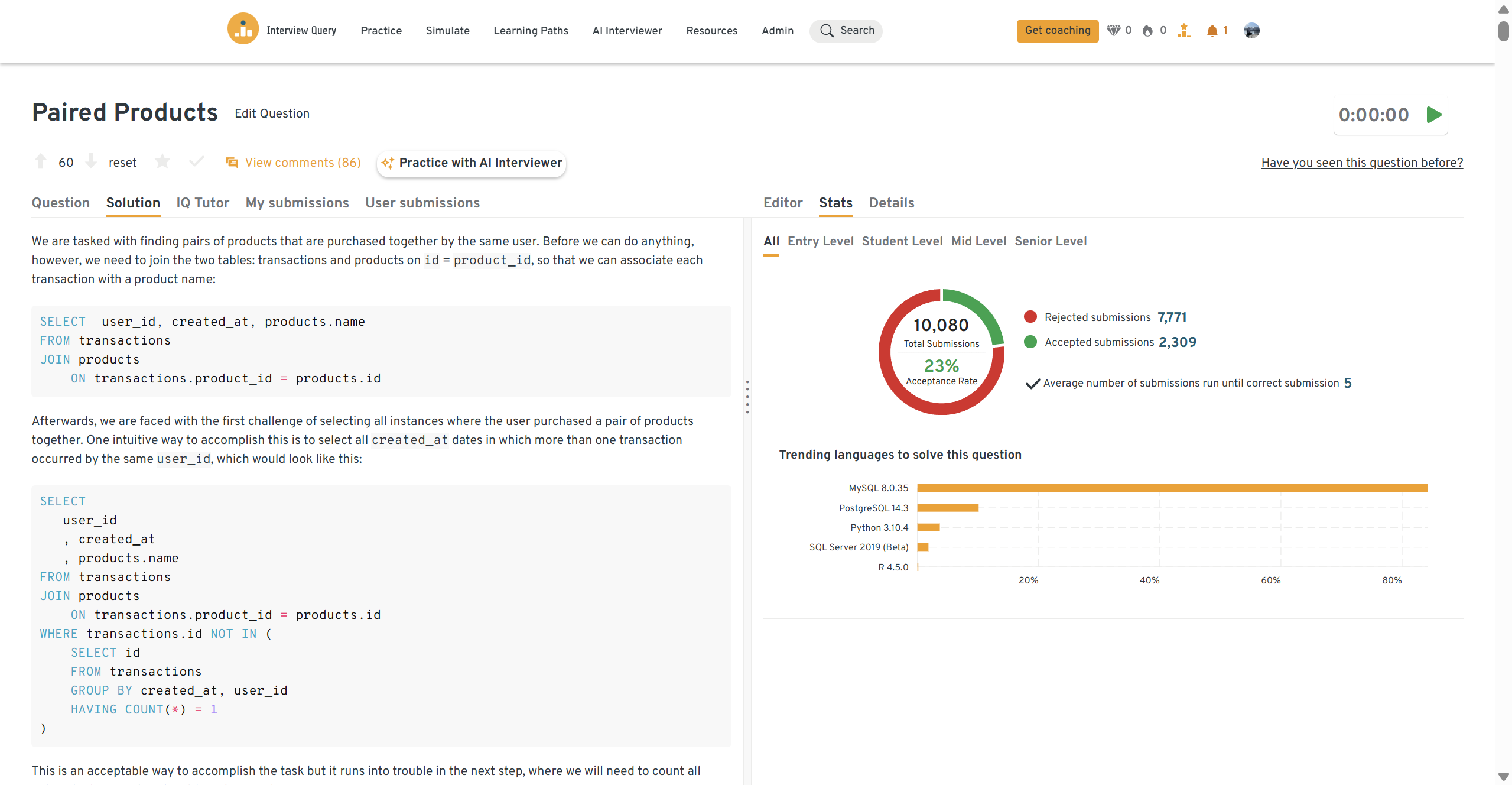
You can practice this exact problem on the Interview Query dashboard, shown below. The platform lets you write and test SQL queries, view accepted solutions, and compare your performance with thousands of other learners. Features like AI coaching, submission stats, and language breakdowns help you identify areas to improve and prepare more effectively for data interviews at scale.
Data Visualization & Storytelling Questions
Apple business analysts are expected to communicate clearly across technical and non-technical audiences. These questions test whether you can choose the right chart, explain what matters, and land a recommendation. Practicing how you narrate results in a timed setting using mock interviews can help tighten your delivery.
How would you build a weekly business review dashboard for an Apple subscription product?
This tests prioritization and metric hierarchy. Strong answers define a small set of “north star” metrics, then add driver metrics (acquisition, activation, retention, revenue) and guardrails (refunds, churn, customer support signals). Interviewers want to see restraint: a dashboard that supports decisions, not a wall of charts.
Tip: Start with the decisions the dashboard should enable, then pick metrics that directly support those decisions.
A stakeholder says engagement is down. What would you show first, and how would you guide the conversation?
This evaluates whether you lead with clarity under pressure. Strong answers start with a definition check (what is “engagement”), then a trend view, then driver decomposition, and only then segmentation. Apple interviewers like candidates who prevent the meeting from turning into opinion battles.
Tip: Anchor the discussion on one agreed definition, then walk step-by-step into drivers.
How would you present findings differently to engineering vs. executive leadership?
This tests audience adaptation. Strong candidates describe a top-line impact narrative for leaders, then a diagnostic deep dive for engineers, with crisp handoffs between the two. Interviewers want to see that you can be concise without being vague.
Tip: Lead with impact for leadership, and lead with root cause hypotheses for engineering.
A dashboard shows a sudden spike. How do you explain whether it’s real or a data issue?
This evaluates data skepticism and hygiene. Strong answers include checks like pipeline changes, logging changes, backfills, and shifts in denominators. In Apple environments, interviewers often look for candidates who can defend metrics before acting on them.
Tip: Always run a “data validity checklist” before proposing business actions.
How would you visualize the tradeoff between conversion and customer support volume after a product change?
This tests whether you can tell a balanced story with competing metrics. Strong answers describe showing both metrics over time, annotating the change date, and checking whether support volume rose disproportionately for certain segments. The goal is to support a decision on rollout, rollback, or iteration.
Tip: Pair outcome metrics with guardrails so you don’t optimize the wrong thing.
Product & Experiment Design Questions
Apple business analysts are often asked to evaluate changes, not just report them. These questions test causal reasoning, experiment hygiene, and whether you can interpret results responsibly. If you want broader prep beyond SQL, the data science interview learning path can help with the experiment-thinking style these prompts require.
In an A/B test, how can you check if assignment to buckets was truly random?
This evaluates experiment sanity checks and your ability to detect bias before interpreting results. Strong answers include balance checks on key covariates, distribution tests, and practical checks for logging or targeting issues. Interviewers want to hear how you’d decide whether to trust the experiment readout.
Tip: Treat randomization validation as a prerequisite, not an optional add-on.
-
This tests whether you understand seasonality and noise, not just hypothesis testing. Strong answers explain baseline variability, seasonal adjustment, and why a naive month-over-month test can mislead. Apple interviewers care that you can avoid false alarms and overreaction to normal fluctuation.
Tip: Compare the change to historical variance for the same season, not only to the previous month.
A new Apple feature shipped. How would you define activation and retention so the metrics can be reused across teams?
This tests metric design and governance thinking. Strong answers define clear events, a time window, and eligibility criteria, then explain how you’d prevent metric drift across orgs. Interviewers look for candidates who can set definitions that scale.
Tip: Write metric definitions as if someone else will implement them without you.
A metric improved after launch. How would you check whether the lift came from product impact or traffic mix changes?
This tests confounding control. Strong answers mention segment-level consistency checks, stable cohort comparisons, and, when possible, experiment design. Apple interviewers want to see that you don’t attribute causality without proof.
Tip: Validate lift across stable segments before celebrating the result.
How would you evaluate an AI-enabled change when ground truth is noisy or delayed?
This tests judgment in evaluation design. Strong answers propose proxy metrics, human review sampling, and monitoring for drift or unintended harm. Interviewers want to hear how you balance speed with correctness when measurement is imperfect.
Tip: Define leading indicators and guardrails so you can act before long-term outcomes arrive.
Behavioral & Culture-Fit Questions
Behavioral rounds focus on ownership, influence, and communication in cross-functional environments. Apple interviewers often probe how you drive alignment without direct authority. If you want live feedback on your stories, coaching can help you tighten your STAR structure without sounding rehearsed.
What are the three biggest strengths and weaknesses you have identified in yourself?
This tests self-awareness and whether you can describe growth areas without undermining your candidacy. Strong answers tie strengths to role outcomes (structure, clarity, stakeholder alignment) and frame weaknesses as active improvement plans. Apple interviewers listen for maturity, not perfection.
Tip: For weaknesses, describe what you changed and how you measure improvement.
Tell me about a time when you exceeded expectations during a project.
This evaluates ownership and how you deliver impact under constraints. Strong answers show a clear baseline expectation, then explain the additional insight, process improvement, or stakeholder alignment you drove. Apple interviewers care most about the decision or outcome your work enabled.
Tip: Quantify the impact, even if it’s time saved, risk reduced, or scope unblocked.
-
This tests influence and communication repair. Strong answers show how you diagnosed the mismatch (language, incentives, timing), adjusted your approach, and rebuilt trust. Apple interviewers look for candidates who prevent repeated misalignment through better processes.
Tip: Emphasize what you changed systemically, not just what you said once.
Describe a situation where you had to analyze complex data while prioritizing competing stakeholder needs. What did you do?
This tests prioritization under pressure. Strong answers clarify how you chose a decision-maker, aligned on success criteria, and sequenced work to unblock the highest-impact decision first. Apple interviewers often prefer candidates who can say “no” or “not yet” with a clear rationale.
Tip: Explain your prioritization rule (impact, urgency, reversibility), then show how you applied it.
Tell me about a time you changed a team’s decision using data that contradicted their assumptions.
This tests persuasion without arrogance. Strong answers show how you validated data quality, presented insights in a stakeholder-friendly way, and offered a path forward rather than just pointing out errors. Apple interviewers want evidence you can influence outcomes while preserving relationships.
Tip: Lead with shared goals, then introduce evidence and options, not blame.
If you want to explore similar role guides before you interview, the companies page is useful for comparing interview patterns across teams and orgs.
If you prefer a quick video breakdown first, watch this video by Jay Feng, co-founder of Interview Query and former data scientist at Nextdoor and Monster. It’s a fast way to understand what hiring managers look for before you dive into deeper practice.
How To Prepare For An Apple Business Analyst Interview
Apple business analyst interviews reward candidates who can bring structure to messy problems, communicate tradeoffs crisply, and back recommendations with clean SQL logic. Your prep should mirror that: a mix of SQL practice, case framing, and stakeholder storytelling.
Prioritize SQL correctness and metric definition.
Even when the role is not “analytics-only,” Apple still expects you to reason precisely with data. Practice writing queries that hold up under edge cases (nulls, duplicates, time boundaries) and make sure you can explain the grain of your query out loud. The SQL interview learning path is the most direct way to build repetition on common patterns, and challenges help you practice under realistic time pressure.
Practice structured case thinking, not just answers.
Many prompts are intentionally underspecified: you will need to clarify the goal, define success metrics, and propose a plan. Rehearse a consistent approach: clarify → hypothesize drivers → pick 2–3 analyses → interpret → recommend. If you want longer-form practice that feels closer to “real work,” use takehomes to build stamina and decision-making flow.
Sharpen cross-functional communication.
Apple business analysts work across product, engineering, and operations, so you’ll be assessed on how you translate between audiences. Practice delivering the same finding in two versions: one for executives (impact and decision) and one for engineers (assumptions and diagnostics). Running reps through mock interviews helps you tighten clarity and pacing, and the AI interview is useful for quick iterations when you want immediate feedback.
Build comfort with systems and data-platform conversations.
Some Apple business analyst roles touch tooling, pipelines, and platform work (especially where AI or data platforms are involved). You do not need to be a data engineer, but you should be able to talk intelligently about upstream vs. downstream issues, instrumentation quality, and what “good requirements” look like. The data engineering interview learning path can fill the gaps if you feel shaky on these concepts.
Use targeted role research to match Apple’s expectations.
Spend a short session scanning how other roles are structured and evaluated so you don’t overprepare in the wrong direction. The companies page is useful for understanding how Apple compares to adjacent interview styles.
If you want the fastest improvement loop, combine SQL practice with spoken explanation, then get feedback on your delivery through coaching.
Role Overview And Culture At Apple
An Apple business analyst operates between data, systems, and decision-making. The role is about helping teams move from unclear requirements to clear direction, whether that means defining metrics for a launch, building a forecast, or translating stakeholder needs into implementation-ready requirements. Apple business analysts often support initiatives tied to services and subscriptions, supply chain and operations, AI and data platforms, or customer support experiences like AppleCare.
Day to day, the work typically includes:
- Data analysis and insight generation: pulling data with SQL, validating assumptions, and translating findings into decisions, not just dashboards.
- Requirements and systems thinking: documenting what “done” means, defining success metrics, and partnering with engineers through build, testing, and UAT.
- Financial and operational modeling: forecasting demand, estimating ROI, and building scenarios that clarify tradeoffs.
- Process improvement: identifying bottlenecks, designing measurable fixes, and making changes stick through clear ownership and follow-through.
- Executive-ready communication: writing and presenting concise updates that help stakeholders decide quickly.
Culturally, Apple tends to value precision, discretion, and high-quality output. Business analysts are expected to be dependable thought partners who can challenge assumptions with evidence while still keeping teams aligned. Beyond day-to-day execution, Apple business analysts are expected to operate with a strong sense of ownership. That means anticipating second-order effects, flagging risks early, and helping teams converge on decisions even when inputs are incomplete. Analysts are not positioned as passive recipients of requirements. They are expected to shape the question, pressure-test assumptions, and clarify what success looks like before work begins.
From a growth perspective, the role offers multiple paths. Many Apple business analysts deepen into product analytics or operations-focused tracks, while others move closer to data science, modeling, or AI-adjacent work depending on team needs. Exposure to forecasting, experimentation, and system design creates optionality over time. For candidates interested in expanding toward predictive or machine learning–driven work, building foundations through the modeling and machine learning interview learning path can be a useful complement.
Average Apple Business Analyst Salary
Compensation benchmarks below are based on recent, role-specific data from Levels.fyi and reflect annual total compensation (base salary + stock + bonus) for apple business analyst roles in the United States. Pay varies by level based on scope, ownership, and cross-functional responsibility.
United States Compensation Overview (Annual)
| Level | Level Description | Total (Annual) | Base (Annual) | Stock (Annual) | Bonus (Annual) |
|---|---|---|---|---|---|
| ICT2 | Junior business analyst | $108,000 | $108,000 | $7,200 | $2,170 |
| ICT3 | Business analyst | $180,000 | $132,000 | $28,800 | $11,250 |
| ICT4 | Senior business analyst | $216,000 | $156,000 | $52,800 | $13,200 |
| ICT5 | Lead / principal | $288,000 | $180,000 | $85,200 | $30,000 |
At the ICT3–ICT4 range, compensation reflects expanded ownership over metrics, requirements, and decision support across multiple teams. Senior levels (ICT5+) typically come with broader strategic scope, higher cross-org influence, and a larger equity component tied to long-term impact.
Average Base Salary
Average Total Compensation
If you want to contextualize these figures against adjacent analytics or product roles, the companies section is useful for side-by-side comparisons.
FAQs
How Long Does The Apple Business Analyst Interview Process Take?
Most apple business analyst candidates complete the interview process in four to six weeks, depending on team availability and scheduling. Early stages such as recruiter screens and initial interviews tend to move quickly, while later rounds may take longer due to cross-functional interviewer coordination. Timelines can vary by org and hiring urgency.
How Technical Is The Apple Business Analyst Interview?
The interview is analytical rather than engineering-heavy. You are expected to be comfortable with SQL, structured analysis, and system-level thinking, but not with advanced algorithms or low-level systems design. Interviewers focus more on correctness, decision-making, and communication than on writing complex code.
Do I Need Prior Big Tech Experience To Get Hired As An Apple Business Analyst?
No. Apple hires business analysts from a wide range of backgrounds, including startups, consulting, operations, and mid-sized companies. What matters most is your ability to work through ambiguity, define clear metrics, and influence decisions using data. Demonstrated ownership and impact often outweigh brand-name experience.
What Does Apple Look For In Strong Business Analyst Candidates?
Strong candidates show structured thinking, clarity under uncertainty, and the ability to work across product, engineering, and leadership teams. Apple interviewers value analysts who can translate vague problems into concrete decisions while maintaining rigor around data quality and assumptions. Communication and judgment matter as much as technical skill.
How Should I Prepare For Behavioral Questions In Apple Interviews?
Behavioral questions often focus on ownership, conflict resolution, and stakeholder management. Use clear STAR-style stories that emphasize decisions made, tradeoffs considered, and outcomes achieved. Practicing out loud through mock interviews or the AI interview can help refine clarity and pacing.
Think Like An Apple Business Analyst
Succeeding in an apple business analyst interview requires more than knowing SQL or preparing polished answers. You need to demonstrate how you frame problems, pressure-test assumptions, and guide teams toward decisions when inputs are incomplete and stakes are high.
The most effective preparation mirrors the role itself. Practice defining metrics before writing queries, explaining tradeoffs before proposing solutions, and communicating insights in a way that different stakeholders can act on. Build fluency through targeted SQL practice, realistic case scenarios, and spoken explanations of your thinking.
To prepare efficiently, focus on role-relevant resources like the SQL interview learning path, applied scenarios from challenges and takehomes, and live feedback via mock interviews or coaching.
With deliberate practice and the right structure, you can walk into the apple business analyst interview confident, credible, and ready to operate at the level Apple expects.