

CompTIA: Tech Job Postings Hit a Three-Year High, But Interviews Remain Tough

More Openings Don't Necessarily Mean Easier Hiring
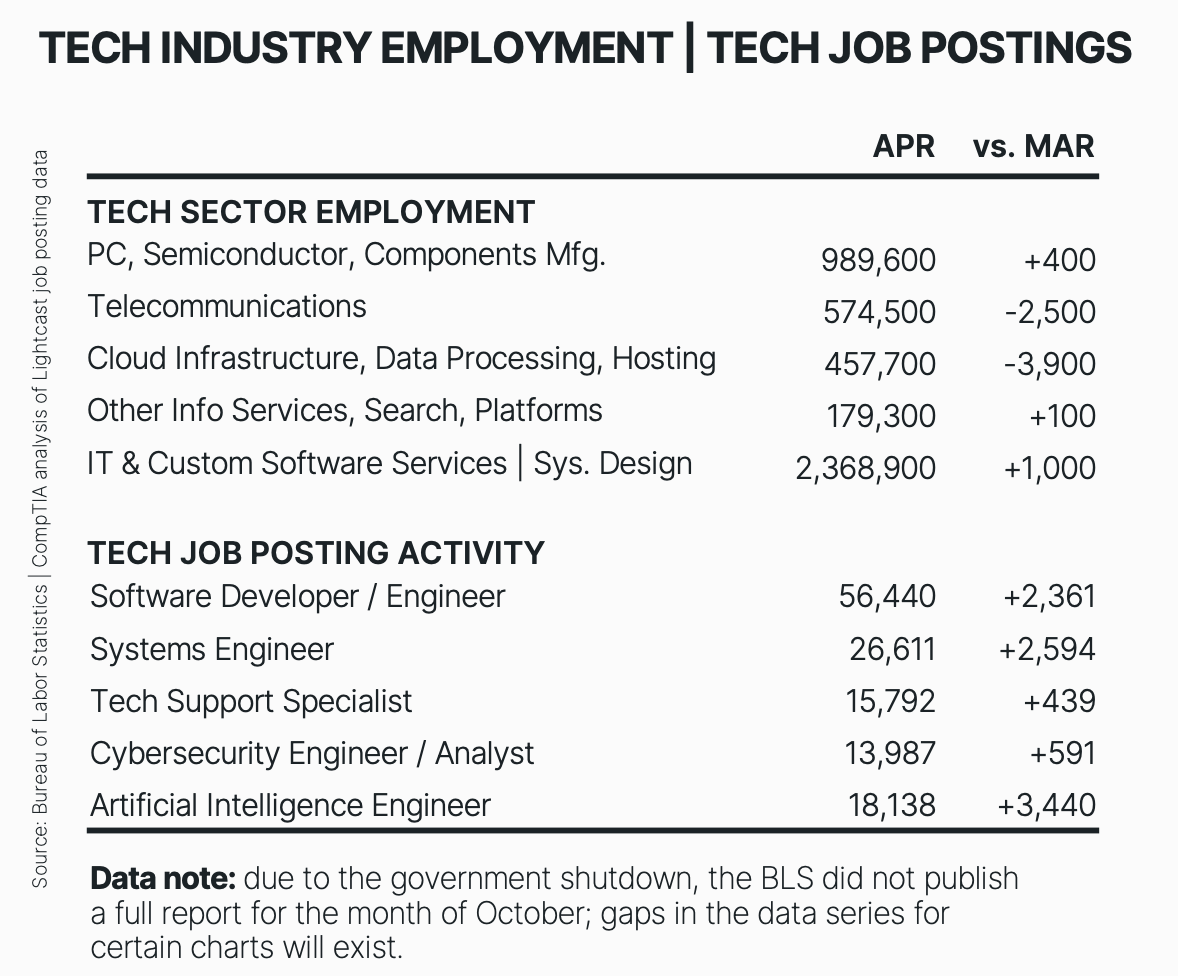
Tech job postings are finally moving in the right direction. CompTIA says employers listed 271,483 new postings for tech occupations in April, the highest monthly total in three years, with more than 575,000 active postings overall. On the surface, that looks like the rebound many software, data, and analytics candidates have been waiting for.
The broader hiring picture still looks more cautious than that headline suggests. LinkedIn’s May 2026 Workforce Report says U.S. hiring across all industries fell 4.7% from March to April and 8.5% year over year. In Technology, Information and Media, hiring was down 5.1% year over year and still more than 30% below its pre-pandemic pace.
That gap matters because candidates do not interview with headlines. They interview with hiring managers who still feel pressure to hire carefully, justify headcount, and avoid bad misses. More openings can coexist with tighter filters, longer loops, and a stronger bias toward candidates who look productive on day one.
What the Latest Tech Job Postings Data Actually Says
CompTIA’s April report is real progress. Beyond the three-year high in new postings, the group says tech occupation employment rose by 260,000 in April and tech unemployment fell to 3.5%.
Source: CompTIA Tech Jobs Report
Demand also spread across core roles, not only flashy AI titles. Active postings for systems engineers and architects rose 42.7% since January, software developers and engineers rose 32.3%, and cybersecurity engineers and analysts rose 23.2%.
That matters because it suggests companies are still spending on foundational technical work. The market is still asking for engineers, analysts, and data workers who can build, debug, communicate, and ship.
CompTIA also notes that 20% of April tech postings asked for zero to three years of experience, while 28% asked for four to seven. That is encouraging, but it does not mean those openings are easy to win. A larger top of funnel does not guarantee a looser interview bar.
Why the Hiring Picture Still Looks Cautious
LinkedIn’s data helps explain the disconnect. Hiring may be stabilizing in some corners of tech, but actual movement into jobs remains slow. The platform’s hiring rate is down 9% year to date and 27% below February 2020 levels. That is not the profile of an employer market that has fully relaxed.
The government data points in the same direction. BLS reported that information employment fell by another 13,000 jobs in April and has dropped by 342,000 since late 2022. Layoffs.fyi, which tracks public tech layoffs, still lists 115,907 tech employees laid off across 159 companies so far this year.
Such trends produce a strange candidate experience. A role can be real, funded, and urgently posted, while the team behind it still runs a slower, more defensive process than candidates expect.
Interviews Are Getting Stricter
When demand starts to recover before confidence does, employers usually expand screening before they expand trust. They can afford to ask for one more round, one more case, or one more live exercise, because candidate flow improves before internal comfort does.
To illustrate, a recently published analysis of data interview processes in 2026 found data-focused roles now require significantly more interview time than in previous years. Employers rely on multiple technical, analytical, and behavioral assessments before making hiring decisions, even as demand for technical talent begins to recover.
That pattern shows up in Interview Query’s own signal. In recent coaching sessions, coaches are still pushing candidates back to SQL joins, Python fluency, experiment design, and case communication, not just AI talking points. Recent approved interview writeups show the same thing. Candidates are still describing loops that combine live coding, product or business cases, behavioral rounds, and take-home style work before a final decision.
Candidates may see more opportunities on the market while simultaneously facing more rigorous screening. This also explains why “more postings” does not always translate into “more offers.” Teams may reopen reqs faster than they simplify evaluation.
What Candidates Are Misreading about an AI-Heavy Market
Many candidates see AI-heavy headlines and assume the fastest way to compete is to sound more AI-native than everyone else. That helps at the margin, but it is usually not the deciding factor.
Across recent IQ interview experiences, the recurring asks still look familiar: SQL live coding, Python debugging, product metrics, experimentation, stakeholder judgment, and behavioral clarity. In one recent candidate experience for a software engineering role , even an “AI coding” round was mostly about parsing API responses, handling messy text, and making sensible engineering choices.
That is why candidates who are preparing for later-stage loops usually gain more from mock interviews than from collecting more AI terminology. Most misses happen when a candidate cannot reason clearly out loud, structure a case, or recover after a wrong first pass.
How Job Seekers Can Adapt Right Now
The current market rewards a different interpretation of good news. Rising tech job postings should tell candidates to apply with more confidence, not to prepare with less rigor. A stronger playbook is straightforward:
- Double down on core technical skills. SQL, coding, system thinking, analytics, and problem-solving remain the foundation of most technical interviews.
- Practice communicating your reasoning. Employers increasingly evaluate how well candidates explain decisions, tradeoffs, and business impact.
- Prepare for longer, mixed-format interview loops. Expect a combination of technical exercises, case discussions, and behavioral assessments.
- Treat rising job postings as an opportunity, not a lower bar. More openings mean more chances to interview, but hiring teams are still being highly selective.
Candidates targeting competitive data and software roles often need a tighter prep plan than generic job-search advice provides. For people who want role-specific feedback on SQL, case rounds, and decision-making, coaching tends to be the fastest way to find the exact gap before a real interview does.
The Bottom Line
CompTIA’s latest report is a real positive signal. Tech job postings are up, active demand is healthier, and the market looks better than it did a year ago. But LinkedIn and BLS data make the same point from the other side: hiring has not fully loosened, and employers are still acting with caution.
That is why interviews still feel harder than the headlines suggest. The market is improving first at the top of the funnel, while selectivity remains high at the decision stage. Candidates who adjust to that reality, by preparing for stricter evaluation instead of assuming an easier market, will read the moment more accurately than candidates who confuse more openings with a lower bar.