

NACE Says New-Grad Hiring Is Rebounding in 2026, But Interviews Remain Competitive

New-Grad Hiring Is Improving
New grad hiring 2026 looks better than it did a few months ago. A new report from the National Association of Colleges and Employers (NACE) found that employers expect to hire 5.6% more new college graduates this year, with hiring increases in certain industries like information and engineering services.
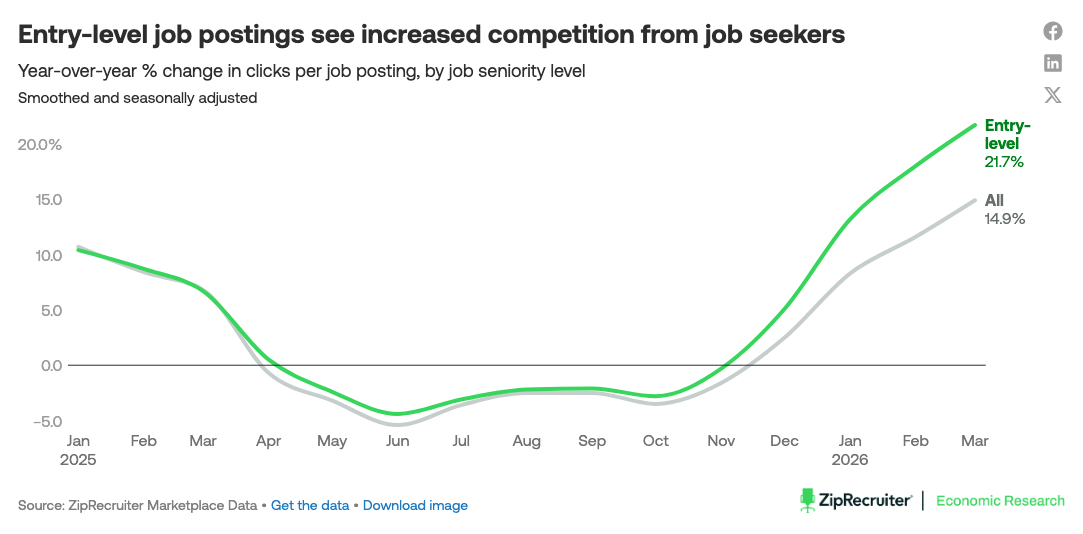
The positive shift is also observed in ZipRecruiter’s Annual Grad Report, which notes that 77.2% of recent grads landed jobs within three months of graduating, up from 63.3% a year earlier. But the underlying signal is more complicated. ZipRecruiter also found that entry-level roles make up a smaller share of available jobs, and many grads are taking bridge jobs just to get a foothold.
That tension sets up the real story. While hiring may be improving, competition and expectations inside interviews are not easing at the same pace.
A Closer Look at the Hiring Rebound
The fresh macro data is genuinely better. In NACE’s spring update, the 5.6% increase in hiring outlook for the Class of 2026 is driven by the more than one-third of respondents who now expect to add hires this year.
Large companies contribute to the hiring gains, as those with over 5,000 employees plan to increase their hiring by 8.7% this year. Employers also expect to bring in 3.9% more interns in 2025-26, which matters because internships remain one of the clearest pipelines into full-time work.
Source: ZipRecruiter’s Annual Grad Report 2026
ZipRecruiter’s annual grad report adds a second layer. It shows recent grads are finding work faster, but mostly because they are adapting to a tighter market. As entry-level roles take up a smaller share of job postings and attract more interest, more new-grads are applying broadly, lowering selectivity, and taking jobs that act as stepping stones rather than ideal first roles.
A hiring rebound does not mean companies are loosening standards. It often means more companies are hiring carefully again, especially for roles where they want junior talent who can ramp fast.
AI Is Still Showing Up in Entry-Level Hiring
The AI signal is real, but it is not the whole story. NACE says more than one-third of entry-level jobs now require AI skills, nearly triple the share from fall 2025. It also found that 28% of employers are seeking early-career talent who can use AI in their work, while nearly 60% are assigning interns projects that use AI tools and skills.
That could sound like a reason to reduce prep to prompt engineering. But the broader NACE finding suggests the opposite. Most employers are discussing how AI changes tasks inside jobs, not whether it eliminates those jobs entirely. In other words, early-career candidates are increasingly expected to use AI, but still within human-reviewed workflows where judgment matters.
Such findings align with the insights from the PwC AI study on data interviews, which shows that even as AI adoption rises, interviewers continue to prioritize core skills like SQL, business judgment, and the ability to explain decisions clearly.
Interview Signals Look More Like Work Simulation
Interview Query’s own interview signal points in the same direction. Instead of one-click AI hiring and easier screens, early-career candidates still face SQL screens, case presentations, behavioral rounds, and work-simulation style assessments.
In a recent Interview Query user transcript, a candidate interviewing for a product data scientist role at a major tech company described an early round built around two SQL questions tied to advertising data. Another candidate described a loop with an HR screen, SQL coding, a case-study presentation, three behavioral rounds, and a director interview.
Meanwhile, an interview write-up with an early-career analytics candidate described a process with multiple Excel exams, a SQL round, a case-style technical interview, and behavioral screens. Another described a take-home challenge followed by case interviews, a data-challenge review, and a behavioral round in a final power-day format.
The consistent pattern is that employers want proof that a candidate can handle messy data, explain tradeoffs, and communicate clearly in business terms.
Key Takeaways for Early-Career Candidates
The practical takeaway is that early-career prep should look broader than a coding grind. SQL still matters, but so do business framing, presentation skills, and the ability to narrate a decision. That is especially true for analytics, product, and data roles, where junior candidates are often screened on whether they can turn analysis into a recommendation.
Candidates should also expect more structured simulations. Take-homes, spreadsheet tasks, and case presentations are showing up because they let employers test how someone works, not just what they remember. Candidates who need help translating past projects into sharper impact stories usually improve faster through coaching, where the weak spot is often framing rather than raw technical knowledge.
If internships are expanding again, they are not just resume fillers. ZipRecruiter found that working during college more than doubles the odds of employment after graduation, and internships remain one of the strongest routes into a first offer. That makes realistic rehearsal through mock interviews more valuable than passive review, especially before Superdays and multi-round loops.
Why the Rebound Could Still Feel Frustrating
The contradiction in the data is the real story. Employers are hiring more new grads, but recent grads still report a tighter market and more compromises. CNBC’s coverage of the ZipRecruiter report notes that more students are submitting 20 or more applications before landing one offer, and many are accepting roles below their ideal level just to get started.
That gap helps explain why the market can look stronger in aggregate while still feeling bad for individuals. More openings do not automatically mean more forgiving interview loops. In many cases, they mean more chances to compete in processes that are now better structured and more performance-based.
The Bottom Line: Emphasizing Applied Skills
The best read on new grad hiring 2026 is not that the market has snapped back to easy mode. It is that employers are reopening early-career pipelines while expecting candidates to show more practical readiness than before. NACE’s hiring rebound and ZipRecruiter’s faster placement numbers are both positive, but neither suggests companies are lowering the bar.
What the IQ signals add is clarity on where that bar sits. Early-career candidates are still being screened on SQL, communication, business reasoning, and their ability to perform in work-simulation formats. If hiring continues to improve through the rest of 2026, those skills will matter even more, because they are exactly what employers use to separate promising applicants from prepared ones.