

NACE Says Communication Skills Still Beat AI Skills in Interviews

How AI Is Reshaping What Employers Actually Evaluate
AI is now part of the hiring conversation almost everywhere. ICIMS and Aptitude Research reported in April that 74% of companies say candidates are already using AI in the job search, and 69% of employers are using AI somewhere in talent acquisition.
But the latest employer signal cuts against the easy narrative that AI fluency is becoming the whole game. In the National Association of Colleges and Employers’ (NACE) recent guidance for new graduates, employers still emphasized critical thinking, communication, and teamwork as the core skills they want to uncover in interviews. Hiring teams are still screening for who can explain decisions, influence people, and stay credible under pressure.
That split is showing up in IQ’s own interview signals, too. Recent interview and coaching transcripts show that early rounds may include a screen, a take-home, or a technical exercise, but later rounds often pivot toward leadership, stakeholder management, and storytelling. As such, technical competence may get candidates through the door, but communication is increasingly what separates finalists from each other. It helps explain why employers are redesigning interviews to test judgment and collaboration alongside raw technical skill.
Why Communication Skills in Interviews Still Outrank AI Fluency
NACE’s latest employer guidance is more direct than a lot of the AI hiring commentary circulating this spring. Seventy percent of employers now report using skills-based hiring, up from 65% a year earlier. And when NACE asked what those employers actually want to see, the answer was not “prompting” or “AI tool familiarity” in isolation. Candidates are being evaluated on communication, teamwork, and critical thinking through examples that demonstrate how they’ve used their skills to solve problems.
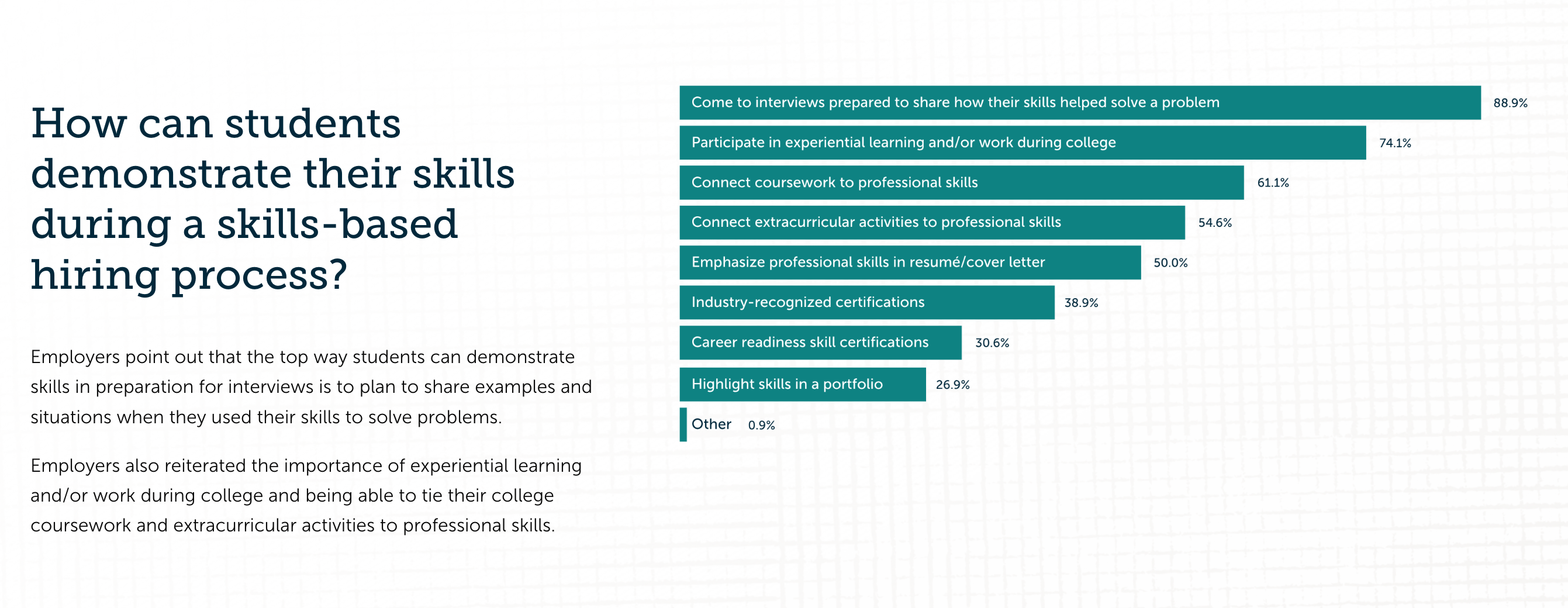
Source: NACE 2026 Job Outlook
That helps explain why behavior-based interviews are not going away. If recruiters and hiring managers are using interviews to surface transferable skills, the strongest candidates make their thinking legible. They show how they handled disagreement, how they made tradeoffs, and how they aligned other people around a decision.
This is also why strong candidates can still feel surprised late in the process. A technical screen can reward correctness and speed. But a final round often rewards judgment, clarity, and trust, requiring a different set of skills.
AI Is Only Changing, Not Replacing, Human Workflows
NACE’s broader May analysis on AI and the early-career labor market makes the same point from a different angle. AI adoption is real, but still uneven. Gallup data cited by NACE found that 38% of employees say their organizations have integrated AI into the workplace, while 41% say they have not.
Even where AI is moving quickly, hiring teams are not handing the final decision over to it. ICIMS found that only 18% of companies are using AI broadly across hiring workflows, and recruiter judgment overrides AI recommendations in 58% of organizations when conflicts come up. In other words, AI is speeding up pieces of hiring, but the most important decisions are still being made by people.
That seems to be changing the shape of interviews more than their purpose. If screening, scheduling, and some first-pass evaluation become more automated, the live interview carries more weight as the place where employers test reasoning, communication, and judgment. [Link insights from internal link: https://www.interviewquery.com/p/karat-data-science-technical-interviews-2026 on how standard technical interviews no longer work so employers have to test something else]
That seems to be changing the shape of interviews more than their purpose. If screening, scheduling, and some first-pass evaluation become more automated, the live interview carries more weight as the place where employers test reasoning, communication, and judgment.
That also aligns with a broader industry shift away from traditional technical interviews that mainly focus on memorization or speed. As previously explored in.Karat’s breakdown of why standard technical interviews are losing effectiveness, employers are increasingly looking for signals around problem framing, communication, and decision-making under ambiguity instead of purely textbook correctness.
What We Are Seeing in Real Interview Loops
This is not just a top-down employer story. It is visible in what candidates are reporting back after real interviews. In the last 30 days, more than 300 approved interview experiences in Interview Query’s database mentioned leadership, stakeholder, cross-functional, or behavioral themes.
One recent data science candidate described a hiring manager round that was almost entirely about cross-functional work, stakeholder conflict, and how they convinced a team when there was friction, before the take-home even became the main topic. Another candidate said their final round shifted away from technical depth and toward whether they could walk through tradeoffs out loud with a senior manager. A third described a SQL-heavy process where the correct answer mattered less than explaining the reasoning behind it clearly.
The same pattern showed up in recent coaching and interview-debrief transcripts. In one call, a candidate preparing for a final round at a major tech company said the biggest surprise was how quickly the discussion moved from coding into leadership and storytelling. Another candidate targeting analytics roles described practical SQL and product-case rigor early, followed by tougher senior-level questions about judgment and communication.
That combination is the real 2026 signal. AI expectations are rising. Technical screens are still there. Take-homes are still eating time. But later rounds are often deciding among candidates who can all do the work on paper. At that point, interviews become a test of explanation, prioritization, and trust.
What This Means for Candidates Right Now
Instead of assuming that technical prep matters less, the practical takeaway should be that technical prep alone is increasingly incomplete.
Candidates who are strongest in this market can adapt by doing these four things well:
- Prepare a small set of stories about conflict, influence, ambiguity, and tradeoffs.
- Practice explaining technical decisions out loud to go beyond just solving quietly.
- Treat take-homes and presentations as communication tests, not just correctness tests.
- Expect final rounds to evaluate judgment at a higher level than early screens do.
That is also why generic behavioral prep often falls flat. Strong answers need a real decision, a real tradeoff, and a clear outcome. For candidates who want that pressure-tested before the actual loop, mock interviews are often the fastest way to see whether a story sounds convincing or just rehearsed.
The same applies to preparation quality; company- and role-specific question banks tend to surface the kinds of behavioral and stakeholder questions employers are actually asking now, instead of relying on generic “tell me about a time” prompts. As interviews become more layered, candidates who prepare for communication and judgment with the same intensity as technical rounds are increasingly the ones advancing furthest in the process.
The Bottom Line
The newest AI hiring data does not show communication skills getting displaced. It shows the opposite. AI is becoming part of the baseline workflow, while communication, teamwork, and judgment remain the skills employers use to separate finalists.
For technical candidates, that means the interview market is not getting simpler. It is getting more layered. The candidates who stand out are increasingly the ones who can do the technical work, explain it clearly, and connect their decisions to business context when the room shifts from problem-solving to judgment.
If that pattern holds through the rest of 2026, the best-prepared candidates will not be the ones who only learned how to use AI tools. They will be the ones who learned how to think out loud in front of other people.