
Dice: AI Skills Dominate 73% of Tech Job Posts, But Fundamentals Win Interviews

How AI Hiring Trends Differ From Interview Reality
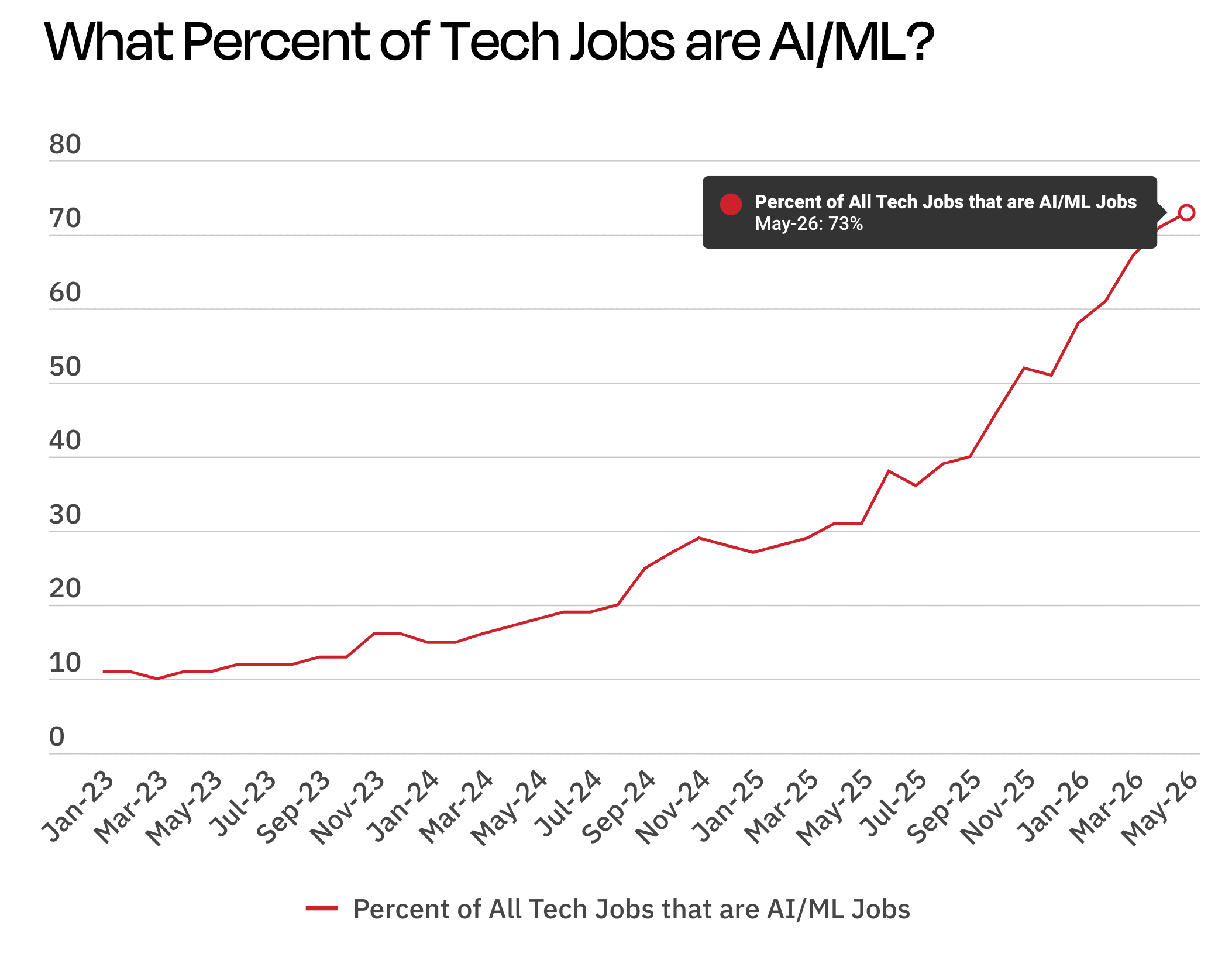
AI skills continue to show up in tech job postings. Dice’s 2026 Tech Jobs Report says 73% of U.S. tech postings included AI skill requirements in May, up from 71% in April and 135% higher than a year earlier. While that may sound like a market where every interview involves prompt engineering and model stacks, that’s not what candidates are actually experiencing.
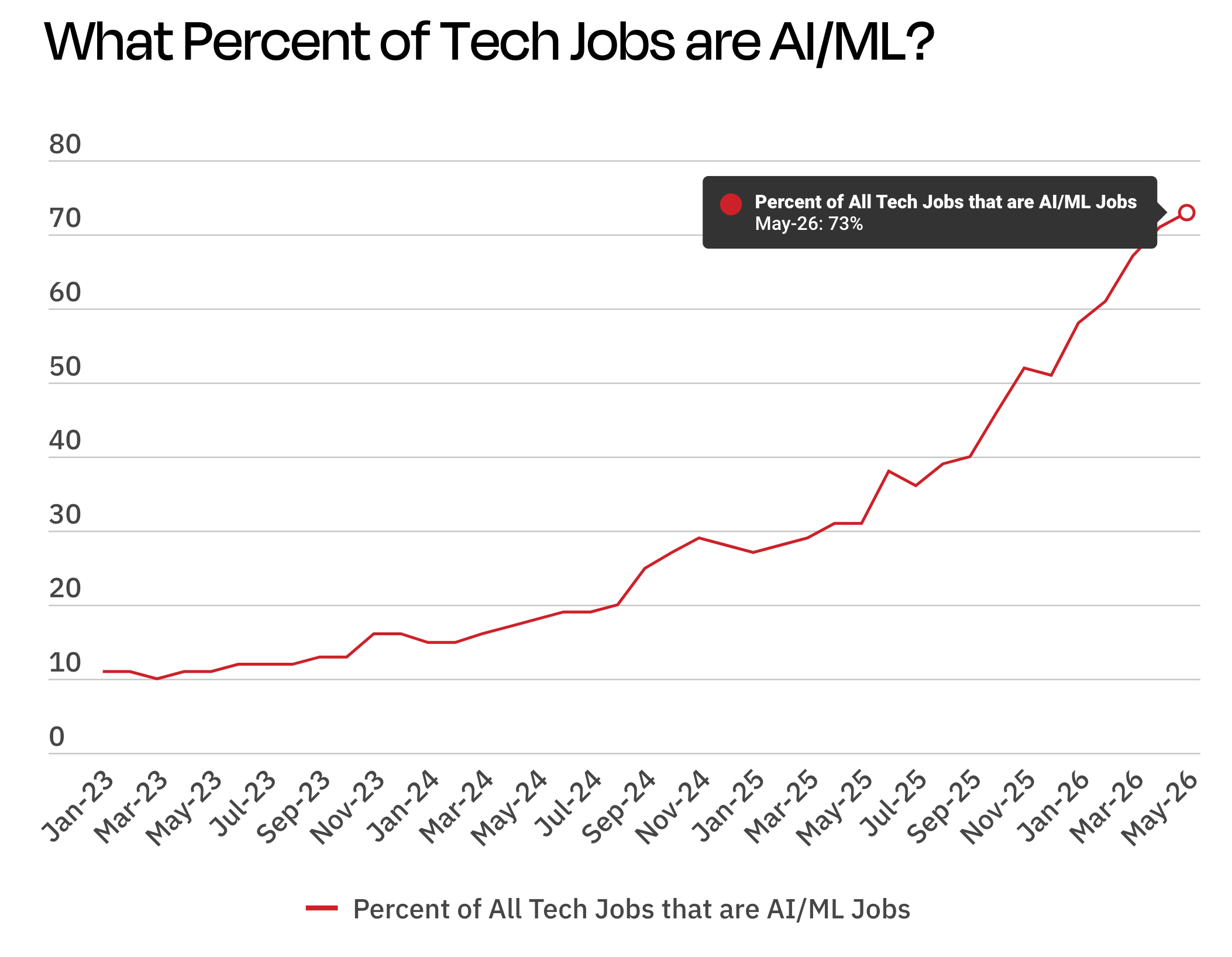
Source: Dice 2026 Tech Jobs Report
Recent Interview Query coaching signals and interview experiences still cluster around core skills: SQL, experimentation, system design, behavioral judgment, and the ability to explain tradeoffs under pressure. Even roles with AI in the title still open by testing whether someone can reason clearly before they test topics like deploying agentic AI.
That gap matters for job seekers. It means the market has changed, but not in the simplistic way many candidates assume. AI fluency is becoming a baseline requirement, while the interview bar is shifting toward applied judgment.
Why AI Skills Are Becoming a Baseline
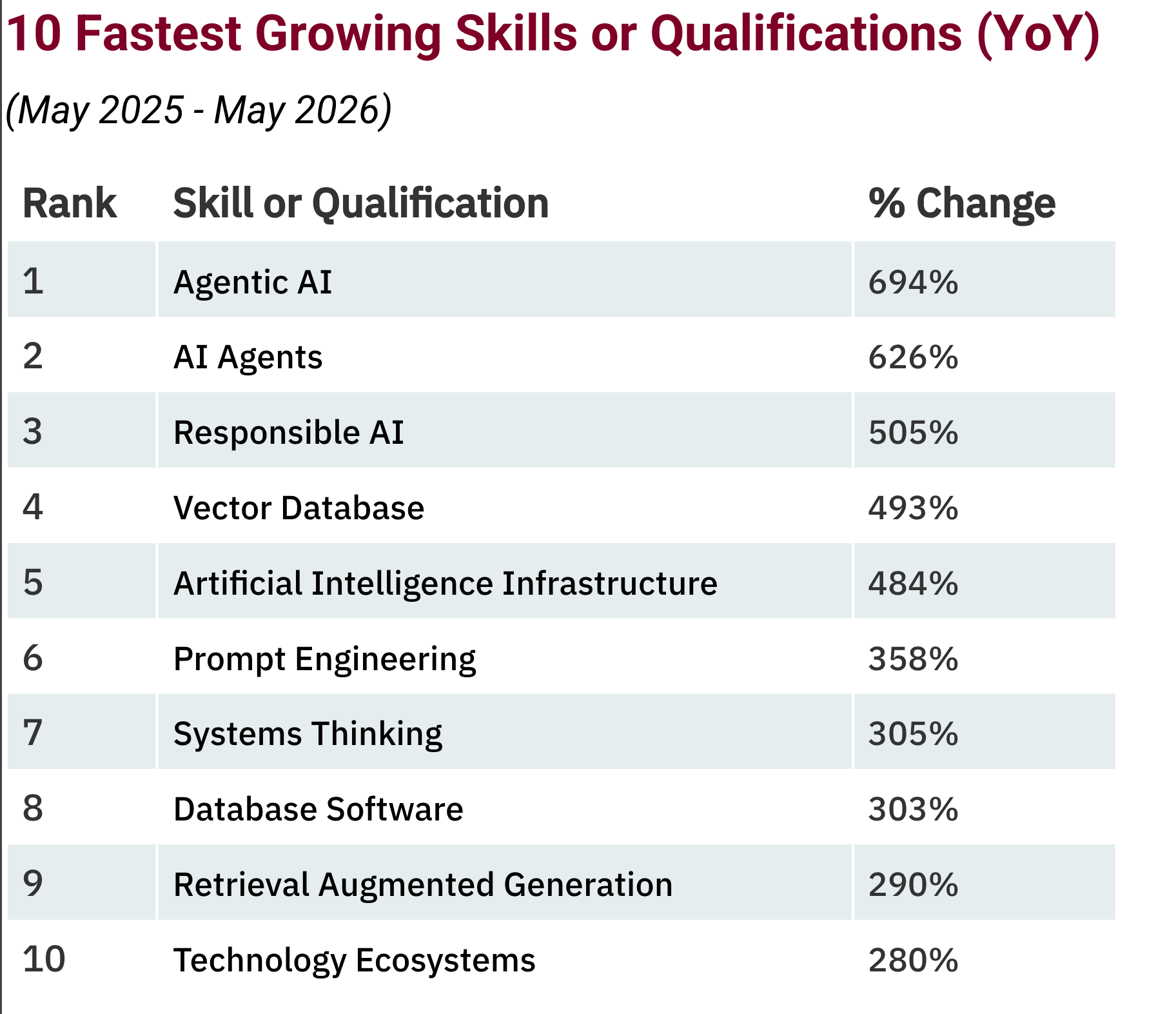
Dice provides the clearest signal. In May, AI skill requirements appeared in 73% of U.S. tech postings, up two points in a month. The same report says skills tied to agentic AI, AI agents, responsible AI, AI infrastructure, vector databases, and systems thinking were among the fastest-growing year-over-year categories. AI familiarity is no longer a niche, as employers are writing it into the default job description.
Robert Half points in the same direction. Its 2026 technology hiring research says AI, ML, and data science roles reached 49,200 U.S. job postings in 2025, up 163% from 2024, while 78% of technology leaders plan to increase permanent headcount in the second half of 2026. For candidates, that means an AI-fluent resume matters. It also means interview prep should reflect the actual role, not just the headline skill list.
Why Hiring Demand Still Feels Tighter
More demand has not translated into an easier funnel. ICIMS says U.S. job openings grew 9% year over year in May, but hiring rose only 1% and applications fell 11%. That combination matters since it means employers may be posting more openings, but they are still moving cautiously and screening hard.
Recent coaching transcripts inside IQ echo that tension. Candidates keep hearing that posted roles do not always map cleanly to real budgeted hiring. Thus, understanding each company’s process matters more than spraying out generic applications. In a tighter funnel, fundamentals become the fastest elimination filter.
What Candidates Are Actually Getting Asked
The interview data looks much less futuristic than the job posts. One recent marketplace data science candidate described a technical round with three fast SQL questions followed by an A/B testing case.
Meanwhile, a candidate interviewing for a product data science role at a major social platform said the hardest part was not the math, it was defending tradeoffs and communicating through ambiguity. The pattern goes beyond data science roles too, as a business intelligence candidate in big tech was surprised that the screen cared more about business impact and reasoning than perfectly polished SQL syntax.
Even AI-titled roles follow the same pattern. Recent AI engineer experiences in IQ’s coaching pipeline still feature coding, ML system design, complexity analysis, and conceptual questions about how systems behave at scale. That is also why coaching remains useful for candidates who already know the tools but need sharper judgment, structure, and live communication under pressure.
Fundamentals Are Winning Again
There is a simple reason interview loops keep returning to SQL, tradeoffs, and communication: those are harder to fake than AI keywords. A resume can claim LLM experience. But an interviewer can still ask a candidate to define the right metric, choose a guardrail, debug a pipeline bottleneck, or explain why a model recommendation should be constrained in production.
Robert Half makes the same point from the employer side. Its report says hiring leaders increasingly value practical, end-to-end execution over deep expertise with any single tool. The skills data from the same Dice report supports that view. Systems thinking, responsible AI, and infrastructure are rising because companies want candidates who can operate AI systems safely, explainably, and in context, not just those who are familiar with using AI.
The New Edge Is Systems Thinking
For job seekers, the best response is to not just be fluent in AI, but to also place AI in the right layer of prep.
- Keep SQL fundamentals sharp. Data science, analytics, and business intelligence interviews still frequently begin with SQL screens that test joins, aggregations, window functions, and practical data manipulation.
- Maintain strong Python and statistics foundations. Candidates are still expected to reason through experimentation, hypothesis testing, metrics, probability, and analytical workflows before discussing AI-specific topics.
- Practice product, system design, and tradeoff discussions. Employers increasingly evaluate how candidates think through ambiguity, prioritize constraints, and connect technical decisions to business outcomes.
- Prepare for production and engineering questions. Engineering and AI-focused roles often probe deployment tradeoffs, scalability, reliability, monitoring, data quality, and failure modes in real-world systems.
- Build AI-specific depth on top of the fundamentals. Topics like model evaluation, retrieval systems, latency, hallucination risk, governance, safety, and cost optimization are becoming increasingly important, but typically after core technical competency has already been established.
Candidates who want a realistic rehearsal can also use mock interviews to pressure-test that stack in real time. Instead of simply mirroring trends, the goal is to show that AI fluency sits on top of solid analytical and engineering judgment.
The Bottom Line
The latest hiring data does show a real AI shift. Dice says AI skills now appear in most tech postings, supported by finidings from Robert Half on how AI, ML, and data science hiring is expanding fast. And while ICIMS says the market is adding openings again, hiring has not fully caught up, signifying candidates’ prep strategies must address these changes.
For one, employers want AI-aware candidates, yet they still hire people who can explain a metric, design an experiment, reason through a system, and defend a tradeoff clearly. Candidates who treat AI as an added layer on top of fundamentals will hence be in a stronger position than candidates who chase buzzwords and trends.