

Data Roles Now Average 24.9 Interview Hours Per Hire, The Highest Across Technical Roles

Data Interviews Are the Longest
The data interview process 2026 is getting harder to predict because companies are stretching evaluation not only across more formats, but also more time. For candidates, that changes what good preparation looks like.
Based on 109 million applications and 247,000 jobs from January 2021 through March 2026, a fresh 2026 Talent Trends report from Ashby found that data roles average the most interviews of any category, higher than product management and engineering, at 19.5 interviews per hire. Data roles also top the chart when you look at interview hours per hire, averaging at 24.9 hours.
This jump in interview time reflects a broader shift in how companies evaluate data candidates. It helps explain why data candidates are increasingly being tested across SQL, experimentation, ML judgment, business cases, presentations, and communication.
The Data Interview Process in 2026 Stretches Across More Stages
Ashby’s report says technical roles average 17.6 interviews per hire, up 52% from 2021. These roles are also twice as “expensive” in terms of interview time, with 23.3 total interview hours versus 12.2 hours for business roles. Data roles stand out even inside that group. They are the most interview-intensive category Ashby tracked, averaging 19.5 interviews and 24.9 hours per hire.
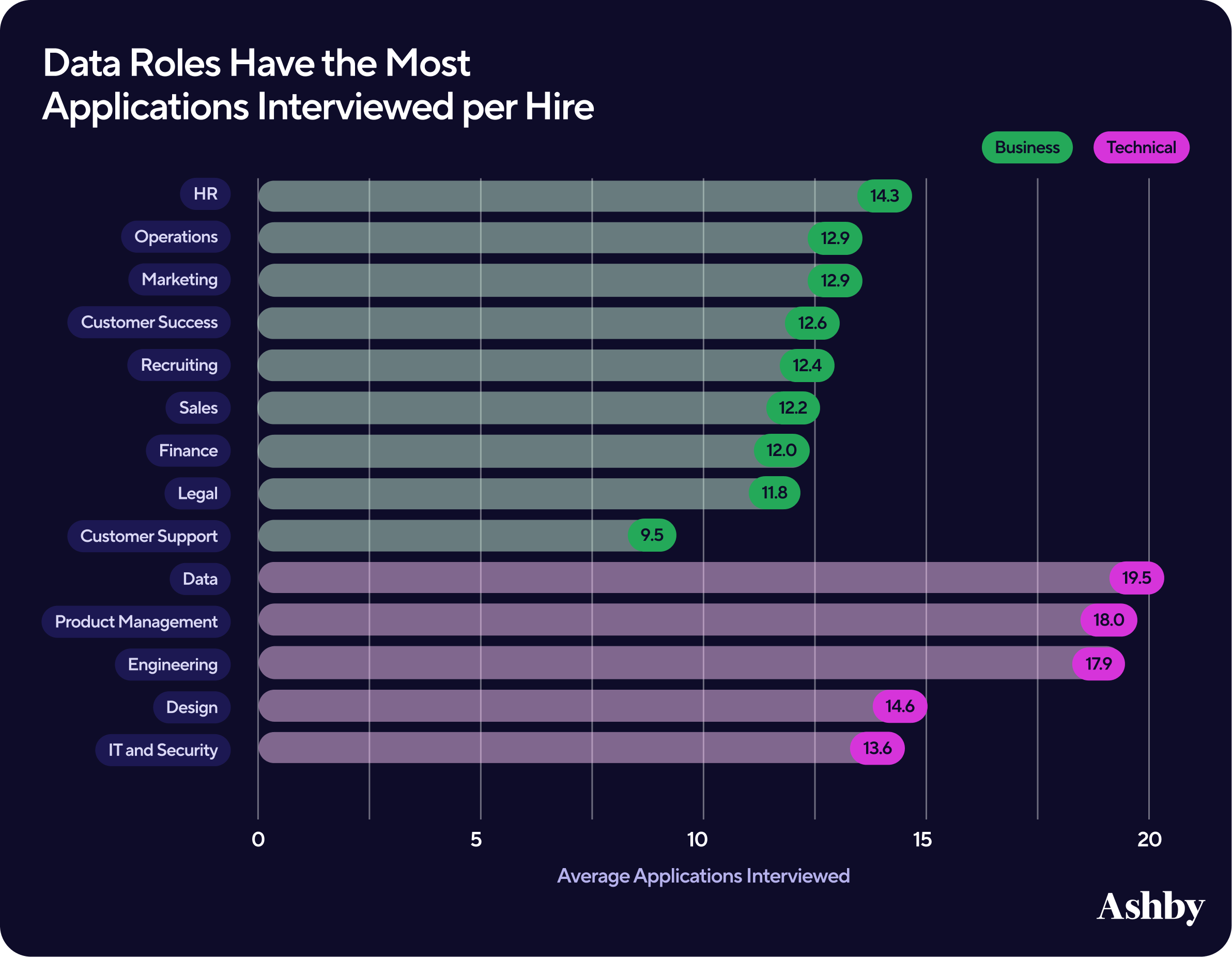
Source: Ashby’s Recruiter Productivity | 2026 Talent Trends Report
Many teams no longer believe one coding round or one hiring-manager conversation is enough to evaluate a data candidate. They want evidence across multiple settings: can this person write SQL, reason about metrics, explain model choices, and communicate tradeoffs to non-technical partners?
That helps explain why so many candidates now feel like they are preparing for several jobs at once. A modern loop can include an online assessment, a technical screen, a business case, a take-home or presentation, and multiple behavioral conversations. As a result, candidates are now expected to perform consistently across a wider range of interview formats.
Why Data Roles Are Leading the Interview-Intensity Spike
Data hiring sits in an awkward middle ground. Engineering interviews can focus heavily on code and system design. Business roles can lean on domain knowledge and communication. But data roles usually need both, plus statistical reasoning.
That hybrid expectation shows up in other 2026 hiring signals. Robert Half’s latest tech hiring outlook says that technology teams, including data engineering and analytics, face critical skill gaps, making employers prioritize people who can work across functions, turn data into decisions, and support AI initiatives. In practice, that often means separate rounds for technical depth, product judgment, and communication.
Ashby’s benchmark helps quantify the result. Data hiring is broad, and employers are spending more time checking whether a candidate can move from analysis to recommendation without dropping the business context.
Recent IQ Interview Reports Show the Same Pattern
What makes Ashby’s report more convincing is how closely it matches what candidates are describing in recent interview reports.
In a recent transcript collected by Interview Query, one data candidate described a process with an HR round, SQL coding, a hiring-manager round, a case-study presentation, three behavioral rounds, and a director round. In another recent interview report, a senior data science candidate described five rounds spread across roughly three months, including ML, SQL, and business-case interviews.
Interview Query’s annotation data echo the same theme. One data science candidate described a structured loop that mixed an online assessment, a technical interview, a portfolio presentation, and a behavioral round. Another described a three-hour technical loop after an assessment, where each hour tested a different skill set.
The common thread is format switching, which exposes a weakness in how candidates typically prepare. Candidates often train as if every round will reward the same strengths. In reality, many data loops now penalize narrow prep. Someone who is strong in SQL but weak in explanation, or strong in ML theory but loose in business framing, can look inconsistent across a long process.
Longer Loops Are Also Creating A Trust Problem
While Ashby found that the candidate’s time investment has remained stable and the change is primarily on the recruiter side, other reports suggest that longer loops are making candidates feel frustrated. This is rooted not only in interviews becoming harder across multiple formats, but also the uncertainty surrounding them.
For instance, Resume Genius’s 2026 Job Seeker Insights Report notes that 44% of job seekers say not hearing back after one or more interviews is a top frustration. Another 37% cited long delays between stages, 31% said there are too many rounds, and 25% pointed to unpaid assignments or tests.
That uncertainty is amplified by the rise of AI-mediated interview steps. As explored in Greenhouse’s AI interviews report, many candidates are entering processes without clear disclosure of how they are being evaluated, whether AI is involved, or what each stage is actually measuring. When combined with longer loops, this lack of clarity makes interviews feel less like structured evaluation and more like a black box.
All of these change how long interview processes feel. A five-stage loop can be reasonable if the scope is clear, the timeline is tight, and the candidate knows what each round is measuring. The exact same loop feels wasteful when instructions are vague, scheduling drags, or AI interviews show up without context.
JobScore’s 2026 candidate-experience roundup adds another warning sign. Only 26% of North American job seekers say they had a great candidate experience. As such, length alone is not the whole issue, as respect for the candidate’s time also matters.
How Candidates Can Prepare for Data Interviews
Given these longer and more complex loops, preparation needs to evolve beyond isolated technical practice. Practicing more LeetCode and brushing up on SQL still helps, but it remains incomplete for the current data market.
Candidates are better served by preparing for transitions between formats. That means practicing how to move from an experiment question to a product tradeoff, from a coding task to a verbal explanation, and from a portfolio walkthrough to a skeptical follow-up. Endurance matters too.
To make this practical, focus on integrating these habits into your prep:
- Practice “explain-as-you-go” solving: Every time you write SQL or analyze a dataset, narrate your assumptions, steps, and tradeoffs out loud. This builds the habit of making your thinking visible across rounds.
- Train format switching explicitly: After solving a technical problem, spend 2–3 minutes summarizing it as if presenting to a stakeholder, then answer one follow-up about business impact or risk.
- Simulate fatigue and consistency: Instead of one-off practice, stack 2–3 different question types in one session (e.g., SQL → case → behavioral) to mimic real interview loops.
- Prepare for ambiguity: Practice with prompts that are intentionally underspecified, forcing you to define the metric, clarify assumptions, and structure your approach before solving.
That is why full-loop simulation is getting more valuable. Mock interviews can help candidates practice sustaining quality across multiple rounds, which is closer to what many employers are now testing than a single isolated screen.
The Best Prep Strategy
Ashby’s new benchmark is a useful reality check. Data hiring is not only becoming more selective at the top of the funnel. It is becoming more time-intensive and more multi-dimensional once a candidate gets inside the process.
For job seekers, the takeaway is simple. The winning prep strategy is no longer just deeper technical study. It is broader interview readiness, better communication under fatigue, and enough structure to stay sharp across a longer loop.
If the next year of hiring looks anything like the last few months of IQ interview data, the candidates who stand out will not be the ones who can ace one round. They will be the ones who can stay clear, technical, and business-minded all the way through.