
Interview Query vs LeetCode: Which Platform Will Land You Your Dream Tech Job?


Introduction
Preparing for tech interviews can feel like juggling a hundred different tools and never knowing which one actually moves the needle. If you’ve found yourself stuck between Interview Query and LeetCode, you’re not alone—we get it. Both help you practice, but in very different ways, and picking the right one can make or break your prep.
This Interview Query vs. LeetCode guide compares them across five critical areas: user experience, content quality, platform features, pricing structure, and community support. In this guide, you’ll discover which one fits your learning style, aligns with your career goals, and can give you the edge to land your dream role.
Interview Query vs. LeetCode: Comparison Metrics
This article evaluates both platforms across five essential categories that directly impact the learning experience. The scoring combines expert analysis with publicly available user feedback from G2 reviews, Reddit discussions, and community testimonials.
The categories reflect what matters most for interview success: platform usability, content relevance, innovative features, cost-effectiveness, and support systems. Each platform receives scores that convert to a simplified 5-point rating for easy comparison.
| Category | Interview Query | LeetCode | Why it Matters | Key Differentiator |
|---|---|---|---|---|
| UI/UX | 8 / 10 | 7 / 10 | Smooth navigation reduces learning friction | IQ’s structured learning paths |
| Content Quality & Depth | 18 / 20 | 15 / 20 | Relevant problems mirror real interviews | IQ’s company-specific scenarios |
| Features & Innovation | 9 / 10 | 8 / 10 | Advanced tools accelerate progress | IQ’s mock interviews system |
| Pricing & Value | 7 / 10 | 8 / 10 | Affordable access matters for students | LeetCode’s free tier advantage |
| Community & Support | 4 / 5 | 3 / 5 | Peer learning enhances understanding | IQ’s active Slack community |
Interview Query leads in most categories due to its specialized data science focus and comprehensive interview simulation features. LeetCode scores higher in pricing due to substantial free content availability, making it accessible for budget-conscious learners.
The content quality gap reflects Interview Query’s business-context problems vs. LeetCode’s algorithm-focused approach. Interview Query’s scenarios include stakeholder communication and real-world constraints, while LeetCode emphasizes technical optimization and competitive programming skills.
What is Interview Query?
Interview Query specializes in data science and artificial intelligence interview preparation through realistic problem-solving scenarios. The platform focuses on preparing candidates for data science, analytics, business intelligence, system design, and machine learning interviews by practicing questions from top tech companies like Facebook, Google, and more.
We differentiate ourselves through company-specific datasets, case study breakdowns, and scenario-based challenges that mirror actual interview conditions. Our platform also has a dedicated section for real-world analytics challenges, allowing job aspirants like you to sharpen their problem-solving skills before the interview.
We’re built for data scientists, analysts, and machine learning engineers who need comprehensive preparation beyond basic coding skills.
What is LeetCode?
LeetCode began as a coding practice platform focused on algorithmic problem-solving and has expanded to include database query challenges. The platform built its reputation through extensive SQL practice sets and coding problems sourced from actual company interviews.
LeetCode offers both free and premium tiers, with Premium costing $35 monthly or $159 annually, providing access to premium video solutions and additional features. Their strength lies in comprehensive algorithm practice and competitive programming preparation.
The platform serves software engineers, developers, and technical professionals preparing for coding interviews at major technology companies worldwide.
Feature-by-Feature Breakdown: Interview Query vs LeetCode
Now, let’s walk you through how Interview Query and LeetCode compare on core preparation tools, from question formats to practice features like insights and guided drills. It helps you easily see which platform matches your needs.
Question Bank & Problem Sets
Interview Query maintains over 30,000+ data science interview questions spanning SQL, Python, statistics, machine learning, and product analytics. Our library grows monthly with new problems sourced from recent interviews at FAANG companies and startups.
We also offer structured study plans that guide you step-by-step, such as SQL, data science, data analytics, product analytics, supply chain, and machine learning. These plans are tailored by role type and difficulty, helping you stay on track and prep more efficiently.
Moreover, the platform organizes interview questions by company (Google, Meta, Netflix), role type (data scientist, analytics engineer), and skill level. Problem types include technical SQL queries, Python coding challenges, case studies, system design scenarios, and product sense questions.
LeetCode hosts 2,500+ problems covering algorithms, data structures, database queries, and system design. Their database section includes 200+ SQL problems with varying complexity levels. New problems appear weekly, often sourced from recent interview experiences shared by users.
LeetCode’s strength thus lies in algorithmic diversity and competitive programming preparation, while Interview Query excels in business-context problems that data professionals encounter.
Difficulty Levels & Realism
Interview Query categorizes problems as easy, medium, and hard based on actual interview difficulty rather than technical complexity alone. The problems include business context, making them highly realistic for actual data science interviews.
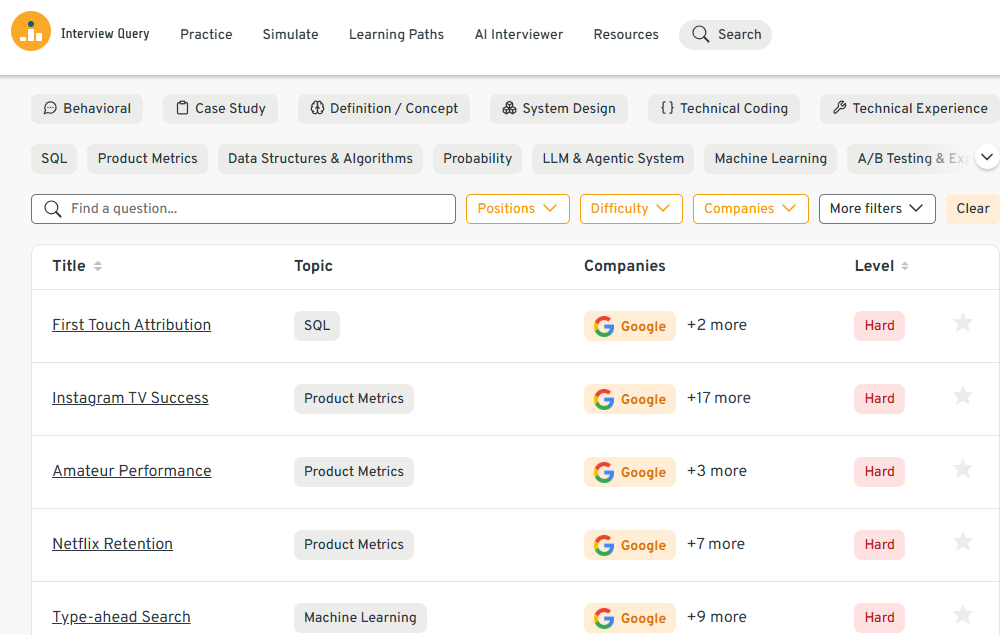
Company-specific problem sets on Interview Query reflect real interview processes. For example, interview questions at Google typically include statistical reasoning, while Meta’s interview guide reveals its focus on product analytics scenarios. This specialization helps candidates prepare for specific company cultures and expectations.
LeetCode uses a similar three-tier difficulty system but focuses on algorithmic complexity. Easy problems introduce basic concepts, medium problems require multiple algorithmic techniques, and hard problems demand advanced optimization strategies.
The realism factor favors Interview Query for data roles, as their problems include business stakeholder perspectives and real-world constraints that data scientists face daily.
Solution Explanations & Walkthroughs
Interview Query provides detailed written solutions with step-by-step reasoning for each problem. Their case study breakdowns include business context, analytical approach, and communication strategies for presenting findings to stakeholders. On top of that, video walkthroughs help explain complex statistical and machine learning concepts beyond just syntax.
Users also have the option to explore Interview Query’s blog for more practical guides on key areas like SQL. These include posts like how to SQL combine multiple rows into one row, and beginner tips for SQL analytic functions.
LeetCode, meanwhile, provides text and video walkthroughs for Premium users, focusing on time complexity, efficient algorithms, and code optimization driven by community discussion and alternate approaches.
Mock Interviews & AI Interview Practice
Interview Query distinguishes itself from LeetCode by letting you prepare through both live and AI-driven practice. With mock interviews, you can pair with another user to simulate real interview conditions and gain perspective from both the interviewer and interviewee roles.
The AI Interview tool, on the other hand, generates SQL and Python questions across difficulty levels and provides instant feedback, making it ideal for self-paced practice. Together, these features give you realistic, flexible ways to build confidence for data science and analytics interviews.
Platform Usability & User Experience
Interview Query features structured learning paths organized by career goals and experience levels. The dashboard tracks progress across different skill areas with visual progress indicators and personalized recommendations.
Navigation emphasizes discovery through company-specific tracks, skill-based categories, and difficulty progressions. The interface prioritizes learning flow over competitive features, creating a study-focused environment.
LeetCode’s interface centers around problem browsing, progress tracking, and competitive features like contests and rankings. The platform excels in problem organization with advanced filtering by difficulty, topic, and company tags.
Both platforms thus offer intuitive navigation. However, Interview Query optimizes for structured learning, while LeetCode emphasizes flexible problem selection and competitive programming features.
Analytics, Progress Tracking & Personalized Recommendations
When it comes to monitoring learning progress, Interview Query offers personalized practice recommendations and structured learning paths tailored to a user’s career goals and skill gaps. It provides analytics to track strengths and weaknesses across data science topics, along with metrics showing overall progress and performance trends.
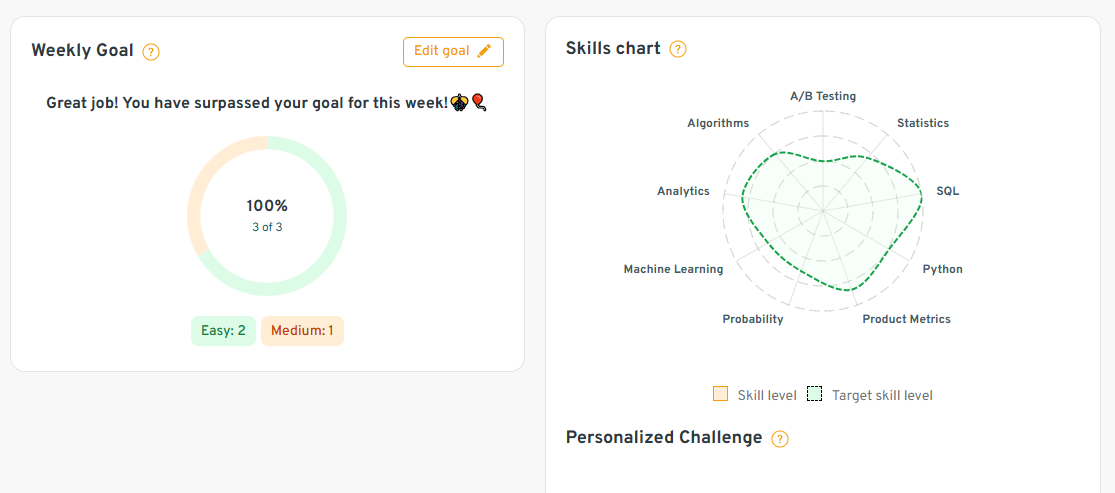
LeetCode tracks key statistics such as problems solved, runtime, memory usage, and contest rankings. Interview Query’s analytics focus on interview readiness for data science, and LeetCode emphasizes tracking improvement in algorithmic problem-solving and competitive programming.
Pricing Comparison: Interview Query vs LeetCode
In terms of their pricing, let’s compare the subscription plans of Interview Query and LeetCode, comparing their pricing structures, key features, and overall value to help readers choose the option that best fits their needs.
Interview Query Pricing Tiers, Key Features, & Limitations
| Plan | Cost | Key Features | Limitations |
|---|---|---|---|
| Free | $0 | Blog posts, some sample questions, community access | Limited content & practice sets |
| Monthly | $79 | 30,000+ interview questions from top tech companies, unlimited code runs, SQL + coding challenges, take-home assignments | No coaching or advanced courses |
| Yearly | $199 | Same as Monthly with ~79% savings | No coaching or advanced courses |
| Lifetime | $299 | All IQ Coder features + courses, structured learning paths, coaching | Higher cost tier |
LeetCode Pricing Tiers, Key Features, & Limitations
| Plan | Price | Key Features | Limitations |
|---|---|---|---|
| Free | $0 | Large problem library, discussions, basic practice | No company-specific filters, no premium problems |
| Premium Monthly | $39 | All problems, company tags, mock interviews, video solutions, progress tracking | Higher monthly cost |
| Premium Annual | $179 | Same as Monthly with ~60% savings | Higher monthly cost |
| Student Annual | $99/year | $99/year | Requires student verification |
ROI for FAANG/MAMAA Preparation
Interview Query: Great if you need SQL + business case studies alongside coding problems. Bundled learning paths and coaching boost preparedness for data-focused roles.
Users can also look into Interview Query’s Coaching program for more tailored guidance. This coaching feature pairs you with mentors to refine your prep and build confidence.
LeetCode: Excellent for pure coding interviews, speed optimization, and practicing company-specific patterns for software engineering roles.
Overall, both Interview Query and LeetCode offer useful tools for interview preparation, but they focus on different strengths. LeetCode is best for practicing algorithms and improving problem-solving speed with a large set of coding problems. Interview Query provides a more structured and targeted approach, with bundled learning paths, strong SQL coverage, and optional coaching.
Interview Query vs. LeetCode
For a quick reference in choosing the platform that best fits your interview preparation goals, the comparison below outlines the key differences between Interview Query and LeetCode, including their focus areas, question types, and practice tools.
| Feature | Interview Query | LeetCode |
|---|---|---|
| Platform Focus | Data science, analytics, and technical interviews | Software engineering and competitive programming |
| Types of Questions | Machine Learning, SQL, Python, statistics, business cases, behavioral questions | Algorithms, data structures, coding challenges |
| Mock Interviews (session with other IQ user) | Available (with Monthly and Yearly plans) | Available (coding mock interviews) |
| Case Studies | Yes | No |
| SQL/DB Query Problems | Strong coverage, integrated into learning paths | Strong coverage, integrated into learning paths |
| Python Problems | Yes | Yes |
| System Design | Limited Coverage | Available (basic and advanced) |
Access company interview guides (such as Meta, Google, Amazon, and 9000+ companies), BI case studies, and SQL case-study walkthroughs on Interview Query to support your data-focused interview prep.
Which Platform Should You Choose?
Choosing the right platform depends on your career goals and the type of interview you’re preparing for. Below, we outline when Interview Query or LeetCode might be the better fit, along with our recommendation based on their strengths.
Is Interview Query Right for You
Choose Interview Query if you’re aiming for data science interviews at product- or data-driven companies. Our content goes beyond raw SQL, offering detailed case study breakdowns, scenario-based problem solving, and mock interviews.
You’ll also benefit from take-home challenges and guided learning paths that mirror real-world interview processes. Struggling with take-home assignments? Explore our structured Take-Home Test Practice to learn how to approach real case studies and ace this critical part of the interview.
Interview Query learner Jayandra Lade shared his data science journey and how the platform helped him prepare:
“At the time, I went through many mock interviews, which gave me real insight into what companies expect, like the kinds of SQL, Python, and technical or non-technical questions they might ask. I used Interview Query to prep for Capital One and SIMON Markets, and I’ve seen how much the platform has grown with more tools and practice options than ever.”
Is LeetCode Right for You
LeetCode is a strong choice if you’re mainly looking to sharpen SQL-heavy problem sets and prefer a self-paced approach. It’s well-suited for roles that focus on SQL assessments and offers a large problem library for independent practice.
“Firstly, I want to thank everyone in the community who contributes. I learned a lot of lessons here, one of which is that sharing helps to learn and understand the true value of community, and kudos to guys who made it to the end with an offer.”
Final Verdict
LeetCode is widely known for software engineering interview prep. It focuses on algorithms, data structures, and coding challenges. While it has SQL problems, they’re more of a side feature than the main focus.
Interview Query, on the other hand, is designed for software engineering and beyond, including data science, analytics, and ML interviews. It offers mock interviews, company guides, and case-based problems that go beyond coding. This makes it very useful for anyone preparing for roles where SQL, data analysis, and business context are tested.
If your goal is purely coding mastery, LeetCode will take you a long way. But if you want to build skills that go beyond standard software engineering—like SQL, real-world problem solving, and domain-specific scenarios—Interview Query adds that extra layer. It helps you practice the kinds of skills employers actually ask for, giving you an edge that even seasoned engineers and analysts find valuable.
FAQs on Data Science Interview Prep Platforms
Is Interview Query worth it for data science interviews?
Yes. Interview Query is designed with data science roles in mind, offering real-world case studies, mock interviews, and company-specific problems. It’s especially helpful if you want scenario-based questions that go beyond just coding challenges.
Which platform is better for SQL interview practice?
If your main goal is to drill SQL problems, LeetCode has a larger volume of SQL-focused challenges. However, Interview Query offers SQL questions in the context of real business cases, which can be more relevant for data science and analytics roles.
Does Interview Query offer company-specific interview questions?
Yes. Interview Query provides company-specific interview guides and question banks, covering both technical and behavioral topics. These are based on real interview experiences and are updated regularly.
How to decide which interview platform will help you land your dream job
Start by asking yourself three questions:
- What’s your target role? If you’re aiming for software engineering, coding-heavy roles, or competitive programming, LeetCode’s algorithm-focused library is a great fit. For data science, analytics, or product-focused positions, Interview Query is built to cover the broader skills those roles demand.
- What skills do you need to sharpen? LeetCode is ideal if your goal is pure coding speed and problem-solving. Interview Query goes beyond that, helping you practice SQL, Python, statistics, machine learning, and business-context problems.
- How do you want to practice? If structured learning paths, company-specific scenarios, and mock interviews matter to you, Interview Query will give you a clearer roadmap and real-world prep. If you prefer self-paced problem-solving with lots of coding variety, LeetCode has you covered.
By answering these questions honestly, you can match your learning style and career goals to the platform that will give you the best shot at your dream role.
Can I use Interview Query and LeetCode together?
Yes! Many candidates use LeetCode for pure algorithm practice and Interview Query for SQL, business-context problems, and mock interviews. Using both gives you a full-spectrum prep strategy.
Which platform is better for new grads vs experienced hires?
- New grads: Interview Query helps with structured learning paths, SQL, and real-world scenarios. LeetCode is great if you need to sharpen algorithms quickly.
- Experienced hires: Interview Query’s mock interviews and company-specific case studies give you an edge in complex, scenario-driven interviews.
How realistic are the Interview Query mock interviews?
Very. They simulate real interview conditions with timed questions, live AI-driven feedback, and behavioral scenarios. You can even practice taking the interviewer role to understand how questions are evaluated.
Does the Interview Query cover behavioral interview prep?
Yes, it includes behavioral questions, frameworks, and tips on communicating technical and non-technical insights—critical for data-focused roles.
Which platform is better for preparing for FAANG/MAMAA interviews?
- Interview Query: Great for data roles at FAANG/MAMAA, covering SQL, ML, analytics, and product-case questions.
- LeetCode: Essential for software engineering interviews at top tech companies, especially coding rounds.
Are there free options to try before subscribing?
Yes. Both platforms have free content:
- Interview Query: Selected questions, blogs, and community access, enough to gauge if the structured approach works for you.
- LeetCode: Large problem library, discussions, and contests.
Ready to Practice Smarter? Start with Interview Query
Access real interview problems, mock interview access, and an active prep community. Start your free trial here and prep with confidence for your next big interview. Dive into company-specific guides that give you insider knowledge and actual interview scenarios.
If you’re targeting top tech roles, tailor your prep to each company. For Google, expect a mix of technical, behavioral, and problem-solving questions. Our Google Interview Questions & Process Guide covers them in detail. Amazon’s 2025 hiring process emphasizes SQL and leadership principles, outlined in the Amazon Interview Guide 2025. Meta combines SQL, Python, and leadership case studies, explored in the Meta Interview Questions in 2025.
You’ll also find insights for Apple’s multi-round process, plus niche prep for Capital One, Netflix, Microsoft, and even specialized roles at Pinterest, Accenture, and IBM.
Browse all company interview guides and create a prep strategy laser-focused on the interview you’ll face.