

Waymo Product Manager Interview Guide | Process, Questions & Prep Tips


Introduction
Waymo, a trailblazer in autonomous driving, is reshaping the future of transportation through relentless innovation and a deep commitment to safety. As Alphabet Inc.’s premier autonomous vehicle subsidiary, Waymo has evolved from a groundbreaking concept into a commercial reality, operating self-driving robotaxis in cities like Phoenix, San Francisco, and Los Angeles. This transformation has been powered, in no small part, by its Product Management team. Product managers at Waymo play a pivotal role in translating complex technologies into human-centric solutions.
This guide is crafted to help you succeed in the Waymo product management interview by equipping you with actionable strategies, a clear understanding of the role’s expectations, and insights into what makes Waymo’s PM function so critical to its success.
Role Overview & Culture
The Waymo product manager is central to bridging frontier technology with real-world needs. As a Waymo Product Manager, your day will involve roadmapping advanced autonomous vehicle features. You will guide initiatives on AI-driven planning systems, behavior prediction, and the deployment of foundation models in production environments.
You will lead cross-functional teams that include robotics engineers, systems researchers, and safety analysts. Your success depends on harmonizing these disciplines to turn raw technical breakthroughs into scalable, safety-first transportation solutions. Waymo’s culture prioritizes safety above all else.
This value is not just a principle but a performance standard, evidenced by a dramatic reduction in serious injury crashes by 88% compared to human drivers. You are expected to thrive in ambiguity. You will need to bring clarity to novel, uncharted problems by setting actionable goals and creating first-of-their-kind roadmaps in a space where no precedent exists.
Why This Role at Waymo?
As a product manager at Waymo, you can help redefine global transportation. This is not an incremental innovation job. It is a chance to address a crisis where 42,514 lives were lost to traffic crashes in the U.S. in 2022 alone. Waymo’s technology is already making a difference. It has safely completed over 50 million rider-only miles and now serves more than 250,000 paid rides every week.
The scale of experimentation is massive. You will make decisions informed by tens of millions of public road miles and over 25 billion miles of simulation. You will also have access to world-class AI infrastructure from Google, including TPUs and models like Gemini. Backed by Alphabet’s $5 billion investment, you can operate with the confidence and tools necessary to shape the future.
What Is the Interview Process Like for a Product Manager Role at Waymo?
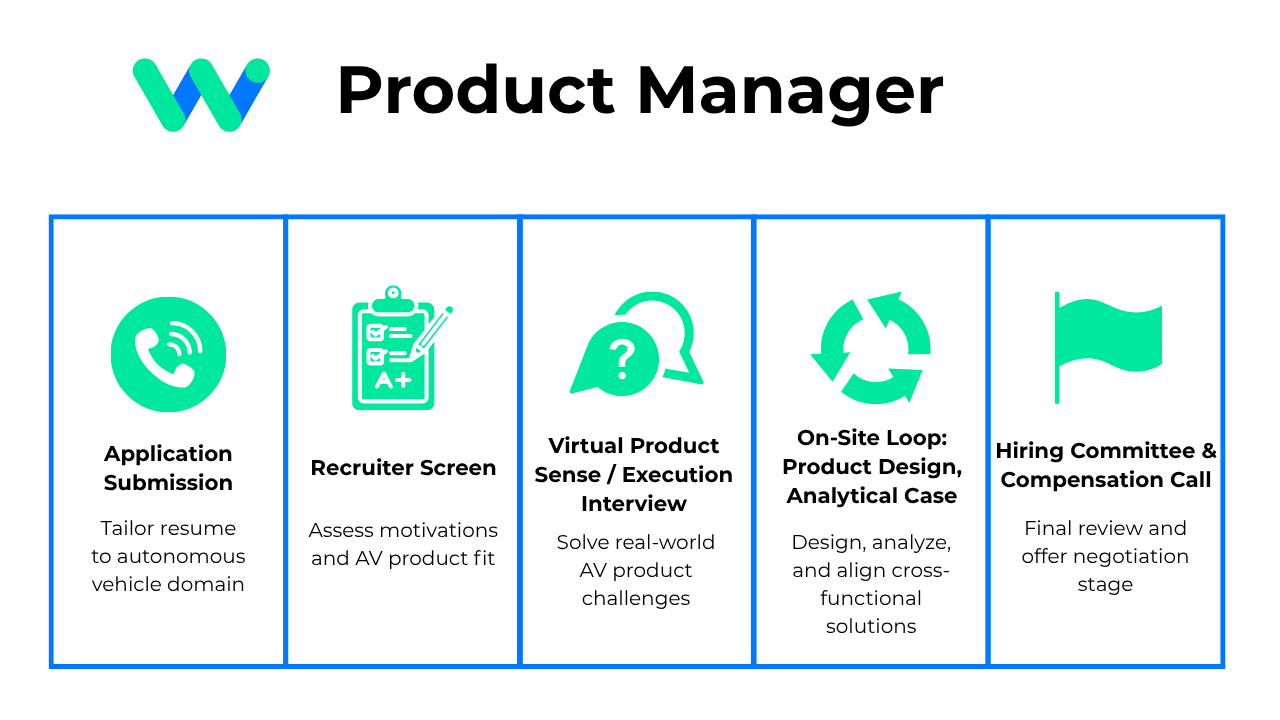
The onsite interview process for product manager roles at Waymo is one of the most rigorous in the tech industry. The Waymo product manager onsite interview process is structured to assess your product thinking, analytical depth, technical collaboration, and cultural alignment. This journey typically spans eight to ten weeks and progresses through:
- Application Submission
- Recruiter Screen
- Virtual Product Sense / Execution Interview
- On‑site Loop: product design, analytical case
- Hiring Committee & Compensation Call
Application Submission
Your journey begins with a focused application submitted through Waymo’s careers site or via recruiter outreach. Roughly 50% of successful candidates are identified through recruiter sourcing, 25% through employee referrals, and the rest from direct applications. You need to tailor your resume and application to show alignment with Waymo’s mission and AV product domains. Highlight experiences that bridge deep technical understanding, safety-conscious design, and large-scale product delivery. This stage filters out candidates who do not meet the specialized requirements for autonomous systems, so aligning your narrative to Waymo’s AV domain is critical. A well-structured, relevant application significantly increases your chance of progressing to the next stage.
Recruiter Screen
This 30 to 45-minute video call is your first live interaction with Waymo. It’s where your motivations, career trajectory, and interest in autonomous vehicles will be scrutinized. The recruiter evaluates whether your background aligns with the PM role’s technical scope and leadership demands. They will also explain Waymo’s organizational structure, culture, and interview expectations. Around 65% of applicants are filtered out at this stage, often due to a lack of domain familiarity or weak articulation of product thinking. Come prepared to discuss your career highlights, why AVs excite you, and how your skills apply to safety-driven, ML-enabled product environments. This is also your chance to ask questions and show curiosity about Waymo’s work.
Virtual Product Sense / Execution Interview
In this 45-minute session with a potential peer or manager, your product instincts and technical execution skills are put to the test. Expect to be challenged with real-world problems like enhancing rider safety, designing fleet UX flows, or improving dispatch logic in a multi-city robotaxi network. The focus is on how you frame ambiguity, synthesize user pain points, and design technically feasible solutions. Your understanding of ML systems, sensor input dynamics, and edge-case safety requirements is important. Around 50% of candidates do not progress beyond this stage. To succeed, you must demonstrate both creativity and executional rigor within the context of highly specialized AV systems.
On‑Site Loop: Product Design, Analytical Case
The virtual on-site loop includes up to five 45-minute interviews covering four major domains. In the product design session, you may design AV experiences involving human-machine trust or operational risk mitigation. The analytical case tests your fluency with metrics, data interpretation, and modeling trade-offs using examples like optimizing idle fleet times or improving battery utilization. Cross-functional interviews assess how you align hardware, software, and ops teams around AV roadmap milestones. Lastly, leadership questions explore how you resolve conflicts, manage ambiguity, and champion safety. Your ability to influence without authority is key. Interviewers submit written feedback within 24 hours, which is used by the hiring committee to ensure consistency across evaluations.
Hiring Committee & Compensation Call
After completing the interviews, your profile is reviewed by Waymo’s hiring committee. This committee, modeled after Google’s process, eliminates individual bias and ensures your performance meets the company’s high bar. The review process can take one to six weeks, depending on feedback complexity and scheduling. If successful, a compensation call follows. Unlike public equity, these private units are evaluated internally, so you’ll want to consider risk-adjusted value carefully. This stage may include negotiation based on peer benchmarks and competing offers. Approval also depends on reference checks and final OKR alignment for senior-level roles.
Understanding each stage lets you tailor your prep to what matters most. Next, we’ll break down the exact types of questions you’re likely to face and how to best prepare for them.
Challenge
Check your skills...
How prepared are you for working as a Product Manager at Waymo?
What Questions Are Asked in a Waymo Product Manager Interview?
Waymo’s product manager interviews are designed to assess how well you think, lead, and execute in an environment defined by safety-critical technology, rapid iteration, and complex cross-functional work. Each question category aligns with key product competencies you’ll need to succeed.
Product Sense & Vision Questions
As a Waymo product manager, you’ll be expected to identify high-impact problems, craft bold solutions, and articulate how those solutions serve both user needs and business priorities. These questions test your ability to evaluate new features and navigate ambiguity in an evolving autonomous ecosystem:
1. How would you present the performance of each subscription to an executive?
To analyze churn behavior, you can use metrics like churn rate, retention rate, and lifetime value (LTV) for each subscription plan. Visualizations such as cohort analysis graphs, retention curves, and revenue trends can help provide an overarching view. Additionally, predictive models like survival analysis or logistic regression can be used to forecast churn and identify key drivers.
To evaluate this, consider the trade-off between increased revenue and decreased user engagement. Analyze metrics like user retention, search frequency, and long-term revenue impact. If the decrease in searches indicates user dissatisfaction, the strategy may harm the business in the long run despite short-term revenue gains.
3. Calculate the formula for the average lifetime value
To calculate the average lifetime value (LTV) for a subscription-based service, use the formula ( LTV = \sum_{i=0}^{\infty} 100 \cdot 0.9^i ), where 100 is the monthly subscription cost and 0.9 represents the retention rate (1 - churn rate). This infinite geometric series converges to ( LTV = 100 \cdot 10 = $1000 ), representing the total expected revenue per customer over their lifetime.
To validate this idea, analyze user behavior data to understand how often items in the trash are restored, the average duration items remain in the trash, and the percentage of users using the trash as secondary storage. Additionally, assess the cost savings from reduced storage needs versus potential revenue loss from users who might stop using the feature or downgrade their plans.
To improve the search feature, investigate user behavior, query patterns, and relevance of search results. Metrics to evaluate performance could include click-through rate (CTR), time spent on search results, user satisfaction scores, and conversion rates for specific actions like event sign-ups or bookings.
Product Execution & Metrics Questions
These questions focus on how you define success, measure outcomes, and apply rigorous analytical thinking to AV systems. You’ll be asked to interpret A/B test results, quantify safety or operational impact, and prioritize features based on data-driven frameworks:
6. How would you assess the validity of the result in an A/B test with a p-value of 0.04?
To assess the validity of the result, first, ensure the A/B test setup was unbiased by checking if user groups were randomly and equally distributed. Next, confirm that the variants were identical except for the tested feature to avoid external influences. Finally, evaluate the measurement process, including sample size, test duration, and whether the p-value was monitored continuously, as this could lead to false positives or negatives. Properly determining the minimum effect size and running the test for an adequate duration ensures reliable results.
7. In an A/B test, how can you check if assignment to the various buckets was truly random?
To check if bucket assignment is random, analyze the distribution of traffic or user attributes across variants. For example, compare traffic sources or demographic attributes like gender and geography. Additionally, examine unrelated metrics (e.g., time spent on a page) to ensure no systematic bias in randomization.
To address potential bias in an AB test with unequal sample sizes, consider factors like test duration, variance, and randomization. If the smaller sample size is sufficiently large (e.g., 50K users), the test’s power is likely adequate, minimizing bias concerns. However, issues may arise if pooled variance estimates disproportionately favor the larger group or if variances differ significantly between groups. Downsampling the larger group to match the smaller sample size can help mitigate bias.
To analyze non-normal AB test data, you can use the Mann-Whitney U-Test, which is suitable for non-normal distributions, or apply bootstrapping to resample and compute statistical tests multiple times. Alternatively, gathering more data can help achieve a larger sample size, improving confidence in the results and ensuring random sampling from the population.
10. Determine whether adding a feature identical to Instagram Stories to Facebook is a good idea.
To evaluate the addition of Stories to Facebook, users are segmented into three groups: low-end, medium-level, and high-end users. Success metrics are defined for each group, such as increasing time spent per session for low-end users, adoption rates for medium-level users, and engagement for high-end users. A/B tests are designed with weighted metrics to assess the feature’s impact across these user groups.
Cross‑Functional & Leadership Questions
To succeed at Waymo, you’ll need to influence without authority, balance stakeholder priorities, and lead through ambiguity. These questions examine your collaboration across engineering, legal, and safety teams through STAR-format storytelling:
In the context of a Waymo product manager role, you may encounter complex discussions where safety teams, legal counsel, and engineering have competing priorities or different vocabularies. You might recall a time when highly technical AV language confused regulatory stakeholders, requiring you to reframe your message using clear analogies and safety-first narratives. This example shows your adaptability and your ability to align diverse stakeholders—critical in an environment like Waymo, where decisions must integrate legal constraints, ethical safety standards, and cutting-edge technology.
12. How comfortable are you presenting your insights?
Waymo PMs frequently brief executive teams and cross-functional groups on product performance, safety trade-offs, and simulation outcomes. Your answer should describe how you synthesize simulation metrics, real-world driving data, and user insights into compelling narratives, tailored for audiences ranging from ML researchers to city officials. Detailing your approach demonstrates your comfort with high-stakes communication and your ability to advocate for AV product decisions backed by rigorous evidence.
This situation is highly relevant to Waymo’s unique hardware ecosystem, which includes LIDAR, sensors, and compute modules sourced from specialized suppliers. You should show how you’d conduct a scenario analysis using total cost of ownership and apply negotiation strategies to find shared value, possibly offering longer-term contracts in exchange for price stability. This response demonstrates financial acumen, resilience under constraint, and alignment with Waymo’s cost-efficiency goals for scaling autonomous fleets.
Behavioral / Culture Fit Questions
Waymo prioritizes candidates who show ownership, safety alignment, and resilience under uncertainty. These questions probe how your values and past behaviors map to Waymo’s mission of deploying life-saving, autonomous technology:
14. Why Do You Want to Work With Us?
Waymo’s mission to reduce traffic deaths through autonomous driving is deeply motivating, especially given 42,514 U.S. road fatalities in 2022 alone. Your response should reflect how this purpose aligns with your own drive to build life-saving technology, and how Waymo’s combination of Alphabet-scale infrastructure and real-world deployment makes it uniquely positioned to succeed. Emphasizing a personal connection to safety, innovation, or mobility equity will show your authentic cultural fit.
15. What do you tell an interviewer when they ask you what your strengths and weaknesses are?
In the Waymo environment, strengths like system-level thinking, technical depth in AI or robotics, and structured decision-making stand out—especially when backed by data and shipped outcomes. For weaknesses, choose areas like over-indexing on execution that you’ve balanced with more strategic foresight, or a prior lack of AV domain knowledge that you’ve actively addressed through targeted learning. This approach shows humility, growth mindset, and alignment with Waymo’s culture of continuous improvement.
At Waymo, delays could affect regulatory timelines, rider trust, and public safety narratives. You could describe a proactive communication plan that explains the delay’s root causes and emphasizes Waymo’s safety-first principle while offering riders options like ride credits or extended service support. Internally, show how you’d lead a root-cause analysis, re-prioritize deployment goals, and work cross-functionally to build in resiliency for future launches—demonstrating ownership, transparency, and systems thinking.
How to Prepare for a Product Manager Role at Waymo
Preparing for a Waymo product manager interview requires a focused, structured approach that balances technical depth, industry knowledge, and sharp communication. The strategies below will help you navigate each key area of preparation with confidence.
Study AV Industry & Waymo Blogs
To become a Waymo product manager, start by immersing yourself in the autonomous vehicle industry and Waymo’s own publications. Research current AV trends, competitors, and regulatory developments to speak knowledgeably about the space. Follow Waymo’s official blog (Waypoint) for insights into their technology and safety research. For instance, understanding Waymo’s mission and how the Waymo Driver improves mobility and safety will help you articulate a vision that aligns with the company’s goals. This industry awareness shows interviewers you grasp the broader context and are genuinely passionate about Waymo’s domain.
Rehearse On‑Site Loop Scenarios
Waymo’s on-site interview process for product manager roles typically involves a loop of back-to-back sessions focusing on different skills. Be ready for product design brainstorming (often on a whiteboard), product strategy cases, metric analysis, and behavioral questions. Each interview round at Waymo tends to delve into autonomous vehicle–specific scenarios and challenges, so rehearse with relevant examples (e.g. designing a rider app feature or improving a safety metric). Practicing these scenarios ahead of time builds confidence and creativity, ensuring you can tackle the on-site loop with structured, well-thought-out answers under pressure.
Run Timed Metric‑Design Drills
In Waymo’s data-driven culture, you’ll be expected to define and assess success metrics. Practice designing metrics under time constraints (set a 15-minute timer) to emulate interview pressure. Focus on safety key performance indicators (e.g. disengagements or crash rates per mile) and latency measures (the vehicle’s reaction time) since autonomous driving prioritizes safety and swift responses. For example, be ready to discuss how you’d evaluate the Waymo Driver’s performance on avoiding collisions or minimizing delay in decision-making. Timed drills will sharpen your ability to think analytically and quantitatively on the fly.
Mock Interviews & Peer Feedback
Conduct mock interviews with peers or mentors to simulate the real interview. Frequent practice builds confidence and improves your answer structure under pressure. It also highlights weaknesses (like rambling or missing key details) that you can fix before the actual interview. Aim to cover all question types – product design, strategy, metrics, and behavioral – and incorporate machine learning (ML) mock interviews if the role involves ML-heavy projects. Consider using a platform like Interview Query to find practice partners and get structured feedback. Incorporating peer feedback from each session will help you refine your approach and present your best self on interview day.
Conclusion
Preparing for a Waymo product manager interview means more than just reviewing frameworks. It requires you to deeply understand autonomous systems, navigate high-stakes product trade-offs, and advocate for safety without slowing innovation. To accelerate your prep, start with our curated product metric learning path to sharpen your analytical thinking. Then, explore our full product sense questions collection to simulate real interview prompts. Finally, get inspired by Chris Keating’s success story, where he breaks down how he cracked Waymo’s process with smart preparation. Every round at Waymo is winnable—with intention, practice, and the right mindset.
Waymo Interview Questions
| Question | Topic | Difficulty |
|---|---|---|
Machine Learning | Hard | |
You work as a data scientist at Cars.com. The company is launching a new personalized car recommendation engine that must support both real-time and batch inference, adapt to changing user preferences, and enable frequent model updates via CI/CD pipelines. How would you design the end-to-end architecture for this system, ensuring it can robustly detect and respond to data distribution shifts while maintaining seamless CI/CD for machine learning models? | ||
DevOps | Hard | |
A/B Testing | Easy | |
SQL | Easy | |
Machine Learning | Medium | |
Statistics | Medium | |
SQL | Hard | |
Machine Learning | Medium | |
Python | Easy | |
Deep Learning | Hard | |
SQL | Medium | |
Statistics | Easy | |
Machine Learning | Hard |
Discussion & Interview Experiences