
Netflix L5 Interview Guide – Levels, Questions & Hiring Process (2025)


Introduction
Netflix’s relentless focus on delivering personalized, seamless entertainment experiences makes it a uniquely product-first, data-driven company where every feature is informed by real-time metrics. Whether you’re aiming to join the teams that build cloud-scale video pipelines or craft the next breakthrough recommendation algorithm, understanding Netflix interview questions and the full Netflix interview process is crucial to your success. This comprehensive guide outlines the end-to-end hiring journey at Netflix and links out to role-specific deep dives—covering everything from Software Engineering and Data Engineering to Product Management and beyond—so you can target the preparation that matters most.
Why Work at Netflix?
Netflix’s famous Freedom & Responsibility culture empowers teams to move rapidly without micromanagement, backed by top-of-market pay and equity refreshers that reward your impact. Here’s what makes this environment stand out:
Freedom & Responsibility Culture
Netflix culture interview questions often probe how you make decisions autonomously and handle ambiguity, reflecting the high trust placed in every employee. Engineers, data scientists, and product leaders alike enjoy the autonomy to propose, build, and ship features end-to-end, embodying an ethos where ownership and accountability go hand in hand.
Top-of-Market Pay & Retention Offers
With a philosophy of Netflix retention offer packages that include generous RSU refreshers and no-levels pay bands, Netflix ensures you’re compensated at the market peak. Recruiters emphasize that your total rewards reflect both your current impact and future potential, making compensation conversations as transparent as your performance metrics.
Engineering Craft & Development Process
The Netflix software development process centers on micro-service ownership, continuous delivery, and open-source contributions—whether enhancing internal tools or shaping community projects. Interviewers test your architectural thinking by asking how you’d design scalable systems, optimize for low latency, and integrate observability for rapid troubleshooting.
Level Structure & L5 Growth Path
Understanding the Netflix l5 interview bar is key to navigating career progression: L5 signifies seasoned individual contributors who can lead complex projects independently. As you move up, the expectations shift from technical delivery to cross-team leadership, strategic roadmap influence, and mentorship, with interview rounds calibrated accordingly.
What’s Netflix’s Interview Process Like?
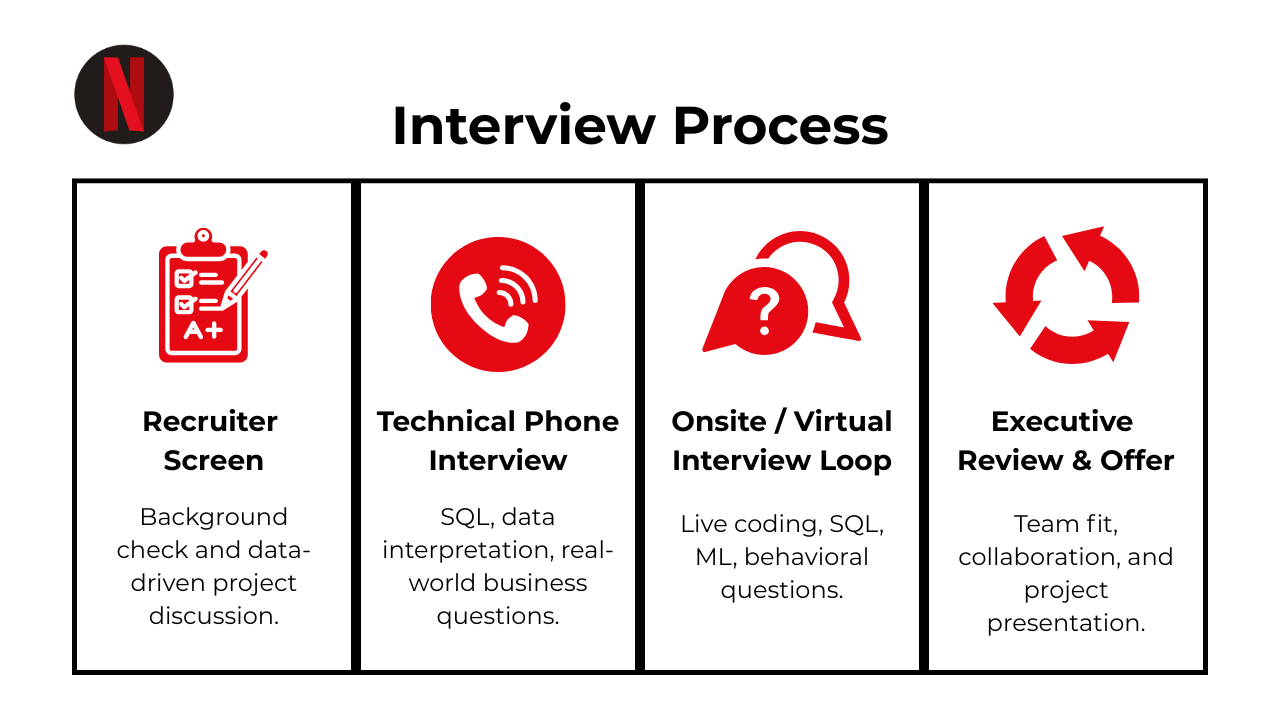
The Netflix interview process is structured to assess both your technical expertise and cultural alignment, ensuring a seamless fit with the company’s data-driven, product-first mindset. Across all roles—from software engineering and data science to product management—you’ll move through a series of well-defined stages, each designed to probe a different facet of your experience and potential.
Recruiter Screen & Resume Alignment
In the initial conversation, you’ll encounter Netflix recruiter interview questions that verify your resume details, clarify your motivations, and discuss compensation expectations. This screen helps Netflix identify candidates whose backgrounds and career goals align with the role’s core competencies and the company’s Freedom & Responsibility culture. Expect the recruiter to outline the process timeline and next steps, linking you to relevant role-specific guides for deeper preparation.
Behavioral & Culture-Fit Round
Next, you’ll dive into situational interviews using Netflix behavioral interview questions, structured around the STAR method. Interviewers explore how you’ve demonstrated ownership, navigated ambiguity, and delivered results independently—key qualities in Netflix’s low-hierarchy environment. Be ready to share concise, impact-focused stories that showcase your alignment with the company’s values.
Technical Assessment (Coding / SQL / Case Study)
For technical roles, this stage involves hands-on problem solving—whether live coding in your preferred language, crafting SQL queries against large datasets, or walking through analyst case studies. Netflix technical interview questions mirror the challenges you’ll face on the job, emphasizing clean, efficient solutions and clear communication of your thought process.
On-Site / Virtual Panel Experience
In the final loop, you’ll meet back-to-back with a rotating panel of peers and hiring managers, often including a casual “lunch interview.” This comprehensive Netflix interview experience blends behavioral, technical, and cross-functional discussions, giving both you and the team a holistic view of fit before the hiring committee convenes to make its decision.
Challenge
Check your skills...
How prepared are you for working at Netflix?
Most Common Netflix Interview Questions
Preparing for Netflix’s rigorous hiring bar means tackling a mix of technical challenges and culture-fit discussions. In this section, you’ll find an overview of the most frequently tested themes and pointers to the deep-dive guides for each role.
Role-Specific Interview Guides
For in-depth question banks tailored to your discipline, check out our comprehensive guides:
- Data Engineer → Netflix Data Engineer Interview Guide
- Machine Learning Engineer → Netflix Machine Learning Engineer Interview Guide
- Research Scientist → Netflix Research Scientist Interview Guide
- Data Scientist → Netflix Data Scientist Interview Guide
- Data Analyst → Netflix Data Analyst Interview Guide
- Software Engineer → Netflix Software Engineer Interview Guide
- Product Manager → Netflix Product Manager Interview Guide
Each guide contains 30–60 high-impact practice questions, complete with tips on how to structure your responses.
Behavioral Themes: Mission, Values & Ownership
When preparing your stories, focus on prompts that explore accountability, autonomy, and driving results with minimal oversight. Integrate Netflix behavioral interview questions into your prep by crafting STAR responses around topics like taking ownership of failures, providing or receiving candid feedback, and making bias-for-action decisions under uncertainty. Illustrate your ability to thrive in Netflix’s Freedom & Responsibility culture by highlighting moments when you moved projects forward independently and innovated beyond the expected scope.
What are effective ways to make data accessible to non-technical colleagues?
Product managers, creatives, and marketers need to act on insights without waiting on analysts. Show that you can translate billions of viewing events into self-serve dashboards, plain-language metric guides, and lightweight alerts so that decisions stay fast and decentralized—perfectly aligned with the company’s “Freedom & Responsibility” culture.
Describe a data project you worked on. What hurdles did you face, and how did you overcome them?
Scaling from prototype to production often exposes messy schemas, petabyte queries, or shifting stakeholder goals. Netflix wants evidence that you can debug these snags, align cross-functional teams, and still ship—because member experience can’t wait for perfect data.
What would your current manager say about your strengths and areas for growth?
Radical candor is a core value. A balanced, specific answer shows self-awareness, receptiveness to feedback, and the drive to “keep raising the bar” that high-performance teams expect.
Talk about a time you struggled to communicate with stakeholders. How did you bridge the gap?
Engineers and scientists constantly explain complex trade-offs to content, studio, or finance partners. Your story should demonstrate that you can reframe technical nuance into member-impact language and keep launches on track.
Why do you want to work with us, and what makes you the right fit?
The company hires for context-driven ownership, not just raw skill. Tailoring your motivation to its culture of candid feedback, global scale, and data-informed storytelling convinces interviewers you’ll thrive in (and add to) the environment.
How do you juggle multiple deadlines and stay organised?
Teams balance roadmap features, A/B reads, and on-call issues—all while maintaining high quality. Detailing a clear prioritisation framework and communication rhythm reassures hiring managers you can deliver at the company’s pace.
Tell me about a time you had to make a recommendation with incomplete data. How did you proceed, and what was the outcome?
New markets, content launches, or emerging product bets rarely come with perfect signals. They want to see that you can quantify uncertainty, choose sound proxies, and still drive timely decisions that minimise risk to member experience.
Describe a situation where you mentored a teammate on a technical concept they initially found challenging. What teaching approach did you use, and what was the impact?
The culture emphasises “strong opinions, loosely held” and peer learning. Demonstrating coaching skills shows you multiply team velocity and maintain the technical excellence that underpins the service’s reliability.
Walk me through a production incident you owned end-to-end. How did you coordinate the fix and the post-mortem?
Streaming downtime or data-quality regressions hurt millions of members instantly. Interviewers look for calm triage, data-driven root cause analysis, transparent communication, and durable preventive steps—hallmarks of an owner’s mindset.
Give an example of how you identified and reduced unnecessary cloud or infrastructure spend while maintaining performance. What trade-offs did you consider?
Operating at exabyte scale means small inefficiencies snowball into huge bills. Showing you can profile workloads, introduce smarter partitioning or spot-instances, and weigh cost against latency proves you’ll safeguard both the member experience and the bottom line.
Technical Depth: Coding, SQL & System Design
In your technical preparation, you’ll encounter Netflix technical interview questions that test core competencies in algorithms, data manipulation, and scalable architectures. For Netflix system-design questions, differentiate between roles:
- Data-focused loops emphasize SQL window functions, data-pipeline optimizations, and modeling for petabyte-scale analytics.
- SWE-focused loops lean into algorithmic coding, microservices design, and low-latency distributed systems.
- Analytics loops blend coding challenges with case-study questions on experimentation and metric design.
Tailor your practice to the specific skill set required by your target role, ensuring you can articulate both code-level solutions and high-level architectural trade-offs.
Rotate an n × n matrix 90° clockwise — in-place
Netflix’s playback pipeline constantly manipulates small image tensors (thumbnails, subtitle masks, artwork). A solution that runs in O(n²) time and O(1) space shows you can reason about cache-friendly memory access and edge-case indexing without leaning on helper libraries. Hiring managers like to see candidates who grasp when an in-place algorithm beats allocating extra buffers—exactly the mindset needed when you’re optimizing client-side code that lives on millions of devices.
Implement a priority queue with a singly-linked list
Queueing shows, alerts, or micro-tasks is everywhere in Netflix’s micro-services. While heaps are the usual answer, interviewers like this twist because it forces you to weigh trade-offs: O(1) delete/peek versus O(n) insert, pointer juggling, and stable ordering of equal priorities. Explaining when such a structure is acceptable (small queues, tiny constant factors) proves you can pick the lightest tool rather than default to heavyweight abstractions.
Select a random element from an unbounded stream (reservoir sampling)
Data arrives at Netflix in fire-hose fashion—view events, device pings, CDN logs—so storing the whole stream is impossible. Reservoir sampling is the canonical O(1)-memory solution, and candidates must articulate both the algorithm and the inductive proof of uniformity. Mastering it signals you can design unbiased telemetry collectors and streaming A/B test logics that won’t explode RAM.
Write
isMatch(s, p)supporting.and*for full-string regexCustom parsers power Netflix’s log filters, monitoring DSLs, and rule engines. A dynamic-programming solution with thoughtful space optimisation shows you can implement language features from scratch and reason about exponential edge cases. It also reveals clarity in explaining transition logic—critical when you later defend algorithmic choices in design docs and code reviews.
Top 3 salaries per department, even when headcount < 3
Window functions are bread-and-butter for compensation analytics, content leaderboards, and experiment readouts. Using
DENSE_RANK()(orROW_NUMBER) correctly—and handling ties—proves fluency with the same constructs analysts use against Netflix’s petabyte-scale fact tables. The question also surfaces whether you understand composite indexing and memory-efficient sorts in MPP engines.3-day weighted moving average of product sales
Many Netflix dashboards smooth volatile metrics (watch-hours, sign-ups) to spot true trends. A
LAG()-based answer keeps the query single-pass and avoids costly self-joins, demonstrating you can push work to the database rather than the BI layer. Citing partition-by indexes or date partitioning shows you think about performance at Netflix scale.First-touch attribution channel for every converting user
Marketing spend runs into the hundreds of millions; attributing conversions accurately is critical. Picking the earliest converting session with
ROW_NUMBER()orFIRST_VALUE()shows mastery of ordered analytics and an eye for edge cases like duplicate timestamps. Candidates who discuss indexing (user_id,session_ts) and data-skew safeguards demonstrate real-world readiness.Design Netflix-style type-ahead search suggestions
Autocomplete must feel instantaneous (< 50 ms) while surfacing personalised, availability-aware titles. Interviewers expect a two-tier answer: prefix trie/FST for recall, personalised ranker for precision, plus logging for nightly retraining. Touching on multilingual tokenisation, tail-latency budgets, and A/B evaluation reveals the breadth of system-plus-ML thinking Netflix needs.
Relational schema & optimisations for a swipe-based dating app
Though Netflix isn’t Tinder, the data pattern mirrors matchmaking between members and titles. Sharding the hot
swipestable, deduplicating reciprocal rights into amatchestable, and caching swipe counters in Redis shows you can design write-heavy systems with millisecond fan-out checks—skills directly applicable to personalisation feeds and social-feature experiments.Why use explicit foreign-key constraints, and when choose
ON DELETE CASCADEvs.SET NULLData consistency underpins every Netflix decision-metric; silent orphan rows corrupt dashboards and models. Articulating how FK enforcement prevents such drift—and weighing cascade deletes (purge child rows) against set-null (retain audit trails)—demonstrates schema judgement. Mentioning index requirements and write-path overhead proves you think through operational impact as well as correctness.
Recruiter Drill-downs & Compensation Queries
Early conversations often feature Netflix recruiter interview questions aimed at aligning on your background, career motivations, and logistical details. Be prepared to discuss headcount urgency, pay philosophy—Netflix’s “no-levels” approach to compensation—and any relocation needs. Demonstrating a clear understanding of the role’s business impact and your own compensation expectations will help set the stage for smoother negotiations later in the process.
What attracts you to Netflix’s “freedom + responsibility” culture, and how have you thrived in similar environments?
Recruiters want early assurance that you’ll flourish without rigid hierarchy, scheduled stand-ups, or step-ladder promotions. Citing concrete examples—self-directed projects, direct candor with leadership—signals you’ll be productive from day one and won’t need micromanagement. It also lets the recruiter gauge whether to emphasize cultural fit in the hiring panel debrief.
Describe the business impact of your most recent project—numbers, not adjectives.
Before lining you up with hiring managers, recruiters must confirm you can translate technical work into bottom-line or audience metrics, a core Netflix expectation. Speaking in terms of churn basis-points saved, hours-watched lifted, or EBIDTA dollars generated reassures them you can defend comp at Netflix’s top-of-market bands.
How do you determine your market value, and what compensation range will you consider to leave your current role?
Netflix publishes few internal levels, so recruiters need a transparent baseline to craft a one-shot offer that matches your expectations. They probe for how you benchmark (peer offers, industry data, value delivered) to see if you’ll be comfortable with performance-based raises rather than title jumps. Clear, well-researched ranges speed negotiations and avoid late-stage surprises.
Are there any non-cash components—equity cliffs, vesting schedules, RSUs—you’d need us to cover if you resign today?
Because Netflix offers fully-liquid cash comp instead of stock grants, recruiters surface potential “golden-handcuff” gaps early. Understanding your unvested equity helps them propose sign-on bonuses or tailored salary splits that keep you whole, preventing last-minute attrition to competing offers with large RSU packages.
What is your target start date, and are there contractual notice periods or visa transfers we should plan around?
Headcount urgency can be high for launch-critical teams; recruiters map your timeline against the interview slate and onboarding classes. Detailing non-compete clauses, H-1B portability, or relocation logistics shows professionalism and helps Netflix allocate resources (immigration counsel, lump-sum moves) in advance.
Tell me about a time you negotiated resources or scope to maximize project impact.
This question doubles as a soft-skills screener and an indirect gauge of how you’ll approach comp discussions. Recruiters look for measured, data-backed advocacy rather than ultimatums, indicating you can navigate Netflix’s famously candid feedback loops—and by extension, salary conversations—constructively.
How do you prefer feedback on performance and compensation—formal reviews, real-time candor, or periodic check-ins?
Netflix eschews annual ratings for continuous feedback and off-cycle pay adjustments. Recruiters assess whether you’ll thrive under that model or feel lost without formal ladders. Your answer guides them in pairing you with a manager whose style aligns with your needs.
Do you envision long-term growth as an individual contributor, a people leader, or fluidly switching between the two?
Because Netflix pays ICs and managers on the same cash curve, recruiters explore whether you’re motivated by scope over title. This shapes which org (algorithms, infrastructure, studio tech) can give you the span of influence—technical or managerial—that matches your ambition without needing level-based promotion promises.
What geographic flexibility do you have—remote-first, hybrid, or office-preferred—and how does that influence your comp expectations?
While Netflix leans on hub locations for creative collaboration, some roles allow hybrid setups. Recruiters surface your stance early to align you with teams that match both location and cost-of-labor bands, preventing mismatch between desired salary and regional comp strategy.
If multiple offers arrived simultaneously, what non-monetary factors would sway your decision?
Netflix recruiters know cash isn’t the only lever; they probe for motivators like ownership scope, cultural alignment, tech stack, or mission. Understanding your decision matrix lets them tailor pitch decks—e.g., freedom to rewrite legacy code or impact on 230 M+ members—ultimately increasing close rates without purely escalating salary.
Tips When Preparing for a Netflix Interview
When you’re figuring out how to prepare for Netflix interview, a structured approach can make all the difference. Here are five targeted strategies to help you shine:
Study the Culture Memo
Netflix’s famous Culture Memo is your blueprint for success. Familiarize yourself with principles like Freedom & Responsibility and weave them into your STAR stories, showing how you own projects and embrace autonomy.
Own Your Projects
Highlight end-to-end impact by walking interviewers through the full lifecycle of a feature or analysis you led—ideation, execution, metrics, and iteration. Concrete examples of ownership resonate strongly.
Practice Open-Ended Design Questions
Drill product-sense and system-design prompts from our Software Engineer and Data Engineer guides. Focus on structuring your thought process under time constraints.
Benchmark Compensation Early
Recruiters expect savvy discussions around pay philosophy. Research public reports on Netflix’s generous Netflix retention offer approach so you can frame your expectations confidently during early conversations.
Rehearse Concise Storytelling
Craft 8–10 STAR anecdotes that balance brevity with depth. Practice delivering them in under two minutes, emphasizing clear context, measurable outcomes, and reflections on lessons learned.
Salaries at Netflix
Below is a representative compensation chart across key roles (Data → SWE → PM). Netflix’s practice of annual retention offers ensures top-of-market pay continuity and long-term talent retention.
Average Base Salary
Average Total Compensation
Conclusion
Mastering the Netflix interview process and drilling the most common Netflix interview questions is your fastest path to an offer. Dive into our role-specific guides for tailored question banks and detailed prep:
- Research Scientist → Netflix Research Scientist Interview Guide
- Data Scientist → Netflix Data Scientist Interview Guide
- Data Analyst → Netflix Data Analyst Interview Guide
- Software Engineer → Netflix Software Engineer Interview Guide
- Product Manager → Netflix Product Manager Interview Guide
Ready for real-time practice? Schedule a mock interview or explore our learning paths to level up.
Need inspiration? Read Simran Singh’s journey.
FAQs
Does Netflix really give “retention offers” every year?
Yes—public filings and employee reports confirm annual stock and salary refreshers aimed at keeping top talent engaged and rewarded.
What is an L5 at Netflix and how is it evaluated?
L5 denotes a mid-level professional expected to lead significant projects independently. Promotions are based on demonstrated impact, leadership, and alignment with cultural principles.
How long does the entire Netflix hiring process take?
Most candidates complete all stages within 3–6 weeks, though timelines can vary depending on role urgency and scheduling constraints.
Is the interview experience different for remote candidates?
No—virtual panels replicate the on-site format closely. You’ll still meet multiple interviewers back-to-back, with a focus on both technical depth and culture fit.
What’s the best way to prepare for Netflix behavioral interviews?
Study the Culture Memo and craft concise STAR stories that highlight autonomy, ownership, and responsible failure. Mock-interviewing with peers can help you refine delivery and timing.
Salary By Position
Most data science positions fall under different position titles depending on the actual role.
From the graph we can see that on average the Product Manager role pays the most with a $494,828 base salary while the Business Analyst role on average pays the least with a $177,500 base salary.
Discussion & Interview Experiences