

Intuit Product Analyst Interview Guide: Questions, Process, Salary


Introduction
An Intuit product analyst interview evaluates whether you can act as a data-driven partner to product teams, not just a reporting function. In this role, you work closely with product managers, engineers, and marketers to guide experimentation, define success metrics, and translate customer behavior into decisions across products like QuickBooks, TurboTax, Credit Karma, and Mailchimp.
The scale of decision-making is substantial. In FY2024, Intuit reported more than $16 billion in total revenue, with growth driven largely by product-led expansion and customer lifecycle optimization. That scale means product analysts routinely evaluate experiments, funnels, and retention initiatives where small percentage changes can materially affect revenue and customer outcomes. The role rewards strong SQL fundamentals, sharp product intuition, and clear communication that helps stakeholders act on insights.
In this guide, we walk through the Intuit product analyst interview process, explain how technical and product-focused rounds are structured, and outline what Intuit looks for when assessing analytical rigor, experimentation judgment, and alignment with its customer-obsessed culture.
Intuit Product Analyst Interview Process
The Intuit product analyst interview process is designed to assess whether candidates can operate as embedded analytics partners inside product teams. Rather than evaluating SQL or statistics in isolation, each stage focuses on how you frame product questions, choose metrics, design experiments, and communicate trade-offs to stakeholders.
Most candidates complete the process within three to four weeks. While the exact structure can vary by team and seniority, the interview loop typically includes four stages that progressively emphasize applied product analytics and decision-making.
| Interview stage | What happens |
|---|---|
| Recruiter screen | Role alignment, background, and motivation |
| Technical interviews | SQL execution, product analytics cases, and reasoning |
| Take-home case study | Independent analysis and recommendations |
| Final virtual onsite | Case presentation and team interviews |
Recruiter Screen
The recruiter screen is typically a 15 to 30 minute conversation focused on your background, experience level, and interest in working as an Intuit product analyst. Recruiters often ask about your prior analytics roles, exposure to experimentation, and how you have partnered with product managers or engineers to influence decisions.
This stage also aligns expectations around leveling, collaboration style, and the types of product problems the team is prioritizing.
Tip: Be clear about why you want a product-facing analytics role and share one or two examples where your analysis directly changed a product decision, not just reporting.
Technical Interviews
Technical interviews form the core of the Intuit product analyst loop and usually include one to two rounds. These sessions evaluate SQL proficiency, analytical rigor, and product judgment through a mix of hands-on problem solving and case-style discussion.
Interviewers care less about syntax memorization and more about how you structure analysis, validate assumptions, and connect metrics to product outcomes.
SQL and data analysis topics are commonly assessed across the areas below.
| Area tested | What interviewers look for |
|---|---|
| SQL fundamentals | Joins, aggregations, window functions, and subqueries |
| Funnel analysis | Ability to analyze conversion paths and drop-offs |
| Cohort and retention | Comfort with time-based grouping and lifecycle metrics |
| Data validation | Sanity checks, edge cases, and data quality awareness |
Many candidates prepare by drilling structured query patterns using Interview Query’s SQL interview questions, then reinforcing speed and clarity through the Interview Query dashboard.
Tip: Narrate your thinking as you write queries, then explain how you would sanity-check the output before trusting it in a product decision.
Product analytics and experimentation judgment is also tested through open-ended scenarios.
| Area tested | What interviewers look for |
|---|---|
| Metric selection | Choosing metrics aligned with product goals |
| Experiment design | Framing hypotheses and defining success criteria |
| A/B test analysis | Interpreting results, confidence, and limitations |
| Trade-off reasoning | Balancing rigor, speed, and business urgency |
Candidates commonly rehearse this style of reasoning using Interview Query’s product analytics interview questions.
Tip: Start by clarifying the product goal and decision being made, then define the minimum evidence you need to recommend an action.
Take-Home Case Study
Many Intuit product analyst roles include a take-home case study designed to mirror day-to-day work. Candidates are typically given a dataset or business prompt and a preparation window of 48 to 72 hours.
Evaluation centers on how you structure the problem, select appropriate metrics, analyze the data, and translate findings into clear product recommendations. Interviewers typically value clarity, prioritization, and reasoning more than complex modeling.
Tip: Lead with the decision you recommend, then use analysis to support it rather than walking chronologically through every step.
Final Virtual Onsite
The final stage typically involves presenting your take-home case to a panel that includes product managers, analysts, and cross-functional partners. You are expected to explain your approach, defend assumptions, and respond to follow-up questions that test robustness and adaptability.
You may also have one-on-one interviews that dive deeper into collaboration style, analytical judgment, and team fit. Candidates often refine delivery by practicing live follow-ups through the AI interview and simulating real rounds with mock interviews.
Tip: Treat the presentation like a product review. Start with the recommendation and rationale, then support it with only the evidence needed to defend the decision.
Challenge
Check your skills...
How prepared are you for working as a Product Analyst at Intuit?
Intuit Product Analyst Interview Questions
Intuit product analyst interview questions are designed to evaluate whether you can turn customer and product data into clear, actionable decisions across Intuit’s ecosystem, including products like QuickBooks, TurboTax, Credit Karma, and Mailchimp. Interviewers focus less on raw query complexity and more on how you define success, design experiments, interpret user behavior, and communicate trade-offs to product and engineering partners.
SQL And Product Metrics Questions
These questions assess your ability to define product metrics correctly, reason about user behavior, and write SQL that supports decision-making rather than vanity reporting.
How would you calculate user retention for a subscription product?
This question evaluates whether you understand cohorting, time windows, and how retention definitions change business interpretation. At Intuit, retention metrics are often tied directly to product-market fit and lifecycle optimization.
Tip: Clearly define the cohort event and explain how you handle reactivations and partial periods.
How would you calculate conversion rates across a multi-step funnel?
This tests your ability to reason about funnel drop-offs and user journeys. Interviewers care about whether you align metric definitions with how users actually move through Intuit products.
Tip: State your funnel assumptions explicitly before writing any SQL.
How would you identify churned users from transactional or event data?
This evaluates your ability to operationalize churn definitions. Interviewers want to see that you distinguish between inactivity, seasonal usage, and true churn.
Tip: Explain how your churn definition maps to actual business actions.
How would you calculate the impact of a feature launch using historical data?
This tests causal thinking and metric selection. Intuit values analysts who can isolate signal from noise when evaluating product changes.
Tip: Call out control groups or pre/post comparison limitations.
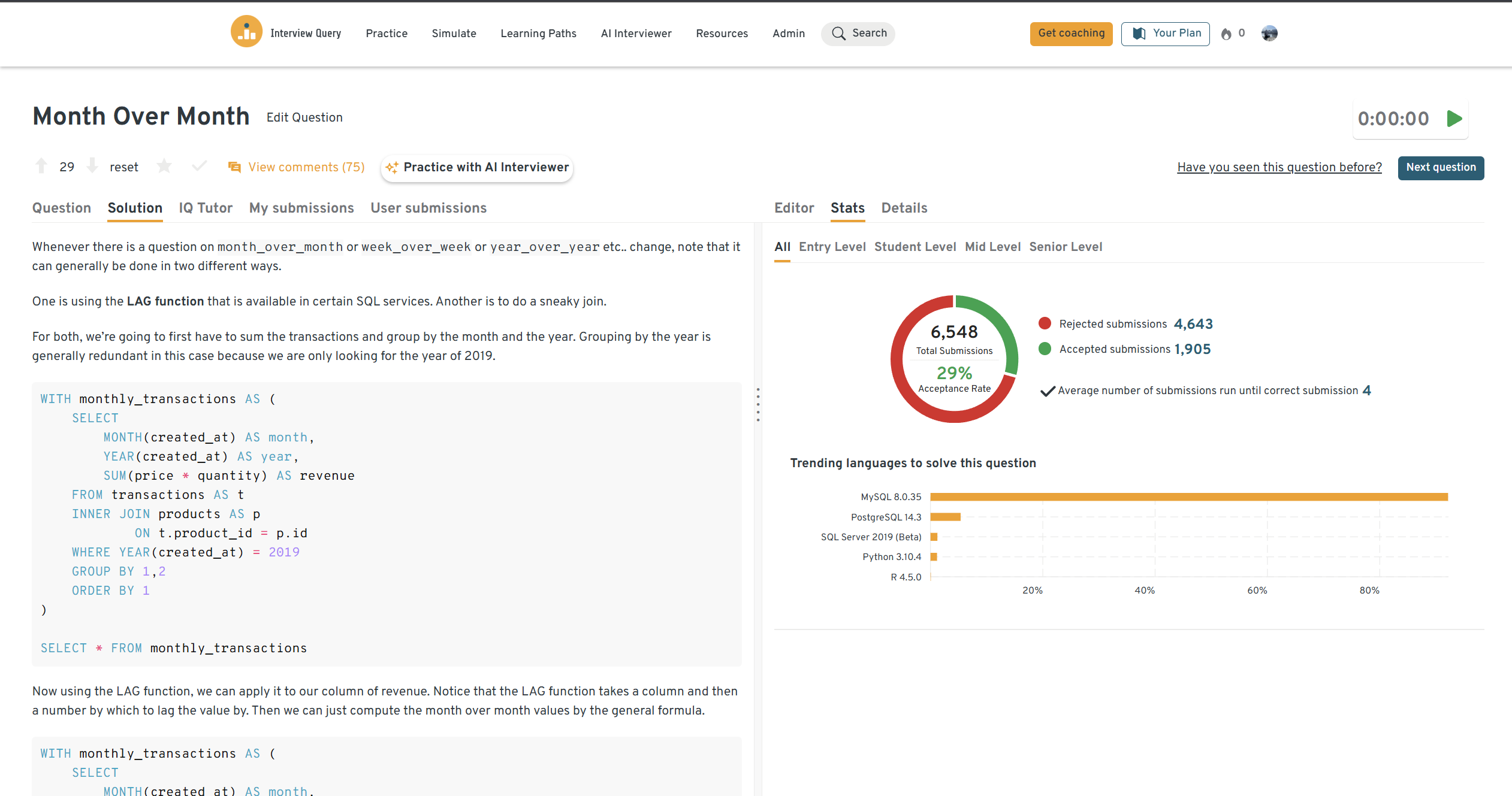
How would you compute month-over-month growth for an active user metric?
This assesses time-based aggregation and your understanding of trend analysis. Intuit expects analysts to recognize how seasonality and reporting lag affect MoM interpretations.
Tip: Mention how you validate anomalies before surfacing growth insights.
Experimentation And A/B Testing Questions
Experimentation is core to Intuit’s product culture. These questions evaluate whether you can design, analyze, and interpret experiments responsibly.
How would you design an A/B test to evaluate a new onboarding flow?
This question assesses experiment setup, metric selection, and guardrails. Interviewers want to see that you think beyond primary metrics to downstream effects.
Tip: Define success metrics and guardrails before discussing implementation.
How do you determine whether an A/B test result is statistically significant?
This evaluates statistical rigor and interpretation. Intuit looks for analysts who understand uncertainty, not just p-values.
Tip: Explain practical significance alongside statistical significance.
How would you handle an experiment where metrics move in opposite directions?
This tests judgment under ambiguity. Product analysts at Intuit frequently navigate trade-offs between conversion, retention, and long-term value.
Tip: Anchor decisions to the primary product objective.
What would you do if an experiment shows no statistically significant impact?
This assesses learning mindset and iteration thinking. Interviewers want to see whether you extract insight even when results are inconclusive.
Tip: Discuss power analysis and follow-up hypotheses.
How would you detect and handle sample ratio mismatch in an experiment?
This evaluates experimentation hygiene. Intuit expects analysts to catch instrumentation and allocation issues early.
Tip: Mention monitoring checks before reading results.
Product Sense And Analytics Case Questions
These questions evaluate structured thinking, product intuition, and how you connect analysis to business outcomes.
How would you define success for a new feature launch?
This tests metric prioritization and clarity. Interviewers want to see that you avoid metric overload and focus on decision-driving signals.
Tip: Tie metrics to a specific user or business outcome.
How would you investigate a sudden drop in user engagement?
This evaluates diagnostic reasoning. Intuit analysts are expected to separate product issues from data or tracking problems.
Tip: Segment before hypothesizing causes.
How would you decide whether to build or sunset a product feature?
This tests judgment and stakeholder alignment. Strong answers balance quantitative evidence with qualitative context.
Tip: Explain how you handle sunk-cost bias.
How would you prioritize analytics requests from multiple product teams?
This evaluates decision-making under constraints. Intuit values analysts who can align work to company-level priorities.
Tip: Anchor prioritization to impact and urgency.
How would you measure long-term customer value for a product like QuickBooks or TurboTax?
This tests business acumen and modeling intuition. Interviewers want to see how you think about retention, monetization, and lifecycle effects.
Tip: Explain assumptions clearly before modeling.
To build confidence in metrics, experimentation, and data-driven product thinking, watch this short breakdown from Interview Query founder Jay Feng. It explains how product data science questions work, common analytical traps, and how to structure your reasoning—all skills that map directly into the analytical portion of the Deloitte PM interview.
How To Prepare For An Intuit Product Analyst Interview
Preparing for an Intuit product analyst interview is about demonstrating decision-quality analytics, not just technical correctness. Interviewers want to see how you define success, evaluate trade-offs, and partner with product and engineering teams to improve customer outcomes at scale.
Sharpen SQL For Product Questions
SQL is foundational in Intuit interviews, especially for analyzing funnels, retention, conversion, and experimentation results. Interviewers care less about complex syntax and more about whether your queries align with the product question being asked.
Tip: When practicing SQL, always explain the metric definition, grain, and validation steps before writing the query.
Practice Experimentation Thinking End to End
A/B testing is central to Intuit’s product culture. Expect questions on experiment design, success metrics, guardrails, and interpretation under uncertainty.
Tip: Practice articulating hypotheses, primary metrics, and what you would do if results are inconclusive or conflicting.
Develop Strong Product Sense Through Metrics
Product analysts at Intuit are expected to define what “good” looks like for features across onboarding, activation, retention, and monetization. Interviewers often probe how you choose metrics and avoid vanity signals.
Tip: Tie every metric you propose to a specific user behavior or business decision.
Prepare Clear Project Walkthroughs
Hiring managers frequently ask for deep dives into past projects. They evaluate how you scoped the problem, worked with partners, handled data limitations, and influenced decisions.
Tip: Structure answers as problem → constraints → approach → insight → decision → impact.
Align With Intuit’s Values And Customer Obsession
Behavioral interviews place strong emphasis on Intuit’s values, especially customer obsession and courage. Interviewers look for examples where you used data to advocate for the customer, even when it meant challenging assumptions.
Tip: Choose examples where your analysis improved the customer experience, not just internal metrics.
Role Overview: Intuit Product Analyst
An Intuit product analyst partners closely with product managers, engineers, and marketers to turn customer and product data into actionable insights. The role focuses on measuring product performance, guiding experimentation, and helping teams make informed decisions across Intuit’s ecosystem.
Day to day, Product Analysts lead exploratory analysis, design and interpret A/B tests, build dashboards, and communicate insights to non-technical stakeholders. Success in the role depends as much on storytelling and judgment as on technical skill.
Core Responsibilities
- Decision support: Partner with product teams to evaluate strategies, feature launches, and roadmap trade-offs.
- Product analytics: Analyze funnels, retention, conversion, and churn to assess product-market fit.
- Experimentation: Design, execute, and interpret A/B tests to optimize customer experiences.
- Data visualization: Build dashboards and reports using SQL and Tableau to enable self-service analytics.
- Data instrumentation: Collaborate with engineering to ensure tracking accuracy and visibility into new releases.
- Insight communication: Translate complex analyses into clear, actionable recommendations.
What Makes Product Analytics At Intuit Different
Product analytics at Intuit operates at massive scale across products like QuickBooks, TurboTax, Credit Karma, and Mailchimp. Analysts work in fast-moving teams where experimentation, AI-driven insights, and customer impact are central.
What interviewers look for:
- Strong SQL and metric reasoning
- Sound experimentation judgment
- Clear communication with non-technical partners
- Comfort operating in ambiguity
- Genuine customer obsession
Candidates who combine analytical rigor with strong product intuition and storytelling tend to stand out in Intuit product analyst interviews.
FAQs
What does a product analyst do at Intuit?
An Intuit product analyst partners closely with product managers, engineers, and designers to measure product performance and guide decision-making with data. The role focuses on experimentation (A/B testing), funnel and retention analysis, and translating customer behavior into actionable insights for products like QuickBooks, TurboTax, Credit Karma, and Mailchimp. Unlike pure reporting roles, Product Analysts at Intuit are deeply embedded in product strategy and roadmap discussions.
What skills does Intuit look for in product analysts?
Intuit looks for strong SQL proficiency, experience with A/B testing and experimentation, and the ability to frame ambiguous business problems into measurable metrics. Tableau or similar BI tools are commonly used, and Python or R is often expected at mid to senior levels. Just as important is communication — Product Analysts are expected to clearly explain insights to non-technical stakeholders and influence decisions.
How technical is the Intuit product analyst interview?
The interview process is highly practical. You should expect hands-on SQL questions, product analytics case studies, and discussions around experimentation design and success metrics. Interviewers care less about advanced algorithms and more about whether your analysis logic is correct, scalable, and aligned with real product decisions. Behavioral questions are also emphasized, especially around influence and stakeholder collaboration.
How does a product analyst differ from a product manager at Intuit?
Product Analysts focus on measurement, insight generation, and experimentation, while Product Managers own product vision, prioritization, and delivery. At Intuit, Product Analysts often work alongside PMs as thought partners, shaping decisions through data rather than owning the roadmap directly. As a result, compensation and scope differ, but senior Product Analysts can have significant strategic influence.
What’s the best way to prepare for an Intuit product analyst interview?
Preparation should focus on mastering SQL for analytics, practicing A/B testing and metric definition, and getting comfortable with product case interviews. You should also be ready to discuss past projects end-to-end: the business question, data challenges, insights, and impact. Practicing real interview-style questions is far more effective than reviewing theory alone.
Final Thoughts: Preparing For The Intuit Product Analyst Interview
The Intuit product analyst interview is designed to test whether you can go beyond reporting and deliver decision-ready product insights. Strong candidates demonstrate solid SQL fundamentals, sound experimentation judgment, and the ability to communicate clearly with product and engineering partners in ambiguous, fast-moving environments.
To prepare effectively, focus on real product analytics problems, not just generic SQL practice. Working through Interview Query’s curated product analytics interview questions helps you build intuition around funnels, retention, and metric definition. Since experimentation is central to Intuit’s culture, practicing A/B testing interview questions is especially valuable for sharpening your decision-making under uncertainty.
Finally, pressure-testing your explanations through mock interviews can help you refine how you structure answers, defend trade-offs, and communicate insights clearly—exactly what Intuit interviewers look for in product analysts.
Interview Questions
| Question | Topic | Difficulty |
|---|---|---|
Analytics | Easy | |
Let’s say you’re given all the different marketing channels along with their respective marketing costs at a company called Mode, that sells B2B analytics dashboards. What metrics would you use to determine the value of each marketing channel? | ||
Behavioral | Medium | |
SQL | Medium | |
SQL | Easy | |
Machine Learning | Medium | |
Statistics | Medium | |
SQL | Hard | |
Machine Learning | Medium | |
Python | Easy | |
Deep Learning | Hard | |
SQL | Medium | |
Statistics | Easy | |
Machine Learning | Hard |
Discussion & Interview Experiences