
Duolingo Business Intelligence Interview Guide


1. Introduction
Getting ready for a Business Intelligence interview at Duolingo? The Duolingo Business Intelligence interview process typically spans a range of question topics and evaluates skills in areas like data analysis, data pipeline design, stakeholder communication, and translating complex insights into actionable recommendations. Interview preparation is especially important for this role at Duolingo, as candidates are expected to demonstrate both technical expertise and the ability to communicate findings clearly to diverse audiences in a fast-paced, product-driven environment. Excelling in the interview means not only showcasing analytical proficiency, but also aligning your approach with Duolingo’s mission of making education accessible and effective through data-informed decisions.
In preparing for the interview, you should:
- Understand the core skills necessary for Business Intelligence positions at Duolingo.
- Gain insights into Duolingo’s Business Intelligence interview structure and process.
- Practice real Duolingo Business Intelligence interview questions to sharpen your performance.
At Interview Query, we regularly analyze interview experience data shared by candidates. This guide uses that data to provide an overview of the Duolingo Business Intelligence interview process, along with sample questions and preparation tips tailored to help you succeed.
1.2. What Duolingo Does
Duolingo is the world’s leading language-learning platform, offering free, gamified courses in over 40 languages to hundreds of millions of users globally. The company leverages technology, data, and engaging design to make language education accessible and effective for all. Duolingo’s mission is to develop the best education in the world and make it universally available. In a Business Intelligence role, you will help drive data-informed decisions that optimize user experiences and support Duolingo’s goal of transforming education through innovation and analytics.
1.3. What does a Duolingo Business Intelligence do?
As a Business Intelligence professional at Duolingo, you will be responsible for transforming data into actionable insights that support strategic decision-making across the organization. You will collaborate with product, marketing, and executive teams to analyze user behaviors, track key performance metrics, and identify growth opportunities. Core tasks include designing and maintaining dashboards, generating reports, and interpreting complex datasets to inform product development and business strategy. This role is essential for driving data-driven initiatives that enhance Duolingo’s user experience and contribute to its mission of making language learning accessible and effective worldwide.
Challenge
Check your skills...
How prepared are you for working as a Business Intelligence at Duolingo?
2. Overview of the Duolingo Interview Process
2.1 Stage 1: Application & Resume Review
The initial phase involves a thorough screening of your resume and application materials to assess your experience with business intelligence, data analytics, and data pipeline design. Recruiters look for proficiency in SQL, ETL systems, dashboard development, and your ability to communicate insights to both technical and non-technical stakeholders. Emphasize quantifiable achievements in data-driven decision-making and experience in designing scalable reporting solutions.
2.2 Stage 2: Recruiter Screen
A recruiter will conduct a 30-minute phone or video interview to discuss your background, motivation for joining Duolingo, and alignment with the company's mission. Expect questions about your experience with business intelligence tools, collaborative projects, and your ability to adapt in a fast-paced, cross-cultural environment. Prepare to clearly articulate your interest in Duolingo and how your skills fit the role.
2.3 Stage 3: Technical/Case/Skills Round
This stage typically consists of one or two interviews focused on practical data challenges and case studies relevant to business intelligence. You may be asked to design data warehouses, build ETL pipelines, analyze A/B test results, and interpret complex datasets. Interviewers will assess your SQL and Python skills, ability to visualize and present data, and approach to ensuring data quality. Be ready to walk through your problem-solving process and justify your technical choices.
2.4 Stage 4: Behavioral Interview
Led by a hiring manager or team lead, the behavioral interview evaluates your communication, stakeholder management, and adaptability. You’ll discuss past projects, how you overcame challenges in data initiatives, and how you handle conflicts or misaligned expectations. Prepare examples demonstrating your ability to collaborate with cross-functional teams and translate technical findings into actionable business recommendations.
2.5 Stage 5: Final/Onsite Round
The final round may include multiple interviews with business intelligence team members, product managers, and sometimes senior leadership. These sessions often combine technical and behavioral elements, including system design, data pipeline troubleshooting, and presenting insights tailored to diverse audiences. Expect to demonstrate your strategic thinking, data storytelling abilities, and how you drive impact through analytics.
2.6 Stage 6: Offer & Negotiation
Once you successfully complete the interview rounds, the recruiter will reach out to discuss offer details, compensation, benefits, and potential start dates. This is your opportunity to clarify any remaining questions about the role, team structure, and career growth at Duolingo.
2.7 Average Timeline
The Duolingo Business Intelligence interview process typically spans 3-4 weeks from application to offer, with each stage taking about a week. Candidates with highly relevant experience may be fast-tracked and complete the process in as little as 2 weeks, while scheduling onsite rounds can introduce slight delays depending on team availability.
Next, let’s explore the specific interview questions you may encounter throughout the process.
3. Duolingo Business Intelligence Sample Interview Questions
3.1 Data Presentation & Stakeholder Communication
Expect questions about how you communicate complex analyses and insights to diverse audiences, including non-technical stakeholders and leadership. Focus on demonstrating your ability to tailor messaging, visualize findings, and drive action through clear recommendations.
3.1.1 How to present complex data insights with clarity and adaptability tailored to a specific audience
Show your approach to simplifying technical results, using visualizations, and adjusting your narrative for different stakeholder groups. Emphasize actionable recommendations and feedback loops.
Example: “I start by understanding the stakeholder’s background, then use visualizations and analogies to make insights accessible. I highlight key takeaways and provide context for business decisions.”
3.1.2 Making data-driven insights actionable for those without technical expertise
Discuss your methods for translating technical findings into business language, such as storytelling and using relatable examples.
Example: “I relate data trends to business outcomes and use clear visuals, ensuring non-technical teams understand both the implications and recommended actions.”
3.1.3 Demystifying data for non-technical users through visualization and clear communication
Focus on how you select the right visualization and avoid jargon, making sure your insights drive understanding and engagement.
Example: “I use simple charts and interactive dashboards, explaining the ‘why’ behind the numbers and inviting questions to ensure clarity.”
3.1.4 Strategically resolving misaligned expectations with stakeholders for a successful project outcome
Explain how you clarify requirements, facilitate alignment meetings, and document decisions to avoid misunderstandings.
Example: “I proactively set up checkpoints, clarify goals, and document agreements to keep all parties aligned and avoid scope creep.”
3.2 Data Modeling, Warehousing & ETL
These questions assess your ability to design robust data architectures and pipelines, ensuring data quality and reliability for analytics. Highlight your experience with ETL, data warehouse design, and troubleshooting data integrity issues.
3.2.1 Ensuring data quality within a complex ETL setup
Describe your approach to monitoring, validating, and remediating data quality issues in ETL processes.
Example: “I implement automated checks and reconciliation steps to catch discrepancies early, and work closely with source system owners to resolve issues.”
3.2.2 Design a data warehouse for a new online retailer
Outline your process for schema design, scalability, and supporting analytics needs, considering business requirements.
Example: “I start with a dimensional model, ensure scalability, and align the schema with key business metrics and reporting needs.”
3.2.3 Design a robust, scalable pipeline for uploading, parsing, storing, and reporting on customer CSV data
Discuss your strategy for error handling, data validation, and scalability in ingestion pipelines.
Example: “I use modular ETL stages with validation checks, scalable cloud storage, and automated reporting to streamline the ingestion process.”
3.2.4 How would you systematically diagnose and resolve repeated failures in a nightly data transformation pipeline?
Explain your troubleshooting steps, including logging, alerting, and root cause analysis.
Example: “I analyze failure logs, implement targeted alerts, and review transformation logic to identify and fix recurring issues.”
3.3 Experimentation & Product Analytics
You’ll be expected to demonstrate expertise in designing experiments, analyzing A/B tests, and measuring product success. Focus on statistical rigor, actionable insights, and connecting analysis to business outcomes.
3.3.1 The role of A/B testing in measuring the success rate of an analytics experiment
Explain how you set up experiments, define success metrics, and interpret results to inform product decisions.
Example: “I establish clear hypotheses, select relevant metrics, and use statistical tests to validate impact, sharing results with stakeholders.”
3.3.2 Assessing the market potential and then use A/B testing to measure its effectiveness against user behavior
Discuss how you combine market analysis with experimentation to guide product launches and feature enhancements.
Example: “I analyze user segments and run A/B tests to validate uptake and engagement, iterating based on observed behaviors.”
3.3.3 An A/B test is being conducted to determine which version of a payment processing page leads to higher conversion rates. You’re responsible for analyzing the results. How would you set up and analyze this A/B test? Additionally, how would you use bootstrap sampling to calculate the confidence intervals for the test results, ensuring your conclusions are statistically valid?
Describe your approach to experiment setup, data analysis, and statistical validation.
Example: “I segment users, ensure randomization, analyze conversion rates, and use bootstrap sampling for confidence intervals to validate findings.”
3.3.4 How would you measure the success of an online marketplace introducing an audio chat feature given a dataset of their usage?
Highlight metrics selection, user engagement analysis, and recommendations for feature improvements.
Example: “I track feature adoption, retention, and impact on transaction rates, sharing actionable insights for future iterations.”
3.4 Data Analysis & Metrics
These questions evaluate your ability to analyze user behavior, business performance, and derive actionable insights from raw data. Emphasize your skills in querying, metric selection, and decision-making support.
3.4.1 Let's say you work at Facebook and you're analyzing churn on the platform.
Explain your approach to cohort analysis, metric definition, and identifying drivers of churn.
Example: “I segment users by activity and demographics, analyze retention patterns, and identify at-risk groups for targeted interventions.”
3.4.2 Cheaper tiers drive volume, but higher tiers drive revenue. your task is to decide which segment we should focus on next.
Discuss how you balance volume versus profitability and recommend strategic focus areas.
Example: “I compare segment contribution to revenue and growth, recommending focus based on long-term business goals.”
3.4.3 Designing a dynamic sales dashboard to track McDonald's branch performance in real-time
Describe your dashboard design process, metric selection, and ensuring real-time accuracy.
Example: “I prioritize key performance metrics, design intuitive visualizations, and implement real-time data feeds for up-to-date reporting.”
3.4.4 What metrics would you use to determine the value of each marketing channel?
Outline your approach to measuring channel effectiveness, ROI, and optimizing spend.
Example: “I track acquisition cost, conversion rates, and lifetime value across channels, recommending reallocation based on performance.”
3.5 System Design & Data Engineering
Expect questions on designing scalable systems and data pipelines to support analytics and reporting. Focus on demonstrating your ability to architect solutions that ensure data integrity, scalability, and efficiency.
3.5.1 Design a system to synchronize two continuously updated, schema-different hotel inventory databases at Agoda.
Explain your approach to data mapping, conflict resolution, and real-time synchronization.
Example: “I implement schema mapping, real-time ETL, and conflict handling to ensure accurate cross-region inventory updates.”
3.5.2 Design an end-to-end data pipeline to process and serve data for predicting bicycle rental volumes.
Describe your pipeline architecture, including data ingestion, feature engineering, and serving predictions.
Example: “I build modular ETL steps, automate feature extraction, and deploy predictions via APIs for business use.”
3.5.3 How would you design a data warehouse for a e-commerce company looking to expand internationally?
Discuss considerations for scalability, localization, and supporting global analytics.
Example: “I design with flexible schemas, localization support, and scalable infrastructure to handle international growth.”
3.5.4 System design for a digital classroom service.
Explain your solution for supporting analytics, user engagement tracking, and reporting for a digital classroom.
Example: “I design modular systems for tracking student engagement, real-time reporting, and scalable data storage.”
3.6 Behavioral Questions
3.6.1 Tell me about a time you used data to make a decision.
Describe the context, the analysis you performed, and how your insights influenced the final outcome.
Example: “I analyzed user retention data and recommended a product change that increased engagement by 20%.”
3.6.2 Describe a challenging data project and how you handled it.
Explain the main obstacles, your problem-solving approach, and the results.
Example: “I led a cross-functional team to resolve data inconsistencies in a reporting pipeline, improving accuracy and stakeholder trust.”
3.6.3 How do you handle unclear requirements or ambiguity?
Share your process for clarifying objectives, asking targeted questions, and iterating on deliverables.
Example: “I engage stakeholders early, document assumptions, and adjust my approach as requirements evolve.”
3.6.4 Tell me about a time when your colleagues didn’t agree with your approach. What did you do to bring them into the conversation and address their concerns?
Discuss how you facilitated discussion, incorporated feedback, and aligned on a solution.
Example: “I presented my analysis, invited alternative perspectives, and collaborated to reach consensus.”
3.6.5 Describe a time you had to negotiate scope creep when two departments kept adding ‘just one more’ request. How did you keep the project on track?
Detail your approach to prioritization, communication, and managing stakeholder expectations.
Example: “I quantified the impact of new requests, established a decision framework, and communicated trade-offs to maintain project focus.”
3.6.6 How have you balanced speed versus rigor when leadership needed a ‘directional’ answer by tomorrow?
Explain your process for triaging data issues and communicating uncertainty.
Example: “I prioritized must-fix issues, delivered estimates with clear caveats, and documented follow-ups for deeper analysis.”
3.6.7 Give an example of automating recurrent data-quality checks so the same dirty-data crisis doesn’t happen again.
Describe the tools or scripts you built and the impact on efficiency and data reliability.
Example: “I developed automated validation scripts that reduced manual data cleaning time by 50%.”
3.6.8 Tell me about a time you delivered critical insights even though 30% of the dataset had nulls. What analytical trade-offs did you make?
Share your approach to missing data, imputation strategies, and transparent communication.
Example: “I profiled missingness, applied statistical imputation, and clearly communicated confidence intervals to stakeholders.”
3.6.9 Walk us through how you built a quick-and-dirty de-duplication script on an emergency timeline.
Explain your solution, tools used, and how you ensured accuracy under time constraints.
Example: “I wrote a Python script using fuzzy matching to remove duplicates, validating results with sample checks.”
3.6.10 How do you prioritize multiple deadlines? Additionally, how do you stay organized when you have multiple deadlines?
Discuss your system for tracking tasks, setting priorities, and communicating with stakeholders.
Example: “I use a task management tool, set clear priorities based on business impact, and proactively communicate updates.”
4. Preparation Tips for Duolingo Business Intelligence Interviews
4.1 Company-specific tips:
Familiarize yourself with Duolingo’s mission to make education universally accessible and effective. Understand how data-driven decisions directly impact user engagement, retention, and product innovation at Duolingo. Spend time exploring Duolingo’s core products—such as its gamified learning platform, courses, and features like streaks, XP, and leaderboards—to appreciate how business intelligence supports user growth and learning outcomes.
Research recent product launches and company milestones, such as new language offerings or major updates to the app experience. Demonstrate awareness of how Duolingo leverages experimentation and analytics to iterate on features and drive adoption. Review Duolingo’s approach to personalization and how data is used to optimize learning pathways for millions of global users.
Prepare to align your interview responses with Duolingo’s values: inclusivity, innovation, and impact. Show that you understand the importance of balancing rapid iteration with rigorous analysis in a fast-paced, consumer-focused tech environment. Be ready to discuss how business intelligence can support Duolingo’s strategic goals, such as expanding into new markets or improving educational outcomes.
4.2 Role-specific tips:
4.2.1 Practice designing and troubleshooting scalable ETL pipelines and data warehouses.
In your interview, you’ll likely be asked to discuss or design ETL processes that ensure data quality and reliability. Prepare to walk through your approach to building modular, scalable data pipelines—addressing validation, error handling, and automation. Be ready to diagnose issues in nightly data transformations and explain how you monitor, log, and resolve failures. Emphasize your experience with dimensional modeling, schema design, and supporting analytics needs for large-scale consumer products.
4.2.2 Demonstrate expertise in translating complex data into actionable business insights for diverse audiences.
Duolingo values professionals who can communicate findings clearly to both technical and non-technical stakeholders. Practice presenting complex analyses using intuitive visualizations, storytelling techniques, and business-relevant language. Show you can tailor your messaging—whether you’re speaking to engineers, product managers, or executives—and drive action through clear recommendations and feedback loops.
4.2.3 Prepare to analyze A/B tests and product experiments with statistical rigor.
Expect to discuss how you design, execute, and interpret A/B tests that measure the impact of new features or changes. Review your process for setting up experiments, defining success metrics, and validating results using appropriate statistical methods, such as bootstrap sampling for confidence intervals. Be ready to connect experiment outcomes to business decisions and recommend next steps based on your analysis.
4.2.4 Be ready to build and critique dashboards that track user engagement, retention, and business performance.
Duolingo relies on dynamic dashboards to monitor key metrics, so practice designing intuitive, real-time reporting solutions. Highlight your approach to selecting metrics that matter—such as active users, completion rates, and cohort retention—and ensuring data accuracy. Discuss how you make dashboards accessible for cross-functional teams and use them to drive strategic conversations.
4.2.5 Showcase your ability to solve ambiguous problems and clarify stakeholder requirements.
Business Intelligence at Duolingo often involves navigating unclear or evolving business needs. Prepare examples of how you’ve managed ambiguity by engaging stakeholders, documenting assumptions, and iterating on deliverables. Emphasize your proactive communication style, ability to facilitate alignment, and strategies for managing scope and expectations.
4.2.6 Illustrate your experience with data quality automation and handling messy datasets.
You’ll be asked about your approach to ensuring data integrity and automating recurrent data-quality checks. Be ready to describe tools or scripts you’ve built to validate, clean, and deduplicate data. Share stories of how you delivered insights despite incomplete or noisy datasets, detailing your analytical trade-offs and transparent communication with stakeholders.
4.2.7 Prepare behavioral examples that highlight collaboration, adaptability, and impact.
Duolingo values team players who can work across functions and drive results. Practice articulating examples of cross-functional projects, negotiating scope, balancing speed versus rigor, and managing multiple priorities. Show how you’ve influenced decisions, resolved conflicts, and delivered business value through data-driven recommendations.
4.2.8 Brush up on your ability to measure and optimize marketing channel performance.
Expect questions about evaluating the effectiveness of different acquisition channels and recommending strategic reallocations. Prepare to discuss how you track metrics such as acquisition cost, conversion rate, and lifetime value, and how you use these insights to inform marketing strategy and budget decisions.
4.2.9 Be ready to design systems and pipelines for new product features or international expansion.
Duolingo is constantly evolving, so you may be asked to architect solutions that support new features, internationalization, or scalable analytics. Practice outlining your approach to system design, including considerations for localization, modularity, and real-time data processing. Emphasize your ability to anticipate future needs and design for flexibility and growth.
4.2.10 Show your passion for education technology and data’s role in driving learning outcomes.
Finally, let your enthusiasm for Duolingo’s mission shine through. Share how you believe business intelligence can transform language learning and support Duolingo’s vision. Connect your technical skills and experience to the company’s goals, and demonstrate a genuine interest in making a positive impact through data and analytics.
5. FAQs
5.1 How hard is the Duolingo Business Intelligence interview?
The Duolingo Business Intelligence interview is considered moderately challenging, with a strong focus on both technical data skills and the ability to communicate insights to diverse stakeholders. Candidates are expected to demonstrate expertise in data analysis, ETL pipeline design, experimentation, and dashboard development, alongside a deep understanding of Duolingo’s mission and product. Success requires balancing analytical rigor with clear, actionable recommendations tailored to a fast-paced, product-driven environment.
5.2 How many interview rounds does Duolingo have for Business Intelligence?
Duolingo typically conducts 5-6 interview rounds for Business Intelligence roles. These include an initial recruiter screen, one or two technical/case rounds, a behavioral interview, a final onsite or virtual round with multiple team members, and an offer/negotiation stage. Each round is designed to assess both your technical proficiency and your ability to collaborate and communicate effectively.
5.3 Does Duolingo ask for take-home assignments for Business Intelligence?
Yes, it is common for candidates to receive a take-home assignment or case study as part of the process. These assignments often involve analyzing a dataset, designing a dashboard, or solving a business problem relevant to Duolingo’s product. The goal is to evaluate your analytical skills, data storytelling, and ability to deliver actionable insights in a realistic scenario.
5.4 What skills are required for the Duolingo Business Intelligence?
Key skills for Duolingo’s Business Intelligence role include advanced SQL, data modeling, ETL pipeline development, dashboard and reporting tool proficiency, statistical analysis, and A/B testing. Equally important are strong communication skills, stakeholder management, and the ability to translate complex findings into business recommendations. Familiarity with Duolingo’s product, experimentation frameworks, and metrics for user engagement and retention are highly valued.
5.5 How long does the Duolingo Business Intelligence hiring process take?
The typical Duolingo Business Intelligence hiring process spans 3-4 weeks from application to offer. Each stage generally takes about a week, though highly relevant candidates may be fast-tracked. Scheduling for final rounds may vary based on team availability, but most candidates can expect a clear and timely progression through the process.
5.6 What types of questions are asked in the Duolingo Business Intelligence interview?
Expect a mix of technical and behavioral questions, including SQL coding challenges, ETL pipeline design, dashboard creation, A/B test analysis, and product analytics case studies. You’ll also be asked about stakeholder communication, resolving ambiguity, and delivering insights with incomplete data. Behavioral questions focus on teamwork, adaptability, and impact in cross-functional settings.
5.7 Does Duolingo give feedback after the Business Intelligence interview?
Duolingo typically provides high-level feedback through recruiters, especially regarding fit and performance in technical and behavioral rounds. While detailed technical feedback may be limited, candidates often receive insights on strengths and areas for improvement following the interview process.
5.8 What is the acceptance rate for Duolingo Business Intelligence applicants?
The Business Intelligence role at Duolingo is highly competitive, with an estimated acceptance rate of 3-5% for qualified applicants. The company seeks candidates who not only possess strong data and analytics skills but also align with its mission and values.
5.9 Does Duolingo hire remote Business Intelligence positions?
Yes, Duolingo offers remote positions for Business Intelligence professionals. Some roles may require occasional visits to the office for team collaboration or key meetings, but remote work is supported for most BI positions, reflecting Duolingo’s global and inclusive culture.
6. Additional Resources
- Related guides:
- Duolingo interview questions
- Business Intelligence interview guide
- Top Business Intelligence interview tips
- Top 12 Business Intelligence Case Studies (Updated in 2025)
- How to Prepare for Business Intelligence Interviews: Success Story
- Top 20 SQL Business Analyst Interview Questions (Updated for 2025)
Duolingo Business Intelligence Ready to Ace Your Interview?
Ready to ace your Duolingo Business Intelligence interview? It’s not just about knowing the technical skills—you need to think like a Duolingo Business Intelligence professional, solve problems under pressure, and connect your expertise to real business impact. That’s where Interview Query comes in with company-specific learning paths, mock interviews, and curated question banks tailored toward roles at Duolingo and similar companies.
With resources like the Duolingo Business Intelligence Interview Guide and our latest case study practice sets, you’ll get access to real interview questions, detailed walkthroughs, and coaching support designed to boost both your technical skills and domain intuition.
Take the next step—explore more case study questions, try mock interviews, and browse targeted prep materials on Interview Query. Bookmark this guide or share it with peers prepping for similar roles. It could be the difference between applying and offering. You’ve got this!
Duolingo Interview Questions
| Question | Topic | Difficulty |
|---|---|---|
Product Sense & Metrics | Easy | |
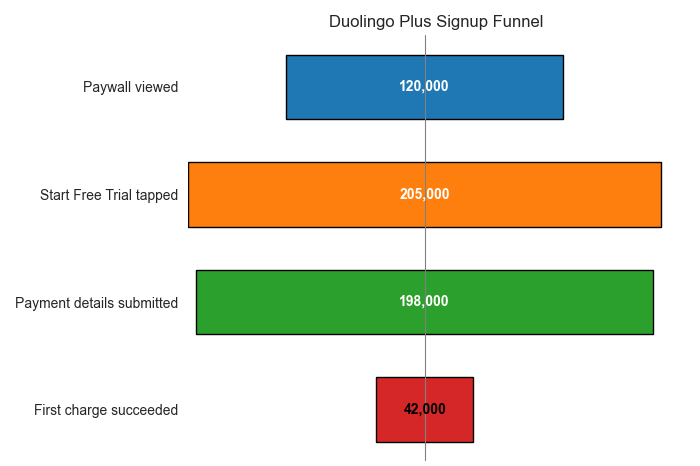
You’ve just launched a 7-day free trial paywall for Duolingo Plus and are monitoring the user journey through the funnel. You pull up a visualization and notice something odd. What do you make of this funnel, and what next steps, if any, would you take?
| ||
Analytics | Medium | |
Machine Learning | Medium | |
SQL | Easy | |
Machine Learning | Medium | |
Statistics | Medium | |
SQL | Hard | |
Machine Learning | Medium | |
Python | Easy | |
Deep Learning | Hard | |
SQL | Medium | |
Statistics | Easy | |
Machine Learning | Hard |
Discussion & Interview Experiences