
Top 12 Duolingo Data Scientist Interview Questions + Guide in 2025


Overview
Duolingo is on a mission to develop the best education in the world and make it universally accessible, impacting half a billion learners globally.
As a Data Scientist at Duolingo, you’ll analyze data to guide product decisions and improve user experiences. Working closely with product managers and engineers, you’ll use statistical modeling, causal inference, and experimentation to understand user behavior and refine the app. You’ll also create dashboards and reports to support data-driven decisions across the company.
Success in this role requires strong SQL skills, proficiency in Python or R, and a solid grasp of consumer digital products. Clear communication of complex insights and a collaborative, growth-focused mindset are key to thriving at Duolingo.
This guide will help you prepare for your interview by providing insights into the role’s expectations and the types of Duolingo data scientist interview questions you may encounter, allowing you to present your skills and experiences effectively.
What Duolingo Looks for in a Data Scientist
Challenge
Check your skills...
How prepared are you for working as a Data Scientist at Duolingo?
Duolingo Data Scientist Interview Process
The interview process for a Data Scientist role at Duolingo is structured and thorough, designed to assess technical skills and cultural fit. The process typically consists of several rounds, each focusing on different competencies relevant to the role.
1. Initial Screening
The first step is an initial screening, usually conducted via a phone call with a recruiter. This conversation aims to understand your background, skills, and motivations for applying to Duolingo. The recruiter will also provide insights into the company culture and what to expect in the subsequent interview stages.
2. Online Assessment
Following the initial screening, candidates are required to complete an online assessment. This assessment typically includes coding challenges that test your problem-solving abilities and familiarity with algorithms and data structures. The questions may involve real-world scenarios that a Data Scientist at Duolingo might encounter, such as data manipulation and analysis tasks.
3. Technical Interview
If you pass the online assessment, the next step is a technical interview, often conducted via video call. This interview focuses on your coding skills and may include questions related to SQL, Python, or R. You might be asked to solve coding problems in real time, demonstrating your thought process and ability to communicate effectively with the interviewer.
4. Onsite Interview
The final stage is an onsite interview, which can be extensive, often lasting several hours. This round typically includes multiple interviews with different team members, including data scientists, product managers, and engineers. You can expect a mix of technical questions, case studies, and discussions about your previous projects. There may also be a focus on product design and analytics, where you must demonstrate your ability to derive insights from data and influence product roadmaps.
5. Behavioral Interview
In addition to technical assessments, there will be a behavioral interview component. This part of the process assesses your cultural fit within the team and the company. You may be asked about past experiences, how you handle conflicts, and your approach to collaboration and mentorship.
Duolingo emphasizes clear communication and a collaborative spirit throughout the process, so be prepared to engage with your interviewers and ask questions about the role and the company.
As you prepare for your interviews, consider the questions that may arise in each stage.
What Questions Are Asked in a Duolingo Data Scientist Interview?
In this section, we’ll review the various interview questions that might be asked during a Data Scientist interview at Duolingo. The interview process is structured and focuses on a variety of skills, including data analysis, product design, and cultural fit. Candidates should be prepared to demonstrate their technical abilities, problem-solving skills, and understanding of data-driven decision-making.
Data Analysis and Statistics
1. Describe a time when you used data to influence a product decision.
Duolingo values data-driven decision-making, so they will want to see how you can leverage data to impact product outcomes.
How to Answer
Discuss a specific instance where your analysis led to actionable insights influencing a product roadmap or feature.
Example
“In my previous role, I analyzed user engagement metrics and discovered many users dropped off after the first week. I presented my findings to the product team, which led to implementing a new onboarding feature that increased retention by 20%.”
2. How do you approach A/B testing?
Understanding experimentation is crucial for this role, as Duolingo runs numerous experiments to optimize user experience.
How to Answer
Explain your methodology for designing, executing, and analyzing A/B tests, including how you determine success metrics.
Example
“I start by clearly defining the hypothesis and success metrics. I then segment users appropriately and ensure randomization. After running the test, I analyze the results using statistical methods to determine if the changes significantly impacted user behavior.”
3. Can you explain the difference between correlation and causation?
This question tests your understanding of fundamental statistical concepts.
How to Answer
Provide a clear definition of both terms and give an example to illustrate the difference.
Example
“Correlation indicates a relationship between two variables, while causation implies that one variable directly affects the other. For instance, ice cream sales and drowning incidents may correlate, but the causation is actually the warmer weather that drives both.”
4. What methods do you use to clean and prepare data for analysis?
Data quality is essential for accurate insights, and Duolingo will want to know your approach to data preparation.
How to Answer
Discuss specific techniques you use for data cleaning, such as handling missing values, outlier detection, and data normalization.
Example
“I typically start by identifying and addressing missing values through imputation or removal. I also check for outliers using statistical methods and normalize data to ensure consistency across different scales before analysis.”
Machine Learning and Modeling
5. Describe a machine learning project you have worked on.
This question assesses your practical experience with machine learning techniques.
How to Answer
Detail the project, your role, the algorithms used, and the outcomes achieved.
Example
“I worked on a project to predict user churn using logistic regression. I gathered historical user data, engineered features, and trained the model, which ultimately helped the marketing team target at-risk users with retention campaigns, reducing churn by 15%.”
6. How do you evaluate the performance of a machine learning model?
Understanding model evaluation is critical for ensuring the effectiveness of your solutions.
How to Answer
Discuss various metrics you use to evaluate models, such as accuracy, precision, recall, and F1 score, and when to use each.
Example
“I evaluate models using accuracy for balanced datasets, but I prefer precision and recall for imbalanced datasets. I also use the F1 score to balance both metrics and ensure the model performs well across different classes.”
7. What is your experience with deploying machine learning models?
Duolingo may want to know how you transition from model development to production.
How to Answer
Explain your experience with deployment processes, including any tools or frameworks you have used.
Example
“I have experience deploying models using Flask for APIs and Docker for containerization. I also utilize CI/CD pipelines to automate the deployment process, ensuring that updates can be made seamlessly.”
8. Can you explain a time when a model you built did not perform as expected?
This question tests your ability to learn from failures and adapt.
How to Answer
Discuss the situation, what went wrong, and how you addressed the issue.
Example
“I built a recommendation system that initially underperformed due to overfitting. I revisited the feature selection process, simplified the model, and implemented cross-validation, which improved its performance significantly.”
Product and Business Acumen
9. How would you design an experiment to test a new feature in the app?
This question assesses your ability to think critically about product development and experimentation.
How to Answer
Outline the steps you would take to design the experiment, including defining objectives, selecting metrics, and analyzing results.
Example
“I would start by defining the objective of the new feature and the key performance indicators to measure its success. I would then segment users randomly, run the experiment, and analyze the results using statistical methods to determine if the feature significantly impacted user engagement.”
10. What metrics would you consider important for measuring the success of Duolingo’s monetization strategies?
Understanding business metrics is crucial for this role.
How to Answer
Discuss key metrics such as customer lifetime value, conversion rates, and user retention.
Example
“I would focus on customer lifetime value to understand the long-term profitability of users, conversion rates to measure the effectiveness of monetization strategies, and user retention rates to ensure that users continue to find value in the app.”
11. Describe when you had to communicate complex data insights to a non-technical audience.
Effective communication is key in this role, especially when working with cross-functional teams.
How to Answer
Provide an example of how you simplified complex data for a non-technical audience.
Example
“I once presented user engagement data to the marketing team. I created visualizations highlighting key trends and used analogies to explain the data, ensuring they understood the implications for their campaigns without getting lost in technical jargon.”
12. How do you prioritize projects when you have multiple stakeholders?
This question assesses your ability to manage competing priorities.
How to Answer
Discuss your approach to stakeholder management and prioritization.
Example
“I prioritize projects based on their potential impact on business goals and the urgency of stakeholder needs. I maintain open communication with stakeholders to understand their priorities and ensure alignment on project timelines.”
| Question | Topic | Difficulty |
|---|---|---|
Product Sense & Metrics | Easy | |
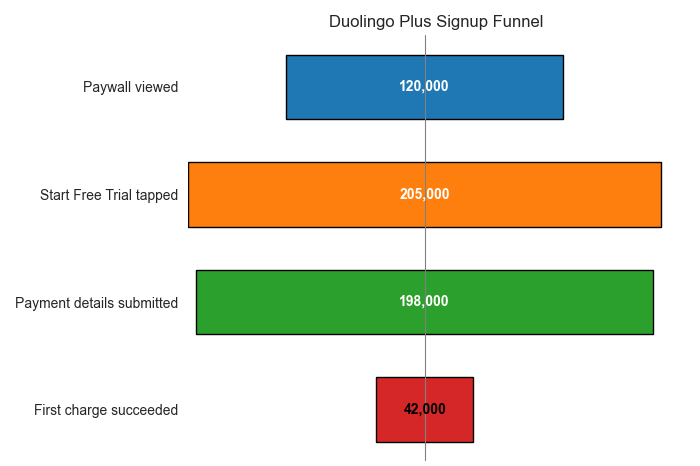
You’ve just launched a 7-day free trial paywall for Duolingo Plus and are monitoring the user journey through the funnel. You pull up a visualization and notice something odd. What do you make of this funnel, and what next steps, if any, would you take?
| ||
Analytics | Medium | |
Machine Learning | Medium | |
SQL | Easy | |
Machine Learning | Medium | |
Statistics | Medium | |
SQL | Hard | |
Machine Learning | Medium | |
Python | Easy | |
Deep Learning | Hard | |
SQL | Medium | |
Statistics | Easy | |
Machine Learning | Hard |
Duolingo Data Scientist Interview Tips
Here are some tips to help you excel in your interview.
Understand the Interview Structure
Duolingo’s interview process is well-structured, typically consisting of multiple rounds that assess various skills. Familiarize yourself with the format: expect an online assessment followed by technical interviews that may include coding challenges, product design discussions, and cultural fit evaluations. Knowing what to expect can help you prepare effectively and reduce anxiety.
Prepare for Technical Challenges
Given the emphasis on coding and analytical skills, brush up on your programming abilities, particularly in SQL and Python. Practice solving problems that involve data manipulation, algorithms, and statistical analysis. Be ready to tackle LeetCode-style questions and real-world scenarios that may arise in your role. Familiarize yourself with common data structures and algorithms, and be prepared to discuss your thought process during coding challenges.
Showcase Your Analytical Skills
As a Data Scientist at Duolingo, you will be expected to derive insights from data to influence product decisions. Prepare to discuss your previous experiences with data analysis, A/B testing, and experimentation. Be ready to explain how you have used data to drive business results in past roles or projects. Highlight your ability to communicate complex data insights clearly and concisely, which is crucial for collaboration with cross-functional teams.
Emphasize Cultural Fit
Duolingo values a collaborative and innovative culture. During your interviews, demonstrate your enthusiasm for the company’s mission and alignment with its values. Be prepared to discuss how you work in teams, handle conflicts, and contribute to a positive work environment. Sharing personal experiences that reflect your adaptability and teamwork can help you stand out as a candidate who fits well within the company culture.
Engage with Your Interviewers
The interviewers at Duolingo are known to be friendly and approachable. Use this to your advantage by engaging them in conversation. Ask insightful questions about the team, projects, and company culture. This shows your interest in the role and helps you assess if Duolingo is the right fit for you. Remember, interviews are a two-way street.
Follow Up Professionally
After your interviews, send a thank-you email to express your appreciation for the opportunity to interview. This is a chance to reiterate your interest in the position and reflect on any key points discussed during the interview. A thoughtful follow-up can leave a positive impression and keep you at the top of your mind as they make their decision.
By preparing thoroughly and approaching the interview with confidence and curiosity, you can position yourself as a strong candidate for the Data Scientist role at Duolingo. Good luck!
Discussion & Interview Experiences