

Citi Product Manager Interview Guide (Process, STAR Questions & Salary Insights)


Introduction
Demand for product managers continues to climb worldwide. Open roles have risen by 11% since the start of the year, and the U.S. Bureau of Labor Statistics expects product managers and related positions to grow another 10% through 2030. Few industries feel this momentum more than financial services, where Citi is actively re-architecting core customer experiences, from mobile banking and digital onboarding to fraud prevention and Treasury and Trade Solutions.
As Citi modernizes its platforms and reshapes its customer journey, product managers play a central role in how users transact, access credit, and manage financial operations. Interviews thus explore more than general product sense, covering compliance and risk, constraints, and stakeholder prioritization in regulated,risk-sensitive environments.
This guide outlines each stage of the Citi product manager interview process, the types of questions you can expect, and the interview preparation strategies that help candidates stand out with Interview Query.
Citi Product Manager Interview Process
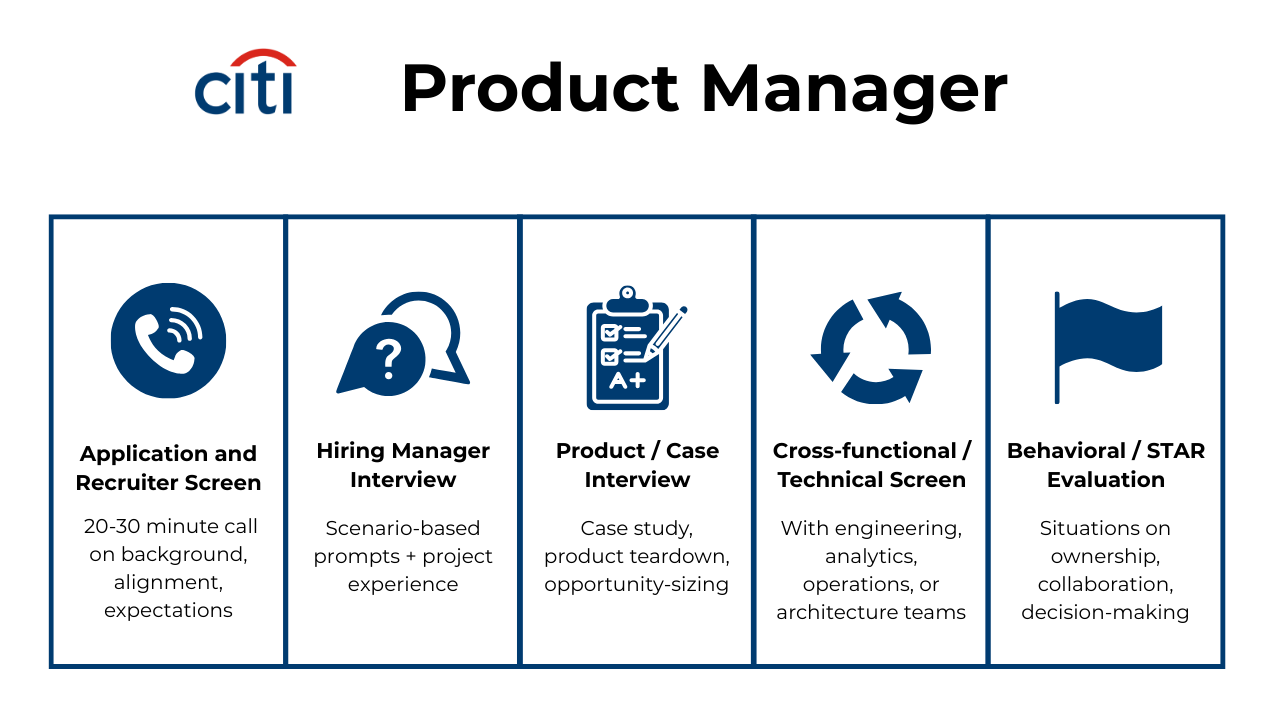
The Citi interview process for product manager roles typically unfolds over several rounds and often spans three to six weeks, though timelines can stretch longer for senior positions. Candidates generally move through recruiter screening, hiring-manager discussions, product or case interviews, and occasionally cross-functional or executive rounds.
The format varies by business line, from retail banking and cards to institutional treasury and global product teams, each balancing user needs with strict compliance and risk controls. Digital product groups may move more quickly but still emphasize global coordination and regulatory awareness at every step.
Application and resume screen
Citi’s resume review filters a high volume of applicants. Many resumes are screened by an applicant tracking system, but some PM candidates have reported receiving manual review by talent acquisition teams. What’s important is that you highlight experience in regulated industries, comfort working with compliance, legal, or operations partners, and clear impact metrics such as reducing onboarding drop-off, improving activation rates, or delivering APIs to client segments. Many applicants never receive initial contact, which underscores the importance of a resume that demonstrates measurable results and domain familiarity.
Tip: Rewrite bullets to highlight moments when you partnered with Compliance, Legal, Risk, QA, or InfoSec. Mentioning when you built features requiring audits, approvals, or adherence to regulatory workflows can also strengthen visibility early in the process.
Initial recruiter conversation
If your resume advances, a recruiter will typically schedule a 20–30 minute phone or video call. This conversation confirms your background, seniority level (such as Associate VP or VP), domain alignment (cards, payments, loans, treasury, digital banking), compensation expectations, and relocation flexibility.
Behavioral questions are kept brief but structured, often using truncated STAR prompts such as: “Tell me about a time you influenced a team without authority,” or “Describe a product win and how you measured success.” Most candidates find this stage straightforward if they answer clearly and concisely, though it is common to experience scheduling gaps or delays.
Tip: Recruiters strongly favor quantifiable outcomes, such as reductions in onboarding steps, increased card activation rates, or operational risk mitigation.
Hiring manager interview
Though it is one of the most in-depth steps in the Citi process, this stage varies significantly. Some candidates meet only the hiring manager, while others proceed through a series of one-on-ones or a broader panel. Occasionally, several meetings are grouped into a single onsite-style session.
Candidates often face scenario-based prompts tied to Citi use cases, for example:
- Redesigning KYC onboarding to reduce drop-off
- Improving card activation rates
- Optimizing treasury workflow tools
- Prioritizing a multi-quarter roadmap
Interviewers often explore your product scope, tool familiarity, and experience influencing multiple stakeholders, including those initially skeptical about a project’s value. They may also ask about project failures, how you recovered from them, and what you learned along the way. For roles tied to risk, KYC, AML, or other compliance-heavy initiatives, anticipate questions that probe your domain knowledge and your familiarity with regulated workflows.
Tip: Demonstrate that you can partner with Risk and Compliance proactively, not reactively. Hiring managers want PMs who ask the right questions early instead of waiting for approval cycles to cause delays.
Product or case interview
Most PM candidates complete a structured product interview that may resemble a case study, product teardown, or opportunity-sizing exercise. Common prompts involve analyzing a digital wallet or a banking feature, designing user flows, defining success metrics, and assessing the impact on customers, operations, and internal risk controls.
You may be asked to:
- Break down a product/feature (e.g., digital wallet, card activation flow, loan onboarding)
- Estimate opportunity or sizing (users, revenue, risk reduction, cost savings)
- Define success metrics (growth, risk, compliance, and operational efficiency)
Tip: Always link recommendations to risk mitigation or regulatory guardrails. Show that you can balance customer value with regulatory expectations.
Cross-functional or technical screen (optional)
Some teams include a cross-functional or technical round with engineering, analytics, operations, or architecture partners. These discussions often focus on tools you have used, how you structured workflows for regulated products, and how you managed projects with KYC, AML, or risk-related components. While coding is not expected, you should be ready for system-thinking questions, basic API concepts, data reasoning, and tradeoff scenarios involving speed, compliance, scalability, and risk.
Tip: When discussing technical or data decisions, outline constraints such as global deployment, data privacy, and regulatory boundaries to show how they shape your product choices.
Behavioral and STAR method evaluation
Behavioral interviews are consistent throughout Citi’s process. Given Citi’s global footprint, expect questions about teamwork, difficult coworkers, receiving constructive feedback, and recovering from failures. Interviewers often explore how you influence without authority, a critical skill in Citi’s matrixed global environment, where priorities must align across product, risk, legal, and operations teams.
Interviewers look for examples that demonstrate ownership, thoughtful collaboration, and strong decision making under regulatory pressure. Your ability to convey context, explain constraints, and show how you navigated complexity is critical.
Tip: Use STAR (Situation, Task, Action, Result), but tailor your stories to reflect global teams, regulatory complexity, audit cycles, or compliance-related conflict/resolution.
Timelines after the final round vary widely. Some candidates receive an offer within a week, while others report longer periods of silence. Many note that their application remained in a “Business Review” status for weeks, even after completing all interviews, and initial post-interview communication can take anywhere from 2–3 weeks.
To prepare more effectively, explore Interview Query’s PM interview questions, real case examples, and guided practice scenarios. These resources help you tighten your frameworks, sharpen your communication, and build the confidence needed to succeed at every stage of the Citi interview process.
Challenge
Check your skills...
How prepared are you for working as a Product Manager at Citi?
What Questions Are Asked in a Citi Product Manager Interview?
Citi product interview questions probe how you approach customer problems, execute in a regulated environment, and communicate decisions across technical and non-technical teams. You’ll encounter a mix of product sense, analytical, execution, and leadership questions, along with structured behavioral prompts using the STAR method. Interviewers want to see how you prioritize, navigate ambiguity, and collaborate with partners in risk, compliance, engineering, and design.
Citi product sense questions
Citi uses product sense questions to gauge how you break down user journeys, identify friction points, and propose solutions that balance customer experience with regulatory and operational realities. Because Citi spans both consumer banking and institutional platforms, they look for structured thinking that translates across products—from mobile apps to treasury systems. Your recommendations should always tie back to customer trust, operational stability, and risk mitigation.
-
Look for consistent spending clusters over time, such as repeated transactions near a customer’s home, workplace, or common travel corridors, and weigh them against recency, frequency, and transaction type. Incorporate signals like merchant categories, time-of-day patterns, and deviations from historical behavior to estimate a stable “home region.” Combining these features with device and login metadata can materially improve detection of unusual or high-risk transactions.
Tip: Emphasize how you’d reconcile inferred location signals with Citi’s global customer footprint, e.g., distinguishing true anomalies from legitimate cross-border travel patterns common to Citi cardholders.
-
Begin by defining labeled outcomes and engineering features from transaction metadata, customer history, and anomaly scores to train a model that flags risk with high precision. Once a threshold is met, route events into a real-time workflow that triggers SMS verification and updates transaction status based on the customer response. You’d also monitor false positives, confirmation latency, and customer-level impact to fine-tune both the model and communication flow.
Tip: Mention how you’d integrate Citi’s existing alert infrastructure to ensure real-time verification doesn’t add friction for high-value or frequent travelers.
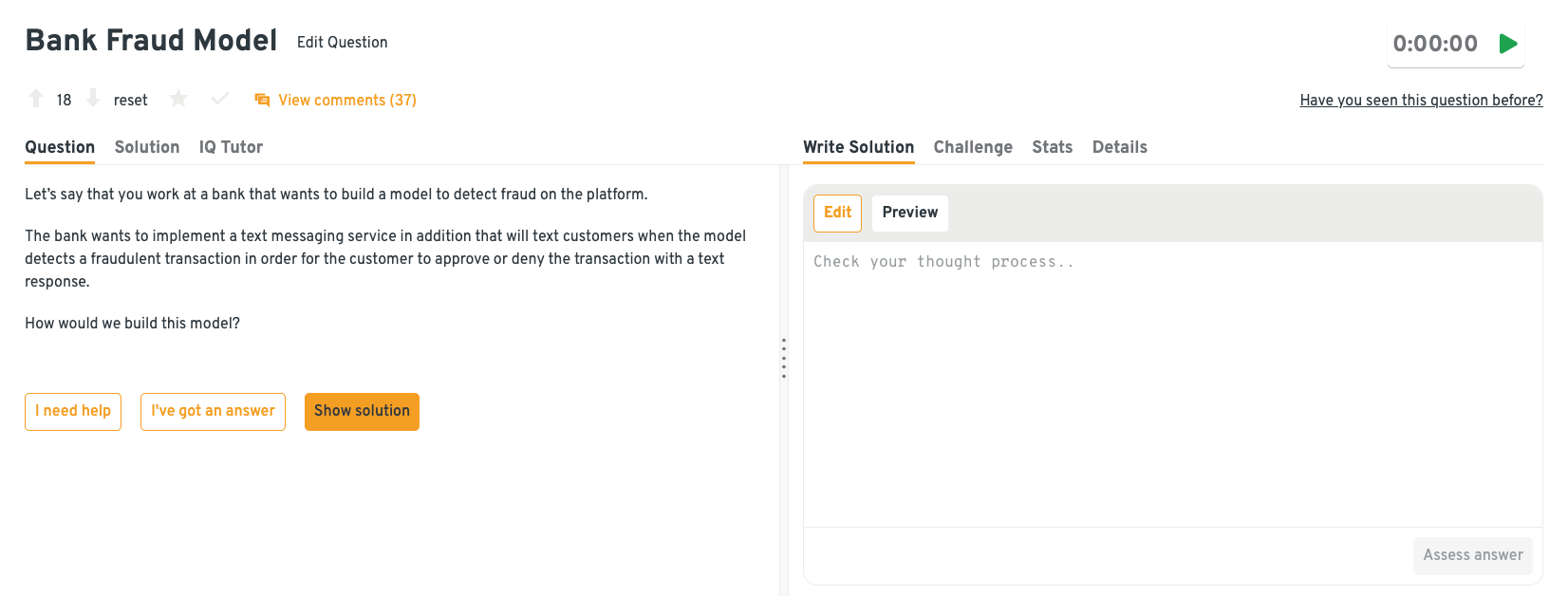
Want to practice this question and get tailored feedback? Try it on Interview Query’s dashboard, where the IQ Tutor and detailed solutions walk you through how top candidates approach product-sense problems.
How would you improve Citi’s mobile account-opening flow?
Start by mapping the end-to-end onboarding journey, pinpointing where customers abandon the process, and isolating steps that introduce the most friction. Focus on streamlining verification, document capture, and initial funding flows, ensuring each change aligns with compliance and KYC requirements.
Tip: Focus on metrics that show depth of engagement rather than surface-level adoption.
How would you evaluate whether to sunset a legacy banking feature?
Assess usage trends, customer value, cost of maintenance, and operational or regulatory dependencies to determine whether retiring the feature is justified. Consider downstream impacts on servicing teams and migration paths for affected users. A clear communication plan and structured risk review ensure the transition maintains stability and reduces customer disruption.
Tip: Highlight your ability to balance modernization with client stability and compliance needs.
How would you improve digital onboarding for small business clients?
Break down the onboarding workflow and identify friction related to documentation, verification, and account configuration. Propose improvements that simplify steps for business owners while satisfying risk and KYC requirements. Success should be measured through reduced cycle time, higher completion rates, and fewer manual reviews.
Tip: Reference the added complexity of multi-owner verification and industry-risk scoring.
Looking for more practice? Explore Interview Query’s question bank to find additional product-sense scenarios tailored to financial services, including risk, compliance, and customer-experience challenges that mirror Citi’s interview expectations.
Product execution and prioritization
Execution is a major focus because Citi PMs work across global teams with competing priorities and tight governance requirements. Effective answers highlight how you surface the riskiest assumptions, address operational pain points, and plan releases that limit disruption. Candidates should also show they can navigate compliance reviews without slowing progress.
-
A strong approach ranks businesses on metrics tied to expected transaction volume, payment acceptance pain points, and likelihood of partnership conversion. Layering in industry segment performance and geographic density helps narrow the list efficiently. Running a small pilot with top candidates can validate assumptions before scaling outreach.
Tip: When discussing prioritization, reference how Citi evaluates merchant value not just through revenue but also strategic network expansion.
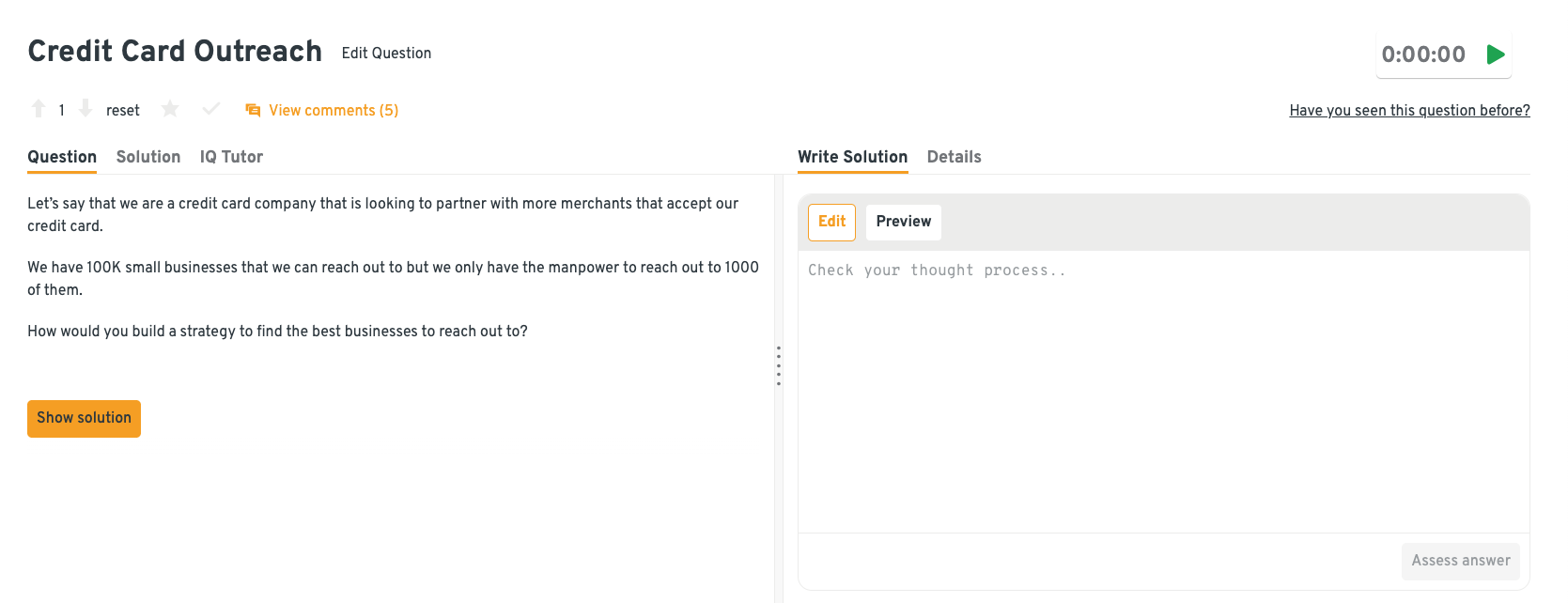
Practice answering this and other Citi-style prompts via Interview Query’s dashboard. You can view the solutions library to break down how top PMs structure their reasoning, or refine your approach by browsing user comments with real-world perspectives.
How would you analyze underperformance when Citi expands into a new geography?
Start by reviewing funnel metrics to pinpoint where adoption drops—awareness, activation, or retention. From there, dig into local customer needs, regulatory constraints, and competitive offerings that may reduce relevance. Cultural expectations around financial trust and digital behavior often reveal gaps in product-market fit.
Tip: Highlight that you would coordinate early with Citi’s regional regulatory and operations teams, which demonstrate that you understand the bank’s heavy emphasis on compliance alignment.
How would you de-risk key assumptions before launching a new Citi banking feature globally?
Identify the riskiest assumptions, usually around compliance, user behavior, and technical scalability. Then, validate them through targeted experiments or limited-market rollouts. Instrumentation and monitoring plans should be defined pre-launch to catch issues quickly.
Tip: Mention that you’d document key assumptions in a traceable risk log, a practice Citi teams often rely on to keep global stakeholders aligned during governance reviews.
How would you diagnose and prioritize fixes for rising failures in a core payments workflow?
Review failure logs to isolate where errors cluster, then map those failures against customer impact and transaction value. Critical paths that affect high-volume or high-risk transactions get addressed first. Parallelizing quick mitigations with deeper root-cause fixes helps stabilize the system without slowing operations.
Tip: Calling out your ability to partner with SRE or fraud operations teams to validate the operational impact of fixes will underline your understanding of Citi’s risk-sensitive payments environment.
How do you handle a critical engineering dependency that threatens a release date?
Clarify the dependency’s root cause and collaborate with engineering to determine realistic timelines or alternative implementation paths. If delays are unavoidable, adjust scope or sequencing while keeping compliance and risk stakeholders aligned. Transparent communication maintains trust and helps prevent downstream bottlenecks.
Tip: Briefly noting how you’d involve program management or tech leads early can signal maturity in navigating Citi’s complex delivery structure.
Watch Next: Fintech Business Case Mock Interview
This video offers a practical, real-world walkthrough of how to approach a fintech business case. It’s a great complement to the written sample questions, especially if you want to see how someone reasons through product-, user-, and risk-related tradeoffs step by step.
In the video, former American Express data scientist Mitul Mundra highlights how to break down a fintech product case by clarifying the user problem, defining constraints, and building a structured roadmap: from hypothesis and user flow to success metrics and risk mitigation. It demonstrates the kind of thinking and communication style that resonates in regulated, risk-sensitive product environments like Citi.
Analytical and metrics questions
Analytical questions test your ability to interpret data, define KPIs, and identify what drives customer behavior. Citi PMs regularly work with transaction data, operational dashboards, and experiment results, so interviewers want to hear how you form hypotheses and validate them. Strong candidates incorporate both leading and lagging indicators into their structured approach, and explain how they partner with analytics teams to design experiments and translate insights into product decisions.
How would you investigate the root causes behind a decline in average credit-card payment amounts?
Start by segmenting transactions by customer group, merchant category, and channel to see where the decline is concentrated. From there, check for external factors like seasonality, macroeconomic shifts, or changes in credit limits. Reviewing recent product or policy changes can help surface internal drivers as well.
Tip: Connect transaction trends to broader macro forces like shifts in spending categories or rate environment changes. This shows that you understand how Citi evaluates portfolio health beyond simple metrics.
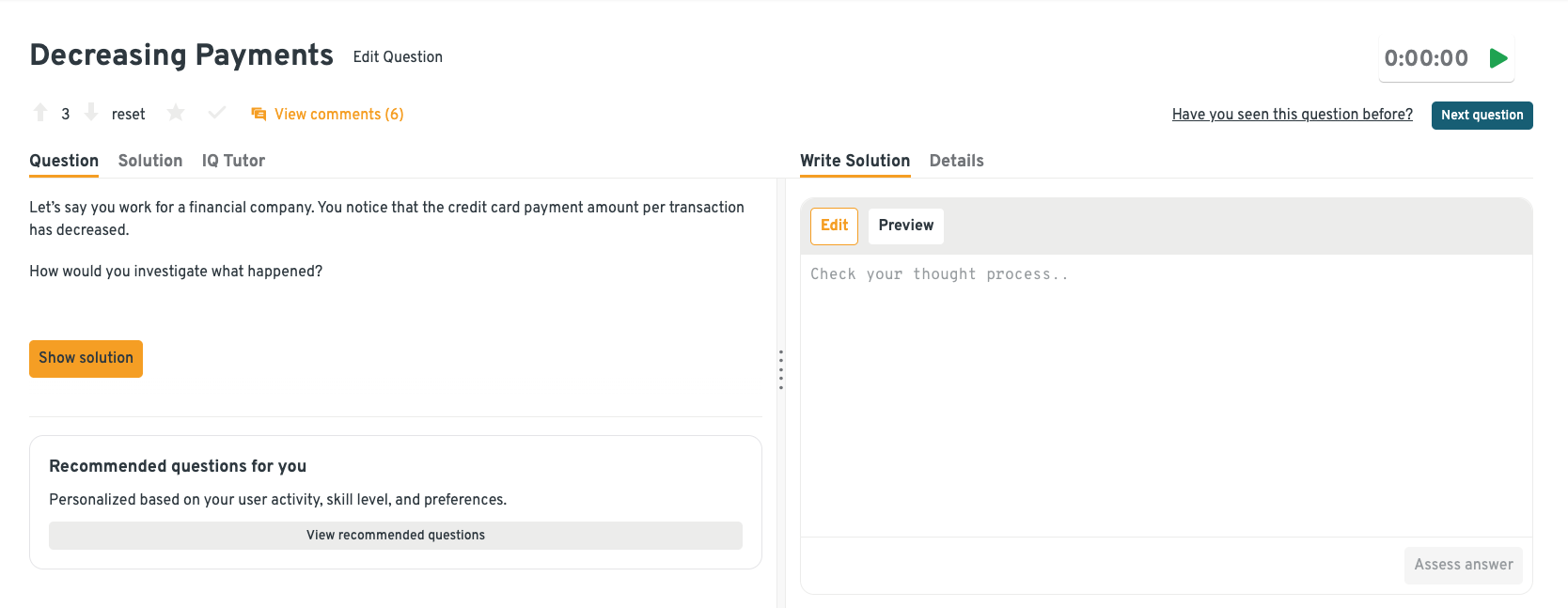
Dive deeper into this question on Interview Query’s dashboard. When answering product metrics questions, the IQ Tutor can guide you through structured investigation paths while the user comments section lets you compare approaches with other candidates to sharpen your reasoning.
-
Compare the revenue curve of upfront payments versus recurring income over the product’s lifespan, adjusting for churn and customer lifetime value. Modeling different retention scenarios helps reveal how sensitive profitability is to subscriber behavior. It’s useful to forecast break-even points to understand when the subscription model overtakes the one-time sale.
Tip: Mention that you’d align any financial modeling with Citi’s risk and finance teams early, as their input on capital treatment and revenue recognition often shapes which pricing models are viable.
-
Look at retention metrics for each product surface and identify where engagement diverges. After spotting the gap, dig into differences in user flows, content quality, and feature availability that may explain the trend. User interviews or targeted experiments can confirm which factors matter most.
Tip: Checking whether differences in regulatory flows or compliance prompts affect certain product surfaces demonstrates awareness of the unique friction points Citi faces across markets.
What retention signals would you track for small business clients?
Usage frequency, transaction volume, and feature adoption usually reveal whether a business is still finding value. Early warning signs like declining logins or lower payment throughput can point to upcoming churn. Monitoring support tickets or complaints also helps catch dissatisfaction before it’s too late.
Tip: Reference how you’d partner with relationship managers to validate your quantitative signals, since Citi places high value on combining frontline insight with data to predict churn.
How would you analyze a funnel drop-off in the digital account-opening experience?
Map each step of the funnel and quantify where users fall off to identify the trouble spots. Once the weak point is clear, review session data or recordings to spot friction, errors, or unclear instructions. Running small tests like simplifying forms or clarifying requirements can validate improvements quickly.
Tip: Highlighting your habit of checking whether Know-Your-Customer (KYC) or identity verification steps create unintended friction will strengthen your answer.
Want to sharpen your reasoning before the actual interview? Explore Interview Query’s full question bank for dozens of Citi-relevant analytics and metrics problems, complete with walkthroughs and real interview patterns.
Behavioral and STAR questions
Citi relies heavily on structured behavioral questions to understand how you lead without authority, communicate with diverse stakeholders, and navigate regulated environments. These conversations follow the STAR method, and your answers should highlight context, action, and measurable impact.
-
This question uncovers your self-awareness, growth mindset, and ability to reflect on feedback, which are all traits Citi values in collaborative, regulated product environments.
**Sample answer: “My manager would say I’m reliable under pressure and strong at breaking ambiguous problems into clear next steps. She’s also encouraged me to develop a more assertive voice during senior-level discussions, which I’ve been addressing by preparing tighter narratives and practicing executive communication. As a result, my presentations have become clearer and I have been invited to represent the team in more leadership forums.”
-
Citi looks for PMs who can communicate across functions like risk, legal, engineering, operations—each with different priorities and vocabulary. The ability to tailor your message, rebuild alignment, and maintain trust is critical.
Sample answer: “I once had a legal partner push back repeatedly because my requirements lacked enough regulatory detail. Instead of continuing the back-and-forth, I scheduled a brief working session to clarify expectations and co-create the risk language. Once aligned, approvals were completed within the same week and the partnership improved noticeably for future projects.”
Tell me about a time you influenced a decision without authority in a complex or highly regulated environment.
This question examines your ability to lead through persuasion rather than hierarchy. Showing how you shaped outcomes with data, relationships, and structured reasoning signals maturity and adaptability.
Sample answer: “At a previous role, engineering preferred a quicker implementation that didn’t fully meet a new regulatory guideline. I assembled customer impact data and a simple risk comparison to show why adhering to the stricter requirement protected us long-term. The team agreed to adopt the stricter standard, and the product passed its regulatory review without issues.”
Walk me through a time you identified a compliance or risk concern and took action before it became an issue.
Proactive risk awareness is a core expectation at Citi, where PMs must anticipate regulatory implications early in product development. Demonstrate that you recognize emerging risk signals and act decisively.
Sample answer: “During a review of an onboarding workflow, I noticed customer data was passing through an outdated service that lacked recent audit approval. I flagged it to compliance, validated the risk, and worked with engineering to reroute the data through an approved path. This prevented a likely compliance exception and strengthened our internal review process.”
Describe a situation where unexpected data or customer insights changed your product strategy and how you adapted.
Citi values PMs who ground decisions in data and are flexible enough to pivot when evidence contradicts assumptions.
Sample answer: “In one project, survey data revealed customers cared far more about real-time balance alerts than the new budgeting features we planned to prioritize. We shifted resources to accelerate the alerting capability and pushed the other work into a later phase. The change boosted adoption significantly because it solved the more immediate customer need.”
Across the product sense, execution, analytical, and behavioral rounds, Citi looks for PMs who can think clearly, move decisively, and communicate with intention in a high-stakes environment. For more targeted practice and full-loop readiness, explore Interview Query’s PM question bank to sharpen your approach and build confidence for every stage of the interview.
What Does a Citi Product Manager Do?
Whether improving consumer mobile banking or supporting institutional clients like treasurers and payment managers, Citi product managers influence products used across more than a hundred countries. The scope is wide, the expectations are high, and the opportunity to drive meaningful financial innovation is substantial.
While responsibilities vary by division, PMs typically support products across Consumer Banking, Credit Cards, Treasury and Trade Solutions (TTS), and institutional platforms used by global corporate clients.
Day to day, Citi PMs drive improvements across critical journeys and backend systems, including:
- Streamlining digital onboarding and identity verification
- Simplifying card activation, servicing, and rewards flows
- Refining payment authorization logic and fraud-detection processes
- Modernizing B2B treasury tools that move high-value transaction volumes across global markets.
Citi product managers also work closely with engineering, design, analytics, risk, legal, operations, and compliance. Much of the role centers on aligning these teams while ensuring every feature shipped is secure, compliant, and operationally feasible.
Learn more about how product roles differ across teams like TTS and Personal Banking by exploring Interview Query’s full Citi interview guide.
How to Prepare for a Citi Product Manager Interview
Citi evaluates PMs on product fundamentals, regulatory awareness, cross-functional leadership, and the ability to operate within a complex, risk-sensitive financial ecosystem. Effective preparation means understanding Citi’s environment, strengthening your product and data skills, and building stories that highlight collaboration with compliance, risk, and operations teams.
Build Strong PM Fundamentals
Citi values PMs who can break down ambiguous challenges and communicate a logical path forward. Study how to frame user problems clearly, map the end-to-end journey, and choose the right prioritization tools for different scenarios. Practice defining success metrics in terms of both user value and operational impact, and be ready to explain the tradeoffs behind your decisions.
Resources: Interview Query’s Product Metrics Learning Path, Reforge PM Foundations
Learn the Financial and Regulatory Landscape
Citi operates in a deeply regulated space, so fluency in financial basics and compliance concepts is a major advantage. Learn the fundamentals of how money moves across banking and payment rails, including authorization, settlement, and reconciliation. In addition to understanding the credit lifecycle, familiarize yourself with KYC/AML processes, and common fraud patterns, and the regulatory guardrails that influence product decisions and timelines.
Strengthen Cross-Functional Collaboration Skills
Citi’s matrixed structure requires PMs to align diverse stakeholders while communicating clearly and concisely. Practice explaining product decisions to audiences with different priorities, such as risk officers, legal reviewers, engineering leads, and operations partners. Develop the ability to craft executive-ready narratives and explore structured communication methods to help you stay logical and crisp under pressure.
Resources: McKinsey SCR/MECE frameworks, executive communication blogs
Prepare Clear Behavioral Stories Using STAR
Citi expects PMs to demonstrate ownership, customer focus, and risk-aware decision making through structured examples. Create stories that show how you handled ambiguity, drove alignment during conflict, or worked through risk and compliance constraints. Highlight situations where you delivered measurable impact by influencing without authority or navigating complex organizational dynamics. Lastly, rehearse closing each story with what you learned and how it strengthened your approach as a PM.
Resources: Interview Query behavioral questions bank, STAR/SCAR frameworks
Understand Citi’s Business Context
Review how Citi’s major product lines operate, from consumer banking and cards to institutional services and Treasury and Trade Solutions. Study how the bank is modernizing its digital experiences and shifting its long-term strategy toward simplification and global platformization. Keeping an eye on competitors and industry trends can also help you understand where Citi is investing and how your role might contribute to its transformation.
Resources: Citi’s company website for annual reports, investor materials, digital strategy decks
Treat this roadmap as your baseline: build fluency in metrics, regulation-aware product thinking, and structured problem solving. Then, pressure-test those skills through realistic practice. Use Interview Query’s Mock Interview feature to simulate PM cases, metric deep-dives, and behavioral prompts and gain valuable peer feedback.
Citi Product Manager Salary Insights
Product managers at Citi earn competitive compensation across levels, according to data from Levels.fyi. Citi’s structure typically includes Associate Vice President, Vice President, and Senior Vice President tiers, each reflecting broader scope, cross-functional influence, and ownership of multi-market initiatives.
Total compensation includes base salary, annual bonus, and restricted stock units, which form a meaningful portion of overall earnings. Compensation varies by team and location, but remains aligned with Citi’s global investment in digital transformation and product leadership.
| Level | Total / Year | Base / Year | Bonus / Year | Stock / Year |
|---|---|---|---|---|
| C11 (Intermediate-level) | ~ $95K | ~ $93K | ~ $2K | N/A |
| Associate Vice President (PM) | ~ $126K | ~ $123K | ~ $3K | N/A |
| Vice President (Senior PM) | ~ $149K | ~ $146K | ~ $3K | N/A |
| Senior Vice President (Group PM) | ~ $225K | ~ $197K | ~ $28K | N/A |
Compensation typically increases significantly after year-two equity vesting begins, especially at Vice President and Senior Vice President levels.
Average Base Salary
Average Total Compensation
Regional salary comparison
Salaries for Citi product managers may also vary across regions due to differences in cost of living, local market competition, and team placement. Based on Levels.fyi data, major hubs such as New York and New Jersey offer the highest compensation ranges given Citi’s concentration of product, risk, and institutional business teams.
Secondary markets with growing digital footprints, such as Texas and Florida, offer competitive packages with slightly lower base salaries and smaller equity grants. Candidates should consider team alignment, growth opportunities, and role scope when comparing regional differences.
| Region | Salary Range | Notes |
|---|---|---|
| New York | ~$180K–$260K | Highest concentration of Consumer and Institutional product teams |
| New Jersey | ~$165K–$235K | Large operations and digital groups |
| Florida | ~$140K–$190K | Expanding technology and servicing teams |
| Texas | ~$145K–$200K | Mix of institutional and consumer product roles |
Learn how to benchmark your offer and prepare for every stage with Interview Query’s compensation insights.
FAQs
Why choose the product manager role at Citi?
Citi offers PMs the chance to build products with global reach across 160+ markets. The role is especially attractive for candidates interested in enterprise-scale infrastructure, including payments rails, credit and risk platforms, and regulatory technology. With clear career paths from AVP to VP to Director, Citi is a strong fit for PMs seeking growth, complexity, and influence in a global financial organization.
How long does the Citi hiring process take?
Most candidates complete the Citi hiring process within three to five weeks. The timeline includes initial screening, interviews with product, engineering, and risk partners, and final hiring manager or executive conversations. Background verification may extend the overall timeline, particularly for roles within institutional banking.
Do Citi product managers need a finance background?
A finance background is helpful but not required. Citi values strong product fundamentals, analytical rigor, and experience working with complex systems. Candidates who understand compliance, operational risk, payments, or onboarding workflows ramp more quickly, but many PMs come from technology, consulting, or SaaS backgrounds.
What is the difference between AVP, VP, and Director PM roles?
Associate Vice Presidents typically own specific features or workflows. Vice Presidents lead larger product areas, manage cross-functional programs, and drive roadmap strategy. Director-level PMs (or Senior Vice Presidents) influence multi-market product portfolios, align with executives, and set long-term product vision. Each level reflects increased scope, autonomy, and stakeholder complexity.
How does Citi evaluate culture fit?
Citi assesses culture fit through communication style, ownership mindset, and collaboration across engineering, risk, and business teams. Interviewers look for candidates who are structured, measured, customer-focused, and comfortable operating within a regulated environment.
How important is the STAR method at Citi?
The STAR method is central to behavioral interviews. Citi wants clear, structured answers that demonstrate leadership, conflict resolution, and cross-functional influence. Strong STAR responses show measurable results, global coordination, and thoughtful risk management.
Does Citi require a background check and what does it involve?
Yes. As a global financial institution, Citi requires background checks for all PM roles. This typically includes employment verification, education confirmation, and a review of compliance-related history. Some roles also require additional checks based on regulatory expectations.
Start your Citi PM journey with Interview Query
Citi offers product managers the opportunity to shape large-scale financial platforms that serve millions of customers and global institutional clients. Preparing for this role means sharpening product fundamentals, building financial-risk awareness, and practicing clear, structured communication.
As you continue your prep, explore Interview Query’s resources, such as:
- The full Citi interview guide for role and culture alignment,
- the question bank for more Citi-specific challenges, and;
- coaching sessions to connect with PM experts and get insider tips.
When you’re ready to apply your skills, use Interview Query’s Mock Interview platform for PM cases, metric drills, and behavioral practice—everything you need to confidently navigate the Citi interview process.
Citi Interview Questions
| Question | Topic | Difficulty |
|---|---|---|
Brainteasers | Medium | |
When an interviewer asks a question along the lines of:
How would you respond? | ||
Brainteasers | Easy | |
Analytics | Medium | |
SQL | Easy | |
Machine Learning | Medium | |
Statistics | Medium | |
SQL | Hard | |
Machine Learning | Medium | |
Python | Easy | |
Deep Learning | Hard | |
SQL | Medium | |
Statistics | Easy | |
Machine Learning | Hard |
Discussion & Interview Experiences