

Apple Product Manager Interview Guide: Process, Questions, Salary, and Prep


Introduction
An Apple product manager interview is designed to test whether you can make durable product decisions at massive scale. Apple ships products used by over 2 billion active devices worldwide, which means even small roadmap choices can affect millions of users overnight. Product managers sit at the center of those decisions, balancing user experience, technical constraints, privacy standards, and long-term brand impact.
What makes the role distinct is scope. An Apple product manager blends traditional product management with product marketing, owning not just feature definition but also positioning, launch narratives, and cross-functional alignment. The interview process reflects this breadth. Candidates are evaluated on structured thinking, user empathy, execution judgment, and their ability to lead without authority across design, engineering, marketing, and operations. This guide breaks down how the Apple product manager interview works, what each stage is designed to assess, and how to prepare for what Apple actually tests.
Apple Product Manager Interview Process
The Apple product manager interview process is structured to evaluate how well candidates can define problems, prioritize tradeoffs, and lead cross-functional teams toward clear outcomes. Across stages, interviewers assess product sense, execution rigor, communication clarity, and alignment with Apple’s culture of quality and user-centric decision-making. Most candidates move through the process in four to six weeks, depending on team availability.
Interview Process Overview
Candidates typically progress through a recruiter screen, a hiring manager conversation, and a virtual onsite loop made up of multiple interviews. Unlike PM interviews at many tech companies, Apple places heavier emphasis on product judgment, storytelling, and ownership across the full lifecycle, rather than lightweight feature ideation alone.
Interview Process Summary
| Interview Stage | What Happens |
|---|---|
| Application and resume screen | Recruiters assess PM experience, product scope, and relevance to the specific team |
| Recruiter screen | Motivation, culture fit, and alignment with Apple’s products and values |
| Hiring manager interview | Role clarity, product thinking depth, and early signal on team fit |
| Virtual onsite loop (3–5 rounds) | Product sense, execution, technical judgment, and behavioral evaluation |
| Offer and team alignment | Final leveling, scope alignment, and compensation discussion |
Application And Resume Screen
Apple recruiters look for evidence of end-to-end product ownership rather than surface-level feature work. Strong resumes show experience driving products from concept to launch, influencing roadmap decisions, and partnering closely with engineering and design. Impact matters more than titles.
Candidates are often aligned to a specific product area early, such as iPhone, Apple Watch, services, or AI-related initiatives. That alignment shapes the types of scenarios discussed later in the process.
Apple-specific tip: Frame resume bullets around problem → decision → outcome, not just features shipped.
Recruiter Screen
The recruiter screen is typically a 20–30 minute conversation focused on background, motivation, and fit. Recruiters often ask why you want to work at Apple, which products you admire, and how your experience maps to the role. This is also where logistics, location, and role scope are clarified.
Apple recruiters pay close attention to authenticity. Generic PM answers tend to fall flat compared to candidates who can articulate a thoughtful perspective on Apple’s ecosystem and user experience philosophy.
Apple-specific tip: Be ready to discuss a specific Apple product and how you would improve it from a user-first perspective.
Hiring Manager Interview
The hiring manager interview goes deeper into role expectations and product judgment. You may be asked to walk through past projects, explain how you made tradeoffs, or reason through an ambiguous product scenario. Interviewers are evaluating how you think, not whether you land on a single “correct” answer.
Candidates who do well show structured reasoning, clear assumptions, and an ability to adapt their thinking as new constraints are introduced.
Apple-specific tip: Talk through your thought process step by step. Apple interviewers value clarity over speed.
Virtual Onsite Loop
The virtual onsite loop is the core of the Apple product manager interview process and usually consists of three to five interviews. Each round focuses on a different dimension of PM work.
Typical Loop Structure
| Interview Focus | What Is Evaluated |
|---|---|
| Product sense and design | User empathy, problem framing, and structured solution design |
| Execution and analytics | Prioritization, root-cause analysis, and data-informed decisions |
| Technical judgment | Ability to partner with engineering and understand system constraints |
| Behavioral and culture fit | Leadership, ownership, and alignment with Apple’s values |
Product sense interviews often involve open-ended prompts like improving an existing Apple product or designing a new experience. Execution interviews test how you handle tradeoffs, timelines, and ambiguous data. Technical interviews vary by team and are focused on judgment rather than hands-on coding.
Candidates preparing for this stage often practice articulating decisions aloud and pressure-testing assumptions using realistic scenarios. Resources like mock interviews and applied exercises from challenges can help simulate the pacing and depth Apple expects.
Apple-specific tip: Always tie your recommendation back to user impact and long-term product quality, not just short-term metrics.
Challenge
Check your skills...
How prepared are you for working as a Product Manager at Apple?
Apple Product Manager Interview Questions
Apple product manager interview questions are designed to assess how well you can define product direction, make tradeoffs under constraints, and lead cross-functional teams from concept through launch. Interviewers evaluate product sense, execution judgment, technical fluency, and behavioral leadership, reflecting the breadth of PM work at Apple. Below are the most common categories of Apple product manager interview questions, with notes on what each question is really testing.
Product Sense And Strategy Questions
These questions test whether you can identify the right user problem, prioritize what matters, and propose solutions that fit Apple’s standards for quality, privacy, and user experience. Strong answers show structured thinking, clear assumptions, and a tight link between user needs and product decisions. Practicing open-ended scenarios under pressure through mock interviews can help you refine how you communicate your thinking.
How would you assess and improve the performance of one of our core apps in a newly entered market?
This question evaluates whether you can separate “product performance” from “market mismatch” and then prioritize the highest-leverage drivers. Strong answers start by defining success metrics (activation, retention, revenue, satisfaction), then isolating where the funnel breaks for the new geography. Interviewers look for evidence you can combine qualitative learning (local context, user friction) with quantitative diagnosis (cohorts, segmentation) and then translate that into a testable plan.
Tip: Start with a funnel view, then layer in market-specific constraints only after you identify the biggest drop-off.
What strategies might drive increased interaction within a user community feature?
This question tests whether you can design for behavior change rather than just adding features. Strong answers discuss how to reduce participation friction, create lightweight prompts, and improve discovery while protecting quality and safety. Interviewers want to see that you define engagement metrics carefully and avoid over-optimizing vanity activity that harms user experience.
Tip: Prioritize first-action conversion (first post or comment) before trying to maximize volume from power users.
How would you design and measure activation for a new Apple product or feature launch?
This question tests metric definition and whether you can choose an activation event that reflects real user value. Strong answers define activation as a meaningful first success moment, specify a time window, and separate eligible users from exposed users. Interviewers look for a clear link between the activation metric and longer-term retention or satisfaction.
Tip: Define activation as “first value,” not “first click,” and explain why your definition predicts retention.
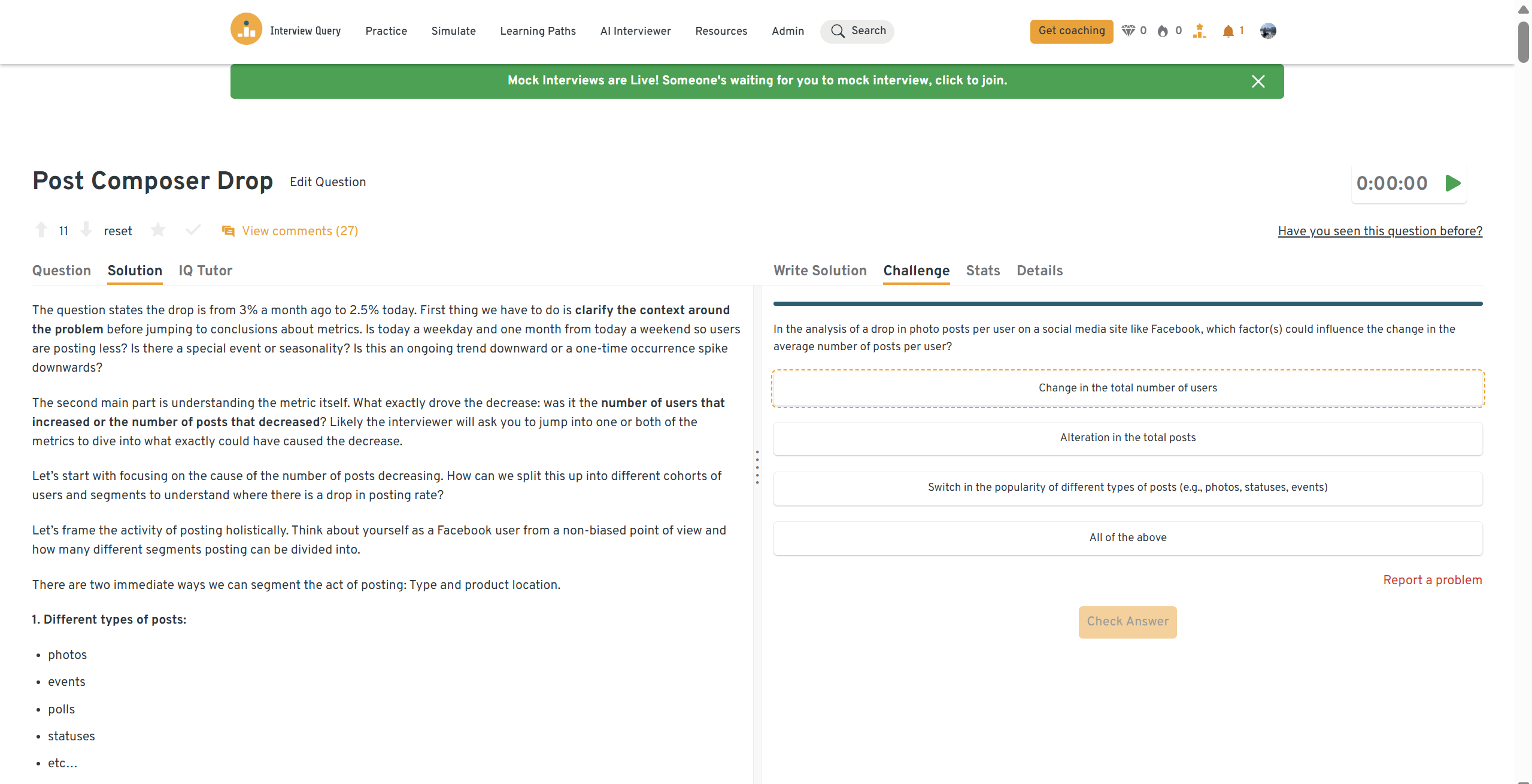
What might explain a sudden decline in user content creation, and how would you investigate it?
This question evaluates root-cause thinking under ambiguity. Strong answers outline a systematic investigation: recent launches or experiments, instrumentation changes, performance regressions, and cohort-level segmentation (device, OS, region, tenure). Interviewers look for candidates who can generate hypotheses quickly, validate data integrity, and propose a safe fix path.
Tip: Confirm whether the decline is real by checking logging consistency and denominator shifts before diagnosing product behavior.
You can practice this exact problem on the Interview Query dashboard, shown below. The platform lets you write and test SQL queries, view accepted solutions, and compare your performance with thousands of other learners. Features like AI coaching, submission stats, and language breakdowns help you identify areas to improve and prepare more effectively for data interviews at scale.
Execution And Analytics Questions
Execution interviews test whether you can turn strategy into action, using data to prioritize, evaluate impact, and communicate tradeoffs. You may be asked to design experiments, interpret trends, or explain how you would validate whether a change worked. For candidates who want repeated practice with analytics-style PM prompts, applied exercises in challenges are a good fit.
How would you diagnose a divergence between weekly active users and email open rates?
This question tests whether you can debug metrics like a product leader rather than jumping to conclusions. Strong answers start with definition checks (windows, user IDs, attribution) and then explore cohort differences: are engaged users shifting channels, or is delivery failing? Interviewers look for candidates who can separate measurement issues from product issues, then recommend an action plan.
Tip: Validate metric definitions and instrumentation first, then investigate behavioral explanations with cohort analysis.
How would you determine if a steady 1% weekly decline in DAU is significant?
This question evaluates statistical and business judgment. Strong answers discuss baseline variance, seasonality, and confidence in the trend, then connect the magnitude of decline to user impact and decision urgency. Interviewers look for restraint: you should show you can avoid overreacting, while still taking the signal seriously.
Tip: Combine statistical confidence with practical significance, then recommend next steps proportional to the risk.
How would you assess the impact of a targeted discount email on free-tier conversion?
This question tests experimentation and ROI thinking. Strong answers define success metrics beyond conversion (retention, margin impact, downstream behavior), then describe how to design a clean comparison and interpret results responsibly. Interviewers want to see that you can prevent short-term wins that degrade long-term value.
Tip: Evaluate conversion lift and post-conversion retention together before recommending scale.
How would you prioritize a roadmap when engineering capacity is constrained and multiple teams disagree on what matters most?
This tests execution leadership and tradeoff discipline. Strong answers define a prioritization principle (user impact, strategic alignment, risk, reversibility), then show how you drive alignment with transparent criteria. Interviewers look for clear communication and an ability to make decisions without forcing consensus.
Tip: Use a consistent prioritization rubric and show how you would revisit decisions when constraints change.
Technical Depth Questions
Technical interviews for Apple product manager roles vary by team, but they generally test whether you can partner effectively with engineering and make sound tradeoffs around architecture, privacy, latency, and reliability. Questions that require designing sensitive systems (for example, inferring a user’s location from activity) are less appropriate for Apple PM interview prep because they conflict with privacy expectations and are unlikely to be asked in that form. The questions below are the most relevant from your list.
-
This question tests incident judgment for AI-driven features. Strong answers focus on triage (user impact, rollback criteria), diagnostics (where the pipeline broke), and safeguards (input validation, monitoring, and alerting). Interviewers want to see that you can balance speed and correctness without letting the system silently fail.
Tip: Lead with user impact and rollback thresholds before diving into root cause.
How would you evaluate on-device versus cloud tradeoffs for an AI feature?
This tests whether you understand constraints that matter at Apple: privacy, latency, battery, reliability, and model iteration speed. Strong answers discuss which parts of the workflow must be on-device, what can be server-assisted, and how you would measure success without compromising user trust.
Tip: Make privacy and latency first-order requirements, then discuss model quality and iteration.
How do you partner with engineering when feasibility constraints contradict the initial product vision?
This tests technical collaboration rather than deep algorithms. Strong answers explain how you narrow scope, identify the core user value, and negotiate phased delivery without losing product quality. Interviewers want to see that you can protect the user experience while respecting constraints.
Tip: Re-anchor on user value, then propose scoped alternatives instead of pushing for the original design unchanged.
Behavioral And Leadership Questions
Behavioral interviews test ownership, influence, and judgment, especially in ambiguous and cross-functional settings. Apple interviewers often listen for how you lead without authority, handle disagreement, and communicate clearly under pressure. For fast iteration on delivery, the AI interview is useful for practicing concise, structured stories.
-
This question evaluates motivation and alignment with Apple’s values. Strong answers connect your product philosophy to Apple’s focus on user experience, quality, and privacy, and they reference a specific product area you are excited to work on. Interviewers look for authenticity, not brand admiration.
Tip: Anchor your answer in one Apple product and one product principle you care about, then connect it to your past work.
Describe a time when you led a team through a major product pivot or challenge. How did you keep everyone aligned?
This tests leadership under uncertainty. Strong answers show how you clarified the “why,” reset success metrics, and maintained momentum while keeping stakeholders informed. Interviewers value decisiveness paired with calm communication.
Tip: Emphasize how you maintained alignment through shared metrics and clear decision ownership.
How have you incorporated accessibility and inclusivity into product decisions?
This evaluates whether you build for diverse users as a default rather than an afterthought. Strong answers describe how accessibility shaped prioritization, design reviews, and success metrics. Interviewers look for concrete examples of tradeoffs you made to deliver inclusive outcomes.
Tip: Name a specific accessibility consideration and how it changed your roadmap or design.
What would your current manager say about your strengths and areas for growth?
This tests self-awareness. Strong answers describe strengths tied to outcomes (alignment, execution, clarity) and a growth area you are actively improving with a clear mechanism. Interviewers want maturity, not perfection.
Tip: Pair your growth area with a behavior you changed and how you measure improvement.
-
This evaluates how you use data without becoming trapped by it. Strong answers show how you validated data quality, resolved stakeholder disagreement, and turned analysis into a decision. Interviewers look for judgment in the face of noisy or incomplete inputs.
Tip: Highlight the decision made and the tradeoff, not just the analysis performed.
To build confidence in metrics, experimentation, and data-driven product thinking, watch this short breakdown from Interview Query founder Jay Feng. It explains how product data science questions work, common analytical traps, and how to structure your reasoning—all skills that map directly into the analytical portion of the Apple PM interview.
How To Prepare For An Apple Product Manager Interview
Preparing for an Apple product manager interview requires more than memorizing frameworks or rehearsing feature ideas. Apple evaluates whether you can think clearly when constraints conflict, users are diverse, and the cost of a poor decision is high. Your preparation should mirror how product managers actually operate inside Apple: structured, user-driven, and detail-oriented.
Build fluency in structured product thinking.
Most Apple PM questions are open-ended by design. Practice a consistent approach to framing problems: clarify the goal, define the user, surface unmet needs, and articulate tradeoffs before proposing solutions. Apple interviewers care less about the specific framework you use and more about whether your thinking is coherent and defensible. Practicing aloud through realistic scenarios in mock interviews helps sharpen clarity and pacing.
Ground product decisions in user value and metrics.
Apple PMs are expected to connect user experience directly to measurable outcomes. Practice defining activation, engagement, and retention metrics that reflect real user value rather than vanity signals. When discussing experiments or launches, be explicit about what success looks like and how you would validate impact. Applied scenarios in challenges are useful for pressure-testing this skill.
Strengthen execution and tradeoff judgment.
Execution questions often probe how you prioritize when engineering capacity is constrained or when teams disagree. Prepare examples where you made tradeoffs transparently and aligned stakeholders using shared criteria. Interviewers listen for how you balance speed, quality, and long-term product integrity, not just how fast you ship.
Develop technical fluency without over-indexing on depth.
You are not expected to write production code, but you should understand system constraints, data flows, and AI tradeoffs relevant to your product area. Be ready to discuss privacy, latency, reliability, and on-device versus cloud decisions at a conceptual level. If your role touches AI-driven features, building intuition through structured material in the modeling and machine learning interview learning path can help.
Practice behavioral stories with ownership and discretion.
Behavioral interviews at Apple emphasize leadership without authority, judgment under ambiguity, and communication in sensitive environments. Prepare concise stories that highlight decisions made, tradeoffs considered, and outcomes achieved. Practicing delivery through the AI interview or targeted feedback via coaching can significantly improve confidence and structure.
Role Overview And Culture At Apple
An Apple product manager operates at the intersection of product definition, execution, and storytelling. The role blends traditional product management with product marketing responsibilities, requiring ownership over roadmap decisions, feature narratives, and launch alignment. Product managers work closely with design, engineering, marketing, legal, and operations to deliver cohesive, high-quality experiences across hardware, software, and services.
Day to day, the role typically includes:
- Defining product direction: translating user needs and company priorities into clear product requirements and roadmaps.
- Leading cross-functional execution: aligning teams across engineering, design, and marketing to move initiatives forward.
- Owning launch narratives: shaping messaging, positioning, and go-to-market plans alongside marketing partners.
- Representing the user: advocating for user experience, accessibility, and privacy in every product decision.
- Managing the full lifecycle: guiding products from discovery through launch, iteration, and refinement.
Culturally, Apple places a premium on clarity, accountability, and quality. Product managers are expected to operate with discretion, make decisions grounded in evidence, and maintain high standards even under tight timelines. The environment rewards individuals who can simplify complexity without oversimplifying the problem.
Strong Apple product managers tend to share a few defining traits:
- User-first judgment: decisions are anchored in user value rather than short-term metrics.
- Comfort with ambiguity: problems are rarely fully specified, and clarity must be created, not assumed.
- Respect for craft: design, engineering, and privacy considerations are treated as core inputs, not constraints to work around.
- Influence without authority: progress is driven through trust, data, and clear communication rather than hierarchy.
For candidates comparing expectations across roles, the broader learning paths section can help contextualize how Apple product manager interviews differ from analytics, data science, or engineering-focused tracks.
Apple Product Manager Salary
Compensation for product managers at Apple reflects the scope of responsibility, cross-functional ownership, and long-term product impact expected in the role. Based on aggregated self-reported data from Levels.fyi, pay is structured across base salary, equity, and bonus, with meaningful increases as product managers progress in seniority.
| Level | Approximate role scope | Total compensation (annual) |
|---|---|---|
| ICT2 | early-career product manager | $192,000 |
| ICT3 | product manager | $216,000 |
| ICT4 | senior product manager | $288,000 |
| ICT5 | staff / lead product manager | $456,000 |
| ICT6 | principal product manager | $720,000 |
These figures represent total annual compensation and include base pay, stock grants, and bonuses. As level increases, equity becomes a significantly larger portion of overall compensation, reflecting Apple’s emphasis on long-term product ownership and sustained impact.
Average Base Salary
Average Total Compensation
What Drives Compensation Differences
Several factors influence where a product manager may fall within these ranges:
- Product surface area: roles owning platform-level features or core system experiences tend to command higher compensation
- Technical depth: teams working closely with AI, operating systems, or infrastructure often require stronger technical fluency
- Leadership scope: senior levels reflect influence across multiple teams or product lines rather than single-feature ownership
- Track record: prior launches, cross-functional leadership, and demonstrated judgment in high-stakes decisions matter more than tenure alone
For candidates evaluating growth paths or comparing roles across companies, reviewing compensation alongside interview expectations can help align preparation strategy with target levels.
FAQs
What does a product manager at Apple actually do day to day?
A product manager at Apple spends most of their time defining product direction, aligning cross-functional teams, and making trade-offs across design, engineering, marketing, and operations. The role blends classic product management with product marketing, requiring strong judgment, structured thinking, and constant user advocacy. Daily work often includes reviewing product specs, refining positioning, validating assumptions with data, and preparing for executive reviews. Unlike many companies, Apple product managers are deeply involved from early concept through launch.
How is an Apple product manager different from PM roles at other tech companies?
Apple product managers typically own both product definition and go-to-market execution, rather than splitting responsibilities across separate PM and product marketing roles. The position places heavier emphasis on narrative clarity, user experience, and launch excellence. Decision-making also tends to be more centralized and detail-oriented, with high expectations for precision and discretion. As a result, communication quality and judgment matter as much as analytical skill.
How technical do Apple product manager interviews get?
Technical depth varies significantly by team. Some roles require comfort discussing system architecture, APIs, or machine-learning constraints, while others focus more on product sense and execution. Interviewers do not expect production-level coding, but they do expect candidates to reason clearly about technical trade-offs and collaborate effectively with engineers. Being able to ask the right technical questions is often more important than knowing implementation details.
What frameworks work best for Apple product manager interviews?
Structured thinking is essential, but rigid frameworks are less effective than adaptable ones. Many candidates use variants of customer-problem-solution or customer-product-technology frameworks to organize their thinking. Apple interviewers care most about whether your structure fits the problem and leads to thoughtful trade-offs. Clear assumptions and logical sequencing matter more than naming a specific framework.
How should I prepare for Apple product manager interviews?
Preparation should focus on product sense, execution rigor, and communication clarity. Candidates should practice articulating user problems, defining success metrics, and reasoning through ambiguous scenarios. Reviewing Apple’s products deeply, understanding their design philosophy, and practicing structured responses aloud are critical. Mock interviews and feedback loops are especially helpful given the conversational but high-bar nature of Apple interviews.
Final Thoughts: Prepare for Apple Product Manager Interviews With Confidence
Apple product manager interviews are designed to evaluate how you think when problems are ambiguous, stakes are high, and inputs come from many directions at once. Strong candidates combine product intuition with analytical discipline, clear communication, and the ability to make trade-offs without perfect information.
To prepare effectively, practice across the full range of skills Apple tests. Work through structured product and analytics questions from Interview Query’s learning paths to strengthen core foundations, then pressure-test your thinking with realistic scenarios from the product and analytics challenges. Finally, simulate real Apple interview dynamics through mock interviews or targeted coaching to refine clarity, structure, and confidence under pressure.
With deliberate preparation and the right feedback loop, you can walk into an Apple product manager interview ready to lead high-quality product discussions—not just answer questions.
Apple Interview Questions
| Question | Topic | Difficulty | ||||||||||||||||
|---|---|---|---|---|---|---|---|---|---|---|---|---|---|---|---|---|---|---|
SQL | Medium | |||||||||||||||||
We’re given a table of product purchases. Each row in the table represents an individual user product purchase. Write a query to get the number of customers that were upsold, or in other words, the number of users who bought additional products after their first purchase. Note: If the customer purchased two things on the same day, that does not count as an upsell, as they were purchased within a similar timeframe. Example: Input:
Output:
| ||||||||||||||||||
SQL | Medium | |||||||||||||||||
SQL | Hard | |||||||||||||||||
SQL | Easy | |
Machine Learning | Medium | |
Statistics | Medium | |
SQL | Hard | |
Machine Learning | Medium | |
Python | Easy | |
Deep Learning | Hard | |
SQL | Medium | |
Statistics | Easy | |
Machine Learning | Hard |
Discussion & Interview Experiences