



Amazon Business Analyst Interview Questions & Process (2026 Guide)


Introduction: Inside the Amazon Business Analyst Interview
Amazon business analysts, whether focusing on delivery routes for Amazon Retail or analyzing AWS usage patterns, serve as both data interpreters and storytellers. As Amazon expands its artificial intelligence investments to nearly $100 billion in 2025, this role leverages the company’s AI-enabled tools, such as AWS QuickSight, to convert raw metrics into actionable insights.
The Amazon business analyst interview reflects not only the company’s data-driven strategy but also its customer-obsessed culture. Candidates must grasp product trends, solve customer pain points, and transform the entire customer journey.
In contrast to traditional analytics roles, Amazon’s interview process features a structured, multi-stage format. Each round is designed to assess your SQL proficiency, analytics tools expertise, and cultural alignment with Amazon’s 16 Leadership Principles.
This guide offers insights on navigating each interview round, preparing effectively, and demonstrating both technical prowess and business intuition in your responses.
What Does an Amazon Business Analyst Do?
The Amazon business analyst role serves as the critical bridge between raw data and measurable business impact. Here’s what the job typically entails:
- Translating data insights into business decisions: Business analysts are tasked with identifying trends, uncovering inefficiencies, and presenting findings that influence product roadmaps, pricing strategies, and resource allocation.
- Forecasting, performance tracking, and metric ownership: BAs develop dashboards, track key performance indicators (KPIs), and create predictive models that optimize customer lifetime value and supply chain outcomes.
- Collaborating with product, operations, and finance teams: Analysts partner with cross-functional teams to analyze A/B test results, warehouse staffing models, or financial forecasts—whether for Prime delivery speed, retail inventory, or AWS customer usage.
- Leveraging SQL, Excel, and visualization tools: Strong command of SQL for querying large datasets, Excel for modeling, and tools like Tableau or QuickSight for visualization is central to the role.
Common high-impact business analyst teams at Amazon include:
- Amazon Retail for inventory optimization and analysis of purchase patterns,
- AWS for tracking adoption metrics and customer usage,
- Prime Video to drive content recommendations and engagement strategies,
- Operations to work with fulfillment networks and delivery logistics, or
- Amazon Advertising to create revenue opportunities through performance marketing and campaigns.
Each team presents unique analytical challenges while maintaining Amazon’s core focus on using data to improve customer experiences and operational efficiency.
Challenge
Check your skills...
How prepared are you for working as a Business Analyst at Amazon?
Amazon Business Analyst Interview Process Explained
The Amazon business analyst interview process is designed to evaluate both your technical expertise and strategic thinking. Each stage, from the recruiter call to the Bar Raiser round, assesses a different dimension of analytical skill, communication, and cultural fit.
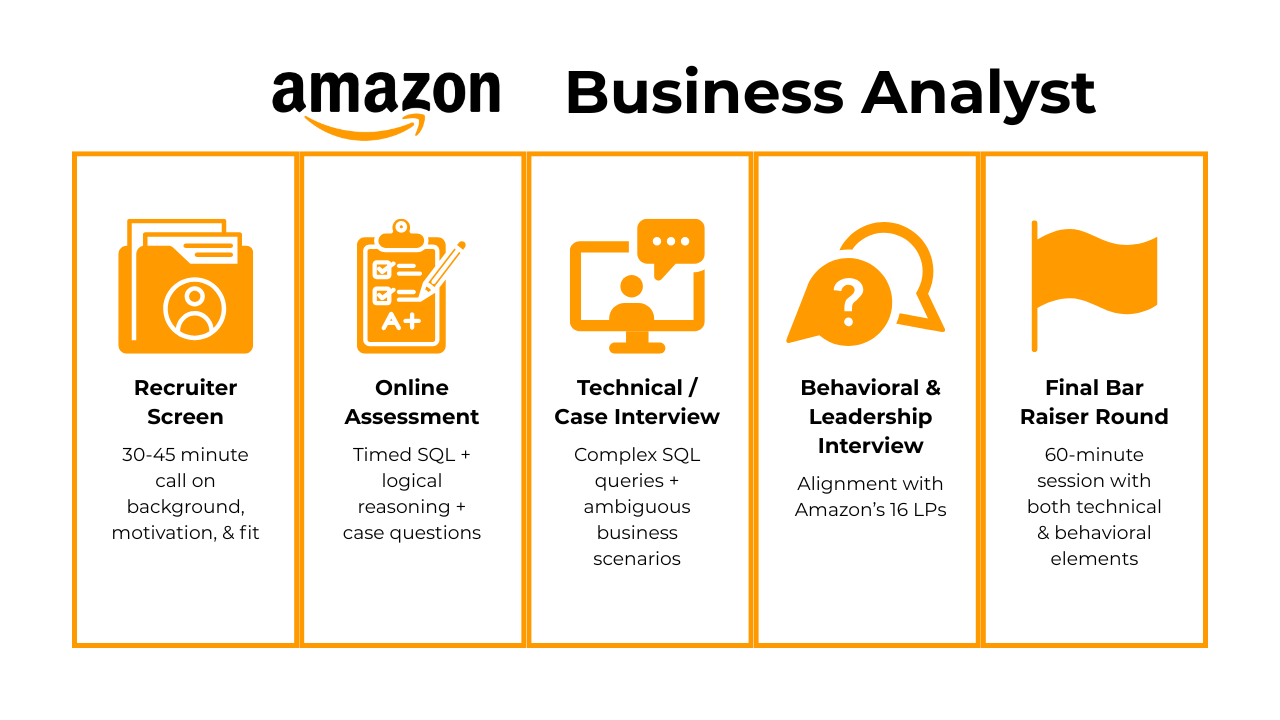
Recruiter Call
The initial recruiter call typically lasts 30-45 minutes, focused on understanding your analytics background, career motivations, and basic technical capabilities. Expect questions about your SQL proficiency, familiarity with statistical analysis, and exposure to business intelligence tools.
This conversation also introduces Amazon’s 16 Leadership Principles and assesses your initial cultural fit, often including one or two behavioral questions to understand how you approach problem-solving and collaboration.
Recruiters may also explain the subsequent interview stages and confirm the process timeline, location preferences, compensation expectations, and your understanding of Amazon’s core business model.
Tip: Be concise and confident. Make a strong first impression by showing both your enthusiasm for Amazon and clarity about your analytical background.
Online Assessment
The Amazon business analyst online assessment typically includes three sections: SQL query problems, logical reasoning questions, and a short business case.
The SQL portion typically tests your ability to extract insights from data, involving 2-4 progressively complex queries with multi-table joins, window functions, subqueries, and aggregations. Meanwhile, the logical reasoning sections assess pattern recognition and problem-solving aptitude through sequences, puzzles, and data interpretation exercises.
Lastly, the case study simulates a real Amazon scenario, such as improving customer retention or optimizing delivery speed. Many candidates find the time constraints challenging, with typical completion times ranging from 60-90 minutes.
Tip: Focus on accuracy and structure over speed. Writing clean, readable SQL and showing clear reasoning in the case section will set you apart from candidates who rush.
Technical/Case Interview
The technical interview dives deep into your analytical capabilities through live problem-solving sessions, typically lasting 60 minutes.
Expect to write SQL queries in real-time using tools like CoderPad or HackerRank, where you might solve problems like analyzing subscription overlap, calculating upsell rates, or aggregating time-series data. Case study discussions require you to approach ambiguous business scenarios such as explaining unexpected metric drops or designing experiments to test new features.
Interviewers look for clarity of thought, attention to detail, and the ability to connect quantitative results to actionable recommendations. A strong answer demonstrates not just how you analyze data, but how you consider trade-offs and how your insights would drive impact at scale.
Tip: Interviewers value transparency in your approach as much as the final answer, so think aloud when you solve problems, especially open-ended ones.
Behavioral/Leadership Interview
The behavioral interview represents Amazon’s most culturally distinctive evaluation stage, structured entirely around the company’s 16 Leadership Principles. Interviewers, often hiring managers or senior team members, ask 3-5 deep-dive questions that probe specific past experiences where you demonstrated principles like Dive Deep, Ownership, and Customer Obsession.
Each question requires detailed responses using the STAR method (Situation, Task, Action, Result) that illustrate not just what you did but why and what impact it created. The evaluation focuses on pattern recognition across your stories, assessing whether you consistently demonstrate Amazon-caliber judgment.
Tip: Select diverse examples from your experience. Mix technical wins with moments of leadership, resilience, and collaboration to paint a well-rounded picture.
Final Bar Raiser Round
The Bar Raiser round serves as Amazon’s quality control mechanism, featuring a specially trained interviewer from outside your target team. This 60-minute session combines both behavioral and technical elements, with the Bar Raiser assessing whether you’d thrive at Amazon long-term.
Bar Raisers are known for asking unconventional questions that probe edge cases or challenge inconsistencies across your interview responses. The round culminates in the Bar Raiser’s recommendation to the hiring committee, weighed not just from your individual qualifications but also how you’d contribute positively to Amazon’s culture.
Candidates who succeed typically demonstrate intellectual curiosity, the ability to uphold Amazon’s standards even under pressure, and a genuine passion for using data to solve customer pain points.
Tip: Bar Raisers value authenticity and logical reasoning over rehearsed answers. Practice behavioral questions on Interview Query to help you craft honest, reflective stories that highlight growth and ownership.
Common Amazon Business Analyst Interview Questions
The Amazon business analyst interview evaluates a candidate’s ability to solve complex problems, analyze data effectively, and demonstrate leadership aligned with Amazon’s core principles. This guide is organized into three main areas: Technical & Case-Based Questions, Analytical & Problem-Solving Questions, and Behavioral & Leadership Principles Questions.
Candidates should approach each question with a structured mindset, using frameworks like STAR for behavioral responses and methodical problem-solving approaches for technical and analytical questions. The examples provided also highlight actionable tips to help you craft precise and impactful answers.
Read more: Business Analyst Interview Questions: A Comprehensive Guide
Technical and Case-Based Interview Questions
Expect a mix of SQL interview questions involving joins, aggregations, window functions, and subqueries, along with Excel tasks focused on pivot tables, lookups, what-if analysis, and dashboards. You may also face data interpretation questions that require identifying trends from charts and metrics, as well as case study questions covering topics like market sizing, metric design, or business growth scenarios.
Determine which Amazon shipments were delivered while customers’ Prime memberships were active.
The task focuses on handling conditional logic, date comparisons, and SQL joins. Start by connecting the
customersandshipmentstables throughcustomer_id, then evaluate whether each shipment date falls between the membership’s start and end dates. ACASE WHENclause can flag deliveries as ‘Y’ for active members and ‘N’ for inactive ones.Tip: When describing your approach, clarify how you handle exact boundary dates.
-
This question tests your ability to handle large-scale transactional data and apply self-joins effectively. Begin by joining the
transactionstable to itself onuser_idto identify items bought in the same order while ensuringp1is alphabetically beforep2to avoid duplicate pairs. Aggregate the results withCOUNT(*)to determine how often each pair occurs, then rank and select the top five. Finally, join theproductstable twice to retrieve product names for both items in the pair.Tip: Explain how you’d optimize performance on large datasets, such as filtering early, indexing
user_id, or using window functions for ranking.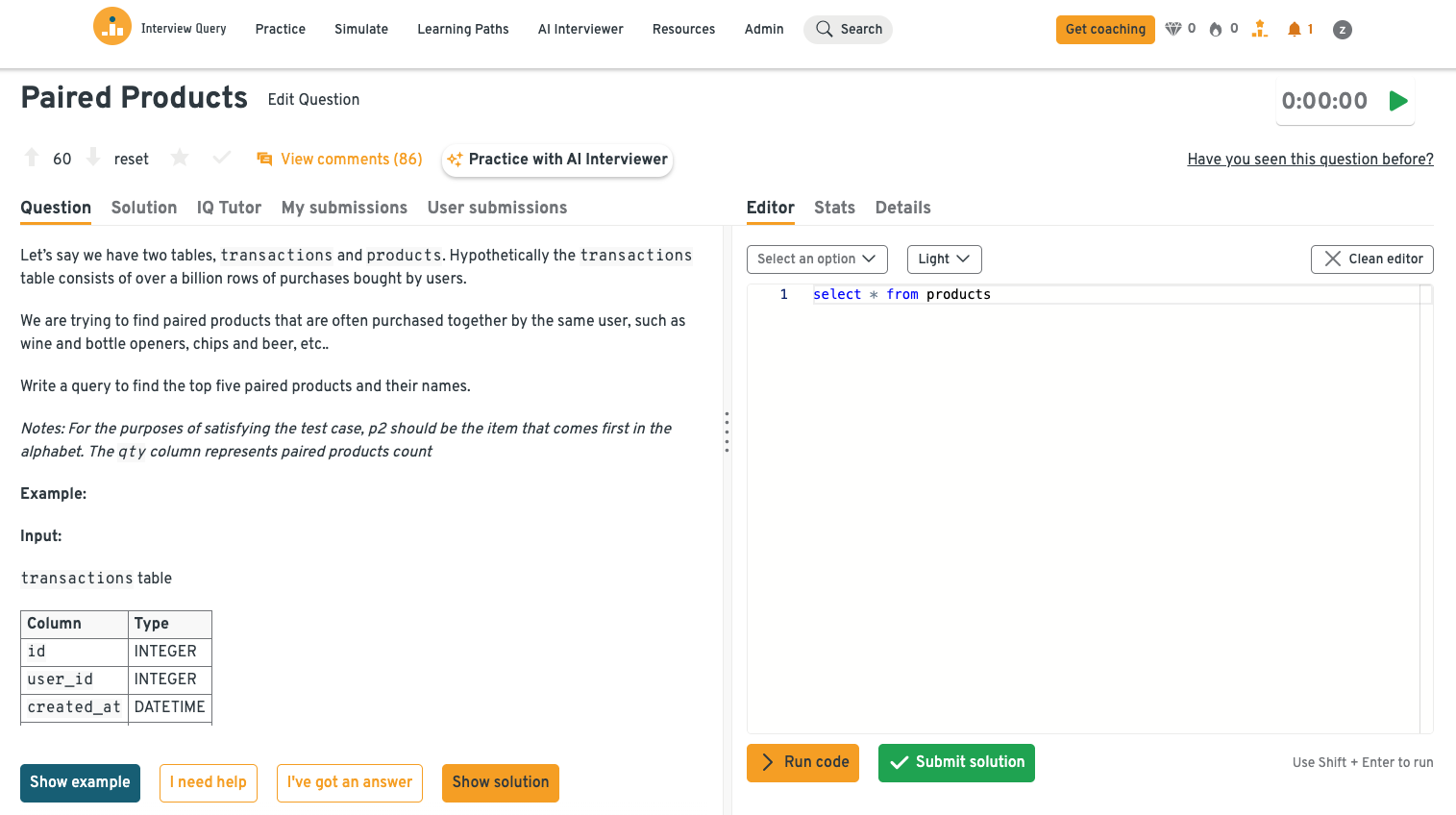
For hands-on practice, try this question on the Interview Query dashboard, where you can also find other Amazon-related questions, the IQ Tutor for step-by-step guidance, and the AI Interviewer to simulate real interview feedback. These features can help you refine your SQL logic, learn best practices, and practice explaining your approach.
Explain how to test whether the change in a monthly performance metric is statistically significant.
The question involves hypothesis testing, data variability, and interpretation of statistical results. The process begins by setting a null hypothesis that the difference is due to random fluctuation, followed by a t-test or z-test depending on sample characteristics. The real value lies in interpreting outcomes within a business context, acknowledging seasonality or campaign shifts that may drive the change.
Tip: Go beyond stating the test result by linking statistical significance to meaningful operational insight.
-
You’re being assessed on financial reasoning, time-value concepts, and modeling proficiency. Construct both scenarios in Excel, discounting future payments to present value for fair comparison. Then weigh each structure’s total cost and liquidity effects to determine which supports healthier cash flow.
Tip: A strong answer highlights key assumptions, like discount rate or available cash balance, to show how financial context shapes your recommendation.
Using Excel, demonstrate how to create a dashboard to track product-level sales trends.
Excel mastery, data summarization, and design for clarity matter for this question. Import sales data, summarize performance metrics with pivot tables, and build dynamic references using VLOOKUP or INDEX-MATCH. Incorporate what-if analysis for forecasting and visualize trends through clean, interactive charts and slicers.
Tip: Emphasize usability. Amazon executives prefer dashboards that surface KPIs instantly, avoid clutter, and make performance patterns easy to interpret.
Given a performance dashboard showing order volume, delivery time, and defect rate by region, identify key insights and trends affecting customer satisfaction.
Your answer should highlight analytical storytelling and the ability to translate data into strategic insight. Look for relationships, such as longer delivery times correlating with lower satisfaction, and pinpoint regions that deviate sharply from averages. Present findings that connect metrics to potential causes, like supply delays or staffing issues, and summarize implications for improvement.
Tip: Structure your summary around clarity and action: one standout trend, one key driver, and one focused next step.
Estimate the potential revenue impact of launching same-day delivery in a new market.
This case-style question evaluates your ability to size markets and forecast outcomes using structured reasoning. Start by estimating the market size and penetration rate, then project adoption based on comparable regions or pilot data. Layer in assumptions for average order value, expected frequency, and incremental lift from faster delivery. Summarize the revenue potential while noting key sensitivities that could alter the outcome.
Tip: Outline your assumptions clearly and mention how you’d validate them with historical or benchmarking data once available.
Analytical and Problem-Solving Questions
In this interview round, you’ll be evaluated on how effectively you turn data into decisions through KPI design and measurement, root cause analysis, and A/B testing interpretation. Knowing how to analyze trends, test hypotheses, and forecast market movements that drive Amazon’s customer and revenue goals also strengthens your performance for this round.
-
This question highlights your ability to combine data analysis with business strategy to optimize pricing decisions. You’d start by gathering historical pricing, demand elasticity, and competitor data to understand how customers respond to price changes. Build models to predict the impact on conversion and profit margins, then segment products or customers to identify sensitivity patterns. Finally, validate your insights through controlled experiments and measure outcomes like revenue growth and customer satisfaction.
Tip: Practice explaining your pricing logic clearly and tie it back to measurable business impact, such as higher profit margins or improved customer trust.
-
Here, interviewers are assessing your ability to dissect complex business problems using data. Begin by breaking revenue into its key drivers: price, quantity, and customer acquisition. Examine time-series and cohort trends to isolate which components or categories are underperforming. From there, use funnel analysis or attribution data to identify specific levers causing the decline and build actionable recommendations.
Tip: Emphasize your structured thinking process when answering, walking through how you’d prioritize hypotheses and validate them with data.
-
This question explores how well you understand experimental design and statistical inference. Make sure the experiment has balanced randomization and a sufficient sample size, then compare conversion rates between control and treatment groups using hypothesis testing. Calculate confidence intervals and p-values to determine statistical significance. Go beyond conversions by evaluating related metrics such as order value or cart abandonment.
Tip: Always mention both statistical and practical significance to show you can interpret numbers in a real-world business context.
-
Interviewers want to see how you balance experimentation with strategic judgment. You’d set up an A/B or geo-based test with clear control and treatment groups, ensuring a representative enterprise sample. Track key outcomes like churn, lifetime value, and overall revenue per customer to measure trade-offs. In the end, determine if the additional revenue justifies potential attrition and aligns with Amazon’s long-term customer-centric philosophy.
Tip: Show that you consider both short-term revenue metrics and long-term customer relationships when framing your answer.
How would you identify underperforming product categories on Amazon using customer engagement, conversion, and return rate metrics?
Expect this question to test your diagnostic thinking and metric interpretation skills. You’d compare KPIs across categories, adjusting for factors like traffic and visibility to ensure fairness. Visualize patterns to uncover areas where engagement or conversion lags, or where returns spike unexpectedly. Then, investigate causes like pricing, quality, competition, and recommend targeted interventions to boost category health.
Tip: When discussing this type of analysis, mention specific tools or dashboards (like Tableau or SQL) to demonstrate hands-on analytical experience.
Amazon customers are abandoning their carts at a higher rate than usual. How would you analyze the data to uncover the cause and recommend actions?
This scenario examines your ability to trace user behavior and isolate bottlenecks in the purchase funnel. Start by reviewing funnel metrics from product views to checkout completion and segment the data by device, region, or category. Identify where drop-offs intensify and correlate them with potential issues like unexpected fees, delivery estimates, or page load times. Once you’ve pinpointed the friction points, suggest solutions such as simplified checkout, clearer pricing, or retargeting strategies.
Tip: In your response, focus on actionable insights and show that you can move from identifying a problem to proposing measurable solutions.
How would you define the KPIs and ensure statistically valid experiment results for a newly launched feature on Amazon Business?
You’re being tested on your ability to connect metrics to business goals and ensure analytical rigor. Define primary and secondary KPIs that reflect the feature’s intended value, e.g. conversion rate, retention, or customer satisfaction. Estimate the required sample size for statistical power and monitor for external biases or seasonality. Finally, validate the experiment through confidence intervals, pre-launch A/A testing, and post-launch tracking to confirm reliability before scaling.
Tip: Explore Interview Query for more analytical questions like this. You can practice your business storytelling skills and communicate results to stakeholders in simple, metric-driven terms.
Behavioral Interview and Leadership Principles
Amazon places a strong emphasis on its 16 Leadership Principles, which guide decision-making, prioritization, and team collaboration. Interviewers assess how candidates demonstrate values like customer obsession, ownership, bias for action, and a drive for results. Using the STAR method (Situation, Task, Action, Result) helps structure your responses clearly, ensuring you highlight context, your initiative, the steps you took, and the measurable outcome.
-
Amazon values and culture are central to this question, and interviewers look for genuine alignment with its Leadership Principles. Highlight what excites you about the company and connect your experiences to principles like customer obsession, ownership, or innovation.
Sample answer: I am inspired by Amazon’s customer obsession and commitment to innovation. In my previous role, I consistently sought to improve processes based on user feedback, which aligns with Amazon’s approach to delivering results. I value continuous learning and ownership, which makes me eager to contribute to projects that impact millions of customers.
Tip: Connect specific past experiences to the Leadership Principles and show how your values align with Amazon’s culture.
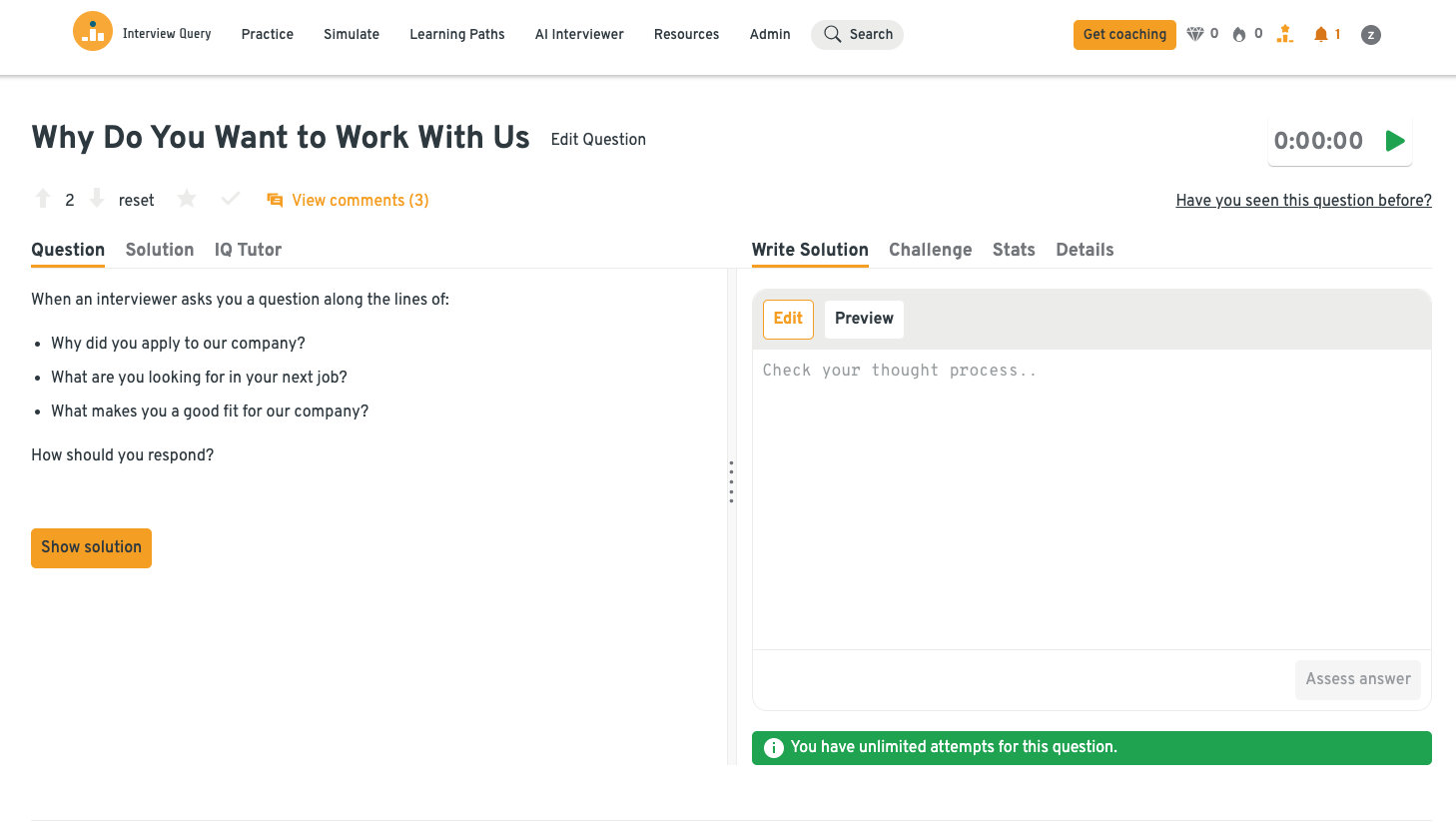
Practice answering this question on the Interview Query dashboard, where you can run not only SQL queries for coding challenges but also check your thought process for behavioral questions. The dashboard also features the IQ tutor for guided solutions and user comments to compare your answer with other IQ community members.
-
Interviewers want to see self-awareness and reflection, along with how your skills or challenges impact results. Emphasize a strength that drives success in analytical work and a weakness you are actively improving.
Sample answer: One of my strengths is the ability to quickly dive deep into data and identify actionable insights, which helped my team increase revenue by 10%. A weakness I’ve worked on is delegating tasks; I used to take on too much myself, but I’ve learned to assign responsibilities more effectively while maintaining quality.
Tip: Balance honesty with growth. Show that you recognize areas to improve and actively take steps to strengthen them.
-
This question highlights communication skills, problem-solving, and your ability to influence others. Share an example where your simplification made a measurable difference.
Sample answer: At my previous company, I simplified a reporting dashboard that previously required manual aggregation of multiple data sources. I created an automated pivot table system and clear visualizations, which reduced analysis time by 50% and made it easier for non-technical stakeholders to track key metrics.
Tip: Emphasize clarity and impact. Highlight how simplifying the process improved efficiency or decision-making.
Tell me about a time you used data to challenge an existing decision or assumption within your team.
Interviewers are looking for critical thinking, courage to question assumptions, and the ability to use data to influence decisions. Describe how your analysis led to a better outcome.
Sample answer: In a marketing campaign review, I noticed that conversion rates were lower than expected in a particular segment. I analyzed the user behavior data and presented evidence that reallocating budget to high-performing segments would increase ROI. Leadership adopted the recommendation, and we improved campaign efficiency by 15%.
Tip: Show how you backed up your challenge with data and present it constructively to drive better decisions.
Give an example of when you took ownership of a project that was falling behind schedule and how you delivered results.
Ownership, accountability, problem-solving, and resilience under pressure are the skills being assessed here. Explain the challenge, your initiative, and the impact of your actions.
Sample answer: During a product launch, our analytics pipeline had missing data, threatening our timeline. I coordinated with engineering and data teams, implemented temporary workarounds, and ensured reporting continued. The launch proceeded on schedule, and the team avoided potential revenue loss.
Tip: Highlight initiative and follow-through. Focus on tangible outcomes that demonstrate you can own results end-to-end.
Describe a situation where you dove deep into data to uncover an unexpected insight that influenced a key business decision.
This question tests analytical rigor, curiosity, and the ability to translate insights into business value. Focus on the insight and its effect on decision-making.
Sample answer: While analyzing churn rates, I discovered that cancellations were concentrated in a specific customer segment using a particular feature incorrectly. After sharing the insight, the product team implemented a UX change and educational messaging, reducing churn in that segment by 12%.
Tip: Make sure to quantify impact whenever possible. Highlight how the insight influenced a concrete business decision.
Looking for more practice questions? In this video, Interview Query co-founder Jay Feng walks through common business analyst interview questions, showing how candidates can approach both technical and behavioral scenarios effectively.
The video emphasizes the importance of connecting technical answers to business impact, thus making your answers concise, measurable, and aligned with Amazon’s culture.
Ultimately, mastering these questions is only one part of the interview journey. To excel, you also need a focused strategy for preparation, including practicing SQL and Excel exercises, refining your analytical reasoning, and rehearsing STAR-based responses through Interview Query. The next section will guide you on how to prepare for the Amazon business analyst interview, helping you approach each round with confidence and clarity.
Amazon Business Analyst Interview Prep Checklist
Effective interview preparation for the Amazon business analyst role requires a structured, multi-phase approach. This proposed timeline aims to build technical proficiency, business understanding, behavioral storytelling capabilities, and practical interview skills over 4-8 weeks.
| Phase | Tasks / Checklist | Quick Tips |
|---|---|---|
| Technical Mastery (Weeks 1-3) | • Do 3-5 daily SQL problems on Interview Query or LeetCode • Build pivot tables, charts, and analyses in Excel • Review statistical fundamentals: A/B tests, regression • Create dashboards and apply data storytelling using Kaggle datasets |
Track your time and error patterns to identify weak areas early. |
| Business Acumen (Weeks 2-4) | • Study Amazon’s revenue streams • Learn key metrics for Amazon products • Learn decision frameworks: Working Backwards, trade-off analysis • Research team-specific challenges, investor reports, and company news |
Connect metrics to decision-making scenarios to demonstrate analytical thinking. |
| Behavioral Stories (Weeks 3-5) | • Map experiences to 16 Leadership Principles (2–3 stories each) • Structure answers using STAR method: Situation, Task, Action, Result |
Practice storytelling in casual conversations to sound natural and confident under pressure. |
| Mock Practice (Weeks 4-6+) | • Schedule mock interviews on Interview Query for SQL & case practice • Film and time yourself to review communication & body language • Simulate real interview conditions (whiteboard or virtual) |
After each mock, note areas for improvement and update story bank. |
Business Analyst Portfolio and Project Presentation Tips
A well-curated portfolio demonstrates your analytical capabilities and business impact more effectively than your resume alone. Whether you’re presenting during a phone screen or discussing your work during the technical rounds, having concrete examples of your analytical work readily accessible sets you apart in competitive Amazon business analyst interviews.
Select and Structure Your Best Projects
Choose projects that highlight a range of analytical skills and clearly document your approach.
- Select 3–5 projects demonstrating SQL querying, statistical analysis, data visualization, and business recommendations.
- For each project, include the business problem, your analytical approach, key findings, and measurable results.
- Create a dedicated portfolio website using GitHub Pages for technical audiences, Notion for its flexibility and ease of updates, or Webflow and Wix for more polished, professional presentations.
Tip: Make sure your portfolio site loads quickly and displays visualizations clearly by testing it on both desktop and mobile devices.
Link Every Project to Measurable Business Results
Amazon’s culture revolves around data-driven decision-making and measurable impact. Transform analytical work into business value by connecting your findings to concrete results:
| Impact Area | Weak (Before) | Strong (After) | Quick Tip |
|---|---|---|---|
| Revenue Impact | Suggested changes to pricing strategy to improve revenue. | Recommended pricing optimization strategy that generated $2.3M in incremental annual revenue by identifying underpriced product categories. | Always quantify impact and connect it to a specific action. |
| Conversion Improvements | Worked on improving the checkout process to get more users to complete purchases. | Increased checkout conversion rate by 18% through cohort analysis that identified and addressed top three friction points in the purchase funnel. | Include metrics and the method used to derive insights. |
| Cost Savings | Tried to reduce marketing costs using a model. | Reduced customer acquisition cost by 31% by building predictive model that optimized marketing spend allocation across channels. | Show exact savings and explain how analysis influenced the outcome. |
| Efficiency Gains | Improved reporting process so it was faster. | Automated weekly reporting process that reduced manual analysis time from 20 hours to 2 hours, freeing team to focus on strategic initiatives. | Highlight measurable efficiency gains and downstream impact. |
| Customer Experience | Helped improve delivery experience for customers. | Identified delivery bottlenecks through operational data analysis, improving on-time delivery rate from 87% to 94% and reducing customer complaints by 22%. | Tie improvements to specific customer metrics and your contribution. |
Even for academic or personal projects without direct business metrics, frame your work in terms of potential impact: “This analysis could help e-commerce companies reduce cart abandonment by identifying the optimal checkout flow.”
Design Dashboards That Tell Clear Stories
Data visualization is a critical skill for business analysts, and your portfolio should demonstrate your ability to transform complex datasets into actionable insights through clear visual communication. Include interactive Tableau dashboards or high-quality static visualizations created in Python, R, or Excel that showcase different visualization types appropriate to your analytical questions. Every dashboard should follow data storytelling principles:
- Clear, descriptive titles that state the insight rather than just labeling the chart type
- Proper axis labels, legends, and data source citations for credibility
- Consistent color schemes that highlight key findings and maintain professional aesthetics
- Before/after comparisons that demonstrate the impact of interventions or changes
- Executive summary views that present high-level KPIs for leadership audiences
Tip: Avoid “data dumps” where you simply display all available data without clear purpose or narrative thread. Each visualization should answer a specific business question or support a particular recommendation.
Prepare to Explain Your Analytical Methodology
During Amazon business analyst interviews, interviewers will probe the depth of your technical knowledge by asking detailed questions about your methodology, data sources, and analytical choices. Be prepared to walk through your complete analytical process:
- Data sources and collection: Explain where your data came from, how you accessed it, and any data quality issues you encountered
- Data cleaning and preparation: Describe how you handled missing values, outliers, duplicate records, and data type conversions
- Analytical techniques: Justify why you chose specific approaches
- Example: “I used cohort analysis rather than simple month-over-month comparison because it accounts for user lifecycle differences and seasonal variations.”
- Tool selection: Explain your technical stack choices
- Example: “I used PostgreSQL for data extraction because of the large dataset size, then moved to Python pandas for transformation and analysis.”
- Limitations and trade-offs: Demonstrate critical thinking by discussing constraints
- Example: “I couldn’t access individual customer data due to privacy restrictions, so I aggregated at the segment level, which limited granularity but still provided actionable insights.”
Tip: Include appendices in your project documentation with SQL queries, Python code, or Excel formulas. Improve technical depth and code quality through Interview Query’s structured learning paths.
Business Analyst Resume and LinkedIn Optimization for Amazon
Your resume and LinkedIn profile should not only demonstrate your technical proficiency but also show that you embody Amazon’s Leadership Principles. Recruiters look for measurable impact, ownership, and data-driven decision-making, so your application should highlight these clearly.
1. Quantify Impact
Recruiters should quickly see the real-world impact of your work, demonstrating that you can drive measurable business outcomes and contribute to Amazon’s results-oriented culture.
- Use specific numbers: percentages, dollar amounts, time saved, customers impacted, data volume analyzed.
- Include context for scale: “Analyzed 50M+ rows of transaction data” or “Built dashboard serving 200+ daily users”
- Structure bullets as: [Result achieved] by [analytical method used] resulting in [business outcome].
Tip: Always pair the metric with the specific action you took to achieve it. This tells the story of ownership and results.
2. Highlight Technical Skills
Demonstrating increasing sophistication signals that you can handle Amazon’s complex, data-driven projects and grow into more challenging analytical roles.
- Include relevant tools and software in both the skills section and project descriptions:
- Languages/Querying: SQL (PostgreSQL, MySQL, Redshift), Python (pandas, numpy, scikit-learn), R
- Visualization: Tableau, QuickSight, Power BI, Matplotlib, Seaborn
- Tools: Excel (advanced), Google Analytics, Looker, Mode Analytics
- Cloud/Big Data: AWS (S3, Redshift, Athena), BigQuery, Snowflake
- Statistical Methods: A/B testing, regression analysis, hypothesis testing, forecasting
- Demonstrate applied skills, not just familiarity.
Tip: Show progression in technical complexity, such as moving from basic reporting to predictive models or automated dashboards.
3. Emphasize Ownership and Cross-Functional Projects
Amazon values leaders who take ownership and drive collaboration across functions. Following this tip signals your ability to navigate complex organizational structures and deliver impact.
- Highlight projects where you led initiatives or collaborated across teams. Use action verbs like “led,” “owned,” “developed,” and “implemented” to emphasize accountability.
- Show stakeholder management and coordination.
Tip: Briefly note team size, departments involved, or challenges overcome to give hiring managers a clearer picture of your influence.
4. Integrate Leadership Principles into Language
Subtly demonstrating alignment with Amazon’s culture shows recruiters that you not only have the skills but also fit their core values. This boosts your chances of passing the recruiter screen and progressing in the hiring process.
- Without explicitly naming the principles, weave them naturally into bullet points.
- Examples:
- Customer Obsession: “Analyzed feedback data to identify top pain points, implementing solutions that improved NPS by 8 points.”
- Dive Deep: “Performed detailed cohort analysis to uncover hidden patterns in user engagement metrics.”
- Deliver Results: “Executed pricing optimization initiative, increasing revenue by 12% within one quarter.”
Tip: Tailor the language for each application. If the role emphasizes operations, highlight “Deliver Results” and “Dive Deep” examples; for product analytics, emphasize “Customer Obsession” and “Invent & Simplify.”
5. Increase LinkedIn Profile Credibility
A strong LinkedIn presence increases visibility to recruiters and reinforces credibility. It also gives you a competitive edge for the Amazon BA role by allowing you to showcase projects that might not fit on a resume.
- Mirror resume highlights in your LinkedIn “About” section and experience descriptions.
- Use keywords from Amazon job postings (SQL, Tableau, business analytics, KPIs) to improve discoverability.
- Add projects, dashboards, or GitHub links where possible to showcase tangible work.
Tip: Keep language concise and metric-focused. Think of your LinkedIn profile as a dynamic, interactive resume that reinforces your data-driven story.
✅ Quick View
Here’s a quick summary of these tips with corresponding examples to help you craft a resume and profile optimized for Amazon’s interview process and hiring standards:
| Tip | Example |
|---|---|
| Quantify Impact | “Reduced customer churn by 15% by building predictive model in Python that identified at-risk segments 30 days before cancellation.” |
| Highlight Technical Skills | “Built SQL pipelines to analyze customer behavior and identify high-value segments.” |
| Ownership & Cross-Functional Work | “Led cross-functional initiative to revamp churn analysis, collaborating with product and engineering teams, reducing cancellations by 12%.” |
| Leadership Principles Integration | “Analyzed feedback data to identify top pain points, implementing solutions that improved NPS by 8 points.” |
| LinkedIn Profile Credibility | Adding dashboards, project links, or GitHub repos to the Featured section for credibility. |
Top Mistakes to Avoid in the Amazon Business Analyst Interview
Amazon’s interview process is fast-paced and multi-faceted. Time pressure and ambiguity throughout all rounds can cause mistakes, whether you over-focus on coding accuracy during technical assessments or get stuck when answering case-based or behavioral questions.
However, being aware of these common challenges helps you focus preparation not just on solving problems, but on communicating impact and positioning yourself as a stronger candidate for the Amazon business analyst role.
| Mistake | Why it’s a mistake | Key Avoidance Tips |
|---|---|---|
| Over-Relying on Technical Skills Without Business Context | Focusing only on queries or models makes your analysis look like a technical exercise rather than a business solution. | - End technical answers with business implications. - Ask clarifying questions about business context. - Follow Technical → Insight → Recommendation framework. - Explain results in non-technical language. |
| Ignoring or Underestimating Leadership Principles | Shallow examples or memorized answers show lack of cultural fit and authenticity. | - Study all 16 principles; focus on Customer Obsession, Dive Deep, Deliver Results, Earn Trust, Ownership. - Prepare stories that naturally demonstrate principles. - Use Amazon language (e.g., “working backwards,” “diving deep”). - Highlight lessons from failures. |
| Giving Vague or Incomplete STAR Responses | High-level summaries without metrics make it hard to assess your impact. | - Follow 2–3 min STAR format: 30s Situation/Task, 90s Actions, 30s Results. - Use “I” to clarify personal contribution. - Include tools, data volumes, stakeholders, and timelines. - Prepare for follow-ups. |
| Poor Communication During Technical Interviews | Silent coding or skipping explanations leaves interviewers unclear about your thought process. | - Start with clarifying questions. - Think aloud; explain choices and trade-offs. - Outline approach before coding. - Acknowledge and explain mistakes. - Summarize solution and complexity. |
Tip: Sign up for Interview Query’s coaching services for personalized guidance and feedback from coaches with firsthand experience in Amazon’s interview process.
Business Analyst Salary, Offers, & Career Pathways at Amazon
Amazon’s compensation structure for business analysts is highly competitive and follows a tiered leveling system that reflects both experience and scope of responsibility. Understanding how Amazon structures business analyst career paths, compensation packages, and growth opportunities helps you evaluate offers strategically and plan long-term career progression.
Amazon Business Analyst Levels and Compensation
Amazon business analysts typically enter at one of three core levels, each with distinct expectations and compensation ranges.
According to recent Levels.fyi data, Amazon business analyst compensation includes base salary, Restricted Stock Units (RSUs), and sign-on bonuses that together create highly competitive total compensation packages. Below is a summary of the average compensation based on level and experience:
| Level + Title | Experience | Base Salary | Total Compensation (Base + RSUs + Sign-On) |
|---|---|---|---|
| L4: Business Analyst I | Entry-level to 2 years of professional analytics experience | $80K | $105K |
| L5: Business Analyst II | 3–6 years of analytics experience with demonstrated business impact | $105K | $135K |
| L6: Senior Business Analyst | 6+ years with track record of driving significant business outcomes | $135K | $175K |
Average Base Salary
Average Total Compensation
Understanding Amazon’s Compensation Components
Amazon structures compensation differently than many tech companies, with important details that affect your take-home pay and financial planning:
- Base Salary: Amazon caps base salaries at approximately $160K-$180K regardless of level, meaning senior roles achieve higher total compensation primarily through equity rather than base pay. This base salary philosophy keeps fixed costs lower while tying compensation to company performance through equity.
- Restricted Stock Units (RSUs): RSUs form the largest component of total compensation for L5 and L6 business analysts, but Amazon’s vesting schedule is back-loaded compared to typical tech companies. The standard vesting schedule is 5% year 1, 15% year 2, 40% year 3, and 40% year 4, but Amazon compensates for this through sign-on bonuses that “make up” for the missing equity in years 1-2.
- Sign-On Bonuses: Amazon offers substantial sign-on bonuses to offset the back-loaded equity structure. These bonuses are typically paid in two installments (year 1 and year 2) and come with repayment clauses if you leave before the bonus period ends.
- Annual Bonuses: Business analysts are eligible for performance-based annual bonuses typically ranging from 10-20% of base salary, though these are less emphasized than equity in Amazon’s compensation philosophy.
Navigating Offer Negotiation
Amazon business analyst job offers are negotiable, though the company has structured bands for each level and generally doesn’t move as dramatically as some other tech companies. Successful salary negotiation at Amazon requires understanding what’s flexible, what’s fixed, and how to present your case.
| Category | Details / Action Items |
|---|---|
| Negotiable Components | • Sign-on bonus • Initial RSU grant • Start date & relocation assistance • Level (if on the border between L4/L5 or L5/L6) |
| Typically Fixed | • Base salary within level band (limited flexibility) • Vesting schedule • Benefits & 401k matching |
Below are negotiation strategies to take note of:
- Present competing offers from companies with similar prestige: Highlight offers from top-tier tech companies like Google, Meta, Microsoft, or highly valued unicorns to provide context for your market value. Frame it professionally; show that your goal is to find the best fit and value, not to create conflict.
- Quantify unvested equity or bonuses you’re leaving behind: Clearly communicate the financial impact of leaving your current company, including unvested RSUs, annual bonuses, or retention incentives. Use concrete numbers to justify requests for a higher sign-on bonus or RSU grant.
- Emphasize unique skills relevant to the team: Highlight specialized experience or technical expertise that directly benefits the team’s mission (e.g., AWS analytics, advertising metrics, supply chain modeling). Explain how your skills accelerate project delivery, improve efficiency, or drive revenue.
- Ask about level: If your experience aligns with the higher end of a level, make a data-driven case for L5 vs L4 or L6 vs L5. Show how your contributions, leadership, or technical depth justify the higher level, which significantly impacts total compensation.
- Request feedback on your interview performance: Politely ask the recruiter or hiring manager where you stood during interviews. Use this insight to strengthen your negotiation rationale and understand potential gaps in your offer.
- Work with your recruiter to understand team-specific compensation ranges: Some teams (AWS, Advertising, Operations) have more flexibility in RSU grants or sign-on bonuses. Ask for range guidance to tailor your negotiation strategy effectively without overreaching.
Tip: Amazon typically provides 5-7 business days to accept offers, though they’ll extend if you have pending interviews elsewhere. Don’t focus solely on year 1 numbers; use this time to evaluate salary expectations based on the team fit, growth opportunities, and long-term compensation trajectory.
Career Growth and Internal Mobility
Amazon’s strong internal mobility culture creates diverse pathways for business analysts to advance their careers, whether deepening analytical expertise or transitioning to adjacent roles. The company encourages internal movement after 12-18 months in role, making it common for business analysts to explore different business areas or career tracks:
- Analytics Track Progression: Business analysts can advance through the analytics career ladder (L4 → L5 → L6 → L7 Senior Manager) by demonstrating increasing scope of impact, technical depth, and business influence. Promotion criteria focus on your ability to operate at the next level.
- Transition to Product Management: Many business analysts leverage their analytical background and business acumen to transition into Product Manager roles at Amazon. This pathway requires demonstrating customer obsession, product thinking, and the ability to drive roadmap decisions.
- Finance and Strategy Roles: Positions in Finance, Corporate Strategy, or Business Development roles add emphasis on P&L ownership, deal analysis, and long-term planning. The transition is common for analysts working in retail, marketplace, or AWS finance teams.
- Data Science and Machine Learning: Technically-inclined business analysts who develop Python, statistical modeling, and machine learning skills sometimes transition into Data Scientist or Applied Scientist roles. This pathway typically requires demonstrating technical depth through side projects, certifications, or taking on ML-adjacent work.
Tips for maximizing internal mobility:
- Build relationships across teams by participating in analytics communities of practice.
- Volunteer for cross-functional projects that expose you to different business areas.
- Seek mentors in roles you aspire to reach and shadow their work when possible.
- Document your impact with metrics and stakeholder testimonials for internal promotion packets.
- Apply to internal roles that interest you, as Amazon’s culture encourages exploration and learning.
FAQs
What are the most common technical questions for Amazon business analysts?
Expect SQL queries, data manipulation, and business problem-solving. Common SQL topics include joins (LEFT, INNER), window functions (ROW_NUMBER, LAG/LEAD), GROUP BY aggregations, subqueries, and CTEs. Statistical questions cover A/B testing, p-values, confidence intervals, and regression or correlation concepts explained to non-technical audiences.
Does Amazon focus more on SQL or Excel?
SQL is emphasized far more than Excel due to Amazon’s large datasets. Excel is used for ad-hoc analyses, quick modeling, and stakeholder presentations, but most live technical interviews test SQL coding and database manipulation. Strong Excel skills remain a differentiator, particularly in finance or operations teams.
How do Leadership Principles affect business analyst interviews?
Behavioral interviews are evaluated against Amazon’s 16 Leadership Principles. Each question is designed to uncover alignment with principles like Customer Obsession, Ownership, Dive Deep, Deliver Results, and Earn Trust. Strong candidates prepare 2–3 stories per principle and naturally weave principle-aligned language into responses rather than relying on rehearsed answers.
What case questions are typical in Amazon BA interviews?
Case questions present ambiguous business scenarios that test your problem-structuring, metric definition, and analytical thinking. Examples include investigating metric drops, measuring feature success, optimizing operations, and designing A/B tests. Interviewers evaluate your ability to ask clarifying questions, propose multiple hypotheses, outline analytical approaches, and connect findings to actionable business recommendations.
How can I prepare for the Bar Raiser round?
Bar Raisers evaluate analytical thinking, cultural alignment, and long-term potential. Prepare authentic stories with details on decision-making, alternatives considered, results, and lessons learned. Expect unconventional follow-ups testing edge cases and hypothetical variations. Focus on demonstrating intellectual curiosity, reflection, and your ability to “raise the bar.”
What’s the best way to demonstrate business impact in an interview?
Quantify results and connect them to business outcomes. Use the formula: “I achieved [metric improvement] by [analytical approach] resulting in [business outcome].” Include percentages, dollar amounts, time saved, or customers impacted, as well as before/after metrics where possible.
What are the salary levels for business analysts at Amazon?
Compensation varies by level and location, combining base salary, RSUs, and sign-on bonuses. L4 (BA I) total compensation start at $105K, while L5 (BA II) ranges from $135K to $150K. Total compensation for L6 (Senior BA) roles starts at $175K, but can reach $200K due to equity vests in years 3–4.
Can I transition internally from a BA to a data analyst or PM role?
Yes. BAs gain transferable skills for product management, data science, finance, and strategy. To prepare, take projects building relevant skills, network internally, align development goals with your manager, and apply to internal postings. PM transitions are common for BAs who show strong product thinking, customer obsession, and influence without authority.
Conclusion and Next Steps
Preparing for an Amazon business analyst interview can feel intense, but with a clear plan, you can stay authentic while also standing out. Focus on sharpening your SQL and case‑study skills, refining your Leadership Principle stories, and mastering data storytelling.
Practice real questions on Interview Query, alongside other resources like the SQL Interview Learning Path for a structured strategy, and Mock Interviews to simulate both technical and behavioral rounds. With consistent practice and focused preparation, you’ll walk into your interview confident, clear, and ready to show your impact.
Next steps: Begin your mock interviews this week, deepen your SQL proficiency, and map your story bank to Amazon’s culture, all toward one goal: impressing confidently and authentically.
Amazon Interview Questions
| Question | Topic | Difficulty |
|---|---|---|
Brainteasers | Medium | |
When an interviewer asks a question along the lines of:
How would you respond? | ||
Brainteasers | Easy | |
Analytics | Medium | |
SQL | Easy | |
Machine Learning | Medium | |
Statistics | Medium | |
SQL | Hard | |
Machine Learning | Medium | |
Python | Easy | |
Deep Learning | Hard | |
SQL | Medium | |
Statistics | Easy | |
Machine Learning | Hard |
Discussion & Interview Experiences