

CS Majors Decline as Students Chase AI Jobs. Are They Chasing the Right Trend?


From CS Boom to AI Degrees
Over the last two years, universities across the U.S. have seen a remarkable shift in what aspiring technologists want to study. Dozens of institutions now offer standalone AI majors or heavily AI-focused tracks.
For example, the New York Times reports that the University of South Florida’s newly created College of Artificial Intelligence and Cybersecurity enrolled more than 3,000 students in its first semester. And at MIT, its “Artificial Intelligence and Decision-Making” program, launched just a few years ago has quickly become the second most popular undergraduate major, right after the long-dominant Computer Science.
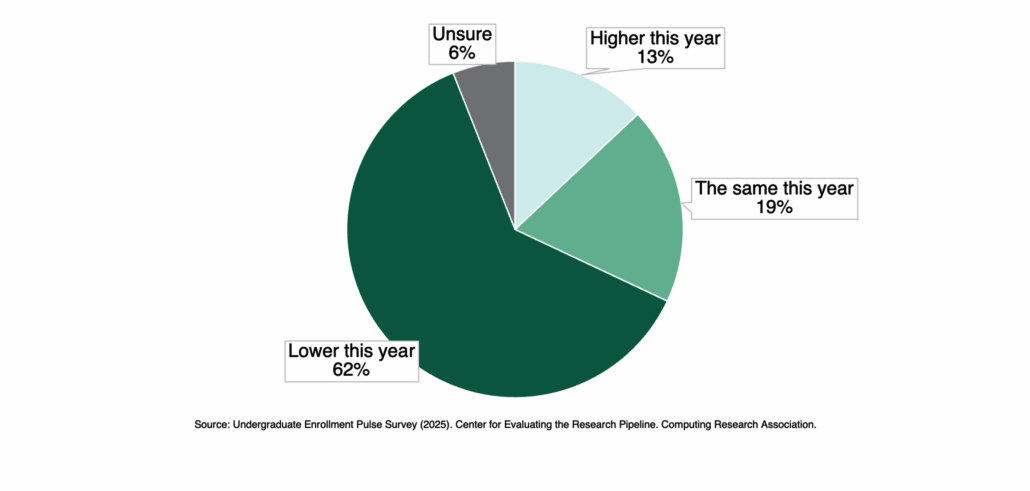
The tide thus appears to be turning against traditional Computer Science programs. According to a recent CRA report, 62% of computing programs nationally reported declines in undergraduate enrollment this fall. This shift suggests a rethinking of what “computing education” looks like: instead of a broad CS degree, many students are opting for specialized AI- and ML-oriented tracks.
But the excitement raises an obvious question: Is an AI degree genuinely becoming a fast track to stable, high-demand tech jobs, or are students betting on a future that may not arrive as smoothly as they expect?
The Growing Demand for AI Skills
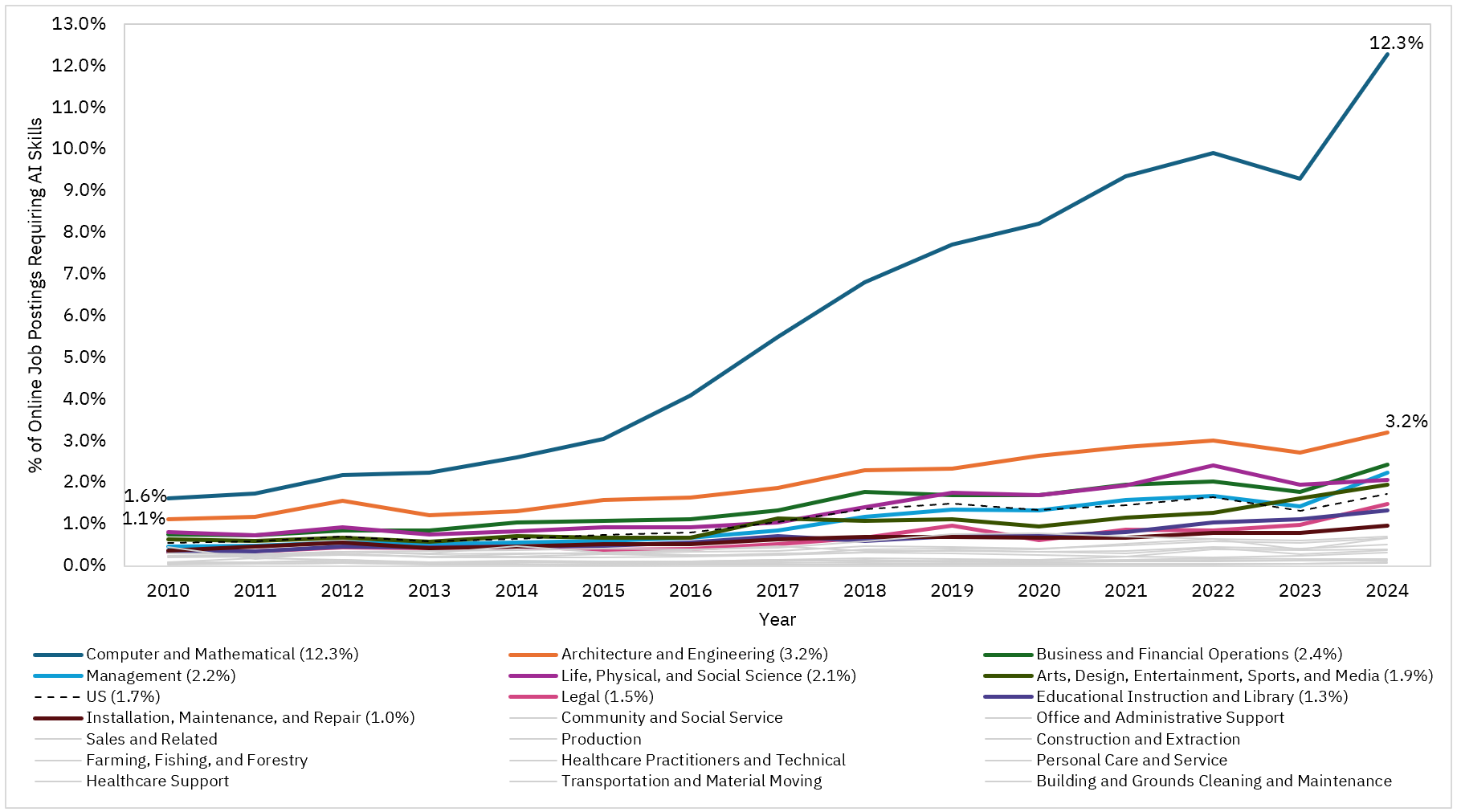
According to research from the Federal Reserve Bank of Atlanta, the share of computer and mathematical job postings requiring AI-related competencies grew from roughly 1.6% in 2010 to more than 12% in 2024, signifying a nearly eightfold increase.
This reflects a broader trend across industries, where organizations increasingly look for workers who can deploy machine-learning models, analyze complex data streams, or integrate generative-AI tools into business operations. As such, AI knowledge is now relevant not just in software engineering, but in fields like marketing, healthcare, manufacturing, and logistics.
Compensation has followed suit. Recent research published on arXiv indicates that roles requiring AI fluency tend to offer higher pay and more benefits than comparable non-AI positions.
On the surface, then, the surge in AI majors makes sense: More companies want these skills, and they appear to be paying a premium for them.
Hiring Realities Prove It’s Not That Simple
Despite the rosy job-market numbers, a degree in AI alone does not guarantee a breakthrough. As covered in one of our articles on rising unemployment among college graduates, employers are placing greater weight on practical experience, portfolio work, and specialized certifications than on formal credentials.
Many job listings now treat degrees as optional, preferring candidates who have deployed models in real-world environments or who have demonstrated fluency with specific tools and frameworks. This means graduates with only classroom knowledge may find themselves edged out by peers with stronger portfolios or by candidates with niches or specializations.
Moreover, the educational-to-professional pipeline is stratified. Reports from the field show that a substantial portion of AI professionals hold master’s degrees or higher, leaving bachelor’s-level candidates competing for a smaller slice of opportunities. Compounding the problem is the notable decline in entry-level hiring across the tech sector, even as companies invest more heavily in AI.
The “fast track,” then, is not automatic. Competition is rising just as quickly, proving security through degrees alone—even AI-aligned ones—is a myth.
Advice & Considerations for Job-Seekers
For students considering AI majors, the wisest approach is to view the degree as a starting point rather than a guaranteed path. Internships, research experiences, and personal projects remain essential differentiators, and staying current with emerging tools is increasingly necessary.
Hybrid skills are also becoming especially valuable. A Forbes article emphasizes that fields like healthcare, finance, sustainability, and UX are experiencing rising demand for professionals who understand both domain knowledge and AI systems. Pairing an AI degree with another discipline may create more resilient and differentiated career prospects.
Overall, the boom in AI degrees reflects genuine opportunity and a labor market that increasingly values AI literacy. But it also exposes the limits of relying on a single credential in a fast-changing industry.
Ambitious and adaptable candidates who pair formal education with hands-on experience may still find that AI is, in fact, a fast track to the jobs they want. Those hoping the degree alone will carry them may find the path far more crowded and much less predictable.