

53% of Tech Jobs Now Demand AI Skills; Generalists Are Getting Left Behind


The AI Shift that Can’t Be Ignored
According to recent hiring data, 53% of tech job postings now require AI or machine learning–related skills. If that number feels abstract, the experience isn’t. Job descriptions read like “five years of backend experience plus AI”, while roles that used to be broad now feel oddly specific.
A previous tech jobs report by CompTIA notes that AI hiring intent in the tech sector has steadily increased. Even as employers slow overall hiring across core roles, job postings mentioning AI, machine learning, and generative AI skills remain resilient.
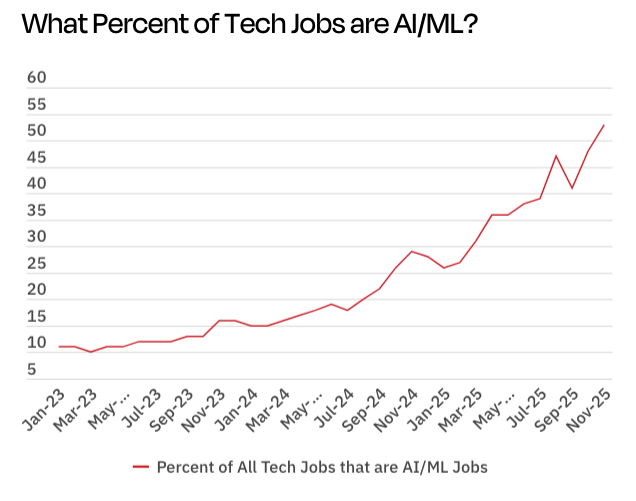
Additionally, as The New Stack’s 2026 tech hiring analysis and Dice’s 2025 Tech Jobs Report both show, tech hiring is shifting away from versatile generalists toward deep, applied specialists, with AI being the clearest signal of that change.
Why AI Skills Matter in Today's Tech Hiring
When companies say they want “AI skills,” they’re not asking every engineer to become a machine learning researcher. In fact, most roles don’t require a PhD or publishing papers. Instead, job listings increasingly emphasize applied AI: integrating large language models, building data pipelines that feed AI systems, deploying inference services, or embedding AI features into existing products.
Both job reports from hiring platforms LinkedIn and Indeed also reveal sustained growth AI-tagged roles across software, data, and infrastructure positions. Moreover, AI-related requirements are spreading beyond dedicated ML roles into mainstream engineering jobs.
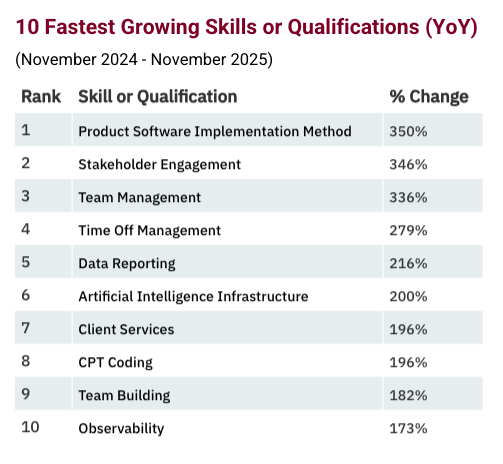 Source: Dice December 2025 Tech Jobs Report
Companies are also increasingly moving away from experimentation, no longer treating AI as a mere side project. Rather, as AI becomes an infrastructure and an integral part of the core stack, hiring isn’t driven by hype but instead operational, budgeted, and tied directly to product roadmaps.
Generalists in the Age of AI
A decade ago, being a generalist was a strength, especially at startups. Teams needed people who could ship features, manage infrastructure, and debug production issues all in one week. Today’s environment is different, as hiring becomes more cautious with leaner teams and sharper expectations.
The problem isn’t that generalists have no value, but that their broad skills don’t map cleanly onto AI-heavy systems. Modern stacks demand depth: understanding model behavior, data quality, latency tradeoffs, and integration risks. As a result, companies still hire generalists, but they expect them to anchor to one clear specialty, whether that’s worded as “full-stack plus AI inference” or “backend plus data systems.”
As such, generalists remain valuable, but nuance matters. While reports like the CB Insights workforce trends signify that broad roles are more common in early-stage startups or internal tooling teams, it is the specialists who are in demand in firms with revenue-critical AI-driven products.
The Specialists Companies Are Actively Competing For
Certain specialist roles now attract both outsized attention and budgets. These include applied AI and LLM engineers who can ship features, data engineers who build and maintain AI-ready pipelines, forward deployed engineers who work directly with customers, and ML platform or infrastructure engineers who keep systems reliable at scale.
What these roles share is proximity to business impact. They’re not abstract “AI engineer” titles, and are instead embedded in product delivery and revenue generation. Such profiles are also increasingly prioritized because they reduce time-to-value.
As such, there’s sustained competition for engineers who can operationalize AI, not just experiment with it. Levels.fyi compensation data reflects this urgency: AI-adjacent specialists often command higher pay bands than more generic software roles, even at the same seniority level.
What This Means for Mid-Level Devs
If you’re a mid-level developer, this shift probably feels unsettling. The good news is that this is a positioning problem and not a huge talent crisis. In short, trying to “learn everything about AI” is a losing strategy. Instead, picking one integration surface that aligns with your background is key, whether that’s backend APIs, data pipelines, frontend AI features, or infrastructure.
There’s also value in building proof through hands-on projects and real usage, not certificates, especially as employers consistently seek demonstrable skills over credentials. Reframe your existing experience in terms of how it enables AI leverage. You don’t need to become someone else, but you need to become more specific.
Overall, what this analysis underscores is the fact that AI continues to be a key filter in tech jobs. Specialists aren’t automatically replacing generalists; unfocused generalists are being filtered out. In this market that continues to get narrower, the path forward is clarity: pick a lane, go deep, and connect your skills to how companies actually ship AI-powered products.