

CompTIA Report Shows AI Hiring Rising Even as Tech Job Growth Slows


A Cooling Tech Job Market
As the year comes to a close, the tech job market is losing momentum again. CompTIA’s latest employment report shows overall tech hiring has softened, with fewer job postings and slower growth across many roles. In November, there were only roughly 436,000 active tech job postings. Despite 174,085 new listings, the total number of tech jobs declined from the prior month and remain well below the average seen earlier in the year.
This marks a shift from more optimistic signals just weeks ago. A previous tech hiring report also released by CompTIA suggested a potential rebound driven by increased employer hiring intent, raising hopes that the worst of the slowdown was over. Instead, the new data suggests caution has returned.
At the same time, one trend stands out clearly. AI-related roles continue to grow in importance, even as overall tech hiring cools. According to CompTIA, 41% of active tech job postings now involve AI skills or dedicated AI roles, underscoring an uneven and increasingly specialized hiring landscape.
What the Data Says About the Shift in Hiring Dynamics
CompTIA’s analysis, drawing on Bureau of Labor Statistics data and Lightcast job postings, paints a picture of selective slowdown. Many traditional tech occupations, including software developers, systems engineers, IT support specialists, and cybersecurity analysts, saw month-over-month declines in active postings in late 2025.
Rather than broad layoffs or collapse, the data suggests employers are slowing hiring across core roles while narrowing their focus. Budgets remain constrained, and companies appear more deliberate about where they add headcount.
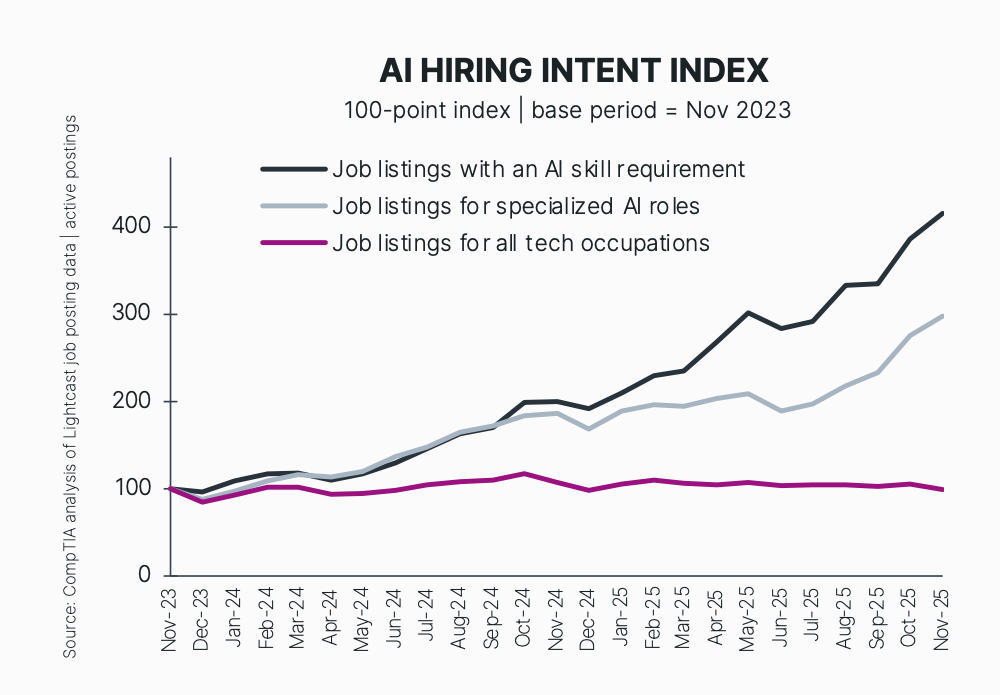
Yet AI remains a clear exception. Job postings that explicitly mention artificial intelligence, machine learning, or generative AI skills remain resilient. In fact, their share of total tech postings has increased steadily throughout 2025. CompTIA’s AI Hiring Intent Index also indicates that employers still plan to expand AI-related teams, even as they pause or reduce hiring elsewhere.
The takeaway from the data is not that tech hiring is shrinking across the board, but that it’s being reallocated, with growth concentrated in specific, high-priority skill areas.
What This Means for Tech Jobs Across the Board
For tech workers, this uneven hiring environment has real consequences. Roles like general software engineering or infrastructure support, which once benefited from strong, steady demand now face longer hiring cycles and fewer openings. Employers also appear more selective, often delaying backfills or combining responsibilities into fewer roles.
Meanwhile, AI fluency has become a major differentiator. Nearly half of current tech job postings either require AI-related skills or are explicitly AI-focused. This trend becomes especially evident with how AI is no longer a niche specialty, but an expected capability layered onto many roles.
For entry-level candidates or professionals with more traditional skill sets, this creates friction. Career paths that once felt linear now feel less predictable. By contrast, candidates with experience in machine learning, data automation, or AI tooling are seeing comparatively stronger demand, opening opportunities even in a cooling market.
The Skills Squeeze: AI vs. Core Tech Hiring
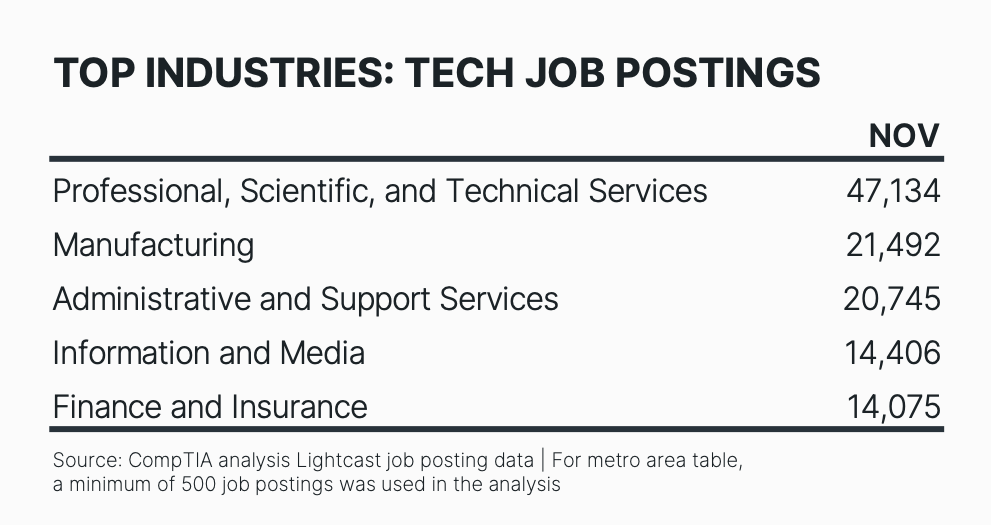
This shift creates both opportunity and constraint. On the opportunity side, AI-skilled professionals are not limited to traditional tech firms and software companies. CompTIA data shows the highest volumes of tech job postings coming from professional and scientific services, manufacturing, administrative and support services, information and media, and finance and insurance.
Location also plays a role. Dedicated AI job postings remain concentrated in major hubs like San Jose (10%), New York (7%), San Francisco (5%), Seattle (5%), and Washington, DC (4%), suggesting that relocation, or even remote flexibility, can meaningfully expand opportunities.
The challenge, however, is equally clear. Professionals focused on legacy tools or narrow technical stacks may find fewer openings, even as headline job numbers remain high. CompTIA notes a persistent skills gap, with employers struggling to find qualified AI talent despite slower overall hiring. This imbalance is pushing companies to rethink training, internal mobility, and long-term workforce planning.
What’s the Future for Tech Hiring?
The latest CompTIA report suggests tech hiring continues to be fragmented. Job seekers will increasingly need to demonstrate how their skills translate into AI-adjacent value, even if they aren’t applying for explicitly AI-titled roles. Employers, meanwhile, may continue to prioritize fewer, higher-impact hires rather than broad team expansion.
What’s emerging is a more targeted, skills-driven hiring market: one that rewards adaptability over tenure and depth over volume. For tech workers, the challenge isn’t just finding open roles, but aligning with where hiring demand is actually consolidating.