

State of Interviewing 2025: How AI Quietly Rewired Tech Interviews


Introduction: The Hidden Shift in 2025 Interviews
Something changed about interviews in 2025.
The questions sound the same — but the expectations are completely different.
After analyzing over 300,000 interviews and tech job postings, Interview Query found that AI-driven restructuring has reshaped hiring across the industry.
For a quick visual walkthrough of how interviews are evolving, watch the video below:
What you’ll see: recruiters adapting to AI-cheating, candidates needing to reason with models instead of just coding, and how in-person rounds are making a comeback. Now let’s break it down.
The Market Shift: How 2025 Quietly Rewired Tech Hiring
1. Layoffs Became an Efficiency Strategy — Not a Collapse
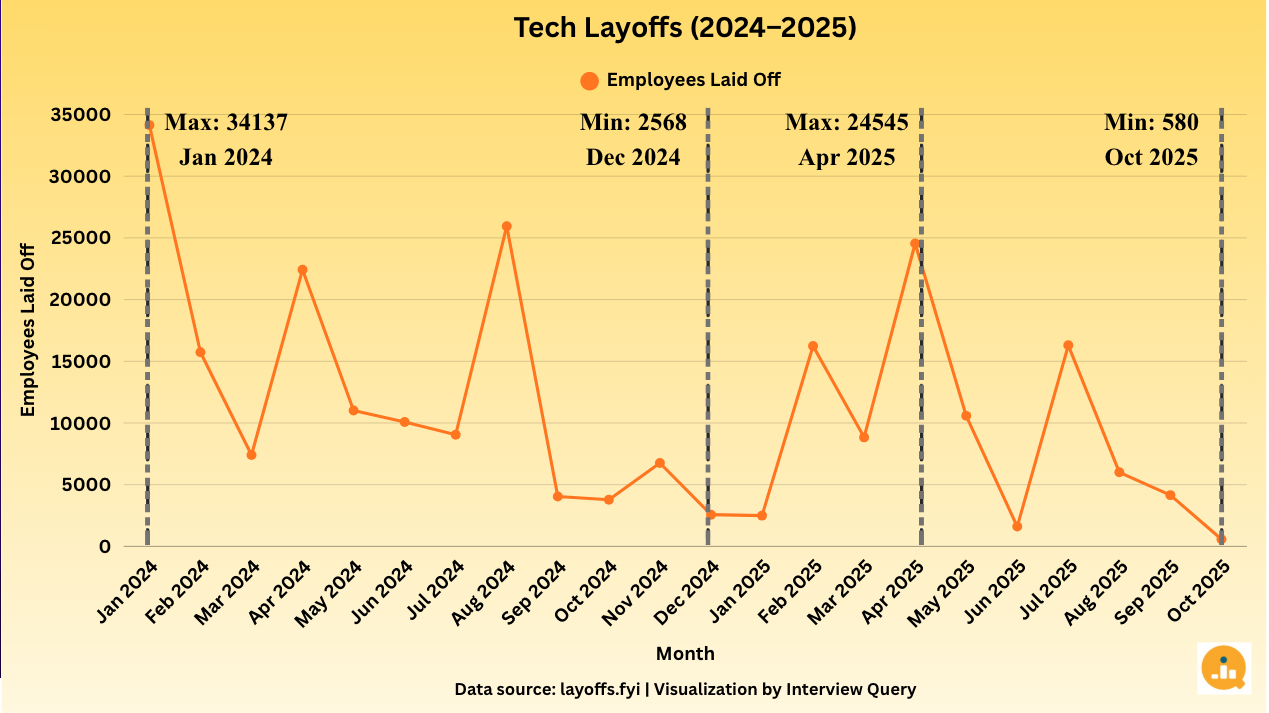
2025 saw 62,000 tech layoffs, including 9,000 at Microsoft, yet hiring didn’t slow down — it evolved.
Companies like Amazon and Apple hired more employees than they laid off. Total tech job openings stabilized around 230,000, up 22% from the 2024 low point.
The reason? Layoffs became a tool for AI-driven restructuring, not survival. Tech firms are optimizing for efficiency and focusing on high-performance, AI-fluent talent.
Key takeaway: Fewer roles, but higher expectations — especially for candidates who can use AI to boost productivity.
2. AI Became the Core of Every Tech Role
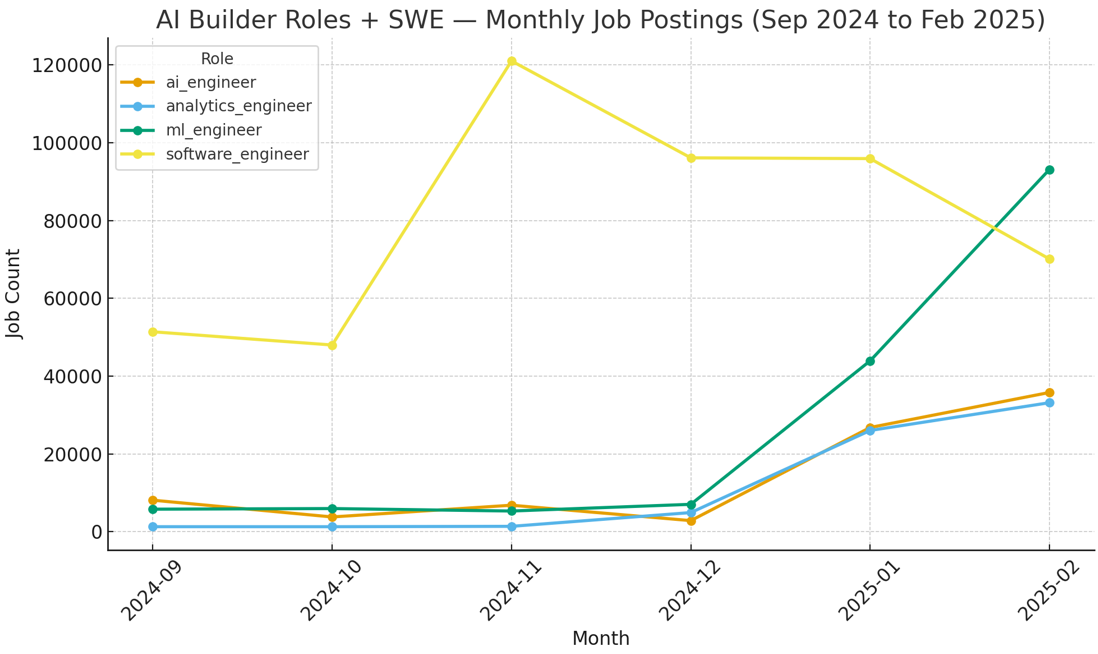
By 2025, AI stopped being a niche specialization and became the baseline for every tech role.
From developers to data engineers, professionals are now expected to build with AI — not just code around it.
AI-native roles like AI Engineer, ML Engineer, and Analytics Engineer surged by 240% in early 2025, while traditional software roles declined slightly but remained essential.
The job market didn’t grow — it shifted toward AI builders.
3. Cheating Scandals Broke Trust — And Ghosting Followed
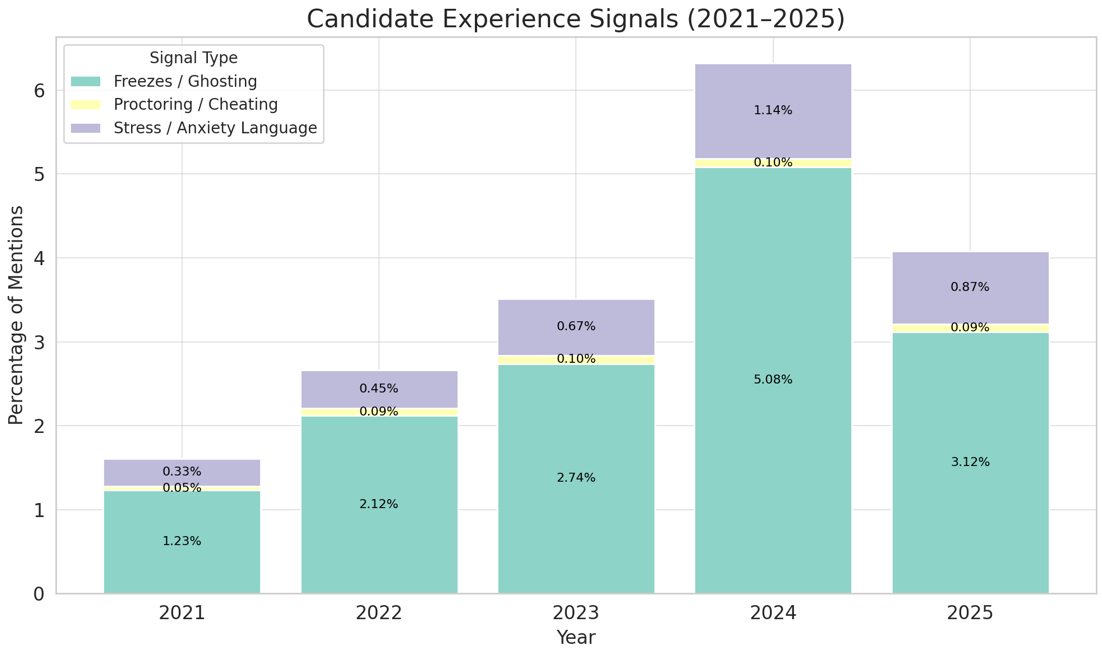
The rise of AI-assisted cheating in 2024 — including hidden prompts, remote “helpers,” and even AI-synced eye-tracking — shattered recruiter trust.
Recruiters, overwhelmed by AI-powered screening tools, responded by ghosting candidates instead of clarifying suspicions.
One candidate shared on Reddit:
“They thought I was cheating and were rude multiple times. I felt insulted — and then got ghosted anyway.”
Platforms like Greenhouse reported that AI automation actually doubled recruiter workloads, worsening candidate experiences instead of improving them.
The Evolution: How Interviews Adapted Around AI
1. In-Person Interviews Are Back
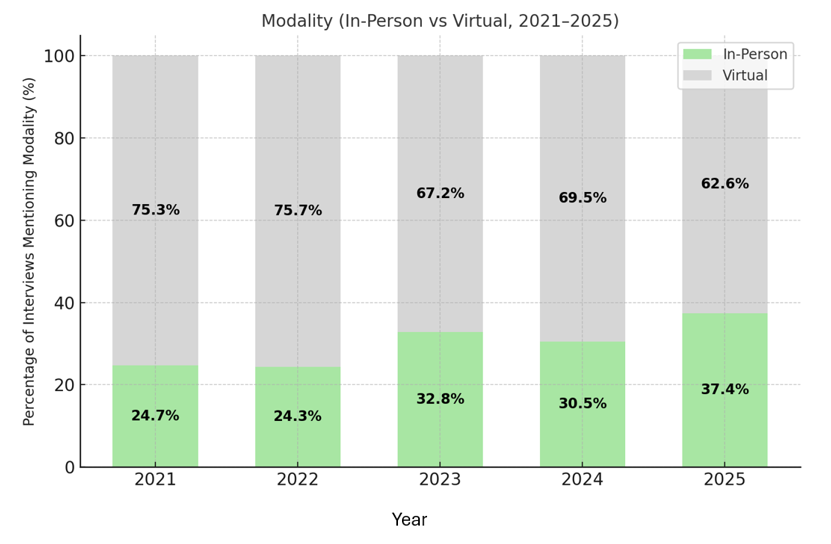
To counter AI cheating, in-person interviews made a comeback.
In-person rounds rose from 24% in 2022 to 38% in 2025, especially for design and behavioral interviews.
- Google reintroduced onsite interviews to reduce cheating.
- Meta experimented with AI-assisted interviews that evaluate responses dynamically.
As Computerworld noted, “Companies want to see your real thinking process — not ChatGPT’s whisper in your ear.”
2. Fundamentals Got Harder — Not Easier
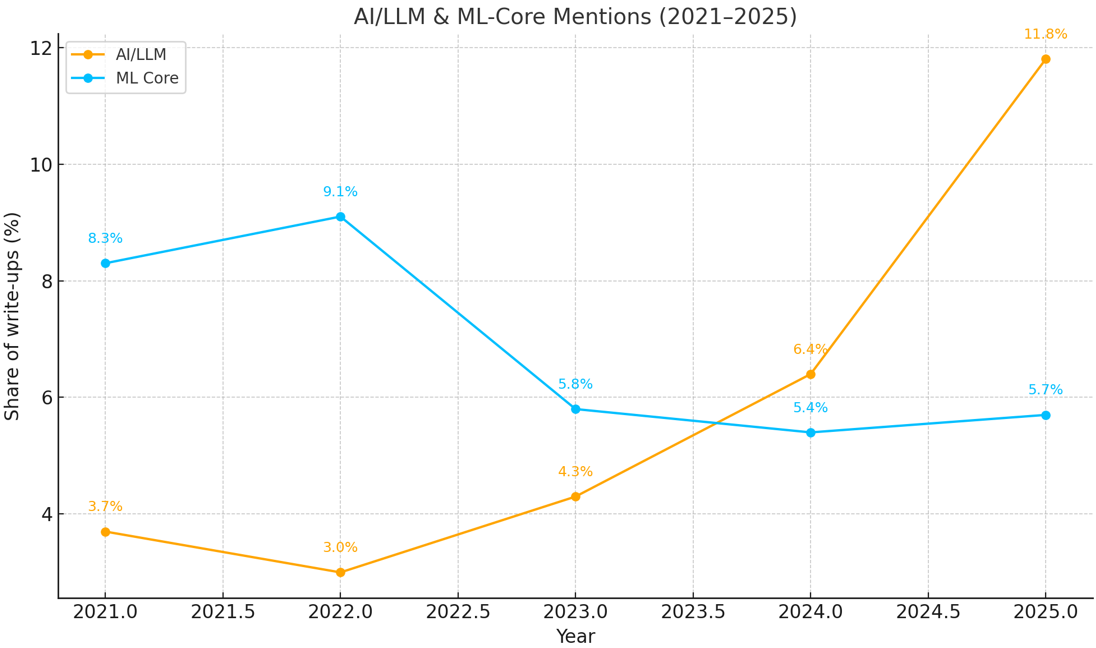
Despite the rise of AI, Python, SQL, and system design remain the most in-demand skills.
But now, they’re tested within AI-integrated scenarios.
Instead of: “Sort this array.”
You might hear: “How would you design an algorithm that uses an LLM to rank and sort user feedback by sentiment?”
AI and LLM-related interview questions have tripled since 2023. The focus has shifted from Can you code? to Can you reason with the AI that codes with you?
3. Take-Homes Became Real-World Simulations
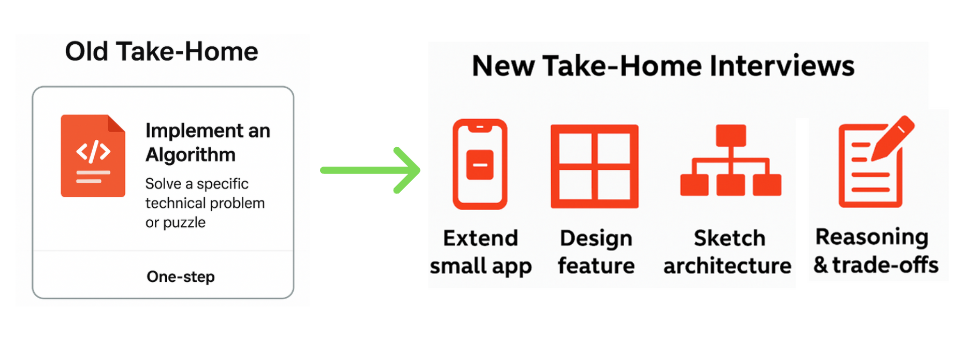
Take-home assessments didn’t disappear — they evolved into real-world projects.
Microsoft’s 2025 Work Trend Index lists AI fluency as a top hiring priority, reflecting the shift from algorithmic puzzles to practical, problem-solving tasks.
Amanda Richardson, CEO of CoderPad, calls it: “The death of algorithmic take-homes — replaced by project-based ones.”
Candidates are now asked to extend small apps, analyze real datasets, or simulate product scenarios involving AI — not grind through abstract coding puzzles.
The Role Playbooks: How to Prepare for AI-Era Interviews
2025 interviews don’t test what you know — they test how you think with AI.
Modern candidates operate on two layers:
- Ground Level: Core technical fluency — Python, SQL, debugging, architecture.
- Model Level: Reasoning with AI — prompt design, evaluation, and ethical decision-making.
Here’s how interview expectations evolved across major roles:
| Role | AI/LLM Mentions (2021 → 2025) | Interview Focus | Prep Focus | Showcase In Interviews | What Recruiters Look For |
|---|---|---|---|---|---|
| ML Engineers | 8% → 29.5% | Model tuning + infra fluency | Fine-tuning, RAG pipelines, latency optimization | Debug hallucinations, manage drift | Reliability > novelty |
| Data Engineers | 3% → 9.7% | Pipeline resilience + AI readiness | Stream processing, feature stores | Real-time data flows | Make data learnable |
| Data Scientists | 4% → 18.4% | Experimentation + interpretability | A/B tests, bias detection, prompt metrics | Diagnose misleading models | Analytical + ethical clarity |
| Backend Engineers | 6.7% → 13% | Integration + scaling | APIs, caching, inference pipelines | Deploy scalable AI workloads | Throughput + stability |
| Analysts & BI | 3.8% → 15.8% | Storytelling with AI insights | SQL, visualization, model metrics | Translate outputs to business strategy | Context > code |
The Future of Interviewing: Judgment Over Knowledge
2025 marked a turning point.
Interviews no longer test what you know — they test how you reason, communicate, and adapt in a world where AI already knows everything.
Because in the age of ChatGPT, knowledge is free — judgment isn’t.
By 2026, interviews will merge human clarity with AI precision.
And the most successful candidates won’t compete against AI — they’ll collaborate with it.
Get Ready for AI-Era Interviews with Interview Query
If you’re preparing for interviews in 2026, you’ll need more than practice problems — you’ll need a framework for thinking with AI.
Interview Query helps you:
- Explore 9,000+ companies and real interview questions.
- Take AI-powered mock interviews that adapt to your level.
- Learn how to analyze and explain your reasoning like top candidates do.
We don’t just teach you to answer questions — we teach you to think like the engineers companies hire now.