

YipitData Data Analyst Interview Guide (2025): Process, Questions & Tips


Introduction
YipitData is a fast-growing market research firm that analyzes alternative data to help investors and businesses make better decisions. Data Analysts at YipitData clean, analyze, and interpret large datasets to uncover trends and answer key client questions. They work closely with research and product teams to build clear, actionable reports. Breaking into YipitData isn’t easy — YipitData Data Analyst interview questions assess your skills, knowledge, and whether you’re a good fit for the role and company culture.
Why This Role at YipitData?
YipitData gives analysts full ownership of projects, exposure to cross-functional teams, and a fast-paced environment where you can grow quickly. It’s a strong fit if you’re analytical, curious, and excited about making data useful. The role also offers continuous learning through feedback, collaboration, and hands-on experience from day one.
This guide walks you through the YipitData Data Analyst interview process, common interview questions, and key tips to help you stand out.
What Is the Interview Process Like for a Data Analyst Role at YipitData?
The YipitData data analyst interview process typically moves through five stages: initial assignment, information session, take-home project, HR interview, and final interview.
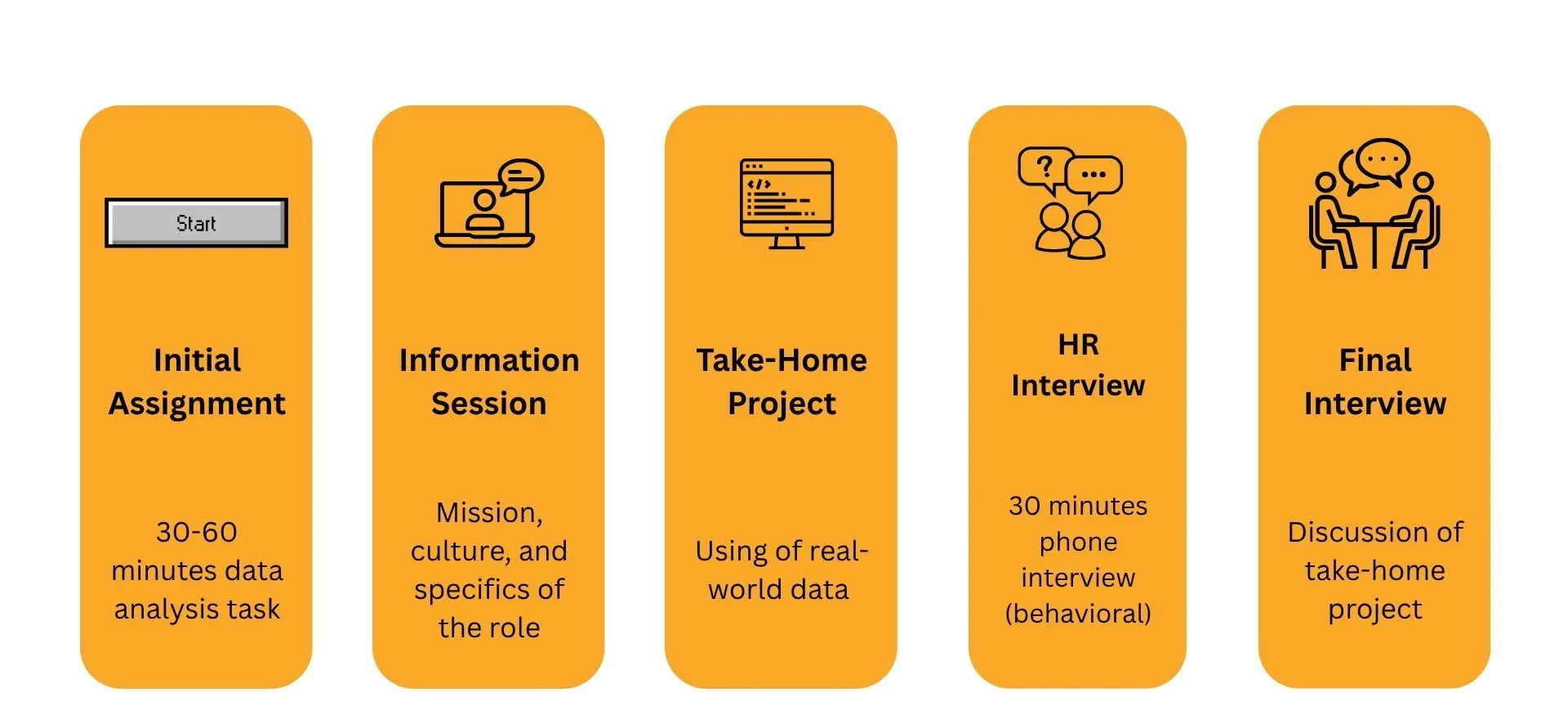
Initial Assignment
The first step in the interview process is a short data analysis task (30–60 minutes). This task is designed to evaluate your basic analytical skills and proficiency with data manipulation tools, often requiring you to work with clean datasets.
Information Session
Following the initial assignment, candidates participate in an information session. The session is either in person or a webinar where you learn about YipitData’s mission, culture, and the role, plus ask questions.
Take-Home Project
The next step is a more complex take-home assignment completed over several days. You’ll work with real-world data to uncover insights, make predictions, or estimate outcomes. This stage assesses your analytical thinking, attention to detail, and ability to clearly communicate data-driven conclusions.
HR Interview
Once the take-home project is submitted, candidates will have a 30-minute phone interview with an HR representative. This conversation focuses on your background, motivations for applying, and alignment with YipitData’s values. Expect some behavioral questions to assess cultural fit and communication skills.
Final Interview
The final stage is a multi-part interview lasting several hours, where you’ll meet with team members, including potential colleagues and managers. You’ll discuss your take-home project, explain your approach, and walk through your findings. This round also includes technical and behavioral questions to assess your problem-solving skills and how you tackle real-world data challenges.
Tips Before You Interview
Before you dive in, a few key reminders. Own your analysis. YipitData values candidates who don’t just run queries but can frame a business question, explore the data, and deliver insights that matter. Be ready to explain your process clearly, not just what you found but why it matters and how it drives decisions.
Think beyond the numbers. They’ll want to see that you can collaborate cross-functionally, work fast without losing accuracy, and take feedback in stride. And whatever you do, read up on YipitData’s culture.
Challenge
Check your skills...
How prepared are you for working as a Data Analyst at Yipitdata?
What Questions Are Asked in a YipitData Data Analyst Interview?
Coding/Technical Questions
Coding/Technical Questions tests your ability to work with data using tools like SQL and Python. Expect practical problems that reflect the kind of work you’d do on the job.
You have an array of integers, nums of length n spanning 0 to n with one missing. Write a function missing_number that returns the missing number in the array. Note: Complexity of O(n) required.
You can use the formula for the sum of the first n natural numbers, which is ( \frac{n(n+1)}{2} ). Calculate the expected sum for numbers from 0 to n, and then subtract the sum of the numbers in the array from this expected sum. The result will be the missing number.
-
To write a function that returns a key at random with a probability proportional to the weights given in a dictionary, you can use a weighted random selection algorithm. This involves calculating the cumulative weights and using a random number to select the appropriate key based on these weights.
-
You would typically write a SQL query that selects the minimum and maximum session dates for each user within the year 2020, and then calculates the difference in days between these two dates. You can use the
DATEDIFFfunction (or equivalent depending on your SQL dialect) to find the difference between the first and last session dates. -
You can use a random offset:
SELECT * FROM table_name
ORDER BY RAND()
LIMIT 1;
This query calculates a random offset based on the total number of rows and retrieves a single row from that offset, reducing the load on the database. 5. Given a table of user sessions, write a query to get the number of days between each user’s first session and last session for the year 2020. You can write an SQL query that selects the minimum and maximum session dates for each user within the year 2020, and then calculates the difference in days between these two dates. The query would look something like this:
SELECT user_id,
       DATEDIFF(MAX(session_date), MIN(session_date)) AS days_between_sessions
FROM user_sessions
WHERE YEAR(session_date) = 2020
GROUP BY user_id;
This query assumes you have a table named
user_sessionswith columnsuser_idandsession_date. It filters sessions to only include those from the year 2020, groups the results byuser_id, and calculates the difference in days between the first and last session for each user.
Analytics and Experiments Questions
Analytics and Experiments Questions focus on how you approach data problems, design analyses, and interpret results. They are looking for structured thinking, clear logic, and business awareness.
You are testing hundreds of hypotheses with many t-tests. What considerations should be made?
When testing hundreds of hypotheses with many t-tests, it is important to consider the issue of multiple comparisons, which can increase the likelihood of Type I errors (false positives). To address this, techniques such as the Bonferroni correction or False Discovery Rate (FDR) control can be used to adjust the significance levels. Additionally, ensuring that the assumptions of the t-test are met for each hypothesis is crucial for valid results.
-
You can conduct a user journey analysis by examining the sequence of user interactions and identifying common paths and drop-off points. This involves analyzing user event data to understand how users navigate through the app, which features are most frequently used, and where users encounter difficulties. By identifying patterns and bottlenecks, you can provide insights into areas where the UI can be improved to enhance user experience and engagement.
-
First ensure data integrity by cleaning and normalizing the data from each source. Next, integrate the datasets into a unified data model, ensuring that data security and privacy are maintained. Finally, apply analytical techniques to extract meaningful insights, focusing on improving system performance by identifying patterns and correlations across the datasets.
How would you differentiate between scrapers and real people in a dataset of page views?
You can analyze patterns such as the frequency and timing of page requests, the diversity of pages accessed, and the user-agent strings. Scrapers often exhibit high-frequency requests, access a large number of pages in a short time, and may use generic or absent user-agent strings. In contrast, real users typically have more varied and less frequent browsing patterns.
What kind of test would you use to measure the outcome of an AB test?
To measure the outcome of an AB test and determine if the results are statistically significant, you would typically use a hypothesis test, such as a t-test or a chi-squared test, depending on the data distribution and sample size. These tests help to infer whether the observed differences in metrics like click-through rates are due to chance or represent a true effect.
Behavioral or “Culture Fit” Questions
Behavioral or “Culture Fit” Questions assess how well you align with YipitData’s values and ways of working. Expect questions about ownership, collaboration, learning from feedback, and working in fast-paced environments.
Why Do You Want to Work With Us?
When responding to questions like “Why did you apply to our company?” or “What makes you a good fit for our company?” it’s important to demonstrate your understanding of the company’s values, culture, and goals. Highlight how your skills and experiences align with the company’s needs and express genuine enthusiasm for the opportunity to contribute to their success. Tailor your response to show that you have researched the company and are motivated by the prospect of working with them.
-
To prioritize multiple deadlines, you can assess the impact and urgency of each task, and then order them based on these criteria. Staying organized with multiple deadlines can be achieved by using tools like calendars, to-do lists, and project management software to track progress and ensure timely completion.
-
It’s important to maintain professionalism and focus on the issue rather than personal differences. A structured approach involves active listening, understanding the other party’s perspective, and finding common ground to reach a mutually beneficial solution. For example, if a conflict arises over project responsibilities, one might address it by organizing a meeting to discuss each party’s concerns and collaboratively agree on a fair distribution of tasks.
-
Highlight the actions you took that led to exceeding expectations, such as implementing innovative solutions, improving efficiency, or delivering results ahead of schedule. Explain the impact of your efforts on the project’s success and any recognition you received.
How comfortable are you presenting your insights?
Presenting complex data insights with clarity and adaptability is crucial, especially when tailored to a specific audience. Comfort in presenting insights often comes from understanding the audience’s needs and being able to adjust the presentation style accordingly.
How to Prepare for a Role at YipitData
Study the Role & Culture
Start by reviewing the YipitData careers page and looking through the LinkedIn profiles of current employees to understand the types of backgrounds and experiences they value. Get familiar with their core business of delivering investment insights using alternative data so you can better connect your skills to their mission during the interview.
Practice Common Question Types
Expect the process to break down roughly as follows: 40% take-home project, 30% technical (mostly SQL and logic), and 30% behavioral. Practice solving real-world analysis problems using open datasets to sharpen both your technical skills and business judgment.
Think Out Loud & Ask Clarifying Questions
YipitData looks for analytical thinkers who are transparent about their thought process. In interviews, don’t just jump to the answer; talk through your reasoning, clarify assumptions, and explain your trade-offs.
Brute Force, Then Optimize
Don’t worry about writing the most elegant code or analysis solution on the first try. Start by getting something working, then walk through how you’d improve it. Showing that you can iterate thoughtfully is a huge plus in their fast-paced, ownership-driven culture.
Mock Interviews & Feedback
Practice makes a huge difference. Use mock interviews or team up with a mentor to simulate the take-home debrief or technical rounds. Honest feedback will help you sharpen your communication, improve your analysis, and walk into the real interview with more confidence.
Conclusion
YipitData interviews are structured, transparent, and focused on real-world problem-solving. The best way to stand out is to show your work clearly, explain your reasoning, and stay curious throughout the process. They value thoughtful analysts who can communicate insights and keep learning as they go.
To dig deeper, check out more data analyst questions. You can also sign up for a mock interview and mentorship, and walk into the interview with confidence.
Yipitdata Interview Questions
| Question | Topic | Difficulty | |||||||||||||||||||||||||||||||||
|---|---|---|---|---|---|---|---|---|---|---|---|---|---|---|---|---|---|---|---|---|---|---|---|---|---|---|---|---|---|---|---|---|---|---|---|
SQL | Hard | ||||||||||||||||||||||||||||||||||
Given a table of product subscriptions with a subscription start date and end date for each user, write a query that returns true or false whether or not each user has a subscription date range that overlaps with any other completed subscription. Completed subscriptions have Example: Input:
Output:
| |||||||||||||||||||||||||||||||||||
Data Structures & Algorithms | Medium | ||||||||||||||||||||||||||||||||||
Data Structures & Algorithms | Easy | ||||||||||||||||||||||||||||||||||
SQL | Easy | |
Machine Learning | Medium | |
Statistics | Medium | |
SQL | Hard | |
Machine Learning | Medium | |
Python | Easy | |
Deep Learning | Hard | |
SQL | Medium | |
Statistics | Easy | |
Machine Learning | Hard |
Discussion & Interview Experiences