

Thomson Reuters Interview Questions & Hiring Process (2025)


Introduction
Thomson Reuters is a global leader in delivering trusted journalism, legal research, and financial intelligence to professionals who shape the world’s economies and justice systems. With a mission to provide accurate, data-driven insights, the company supports decision-makers across law, tax, compliance, media, and finance.
As one of the most recognized names in business information services, it’s no surprise that many applicants search for Thomson Reuters interview questions and insights into the Thomson Reuters interview process to prepare for roles that demand both analytical rigor and ethical clarity. In this guide, you’ll find real candidate-reported examples, a step-by-step breakdown of the Thomson Reuters interview, and links to job-specific prep resources tailored for roles in data, legal tech, journalism, and more.
Why Work at Thomson Reuters?
Thomson Reuters stands out for its unique blend of global influence, purpose-driven work, and a strong commitment to innovation in the information services space. Employees are part of a mission to advance transparency, justice, and commerce—while benefiting from a culture that supports both professional growth and social impact. The company’s hybrid workplace model, commitment to free press, and ongoing investment in AI and legal tech make it a top destination for high-performing professionals.
Here are a few standout perks:
- Global Reach with Purpose: Collaborate on products that impact governments, law firms, financial markets, and newsrooms worldwide.
- Flexible, Hybrid Work Culture: Emphasis on work-life balance through remote-friendly policies and wellness support.
- Pro Bono Journalism and Legal Access Programs: Opportunities to contribute to initiatives that promote press freedom and legal equity.
- Continuous Learning & Mobility: Access to internal learning hubs, mentorship, and career mobility across regions and functions.
See the breakdowns for interview process and expected questions below.
What’s Thomson Reuters Interview Process Like?
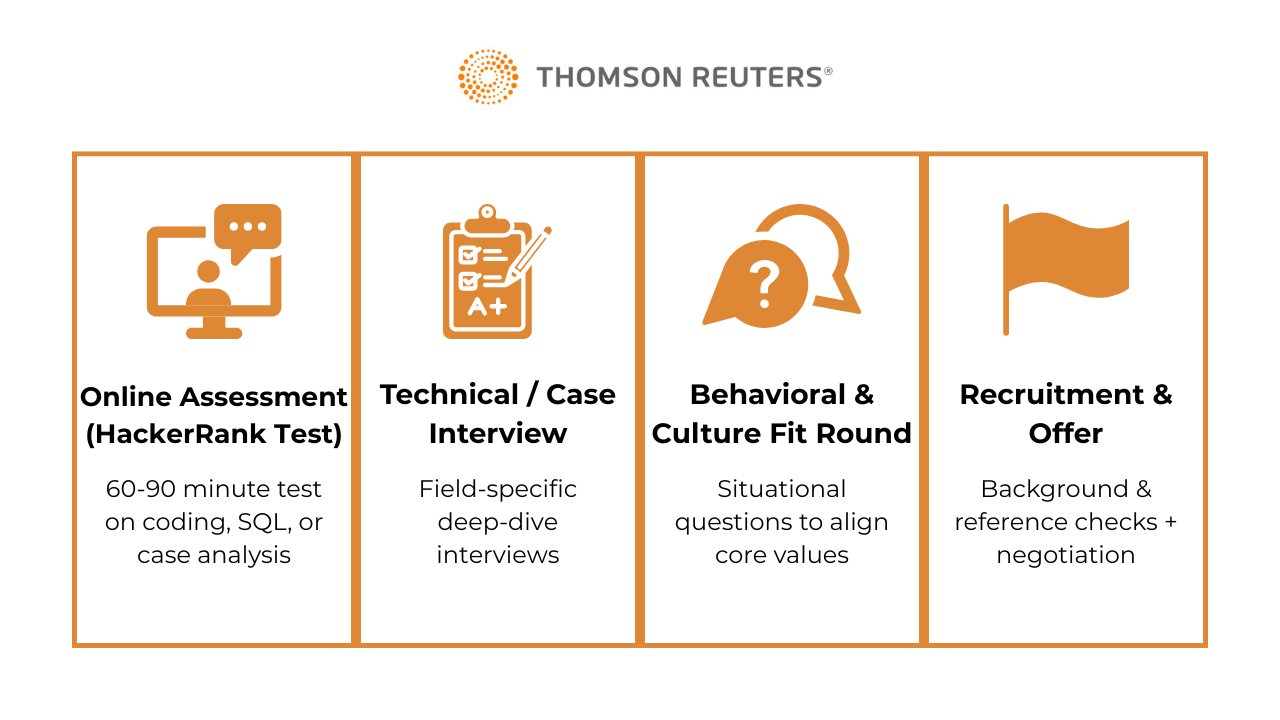
Online Assessment (HackerRank Test)
The interview journey at Thomson Reuters typically begins with a timed HackerRank test, especially for technical, analytical, or graduate roles. Thomson Reuters HackerRank test is designed to evaluate your coding ability, SQL fluency, or case analysis skills, depending on the role. For data or software positions, expect problems involving string manipulation, sorting, or database querying. Business-oriented candidates may receive case scenarios that test reasoning, math, or business acumen. The test usually lasts 60–90 minutes and is proctored remotely. Accuracy, efficiency, and clarity in your approach will set you apart.
Technical or Case Interview for Experienced Candidates
The Thomson Reuters interview process for experienced professionals involves one or more rounds of deep-dive interviews tailored to your field. These interviews may include technical screens, case studies, or problem-solving exercises, depending on the role—whether you’re applying in product, legal analytics, journalism, or engineering. Interviewers often pose real business problems that assess how you would navigate ambiguity, structure a solution, and communicate clearly. In some roles, expect cross-functional panels with domain experts and hiring managers who are looking for sound judgment, domain knowledge, and strategic thinking.
Behavioral & Culture Fit Round
Regardless of role or level, Thomson Reuters emphasizes alignment with its core values—trust, independence, and impact. In this behavioral round, you’ll face situational questions framed to elicit STAR (Situation, Task, Action, Result) responses. Interviewers are particularly interested in how you’ve responded to conflict, managed ambiguity, or contributed to diverse teams. Stories that demonstrate integrity, adaptability, and a mission-driven mindset will resonate well. Expect follow-up questions probing how you handle ethical tradeoffs or ensure information accuracy—especially in data or news-related roles, such as a data analyst verifying financial datasets for accuracy before client delivery or a journalist fact-checking breaking news stories under tight deadlines.
Recruitment Timeline & Offer
Once interviews conclude, the Thomson Reuters hiring process continues with a structured background and reference check phase. Depending on the region and role, this may include employment verification, legal compliance checks, and in some cases, additional assessments. The Thomson Reuters recruitment process typically wraps up within two to three weeks after the final interview, with recruiters maintaining good communication throughout. If you’re selected, you’ll be guided through salary negotiations and onboarding preparation. Offers generally reflect competitive pay with flexibility perks, and in many cases, Thomson Reuters shows openness to negotiate—particularly for experienced candidates.
Note: If you’re a new grad, the flow and expectations may differ—typically with lighter behavioral rounds and project-based assessments. Head to the FAQ section for more details.
Challenge
Check your skills...
How prepared are you for working at Thomson Reuters?
Most Common Thomson Reuters Interview Questions
Role‑Specific Interview Guides
- Software Engineer → Software Engineer Interview Guide
- Business Analyst → Business Analyst Interview Guide
- Business Intelligence → Business Intelligence Interview Guide
- Data Analyst → Data Analyst Interview Guide
- Data Engineer → Data Engineer Interview Guide
- Data Scientist → Data Scientist Interview Guide
- Machine Learning Engineer → Machine Learning Engineer Interview Guide
- Growth Marketing Analyst → Growth Marketing Analyst Interview Guide
- Product Analyst → Product Analyst Interview Guide
- Product Manager → Product Manager Interview Guide
- Research Scientist → Research Scientist Interview Guide
Technical Depth & HackerRank‑Style Questions
Candidates applying for data, software engineering, or analytics roles often face a series of algorithmic problems both in the Thomson Reuters HackerRank test and technical interviews. While difficulty varies by level, some recurring problem types include:
- String manipulation and pattern matching (e.g., regex, anagram detection)
- Matrix traversal and dynamic programming (common in time-series or table-based questions)
- SQL queries with window functions (often tied to case data or time-bound analysis)
- Financial math problems, such as calculating CAGR, NPV, or tax impact
- Greedy or sliding window algorithms, particularly for optimization scenarios
Strong candidates explain their thinking clearly, test edge cases, and balance performance with readability in their code.
Behavioral Questions About Mission & Values
A significant part of Thomson Reuters interview experience revolves around assessing your alignment with the company’s mission: delivering trusted, unbiased information to help professionals make critical decisions. Candidates often encounter behavioral questions that probe their motivation for joining the company, their ethical reasoning, and how they navigate complexity in high-stakes environments. Expect prompts like:
- Why Thomson Reuters?
- Describe a time you had to defend a point of view with integrity
- How would you react if pressured to alter data or reporting?
- How do you ensure accuracy and reliability when working with large, fast-moving datasets?
- What steps would you take to fact-check information before publication under tight deadlines?
These scenarios are especially relevant in editorial, legal, and data-centric roles, where trust and objectivity are non-negotiable values.
Interview Questions for Freshers vs Experienced
The Thomson Reuters interview questions for freshers tend to focus on foundational knowledge, academic projects, and general aptitude. Campus candidates may be asked to explain coursework, walk through a resume project, or solve simplified data structures and logic puzzles. In contrast, experienced professionals face deeper evaluations ranging from business-case walkthroughs to system-design discussions (like architecting a content delivery platform or designing a scalable legal search engine). For managerial candidates, stakeholder alignment and strategy execution are emphasized, often through cross-functional case interviews or leadership story prompts. Below are some examples:
New grad
- What courses or skills have best prepared you for working with large datasets?
- How would you fact-check an article or dataset if given limited resources?
- Walk me through how you would solve a simple data structure problem, such as reversing a linked list.
Experienced Professionals
- How would you design a scalable system for delivering real-time financial data to global clients?
- Walk me through a business case where you optimized workflow efficiency or reduced costs.
- Thomson Reuters products often combine legal, news, and financial data. How would you architect a content delivery platform that handles multiple data streams?
- Describe a time you had to align stakeholders across editorial, technical, and business teams—what approach did you take?
Tips When Preparing for a Thomson Reuters Interview
Master Timed Practice for the HackerRank Test
The first step in many roles is a timed technical screen. Practice solving coding problems or business case scenarios within 60–90 minutes. Use LeetCode, HackerRank, and Interview Query to help simulate the pace and pressure of the real Thomson Reuters HackerRank test.
Tips:
- Focus on accuracy before speed—getting correct answers matters more than solving every question.
- Review common data structures and SQL queries, as these frequently appear in the test.
Build Strong STAR Stories Ahead of Time
Use the STAR (Situation, Task, Action, Result) format to prepare narratives that highlight your leadership, problem-solving, and ethical reasoning. Focus on examples that show how you handled complexity, maintained integrity, or collaborated across departments—key themes across roles in the Thomson Reuters interview.
Tips:
- Prepare at least 3–4 stories you can adapt to different behavioral prompts.
- Emphasize measurable impact (e.g., “reduced turnaround by 20%”) to make results stand out.
Read Up on Industry Trends and Global News
Thomson Reuters values curiosity and informed perspectives. Follow developments in legal tech, global finance, and investigative journalism to demonstrate domain fluency. Bring up recent stories or regulatory shifts in your interview to stand out as someone who understands the firm’s mission and impact.
Tips:
- Subscribe to Reuters News or the Thomson Reuters blog to stay current with company priorities.
- Connect industry news to your role-specific impact (e.g., how AI in legal research could affect your work).
Do Mock Interviews, Especially for Behavioral Rounds
Practicing aloud—especially with a peer or mentor—helps refine your tone, timing, and clarity. Simulate panel-style Q&As for experienced roles and culture-fit prompts for entry-level positions. Use feedback to adjust your communication style for virtual or hybrid Thomson Reuters interview settings.
Tips:
- Record yourself to spot filler words or unclear phrasing.
- Rotate between technical, case, and behavioral practice so you’re ready for every round.
Research Compensation Ranges and Prepare to Negotiate
The Thomson Reuters hiring process includes a formal offer phase, where salary and benefits can be discussed. Review pay benchmarks on Glassdoor or Levels.fyi and think through your must-haves before the recruiter call. Confidence in negotiation shows you’re informed and value your contributions.
Tips:
- List your non-negotiables (e.g., location flexibility, signing bonus) before discussions.
- Practice a polite but firm script to communicate expectations without sounding rigid.
Salaries at Thomson Reuters
Average Base Salary
Average Total Compensation
Compensation at Thomson Reuters varies by role, seniority, and location. Software Engineers in the U.S. typically earn between $90,000–$130,000 base, while Financial Analysts may range from $70,000–$100,000. Entry-level roles in cities like Toronto or Bangalore may start lower but offer faster internal mobility. Senior professionals in hubs like New York or London can also receive performance bonuses and equity-based incentives.
- Data Engineer
- Data Analyst
- Product Manager
- Entry level / early PM: roughly $100,000–$130,000 total comp. (comparably)
- Senior PM / higher responsibility PM roles: in the range of $140,000–$190,000+ depending on scope, location, and bonus/equity. (Glassdoor)
Conclusion
Preparing for your Thomson Reuters application means more than just updating your resume—it requires mastering the types of interview questions you’ll face and understanding the structure of the hiring process from start to offer. Whether you’re aiming for a data analyst, product analyst, or software engineering role, knowing what to expect gives you a critical edge.
Ready to dive deeper? Explore our learning paths to build the exact skills you need. Then, sharpen your prep with our company question bank and simulate the real experience through mock interviews matched with peers.
FAQs
How many applicants get a first round interview at Thomson Reuters?
While exact numbers vary by role and location, Thomson Reuters typically advances only a small percentage of applicants—often 10–20%—to the first interview stage. Strong resumes that highlight relevant skills (e.g., data analysis, legal research, or software development) and alignment with Thomson Reuters’ values stand out most.
What interview mistakes should I avoid?
Common pitfalls include failing to research Thomson Reuters’ business areas, giving vague or generic answers without the STAR framework, overlooking the importance of accuracy and ethics in responses, and neglecting to prepare thoughtful questions for interviewers. Another mistake is over-relying on technical skills without demonstrating communication and collaboration, which are critical in cross-functional roles at the company.
How long does the Thomson Reuters hiring process take?
The Thomson Reuters hiring process typically takes between 2 to 4 weeks from application to offer. After the initial screening and online assessment, candidates usually proceed through technical and behavioral rounds, followed by background checks and negotiation. Timelines can vary slightly based on the role and region.
Is the Thomson Reuters HackerRank test hard?
The Thomson Reuters HackerRank test is moderately challenging, depending on the position. For technical roles, expect questions on algorithms, data structures, or SQL. Business and analytics candidates may face logic-based case scenarios. Success depends on your problem-solving speed, clarity of approach, and ability to handle time pressure.
What’s different in the interview process for experienced hires at Thomson Reuters?
Thomson Reuters interview process for experienced professionals involves more advanced case discussions, system design, and strategy-based questions. Panels may include senior managers or cross-functional leads, with an emphasis on domain expertise, stakeholder influence, and decision-making under ambiguity.
Does Thomson Reuters hire freshers, and what questions do they ask?
Yes, the company actively hires entry-level talent. Thomson Reuters interview questions for freshers typically focus on academic projects, internship experience, aptitude tests, and basic coding or case problems. Fresh grads can expect fewer rounds but should still prepare for behavioral and mission-fit questions.
What’s the typical interview experience like at Thomson Reuters?
Overall, the Thomson Reuters interview experience is professional, structured, and transparent. Interviewers are friendly yet rigorous, valuing clear communication and ethical reasoning. Most candidates report a smooth scheduling process and appreciate the company’s focus on aligning candidates with its values and mission.
Discussion & Interview Experiences