
Anduril Interview Questions & Process Guide (2025) – Software & Tech Roles


Introduction
Anduril Industries is a tech-driven powerhouse building everything from autonomous weapons to AI platforms that are changing how national security operates. With over $2 billion in funding and a $14 billion valuation in 2024, and more in 2025, Anduril interview questions are understandably hard.
They’re expanding their workforce, increasing production, and locking in major contracts with the US and allied defense agencies. With that kind of growth, they’re looking for people who can operate at the intersection of software, hardware, and national defense. Whether you’re into AI, robotics, or systems engineering, getting through an Anduril interview means understanding beyond the technical questions to its mission.
This guide walks you through the Anduril interview process, what Anduril is really looking for, and how you can prepare to stand out.
Why Work at Anduril?
Here’s why you might want to work at Anduril:
Mission-Driven Impact
At Anduril, you’ll not be working on hypothetical projects. The company is focused on transforming national security with advanced technologies like AI, robotics, and autonomy. Your work will impact real-world scenarios, countering drone threats, securing borders, and protecting critical infrastructure. And it directly impacts global safety. There’s no pretending to be at the cutting edge; you’ll actively be contributing to operational systems.
Rapid Growth & Career Opportunities
Anduril is scaling quickly. With a $14 billion valuation and an expanding workforce, the company’s rapid growth creates opportunities for those willing to take on more responsibility. As Anduril continues to expand its operations and product lines, there’s room for career advancement and internal mobility, though it’s clear this is a company on a fast track and employees need to keep pace.
Health & Wellness Benefits
Anduril offers competitive health benefits, including platinum-level coverage for medical, dental, vision, and life insurance, with 100% of premiums covered for employees and their dependents. There’s also a 401(k) plan, equity opportunities, and an employee stock purchase program to ensure you’re supported both personally and financially.
Work-Life Balance & Family Support
The company recognizes the need for work-life balance, offering flexible time off, unlimited vacation days, and paid holidays. Family support is another priority, with comprehensive benefits for fertility treatments, adoption support, and 16 weeks of fully paid parental leave for all caregivers.
Ownership & Equity
Every employee receives equity, giving them a stake in the company’s growth. Their leading mentality means engineers take full ownership of their work, from design to deployment, and see their systems tested in real-world environments. It’s a culture that expects autonomy and accountability, with a focus on results.
Challenge
Check your skills...
How prepared are you for working at Anduril Industries?
What’s Anduril’s Interview Process Like?
Here’s what a typical Anduril Interview process looks like:
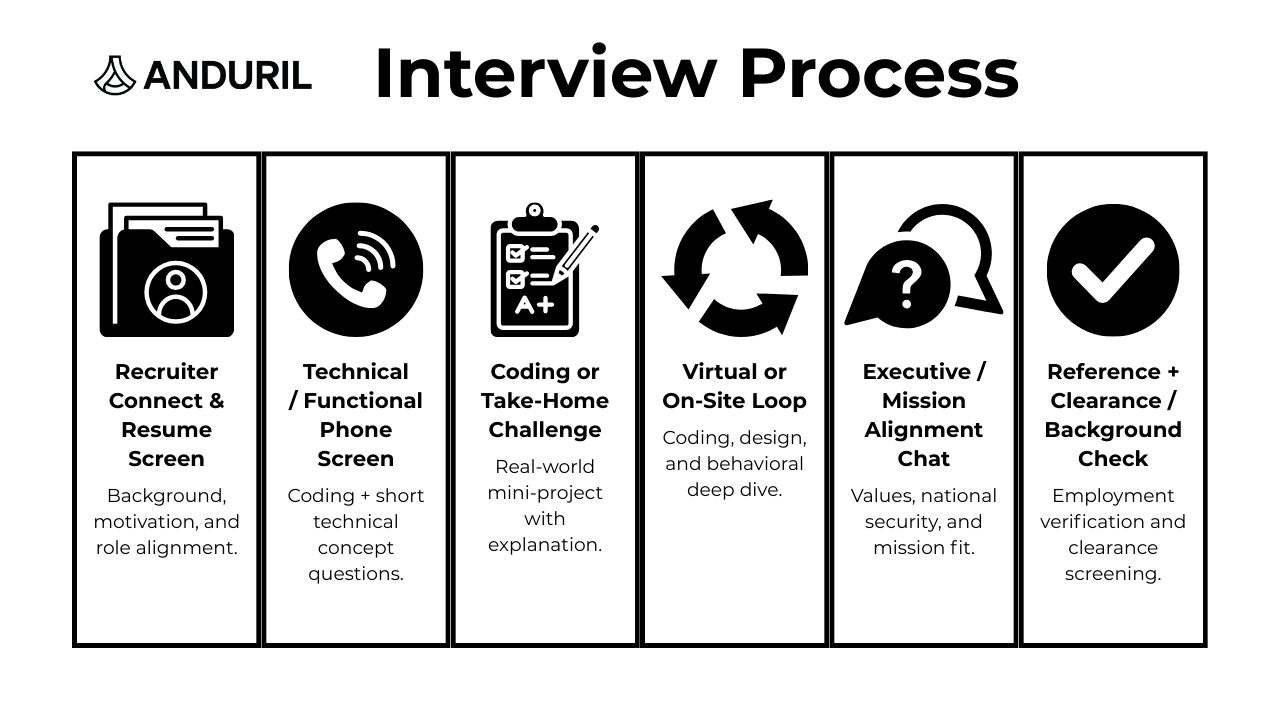
Recruiter Connect & Resume Screen
The process starts with a call from a recruiter. During this call, they’ll want to hear about your background, your interest in Anduril, and how your skills align with the company’s needs. Expect questions like, “Why Anduril?” and “What projects have you worked on that are most relevant to this role?” This call typically lasts between 30 and 60 minutes and serves as a screening to see if there’s a match between your experience and the role you’re applying for.
Technical/Functional Phone Screen
Next comes the technical phone screen. This is a video or phone interview where you’ll answer some quick questions on programming basics and solve coding problems.
They might throw in something more specific to Anduril’s tech, like drones or sensor systems, to see how you handle real-world applications. This part typically lasts around 40-60 minutes, with about 30 minutes spent on coding and the rest on short answer questions.
Coding or Take-Home Challenge (Engineering Roles)
For engineering roles, there’s often a take-home assignment, though these are being phased out due to the increased use of AI in coding tasks.
It’s a real-world challenge where you get to show off your skills in a more hands-on way. The focus is on how you solve the problem, your coding quality, and your approach. Think of it like a mini-project, where you’ll need to explain your decisions clearly.
Afterward, you’ll likely discuss your solution during the onsite interview.
Virtual or On-Site Loop (4–6 Rounds)
The onsite or virtual interview loop is where the process really picks up. You’ll go through four to six rounds with different members of the team. These interviews will assess your technical skills, problem-solving abilities, and how well you fit within Anduril’s culture.
The technical interviews will dive into coding challenges, system design problems, and deep discussions about algorithms and data structures. There will also be behavioral interviews to explore your teamwork, leadership experience, and how you’ve approached challenges in the past.
You may also encounter role-specific scenarios, where you’ll solve case studies or operational challenges relevant to the position.
For some roles, you might have to present a technical solution or product concept to a panel, which helps them assess your communication and presentation skills. This stage typically takes several hours and could span multiple days.
Executive / Mission Alignment Chat
Once you’ve made it through the technical rounds, you’ll have a conversation with a senior leader or executive. Expect to discuss why you’re interested in working for a defense technology company, how you feel about their focus on national security, and how your values match with their goals.
Reference + Clearance / Background Check
If you reach this final step, Anduril will conduct a reference check to confirm your employment history and ensure that your background is a good fit for the company.
With the flow in mind, let’s look at the questions candidates report seeing most often.
Most Common Anduril Interview Questions
Role-Specific Interview Guides
- Anduril Industries Software Engineer Interview Questions
- Anduril Industries Business Analyst Interview Questions
- Anduril Industries Data Analyst Interview Questions
- Anduril Industries Data Engineer Interview Questions
- Anduril Industries Data Scientist Interview Questions
- Anduril Industries Growth Marketing Analyst Interview Guide
- Anduril Industries Machine Learning Engineer Interview Questions
- Anduril Industries Product Manager Interview Questions
Mission & Values Questions
Anduril puts significant emphasis on mission and values questions; prepare well for them:
1. How would you answer when an Interviewer asks why you applied to their company?
When responding to why you want to work for a company, focus on aligning your skills and career goals with the company’s values and mission. Highlight specific aspects of the company that appeal to you, such as its culture, projects, or growth opportunities, and explain how you can contribute to its success.
When discussing strengths, choose qualities that are relevant to the job and provide examples of how you’ve demonstrated them. For weaknesses, select an area for improvement that you’re actively working on and explain the steps you’re taking to address it.
3. How do you resolve conflicts with others during work?
To resolve conflicts with co-workers, it is important to approach the situation with an open mind and a willingness to understand the other person’s perspective. Effective communication and finding common ground are key strategies in resolving conflicts amicably.
4. Describe a data project you worked on. What were some of the challenges you faced?
In this question, you are asked to describe a data project you have worked on and the challenges you encountered. This involves detailing the project’s objectives, the data involved, and any obstacles you faced, such as data quality issues, technical limitations, or resource constraints.
When describing a time you exceeded expectations, focus on a specific project where you went beyond the requirements. Detail the actions you took, the challenges you overcame, and the positive outcomes that resulted from your efforts.
Coding & Algorithm Questions
Expect medium-to-hard coding and algorithms questions, framed in real-world, mission-critical defense contexts:
The task is to identify the element in a sorted list closest to a given integer N and return it along with k-next and k-previous elements. If k exceeds the list bounds, return all entries up to the bound without error, and if two values are equally close, choose the lower value.
To solve this problem, use two arrays to store the maximum height to the left and right of each index. Then, iterate through the terrain levels to calculate the trapped water at each index by taking the minimum of the maximum heights from both sides and subtracting the terrain height at that index. Sum these values to get the total trapped rainwater.
To find the shortest path in a graph, you can use Dijkstra’s algorithm or Bellman-Ford algorithm. Dijkstra’s algorithm is efficient for graphs with non-negative weights, while Bellman-Ford can handle graphs with negative weights. Both algorithms involve initializing distances, updating them based on edge weights, and iterating until the shortest path is found.
To search for a target value in a rotated sorted array, use a modified binary search. First, determine which part of the array is sorted by comparing the middle element with the start and end elements. Then, decide which half to search based on the target’s value relative to the sorted half. Repeat this process until the target is found or the search space is exhausted.
To find the closest sum of three integers to a target, sort the array and use a three-pointer approach. Fix one element and use two pointers to find the other two elements. Calculate the sum and update the closest sum if the current sum is closer to the target. Adjust the pointers based on whether the current sum is less than or greater than the target.
Technical Depth Questions
More in-depth technical questions focused on concurrence and real-time systems may be asked in your Anduril technical interviews:
11. What are kernel methods in machine learning?
Kernel methods in machine learning are techniques used to analyze patterns in data by transforming it into a higher-dimensional space. For a matrix to represent a kernel, it must be symmetric and positive semi-definite. If a support vector machine model uses a kernel that does not meet these requirements, it may lead to incorrect or suboptimal results.
To solve this, filter the packet_rates table for entries within the first 10 minutes of January 1st, 2022. Group the results by ssid and mac_address, then count the number of packages sent by each device. Finally, select the maximum count for each ssid.
13. Between linear regression and random forest regression, which model would perform better and why?
Random forest regression is likely to perform better for predicting booking prices on Airbnb due to its ability to handle non-linear relationships and interactions between features. It is also more robust to overfitting compared to linear regression, especially when dealing with complex datasets.
Design the bomb detection model by selecting relevant inputs such as sensor data, image recognition, and environmental factors, and define outputs like threat level or alert status. Measure accuracy using metrics like precision, recall, and false positive rates, and test the model with real-world scenarios and controlled experiments to ensure reliability.
15. How would you design a model to detect potential bombs at a border crossing?
To design a bomb detection model, you need to define the inputs, such as sensor data or images, and outputs, like a binary classification indicating the presence of a bomb. Accuracy can be measured using metrics like precision, recall, and F1 score, while testing can involve real-world scenarios and simulations to ensure reliability.
To design a system for processing and displaying real-time data across multiple platforms, you need to ensure that comments are persistent and support interactive features like reactions. The system should update reaction counts in real-time for all viewers, requiring a robust architecture that can handle simultaneous data processing and display across platforms like Instagram, Facebook, and WhatsApp.
Interview Process & Logistics Questions
Expect questions that test both your decision-making under ambiguity and your ability to analyze incomplete, real-world data without ideal conditions.
Messy datasets often have drawbacks such as inconsistent data formats, missing values, and redundant information, which can hinder analysis. To improve the dataset’s utility, standardize formats, fill in missing data, and remove redundancies. Common problems in messy datasets include misaligned data, incorrect data types, and lack of normalization.
18. How would you decide whether or not to create a product, like a job board, for Facebook?
To decide on creating a Facebook job board, assess market potential through user research and competitor analysis. Design an A/B test to evaluate the job board’s effectiveness by measuring user engagement, conversion rates, and overall satisfaction compared to a control group.
To evaluate the improvement in operational efficiency without AB test data, you can start by defining key performance indicators (KPIs) that align with the tool’s intended impact. Collect baseline data on these KPIs before the tool’s implementation and compare it with data collected after the tool’s launch. Additionally, gather qualitative feedback from users to understand the tool’s impact on their workflow and identify any areas for improvement.
To test if survey responses are random, analyze patterns in the data for inconsistencies or unlikely response distributions. Use statistical tests to compare the observed response patterns against expected distributions under the assumption of random selection, and look for anomalies that suggest non-random behavior.
Tips for Preparing for an Anduril Interview
Here are some tips and interview stories to help you prepare for your next Anduril interview:
Start by reading Anduril’s mission. Interviewers often ask how you feel about working in defense—not to trip you up, but to gauge alignment. Be honest and thoughtful. Candidates who stand out can explain why the mission matters to them personally, not just why the job sounds cool. Know what Lattice OS and Ghost 4 are and the problems they solve.
Technical interviews often involve real-time systems, not just textbook questions. A standard coding problem might turn into designing a radar ingestion pipeline or drone fleet coordination. Brush up on shared memory models, async channels, producer-consumer queues, and lock-free data structures. Experience with NUMA-aware design or hardware acceleration? Definitely bring it up.
They care deeply about impact. One candidate shared how their system’s error rate dropped from 10% to under 1% after iteration—that kind of story lands. Be ready to dig into one or two projects and answer multiple follow-ups. What changed? Why did it matter? Even if things didn’t go perfectly, show what you learned and how you improved it.
Anduril’s products rely on fusing radar, lidar, and camera inputs in real time. Know how to combine noisy, asynchronous data streams into one reliable output. Study Kalman Filters, sensor calibration, and how to balance latency and accuracy under compute constraints. Candidates are often asked to design multi-sensor systems—real-world integration matters more than textbook definitions.
You don’t need a clearance to interview, but many roles will require one eventually. If you’re a U.S. citizen with a clean legal and financial record, you’re likely eligible. Ask if the role requires clearance. And no, polygraphs are not common—they’re reserved for high-level access.
Salaries at Anduril
Average Base Salary
Average Total Compensation
FAQs
Is the Anduril interview considered hard?
Yes, the interview is generally moderate-to-hard. Candidates face technical challenges similar to mid-level LeetCode problems, but the bar is higher on mission alignment, ethical awareness, and deep technical reasoning, especially around real-time systems, autonomy, and defense tech use cases.
How long does the Anduril hiring process take?
Most candidates complete the process in 3–6 weeks. However, roles requiring a security clearance can involve longer timelines post-offer, sometimes up to a year. Some teams run “fast-track” pipelines to accelerate hiring for urgent needs or critical roles.
Do I need an active security clearance to apply?
No—an active clearance isn’t required at the application or interview stage. Anduril can sponsor your clearance if the role demands it. In some cases, candidates may be granted interim clearance to begin work while the full process is underway.
What programming languages are used at Anduril?
Anduril’s core stack includes C++ (for performance-critical systems), Go (for backend infrastructure), and Python (for ML and data). On the front end, teams use TypeScript and React for operational and mission control interfaces.
Can new grads get hired at Anduril?
Yes—Anduril hires new grads and runs internship/co-op programs. However, hands-on project experience (e.g., robotics, embedded systems, defense simulations) carries more weight than GPA. Candidates who show initiative and mission-driven thinking stand out.
Conclusion
Anduril offers a chance to work on cutting-edge tech with real-world impact in national security and defense. If you’re excited by rapid iteration, meaningful missions, and complex systems like Lattice OS and Ghost drones, this is a place to grow fast and build boldly.
To prepare, explore our curated Learning Paths to strengthen core concepts, and challenge yourself with these Data Science Coding Interview Questions to simulate what you’ll face in technical rounds. For inspiration, check out how Hanna Lee broke her dream role with a focused and strategic prep journey.
Discussion & Interview Experiences