

Glassdoor: Tech Has the Sharpest Drop in Worker Confidence in 2026


Tech Worker Confidence Dips in 2026
For years, tech workers were among the most optimistic employees in the labor market. High salaries, strong demand for engineering talent, and rapid industry growth helped make the sector one of the most stable career paths.
But new data suggests that optimism may be fading.
According to the latest Employee Confidence Index from Glassdoor, tech workers have seen the largest drop in confidence of any major industry in early 2026.
The index measures how confident employees feel about their company’s business outlook over the next six months. Workers are asked whether they feel positive or negative about their employer’s future prospects, offering a snapshot of employee sentiment across industries.
The tech industry stands out for the speed and scale of the shift compared to major industries, suggesting that uncertainty in the sector may be growing even as many professionals remain employed.
Only 47.8% of Tech Workers Feel Confident
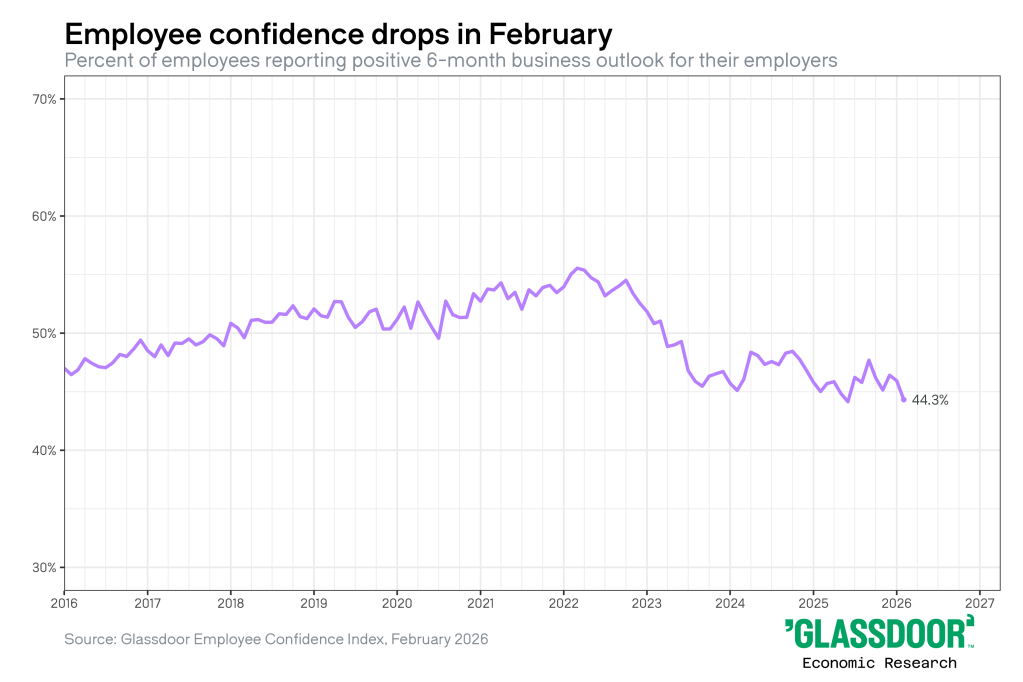 Source: Glassdoor Employee Confidence Index - February 2026
The data highlights a notable decline in tech-sector optimism.
According to the index:
- Less than half (47.8%) of tech workers say they feel confident about their company’s outlook
- That’s down from roughly 55% one year earlier
- The sector saw a 7.1 percentage-point drop, the largest decline across industries measured by the index
For comparison, the overall workforce has also experienced declining confidence in 2026, from 45.9% in January to 44.3% in February. However, no other major industry has seen as steep a fall as tech.
Despite recent reports suggesting modest signs of improvement in the tech job market, there remains growing uncertainty about the direction of the industry.
Analysts say employee confidence can often act as an early signal of broader labor market trends, especially in fast-moving sectors like technology.
Why Tech Workers Are Feeling Less Secure
Several factors may be contributing to the shift in sentiment across the tech workforce.
Continued layoffs across the industry
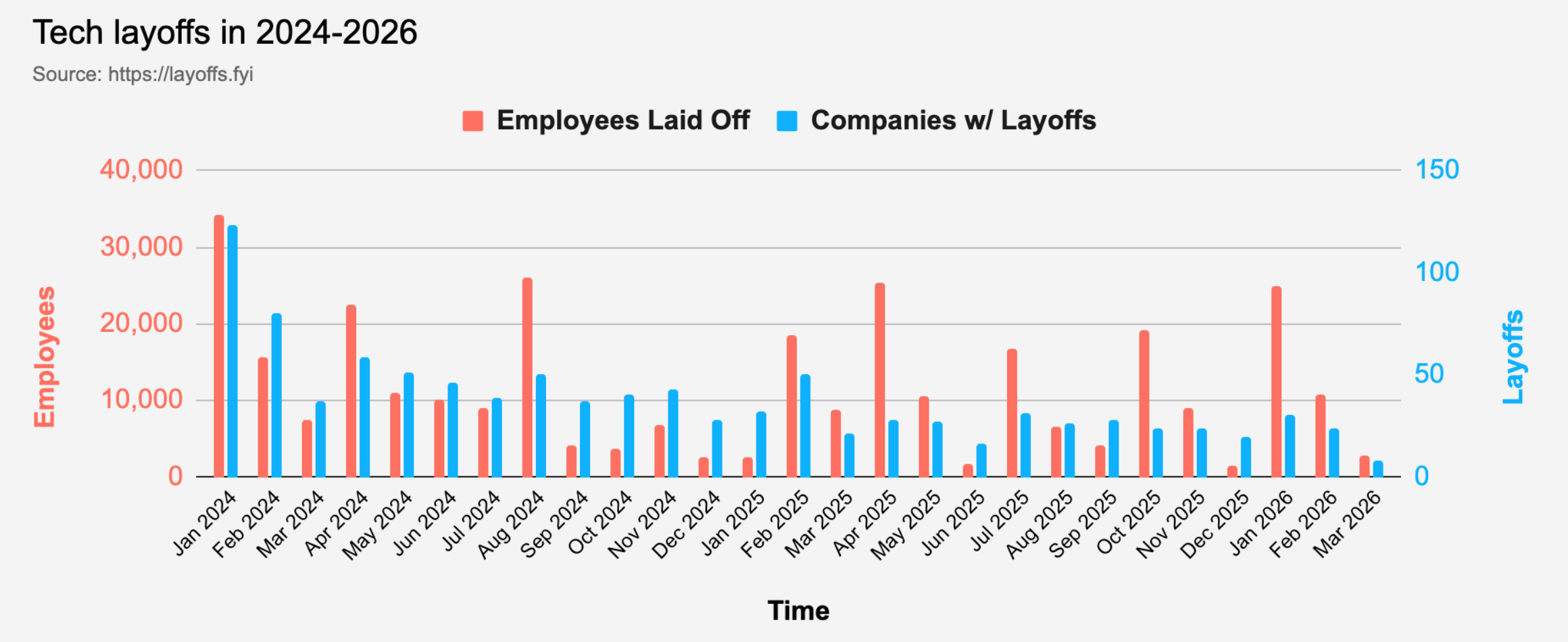
After years of aggressive hiring during the pandemic tech boom, many companies have spent the past two years restructuring and cutting costs. Large tech firms and startups alike have announced layoffs, creating a sense of instability even among employees who remain employed.
Slower hiring and fewer entry-level opportunities
Hiring activity has cooled compared to the peak years of 2021 and 2022. Instead of expanding headcount rapidly, many companies are prioritizing efficiency and profitability.
A previous job market report from January noted that worker productivity in many industries has increased but hiring growth slowed, a trend that may reduce the urgency for companies to add new roles. This dynamic has contributed to what some analysts describe as a tech hiring freeze, particularly affecting entry-level candidates who must navigate few real hires despite an increase in job postings.
Uncertainty around AI and job roles
The rapid adoption of generative AI tools has introduced new questions about how work may change in fields like software engineering, data analysis, marketing, and customer support. While AI is often framed as a productivity tool, some workers are unsure how it will affect long-term job demand or skill requirements.
Together, these trends may help explain why confidence levels are falling even as many tech professionals remain employed.
The Tech Job Market May Be Stabilizing, But Is Still Selective
Despite declining confidence, the broader tech labor market is not necessarily collapsing.
Many companies are still hiring, particularly for roles related to AI, machine learning, and data infrastructure. Demand for specialized talent in these areas remains strong.
However, the market looks different from the rapid expansion seen earlier in the decade. Instead of aggressive growth, many organizations are focusing on:
- Efficiency and cost control
- Smaller, specialized teams
- Higher expectations for productivity
This shift can create the perception of a weaker job market even when employment levels remain relatively strong.
For workers who entered tech during the boom years, the current environment may simply represent a normalization of hiring patterns rather than a long-term downturn.
Nonetheless, perception plays a crucial role in workplace sentiment. When employees feel uncertain about the future, it can influence job satisfaction, retention, and career planning.
Adapting to the Confidence Shift Across Tech
For professionals working in technology today, the drop in confidence may reflect a broader shift in how the industry is evolving. It’s important for tech workers to take note of the following trends to better adapt their career planning to industry shifts.
Skill adaptability.
As technologies evolve rapidly, especially with the rise of AI, workers who continuously update their skills may have an advantage. Employers increasingly value professionals who can adapt to new tools and workflows, such as collaborating with AI agents beyond the automation of simple tasks.
Slower career mobility.
During the tech hiring boom, switching jobs was often one of the fastest ways to advance compensation or career opportunities. With fewer companies hiring aggressively, career moves may require more planning and patience. Early-career workers can also expect increased competition and tighter hiring standards even for junior roles.
Productivity expectations may rise.
The growing adoption of AI tools may also raise expectations around productivity. Recent research on tech work culture reveals that some companies are already experimenting with AI-driven workflows that compress tasks and accelerate output.
In some cases, particularly in AI-focused startups, this shift has been associated with longer work hours and higher performance expectations as teams attempt to move faster with fewer employees.
Overall, while confidence levels may fluctuate with economic cycles, the long-term outlook for technology careers remains closely tied to innovation and demand for digital infrastructure. For many workers, the challenge now is learning how to adapt to a tech industry that is evolving as quickly as the technologies it builds.