
Interview Query vs StrataScratch: Which Data Science Interview Platform Is Right for You?


Introduction
If you are preparing for a data science or analytics interview, chances are you have already encountered both Interview Query and StrataScratch. On the surface, they appear similar. Both offer real interview questions. Both focus on SQL, Python, and data roles. Both promise to help you land your next job. But once you start preparing seriously, you realize something important. Not all interview prep is built the same way. Some platforms help you practice technical execution. Others help you understand how interviews are structured, evaluated, and scored. And that difference matters, especially if you are targeting competitive companies.
This guide breaks down Interview Query and StrataScratch in depth. We will look at:
- Question quality and realism
- Learning structure
- Solution depth
- Mock interviews and simulation
- Community and support
- Pricing and long-term value
By the end, you will know which platform aligns with your preparation style, timeline, and target role.
Who This Guide Is For
This comparison is written for serious candidates, not casual browsers.
You might be:
- A data analyst preparing for SQL-heavy screens
- A mid-level data scientist targeting top tech companies
- A career switcher trying to build structured foundations
- A candidate entering final rounds and wanting realistic simulations
If you care about using your prep time strategically, this guide is for you.
How We’re Comparing Interview Query vs StrataScratch
This comparison of Interview Query vs StrataScratch looks at both platforms through five key categories that shape a candidate’s interview prep experience. The scoring blends hands-on testing with feedback from real candidates, practicing data professionals, and public reviews from trusted sources such as Trustpilot, Reddit, and LinkedIn.
The categories focus on what matters most for interview success: UI/UX, quality of content, innovative tools, pricing value, and community support. Each platform’s total score out of 55 is then converted to a simple 5-point scale for easy comparison.
| Category | Interview Query Score | StratScratch Score | Why it Matters | Key Differentiator |
|---|---|---|---|---|
| UI/UX | 8 / 10 | 7 / 10 | Determines how intuitive and efficient the platform feels during usage | Interview Query offers more structured navigation, while StrataScratch has cleaner code execution |
| Content Quality & Depth | 18 / 20 | 14 / 20 | Reflects the breadth, structure, and realism of interview questions and solutions | Interview Query offers domain-specific guides, video walkthroughs, and case studies |
| Features & Innovation | 9 / 10 | 5 / 10 | Highlights platform tools like mock interviews, learning paths, and AI feedback | Interview Query includes P2P mocks, AI critique, and company timelines |
| Pricing & Value for Money | 7 / 10 | 9 / 10 | Compares access vs. cost across plans and question volume | StrataScratch offers a stronger monthly value; Interview Query excels in lifetime tools |
| Community & Support | 4.5 / 5 | 3 / 5 | Shows how much peer learning, forums, and expert access is enabled | Interview Query offers AMAs, LinkedIn engagement, and live sessions |
| Running Total | 46.5 / 55 | 38 / 55 |
Interview Query shines in most categories because it prepares candidates for the full interview journey. Instead of narrowing in on a single skill like SQL or Python, it covers the entire loop from start to finish. StrataScratch makes its mark in pricing and value. With a lower monthly cost and strong returns for those diving into SQL tutorials and interview questions, it is a go-to for SQL specialists.
The gap in features and innovation tells the story even more clearly. Interview Query builds a one-stop hub for interview prep, complete with mock interviews, an AI interviewer, coaching, and in-depth case studies. StrataScratch stays in its lane, delivering sharp, real-world SQL challenges without the extra bells and whistles.
User Testimonials:
Alma Chen, now a data analyst at Lyft, shared how Interview Query became essential during her career transition from actuarial science to tech. She struggled to find targeted interview prep resources until discovering Interview Query.
“I quickly narrowed my search to data roles at tech companies, but I didn’t know much about their interview process compared to actuaries. It was easy to find generic resources online or on YouTube, but much harder to find specific interview preparation materials. That’s when I first stumbled upon Interview Query. The further I got into the field, the more I turned to Interview Query for guidance.”
Kyle, a data scientist at Twitch, praised StrataScratch for rapidly building his SQL skills and confidence.
“StrataScratch has been super helpful. I started with barely being able to finish an easy SQL query to no problem solving most of the medium level in just a few days.”
Preparing for interviews can often feel like navigating a maze—so many platforms, each promising to be the key to success. Among the most discussed are Interview Query and StrataScratch. Both offer access to real interview questions and aim to help you land your next role. But how do you determine which platform aligns best with your goals and learning style?
This guide provides an in-depth comparison of Interview Query and StrataScratch, focusing on:
- The strengths and limitations of each platform
- Which platform suits your specific needs, whether you’re targeting SQL-intensive roles or seeking a broader range of interview preparation
- How to maximize your investment in terms of time and resources
By the end of this article, you’ll have a clearer understanding of which platform can best support your journey to acing data science interviws.
If you’ve ever sat down to prepare for a data science interview and felt like you didn’t even know where to start, you’re not alone. Between SQL drills, case studies, product sense, and behavioral prep, it’s easy to get lost in a sea of platforms all promising to “get you ready.”
The truth is, not all interview prep tools are the same. Some offer plenty of questions but little direction, while others help you focus on learning, but leave gaps in practical skills.
Among the most recommended ones, two of the most talked-about interview prep platforms are Interview Query and StrataScratch, with both promising access to real interview questions and claiming to help you land your next role without being ghosted.
But how do you know which one’s best for you?
This guide will help you understand:
- The strengths and weaknesses of each platform
- Which platform fits your goals, skills, and timeline
- Where do you get the most value for your time and money against your goal
What Are Interview Query and StrataScratch?
Before comparing features or pricing, it’s important to understand what each platform is fundamentally designed to do.
At a high level, both Interview Query and StrataScratch aim to help candidates prepare for data science, analytics, and related technical interviews. But they approach preparation differently, and that difference affects how you experience the platform and what kind of outcomes you get from it.
What is Interview Query?
Powered by experienced data scientists, software engineers, and professionals from various industries, Interview Query is a specialized online service and platform focused on helping aspiring data scientist candidates prepare for job interviews. The site curates real-world interview questions from data science roles at companies like Google, Meta, Airbnb, Amazon, and more. If you’re preparing for roles in data science, analytics, machine learning, or product analytics, you’ll find questions across SQL, statistics, algorithms, ML, A/B testing, and product sense. Many of these are reportedly asked at companies, including MAANG+ and beyond - Meta, Amazon, Apple, Nvidia, and Google
With a proud collection of 35000+ real-world questions covering SQL, statistics, algo, ML, product sense, Interview Query also offers supporting tools like mock interviews, take-home challenges, and AI Interviewers for more personalized preparation and solutions.
But here’s what you should really care about: Interview Query doesn’t just give you questions. It gives you context.
You can:
- See how interviews are structured at specific companies
- Follow guided learning paths instead of guessing what to study next
- Practice mock interviews with peers. If you wish to practice real case studies or interview questions with real interviewers, try Interview Query’s Mock Interviews for hands-on feedback and interview prep. Feel free to also explore the AI Interviewer feature to gain more confidence before facing the more critical mocks. Book a Mock Interview →
- Use an AI interviewer to simulate live questioning
- Work through take-home style case challenges
What is StrataScratch?
StrataScratch is a relatively new online education platform designed for professionals preparing for data science, engineering, and analytics roles. Its key priority is to provide hands-on coding practices and expose candidates to real-world interview questions sourced from top companies.
StrataScratch is more focused on sourcing coding and non-coding questions from recent interviews at leading tech firms. And while they cover a range of roles, including data scientist, data engineer, BI analyst, and ML engineer, it leans more toward offering a clean, student-friendly learning experience. However, it tends to be lighter on providing advanced tools or structured guidance specifically geared toward real interview preparation.
Feature-by-Feature Breakdown: Interview Query vs StrataScratch
| Feature | Interview Query | StrataScratch |
|---|---|---|
| Platform Focus | End-to-end interview preparation with mock interviews, learning paths, and guides | Practice-heavy coding platform with SQL emphasis and self-paced learning |
| Types of Questions | Coding, case studies, ML system design, behavioral, take-home projects | Primarily SQL and Python, with some non-coding and product questions |
| Mock Interviews | Yes — peer-to-peer video interviews with AI feedback and structured sessions | No — only standalone practice problems |
| Case Studies | Included with breakdowns, walkthroughs, and video discussions | Limited and mostly embedded in problem sets |
| SQL/DB Query Problems | Very Strong — Over 130 SQL questions included within broader question sets | Very Strong — Real SQL interview questions with a built-in SQL editor |
| Python Problems | Yes — with guided explanations, video support, and runnable code | Yes — runnable solutions but limited contextual guidance |
| System Design | Included in company-specific guides and interview prep paths | Not a core focus |
| Personalized Feedback | Available — AI code critique, 1:1 coaching, and peer reviews | Not available |
| Community/Forums | Active — peer discussions, live Q&A, AMAs, YouTube, LinkedIn, networking events | Basic — individual question threads and tutorials |
| Pricing | Higher monthly cost, better long-term value with lifetime plan. | Lower monthly cost, strong value for short-term practice |
Here’s a detailed look at how Interview Query and StrataScratch differ when it comes to core offerings, depth of content, and interview realism.
Question Bank & Problem Sets
| Feature | Interview Query | StrataScratch |
|---|---|---|
| Total Questions | 35,000+ | 1,000+ |
| Real Company Questions | Yes | Yes |
| Python, Pandas, R Support | Yes | Limited |
| Case Studies | Included | Not Structured |
| Filtering by Role/Type/Company | Advanced filters | Limited |
When you subscribe to an interview prep tool, a huge question bank can either be a blessing or a trap due to information overload. If the content is relevant, organized, and mirrors real interviews, you progress faster. If it’s scattered or one-dimensional, you waste precious prep time.
This is where Interview Query and StrataScratch take very different approaches.
Interview Query
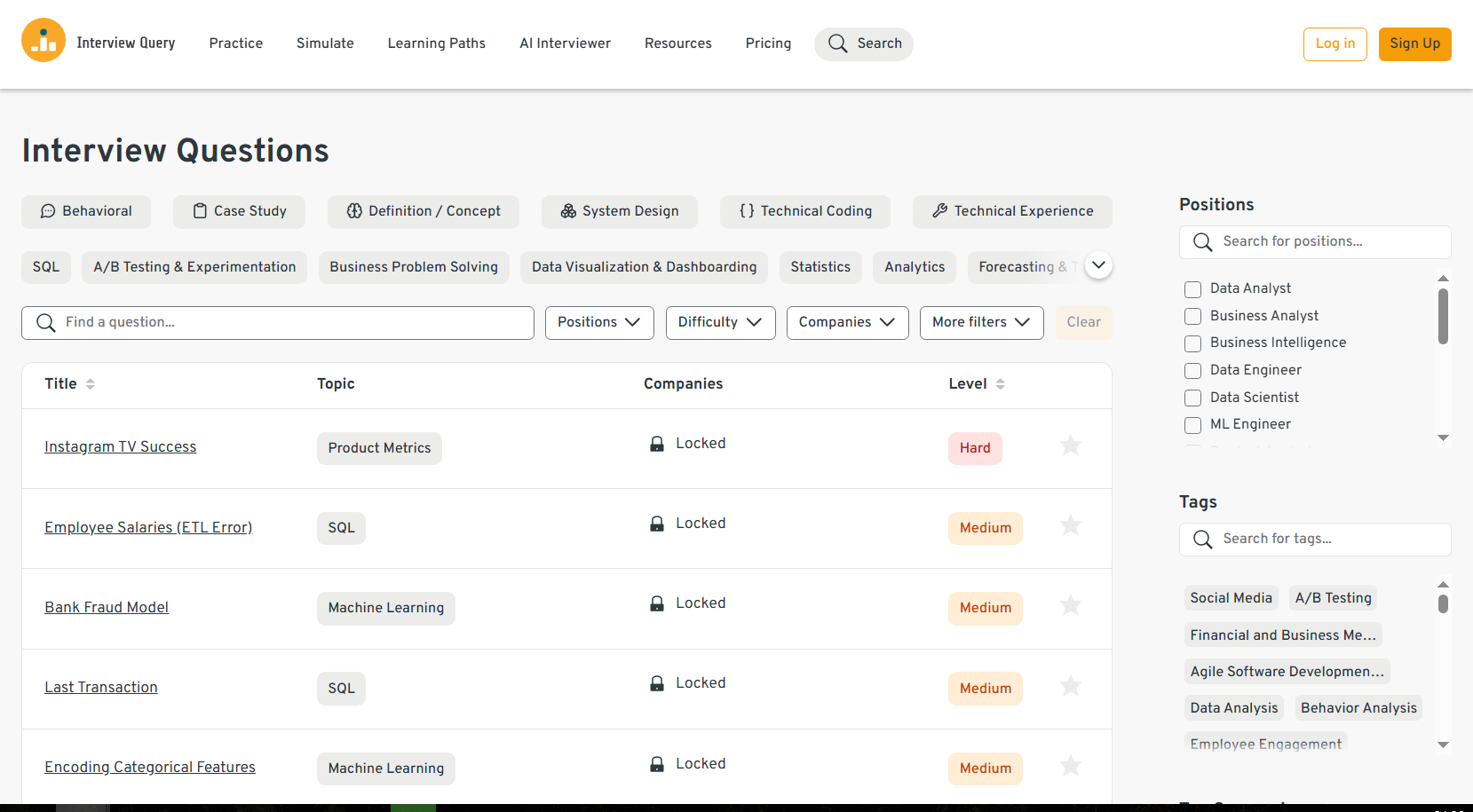
Interview Query boasts an extensive library of over 35,000 real-world interview questions sourced from top tech companies. These questions cover a wide range of topics. Our focus is not just on coding problems but also on 360-degree preparation.
But the value isn’t just in the number.
Here’s what changes your prep experience:
- Questions are grouped inside company-specific guides.
- You can filter by role, topic, company, and difficulty.
- Case studies, behavioral prompts, and ML system design questions sit alongside coding problems.
So instead of just practicing “a SQL question,” you see where that SQL question might appear in a real interview loop.
That structure reduces guessing. You’re not randomly picking problems, you’re preparing with context.
Reflecting on the experience, one candidate shared:
“Interview Query has a lot more questions and supports Python, pandas, PostgreSQL, and R already. More info on the job process as well. I looked at both tools when I was applying for jobs and ended up going with Interview Query.”
If you’re aiming for multi-round interviews, that context matters.
StrataScratch
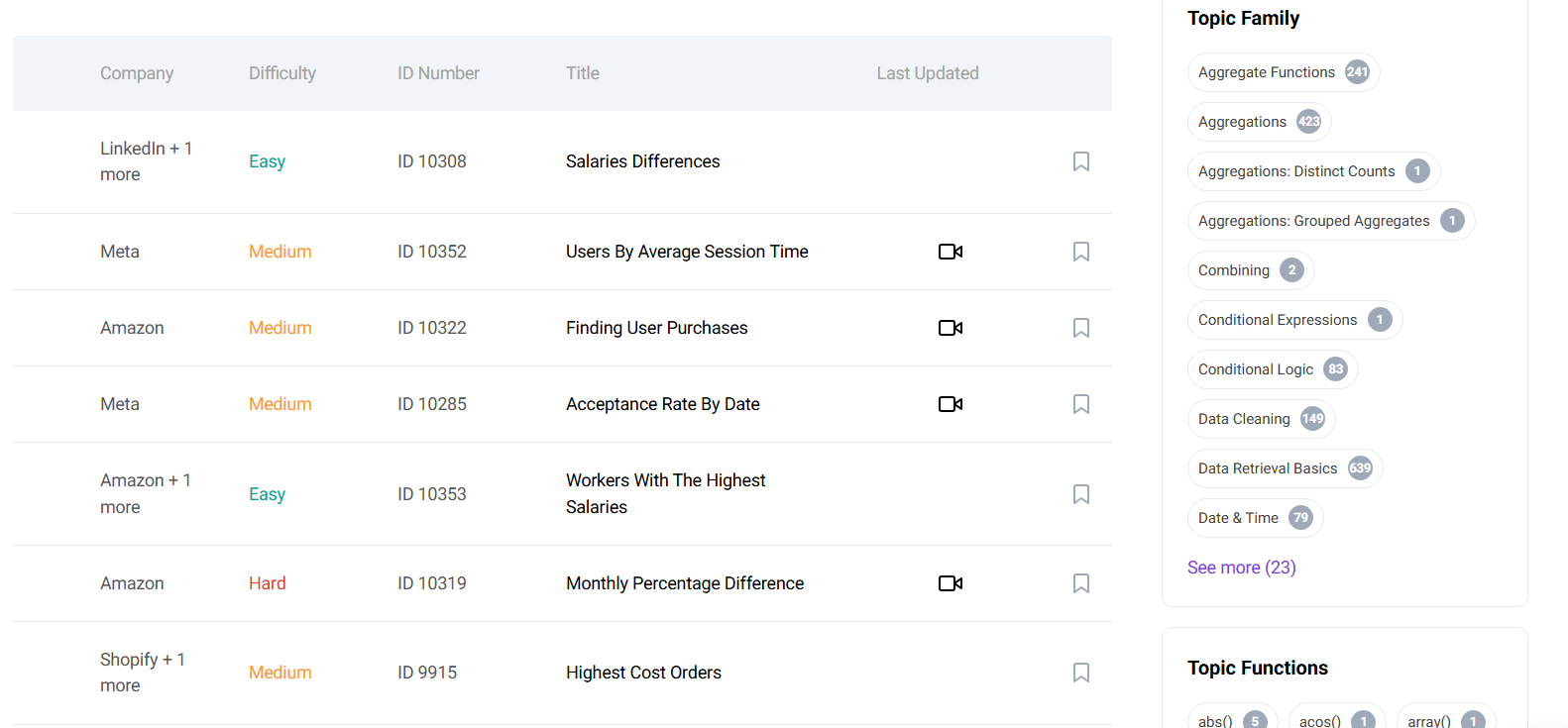
StrataScratch is more execution-focused. Currently, it includes 649 SQL problems, which is a strong number if your priority is database query mastery. You open a problem. You solve it. You run it. You move on. It’s excellent for building SQL confidence through repetition. Outside SQL, there are Python and some statistics or product-style questions, but the platform doesn’t emphasize how those questions fit into full interview structures.
So if your interview tests SQL, stats, and business reasoning together, you may need to connect those dots yourself.
One user admitted that the platform pushed them much harder than expected:
“Thought I was good in SQL until I tried Stratascratch… Stratascratch however, is seriously difficult, either I am not good at SQL enough or I lack the intellect to solve these questions.”
Key Takeaways:
- For most data science candidates who need well-rounded prep, Interview Query’s mix of breadth, real interview context, and domain variety makes it a more strategic choice.
- StrataScratch is mostly for those who need intensive SQL practice or are focused on mastering coding problems.
To test your skills beyond interview questions, take on the real-world analytics challenges from top companies on Interview Query. Great for sharpening your problem-solving before interviews.
Difficulty Levels & Realism
Practicing difficult questions is useful only if the format mirrors real interview conditions. Technical challenge alone does not guarantee interview readiness. Both Interview Query and StrataScratch categorize their questions by difficulty level, typically easy, medium, and hard. That is the baseline expectation.
Interview Query adds another layer of realism through company-specific interview guides. These guides group questions by technical domain within actual interview structures. The platform includes over 6,000 company guides with role-specific interview questions. This allows you to prepare for complete interview sequences rather than isolated challenges.
If you’re targeting, for example, a senior business analytics role at Airbnb, you can zero in on the exact mix of SQL challenges, product sense cases, and behavioral questions past candidates have faced.
This added flexibility is one reason Interview Query stands out. As noted by Candor:
“On Interview Query, you can specify what types of questions to practice, sorting by question type, job position, difficulty level, company and question topic… tailor your studying to … your dream role and company.”
StrataScratch also offers company-tagged questions, but it lacks domain-specific categorization within structured interview flows. You practice challenging problems, but the sequencing and interview timeline context are lighter.
Interview Query’s guides often include visuals of interview processes, estimated timelines, and breakdowns of each round. That additional context creates a more immersive preparation experience.
Key Takeaways:
- Interview Query offers more realistic, company-specific scenarios with structured difficulty levels that mirror real interview conditions, preparing you not just for coding, but for interview dynamics as well.
- StrataScratch provides highly challenging technical problems, especially in SQL, making it a great choice for users looking to improve their coding skills but lacking the real interview context.
- Interview Query better bridges the gap between practice and the realities of a full interview loop, making it more effective for most data science candidates.
Solution Explanations & Walkthroughs
| Element | Interview Query | StrataScratch |
|---|---|---|
| Step-by-Step Explanations | Most questions | Shorter explanations |
| Runnable Code Environment | Yes. Good. | Yes. Better. |
| Video Walkthroughs | Available (premium) | Available |
| Expert Coaching Option | 1:1 sessions offered | Not Available |
A particular issue that candidates frequently mention while choosing an interview prep tool is the lack of walkthroughs in the provided solutions. Since the change in interview processes for data science roles since 2023-24, it has become increasingly important to walk your interviewer through the solution you’ve come up with.
Bearing that in mind, we have started to embrace a more structured approach with walkthroughs for coding problems and case studies with video discussions, in addition to our existing code-focused approach.
Interview Query
Most solution on the Interview Query platform is now accompanied by a clear breakdown of the reasoning process and edge-case handling. Premium users, moreover, enjoy 1:1 personalized coaching sessions with industry experts with firsthand experience navigating the interview process.
For example, take this SQL question about cumulative distribution on the platform. The solution breakdown walks you through each step, from initial query construction to refining logic for the final cumulative distribution. This method not only explains the “how” but also the “why,” helping you build transferable problem-solving patterns for similar SQL challenges.
Struggling with take-home assignments? Get structured practice with Interview Query’s Take-Home Test Prep and learn how to ace real case studies.
StrataScratch
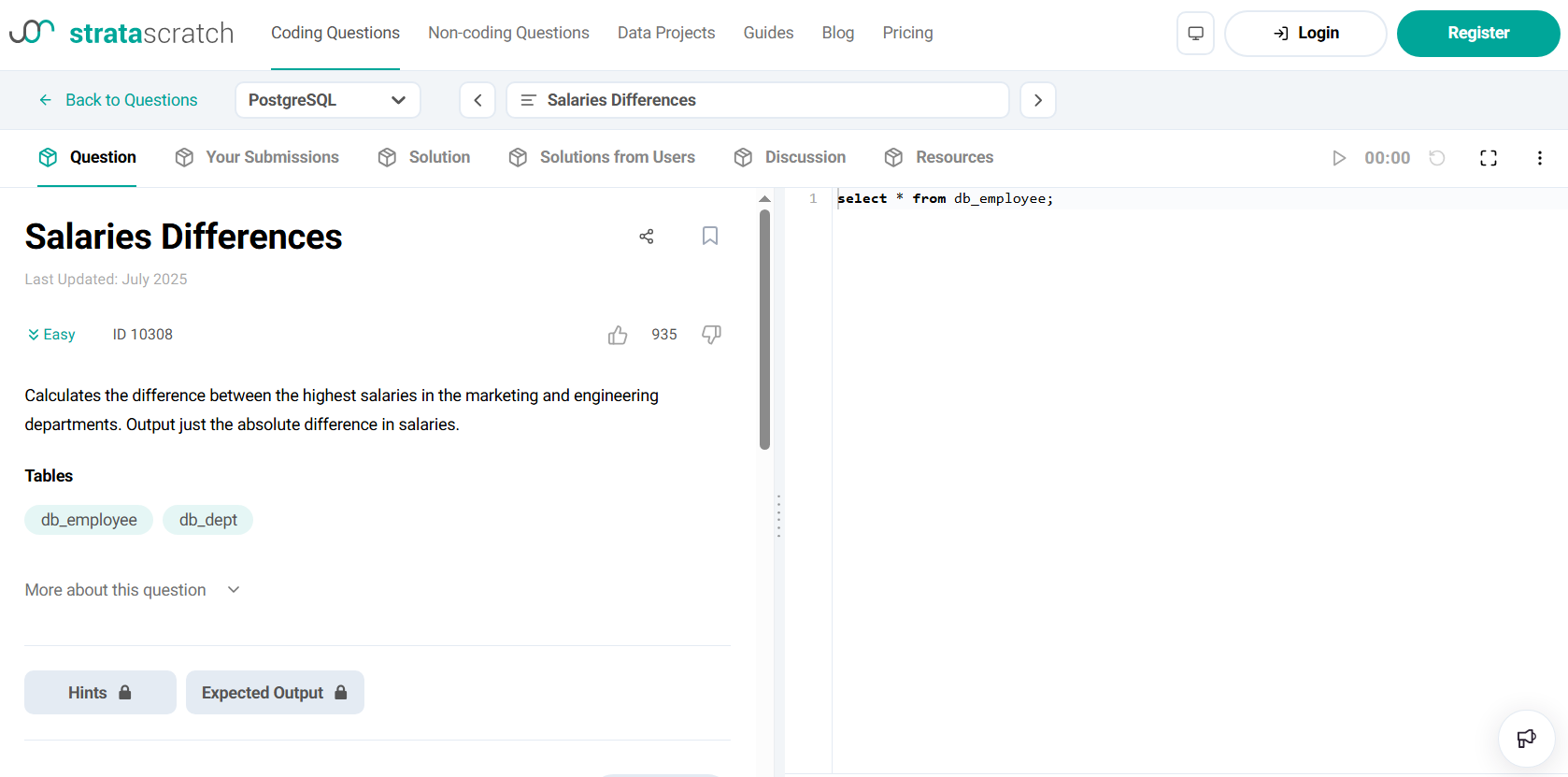
StrataScratch excels at providing a more accessible, runnable coding environment, but is more succinct in its explanatory content. Similar to Interview Query, most coding questions on the platform are paired with a complete runnable Python or SQL solution that you can edit and execute directly.
However, while some of the questions have an “approach” discussed, most of the guidance centers on the final code rather than step-by-step breakdowns. The platform’s approach is more focused on giving you the tools to solve problems independently, rather than walking you through each step in detail.
Key Takeaways:
- Interview Query provides thorough explanations with step-by-step breakdowns, video walkthroughs, and the option for 1:1 coaching.
- StrataScratch offers shorter, code-focused explanations, encouraging users to figure things out on their own. It may not be suitable for those who need more detailed guidance.
Mock Interviews & Scenario Practice
| Feature | Interview Query | StrataScratch |
|---|---|---|
| Peer Mock Interviews (Video) | Yes | No |
| AI-Powered Feedback | Yes | No |
| Timed Challenges | Included | Not Included |
| Take-Home Case Projects | 50+ curated projects | Limited |
| Scenario-Based Practice | Realistic simulations | Not Offered |
A huge challenge for data science candidates is bridging the gap between solving isolated problems and performing under real interview pressure. It’s entirely different to explain stats when you’re alone at your desk versus when watched by an interviewer, seeking justification for every step and expecting you to think aloud. Mock interviews recreate this high-pressure, multi-skill environment.
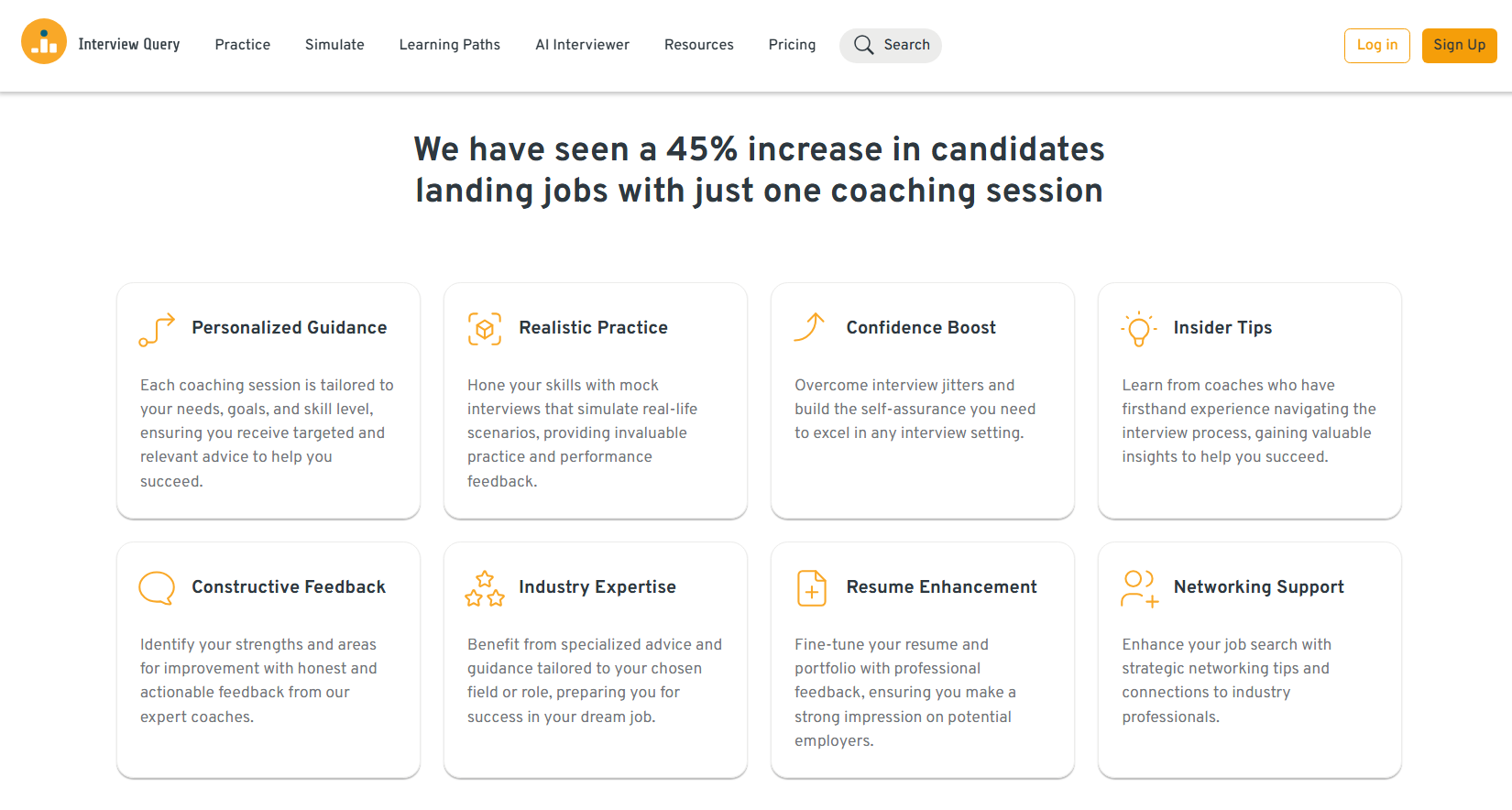
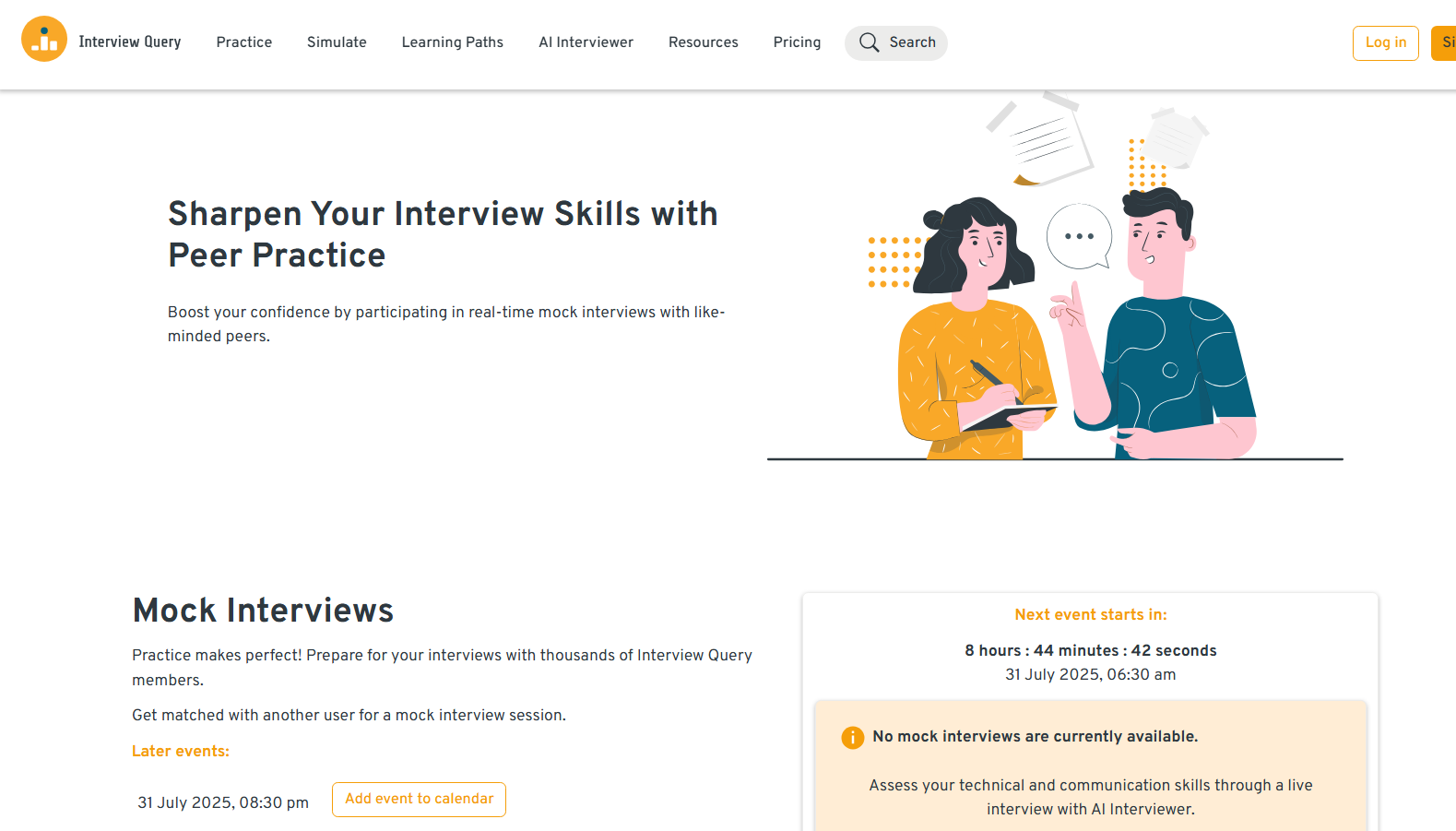
When it comes to mock interviews, Interview Query stands out as the only one of the two platforms actively providing the simulations. Interview Query provides a structured, peer-based mock interview suite with real-time video sessions and AI-Interview feedback.
Laura Gomez says:
“Smooth interface, superior video quality. P2P interviews emulate real job interviews effectively. Can do multiple interviews weekly. Thoroughly positive experience, 10⁄10.”
Interview Query’s P2P video interviews are designed to closely simulate live interview conditions. The interface is smooth, the video quality is high, and the sessions typically last around 1.5 hours. These sessions include company-specific scenarios, timed challenge quizzes, and case-study walkthroughs, all within the mock interview suite.
In contrast, StrataScratch does not offer formal mock interviews or video-based interview simulations. While it provides access to an extensive library of coding challenges and problems, these are primarily standalone exercises.
Key Takeaways:
- If you’re preparing for an advanced level of data science interview, mock interviews offered by Interview Query, complete with AI feedback, case studies, and love coaching, make the perfect solution. For candidates already preparing for interviews or nearing the final rounds, Interview Query offers a more complete and realistic preparation experience.
Need 1:1 guidance on your interview strategy? Interview Query’s Coaching Program pairs you with mentors to refine your prep and build confidence.
Community, Forums, & Peer Discussion
Peer learning is a critical component for skill development and preparing for the upcoming data science interviews. Both Interview Query and StrataScratch understand the essentiality of having a community for potential and successful candidates, and pros to discuss problems and come up with better approaches.
Interview Query has a peer learning model revolving around live Q&A, in-platform discussion boards, networking, AMAs, and expert coach drop-ins, whereas StrataScratch depends on tutorials and individual, question-specific discussions. Interview Query Co-Founder, Jay Feng, also actively engages with his 58K followers through the latest job posts, industry news, and problem-solving sessions
Key Takeaways:
- Interview Query offers a rich, community-driven environment with live sessions, expert engagement, and a network of active users. This makes it ideal for those who value peer support and expert insights throughout their prep journey.
- StrataScratch provides more independent learning with less focus on community interaction.
Platform Usability, Progress Tracking, & User Experience
A poorly organized platform without intuitive elements can waste valuable preparation time. If it takes too long to find the right questions, switch between topics, or resume where you left off, your focus shifts from skill-building to navigation. Let’s see how Interview Query and StrataScratch hold up to the promise:
Interview Query
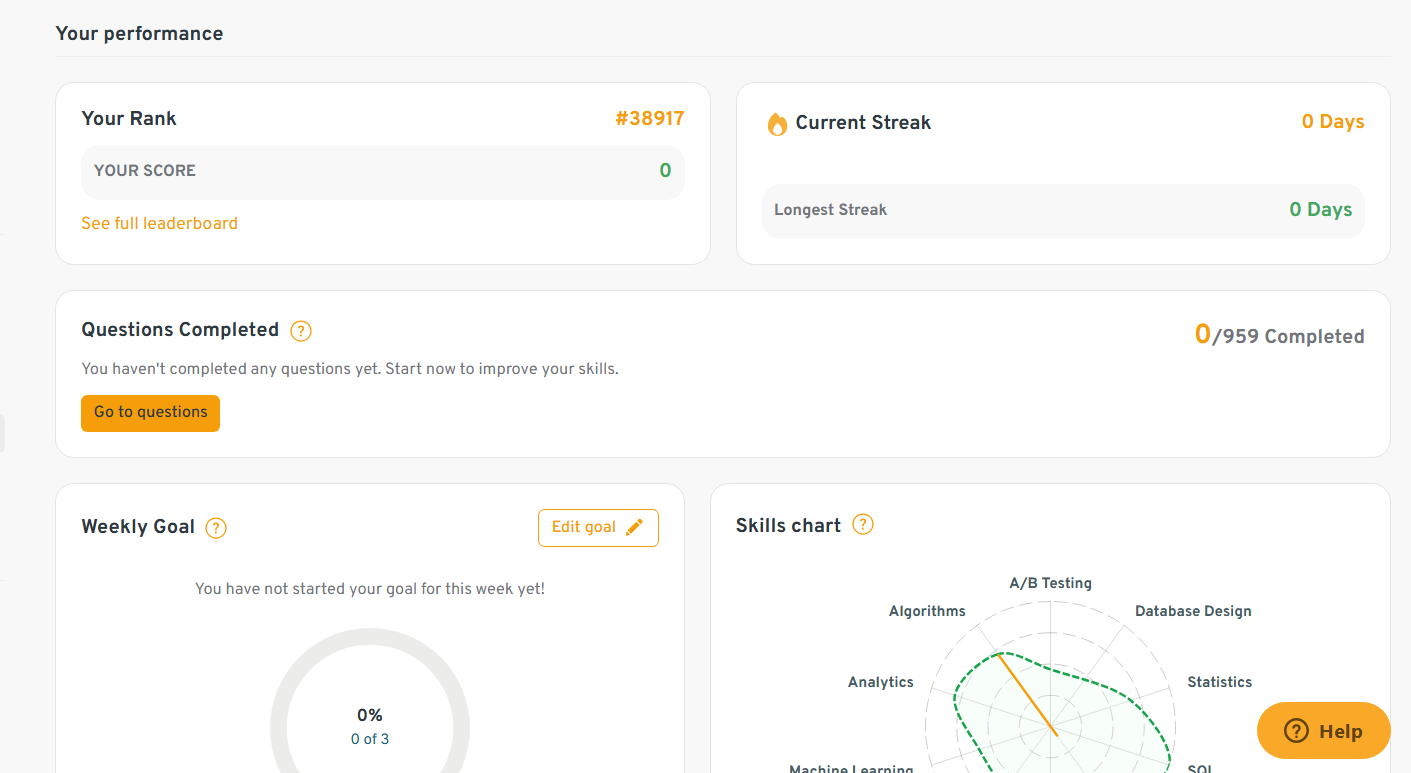
Our ultimate objective is to deliver a seamless and intuitive user experience. With Interview Query, the approach centers on a modern interface with clear sections like Interview Questions, Job Board, Mock Interviews, Company Guides, AI Interviews, Learning Paths, etc.
Moving on to structured learning, in addition to dedicated posts on numerous topics and candidate issues, Interview Query’s Learning Paths help you focus on what’s essential, like SQL, stats, and A/B testing for DS, so you don’t waste time jumping across random topics. Each Path shows completion progress, remaining modules, and time estimates to help pick up where you left off. Interview Query is forced to embrace a more desktop-first UI for mock interviews and deeper code editor functions.
StrataScratch
For StrataScratch, a minimal design made its claim through clean individual questions and a great compiler to execute code. StrataScratch’s minimal design particularly complements its focus on individual technical question-and-answer. While it has blog posts and domain-specific guides, formal learning paths or guides to track progress are absent.
Key Takeaways:
- Interview Query provides a well-structured interface with progress tracking and learning paths that guide you through your preparation journey, making it ideal for candidates who appreciate organized, goal-oriented learning.
- StrataScratch offers a minimalist design with a focus on hands-on coding practice. It’s great for users who prefer a self-paced.
Pricing Comparison: Interview Query vs StrataScratch
We compared not just the prices, but also what each plan unlocks in terms of features, depth, and long-term value.
Pricing Tiers
Here is a comprehensive comparison of pricing tiers for both platforms:
| Plan | Interview Query | StrataScratch |
|---|---|---|
| Monthly Plan | $79/month (billed monthly) | $44/month (billed monthly) |
| Yearly Plan | $199/year (billed annually) | $199/year (billed annually) |
| Lifetime Plan | $299 (one-time payment) | $289 (one-time payment) |
Interview Query Features:
- 1,000+ authentic interview questions from recruiters
- 6,000+ company guides with hiring processes and salary data
- 11 distinct learning paths with 350+ lessons
- 50+ real take-home challenges from top companies (Amazon, Airbnb, DoorDash, Uber)
- Mock interviews with peers and mentors
- Tools to compare salaries across companies, locations, and roles.
- Interactive quizzes to test knowledge and track performance against peers.
- AI Interviewer: Simulated practice with instant feedback on answers to improve interview responses.
- One-on-one personalized coaching sessions with industry professionals to guide preparation.
- Data science job board access
- Industry expert insights (12+ years experience)
StrataScratch Features:
- 600+ data science coding questions (SQL, Python, R)
- 500+ non-coding questions (ML, product sense, statistics, probability, system design)
- 50+ data science projects and take-home exams
- Monthly addition of new questions from real interviews
Value for Money
If you’re opting for a monthly plan, StrataScratch holds a clear pricing advantage, with Interview Query costing approximately 132% more. However, that gap narrows—and even shifts in favor of Interview Query—when considering lifetime access. This is due to the added value of its extensive tools, in-depth company guides, and integrated job board.
Considering the updated July 2025 database, the Interview Query costs approximately $0.20-$0.30 per question, while StrataScratch costs $0.13-$0.26.
Which Platform Should You Choose? (Use Cases + Recommendation)
Here’s a breakdown of who each platform is best suited for based on your learning goals and interview preparation stage.
Choose Interview Query If:
- You’re seeking an all-in-one platform combining question practices, learning paths, company research, and mock interviews in one ecosystem. You don’t have to juggle multiple tools or guess what to do next.
- You’re targeting data science interviews at product/data-driven companies. Aimed at landing interviews with top tech firms (Google, Meta, Airbnb, DoorDash, etc.), where questions often blend SQL, product intuition, statistics, and business acumen.
- You need detailed case study breakdowns and mock interviews. Choose Interview Query if you value step-by-step case breakdowns, scenario-based reasoning, and access to a full mock interview suite (including company-specific guides and AI-powered feedback).
- You prefer scenario-based problem-solving beyond just SQL, and want to practice with real interview simulations (not just isolated coding questions) covering analytics, algorithms, product sense, A/B testing, and machine learning.
- You require structured learning and progress tracking to maximize benefits from curated learning paths, dashboard analytics, and adaptive recommendations that guide you through what to learn next.
Choose StrataScratch If:
- You’re solely looking to practice SQL-heavy problem sets and need to sharpen SQL and database query skills for roles (data analyst, BI developer, or entry-level data scientist) where technical SQL screener rounds are common.
- You enjoy tackling hundreds of hands-on, real interview coding questions at your own pace, with instant code execution and succinct explanations.
- You’re preparing for roles with heavy SQL assessment rounds.
Final Verdict: Interview Query vs StrataScratch
Let’s cut to the chase. If your biggest blocker is solving SQL questions on repeat and hoping it clicks on interview day, StrataScratch will serve you well. It’s a solid pick for hands-on technical drilling, especially if you’re early in your journey or applying to roles where SQL is the main hurdle.
But if you’re done guessing what companies actually ask, or you’ve realized practice problems alone don’t prepare you for “walk me through your thought process” moments, then Interview Query is built for you.
It goes beyond repetition. You get mock interviews that simulate real pressure, AI feedback that points out blind spots, and curated learning paths that don’t waste your time.
Add in company-specific guides with actual questions and timelines, and it’s clear: Interview Query is the smarter long-term bet if you’re serious about landing offers, and not just passing online assessments, which are already in decline.
FAQs on Data Science Interview Prep Platforms
Still deciding? These quick answers to common questions can help clarify which option is right for you.
Is Interview Query worth it for data science interviews?
Yes, Interview Query is especially valuable if you’re preparing for roles at product-focused or data-driven companies. It offers more than just question banks. You get access to mock interviews, case studies, company-specific guides, AI-powered feedback, and structured learning paths. These features make it a strong all-in-one prep solution for candidates who want to simulate real interview environments and improve holistically.
Which platform is better for SQL interview practice?
If SQL is your main focus, StrataScratch is the better choice, despite Interview Query having more step-by-step discussions. StrataScratch is designed with SQL-heavy assessments in mind and is ideal for roles where SQL is a core requirement, such as data analysts or BI developers.
Does Interview Query offer company-specific interview questions?
Yes, Interview Query provides detailed company-specific interview guides for hundreds of companies, including Google, Meta, Amazon, Airbnb, and more. These guides often include real past questions, interview timelines, process breakdowns, and insights into role expectations. They help candidates prepare strategically for interviews at targeted organizations.
How to decide which platform suits my interview needs?
Start by identifying your primary goal. If you’re focused on mastering SQL and want self-paced, hands-on coding practice, StrataScratch is a great fit. If you’re looking for a comprehensive prep experience that includes mock interviews, case studies, behavioral prep, and structured learning, Interview Query is the better choice. Your decision should align with the type of role you’re pursuing and how far along you are in the interview preparation process.
Ready to Practice Smarter? Start with Interview Query
Ready to land your dream role at Google, Amazon, Meta, or Airbnb? Interview Query gets you out of the endless grind and into real interview prep, with mock interviews, company guides, and step-by-step learning built for the roles you’re actually applying to. Explore real interview questions for 2025 →
With resources like our Company Interview Guides and curated question banks, you will get real case questions, step-by-step walkthroughs, and coaching support to boost both your technical skills and problem-solving confidence. Take the next step, explore more interview questions, try a mock interview, and see how fast your prep can accelerate. Start for free today.