

Gallup Finds 45% of Workers Use AI at Work, but Many Managers Lag Behind


AI Use at Work Increases
AI use at work has quietly crossed a major threshold. According to Gallup’s latest research, around 45% of U.S. workers now say they use AI in some capacity on the job.
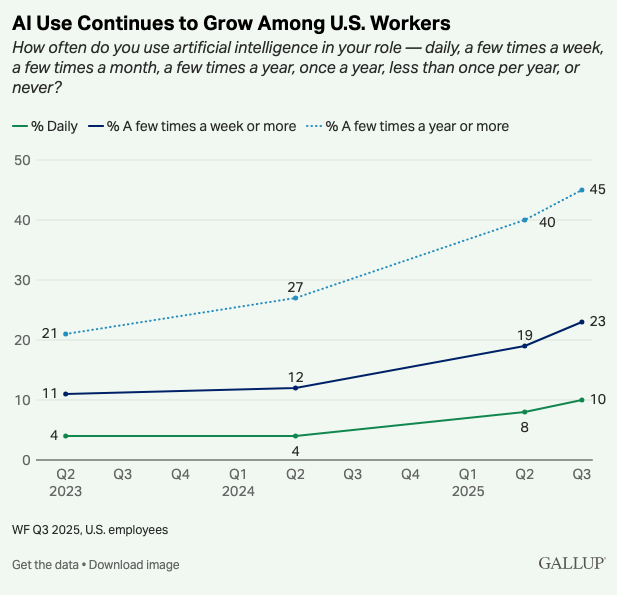
In other words, what once felt experimental or reserved for tech-forward teams is becoming an everyday productivity tool across roles. Workers across sectors are using AI to draft emails, analyze data, summarize meetings, and automate other routine tasks.
However, Gallup’s data also surfaces a growing tension: AI adoption is happening faster at the individual worker level than at the organizational level. Many employees are already using AI tools without clear guidance, visibility, or alignment from leadership, setting the stage for confusion and miscommunication.
The Worker–Employer AI Disconnect
One of the most striking findings from Gallup is the scale of the leadership and communication gap. About 40% of workers say their manager or leadership team doesn’t use AI at all, while nearly a quarter (23%) aren’t even sure whether their company officially uses AI in the first place.
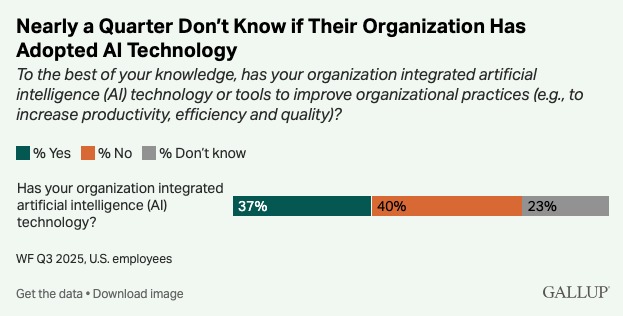
This suggests AI adoption is largely bottom-up rather than top-down. Employees are experimenting on their own to stay productive, competitive, or simply keep up with workload expectations. In contrast, leadership teams often move more cautiously, constrained by concerns around risk, compliance, data security, or reputational exposure.
But when leadership isn’t visibly involved, AI use becomes fragmented. Workers are left guessing what’s allowed, what’s discouraged, and what might cross an invisible line. Without clear organizational policies and managerial expectations, there’s also the risk of ethical and security considerations being handled inconsistently—if at all.
The result is a growing trust and communication problem. Employees see AI everywhere in their day-to-day work, while company strategy feels quiet or ambiguous. Both sides end up misreading reality, even as AI becomes more deeply embedded in workflows.
AI Adoption Isn’t Equal Across Industries
Gallup’s data also shows that AI adoption is far from uniform. Roughly 76% of tech workers report using AI at work, making tech the clear leader. In contrast, frontline industries like retail (33%), healthcare (37%), and manufacturing (38%) lag significantly behind.
The reasons go beyond comfort with technology. Access to tools and training plays a major role, as does the nature of the work itself. Knowledge-based roles are easier to augment with AI, while physical, regulated, or customer-facing jobs face stricter constraints. Employer policies and compliance concerns further limit adoption in certain sectors.
This uneven rollout reflects a deeper issue: not all workers benefit equally from AI’s productivity gains. As AI tools become more capable, especially in technical and analytical tasks, gaps can widen between roles, industries, and skill sets. Interview Query’s previous discussions around advanced models like GPT-5.2 highlight how AI may reshape tech roles faster than other sectors, reinforcing these divides rather than smoothing them out.
AI Usage at Work Remains Nuanced
Taken together, the findings point to the fact that AI adoption is happening whether organizations plan for it or not.
In response to the increasing ubiquity of AI, workers want clearer signals, from which tools are approved to how AI can be used responsibility with human judgment and accountability. Employers, meanwhile, need more visible leadership participation and open conversations about expectations, risks, and boundaries.
It also signifies how tech marketing gets it wrong, often painting AI adoption as clean, strategic, and top-down. On the ground, it’s messier. When adoption is driven by individuals rather than institutions, oversight becomes harder.
And there are real risks in the growing misalignment between how work is done and how it’s managed. Burnout, data leaks, and ethical missteps become more likely, making it all the more crucial to bridge that gap more than just simply adopting the technology.