

Not All AI Jobs Require Experience — These New Entry-Level AI Roles Are Hiring Fast into 2026


Entry-Level AI Hiring Is Surging — And It’s Not Just Data Entry
The AI boom isn’t just pumping out high-paying roles for senior engineers and LLM specialists; it’s also reshaping the entry path for newcomers. In a previous breakdown of why AI engineering roles are exploding into 2025–2026, we highlighted how companies are scrambling to hire talent that can build, scale, and maintain AI systems, leading to over 4,000 new monthly listings for these roles.
However, a new report from eWeek shows something equally important. Summarizing one of the most comprehensive studies on early-career hiring with input from hiring managers themselves, the report reveals entry-level AI jobs are growing just as quickly—sometimes faster—than senior roles.
The study confirms that companies aren’t just looking for PhDs and staff-level ML engineers. They’re actively opening roles for fresh graduates, bootcamp grads, and junior applicants who can work with AI tools, handle data workflows, or support AI research teams.
What’s more interesting is that many of these do not require deep AI experience. Continue reading to learn more about these fastest-growing AI roles.
In-Demand Entry-Level Roles & What They Actually Do
Below are the top entry-level AI roles identified in Study.com’s survey on hiring managers:
| Role | Projected Demand Increase | What They Actually Do | Average Annual Salary |
|---|---|---|---|
| AI Security & Risk Analyst | 49% | Monitor AI safety, ensure compliance, track misuse risks, review outputs for ethical issues. | $83K — $156K |
| AI Research Assistant | 42% | Support model experiments, prepare datasets, run evaluations, and document findings. | $81K — $133K |
| Junior Data Scientist | 34% | Handle data cleaning, basic modeling, exploratory analysis, and feature prep. | $151K to $207K |
| Generative AI Content Creator | 32% | Produce and refine AI-generated text, images, or media for product or content pipelines. | $58K to $107K |
| Data Annotation Specialist | 27% | Label, tag, and structure data used to train supervised and multimodal models. | $59K to $108K |
What makes these roles appealing is that none require an advanced degree. The bar is lower than many assume; familiarity with generative-AI tools, basic analytics, or cloud fundamentals can already make you competitive.
This aligns with other findings from the study, which notes ongoing talent shortages in industries adopting AI the fastest. This means beyond tech itself, sectors like healthcare, finance, education, logistics, and media will need entry-level candidates who can combine AI skills with domain knowledge.
How to Make Yourself Employable in 2026
According to the same study, employers hiring for early-career AI roles value a mix of technical and soft/non-technical skills. Here’s a clearer breakdown of why such skills matter in 2026 and beyond:
| Skill | Why It Matters |
|---|---|
| Data Cleaning & Preparation | Foundation for all AI/ML workflows; ensures training data is usable and accurate. |
| Basic Data Analysis (Python, SQL) | Helps junior hires work with datasets, generate insights, and support model development. |
| Familiarity with Generative AI Tools (GPT, Claude, etc.) | Demonstrates ability to leverage AI for productivity, prototyping, and content generation. |
| Cloud Basics (AWS, GCP, Azure) | Many AI systems run on cloud pipelines; even baseline knowledge is valuable. |
| Responsible AI & Model Safety Awareness | Fast-growing priority as companies emphasize compliance and risk management. |
| Adaptability | AI tools and workflows evolve quickly — junior hires must keep up. |
| Problem-Solving | Critical for debugging data issues, exploring models, and improving workflows. |
| Communication | Needed for documenting data processes and collaborating with engineering, research, or product teams. |
| Creativity | Supports generative-AI work, experimentation, and idea-generation on small teams. |
| Ethical Judgment | Important for handling model outputs, sensitive datasets, and emerging AI safety expectations. |
Moreover, Study.com emphasizes skill-building routes that help candidates strengthen candidate profiles and go beyond traditional university degrees. Projects, GitHub repos, Kaggle work, open-source contributions, or even well-documented personal experiments are now essential for AI newcomers.
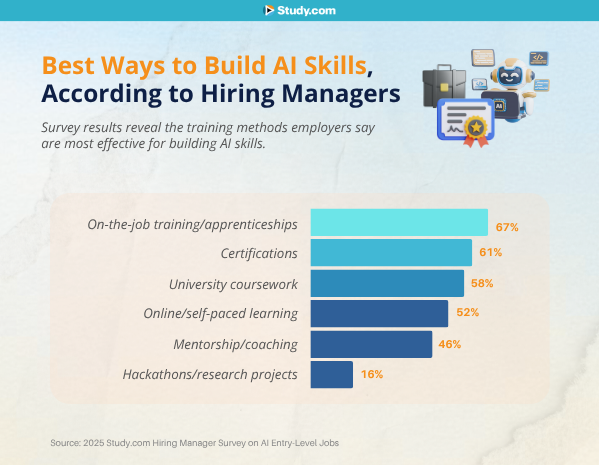
Practical experience, even freelance or self-initiated, can also be the missing piece that often gets early-career candidates hired.
Where Opportunities Meets Reality
While the previously explained findings signify good news for early-career candidates, it’s worth noting that not every AI role is growing. Some traditional tech entry-level jobs are shrinking as automation replaces repetitive tasks.
We covered this dual trend in a previous report on the shrinking and growing pockets of the tech job market, making skill-building and adaptability more important than ever.
As AI unlocks new entry paths and simultaneously closes others, here are some challenges early-career candidates need to understand:
- Competition is increasing as more bootcamp grads and self-taught candidates enter AI-adjacent roles.
- Task-based AI jobs (annotation, content generation) can be temporary or offer slower career progression.
- Basic tool familiarity may land you a role, but career growth requires deeper technical foundation.
Thus, the most realistic approach is a dual-track strategy:
1. Break in through accessible AI-adjacent roles: Data annotation, junior data science, compliance/risk, or research support.
2. Build long-term leverage in parallel: ML fundamentals, cloud skills, open-source contributions, and system-level understanding.
This strategy gives early-career candidates both immediate access and long-term mobility, allowing them to break into and thrive in a market that increasingly rewards fast learners over formal backgrounds.