


Spotify Machine Learning Engineer Interview: Complete Guide & Preparation Tips (2025)


Introduction: Why Become a Spotify Machine Learning Engineer?
Machine learning at Spotify powers how 600 million listeners discover and enjoy music every day. Engineers here design large-scale systems that personalize listening through real-time recommendations, audio understanding, and experimentation. As streaming competition grows, demand for machine learning engineers has surged, with Spotify investing heavily in personalization research and AI infrastructure.
This guide, built from verified Spotify roles and interview data, breaks down each stage of the machine learning engineer interview by covering core skills, sample questions, and preparation strategies. Backed by data, research, and first-hand insights, it provides a clear path to mastering Spotify’s uniquely creative, data-driven approach to machine learning.
Machine Learning Engineer Role Overview & Spotify Culture
Machine learning engineers at Spotify design and deploy the personalization systems that connect artists and fans worldwide. They combine large-scale machine-learning development with creativity, ensuring every recommendation and playlist feels uniquely human. Core responsibilities include:
- Designing, building, and shipping ML solutions that refine Spotify’s personalization products through hands-on model development and evaluation.
- Collaborating across disciplines by partnering with user researchers, designers, data scientists, product managers, and engineers to deliver ML-powered features that enhance listener experience.
- Prototyping and productionizing at scale, bringing new approaches into production for hundreds of millions of active users.
- Driving optimization, testing, and tooling to improve model quality and ensure responsible, high-impact recommendations.
- Participating in Spotify’s ML community, sharing learnings, and advancing the company’s personalization research efforts across global teams.
Spotify’s culture centers on innovation, sincerity, passion, collaboration, and playfulness. Through the Work From Anywhere program, employees choose flexible setups and receive support for home or office work. Benefits include six-month paid parental leave, flexible holidays, robust mental-health resources through Heart & Soul, and ongoing growth opportunities via GreenHouse.
Machine learning engineer compensation in the U.S. ranges from $175K to $355K total, with a median around $239K(Levels.fyi).
Spotify Machine Learning Engineer Interview Process
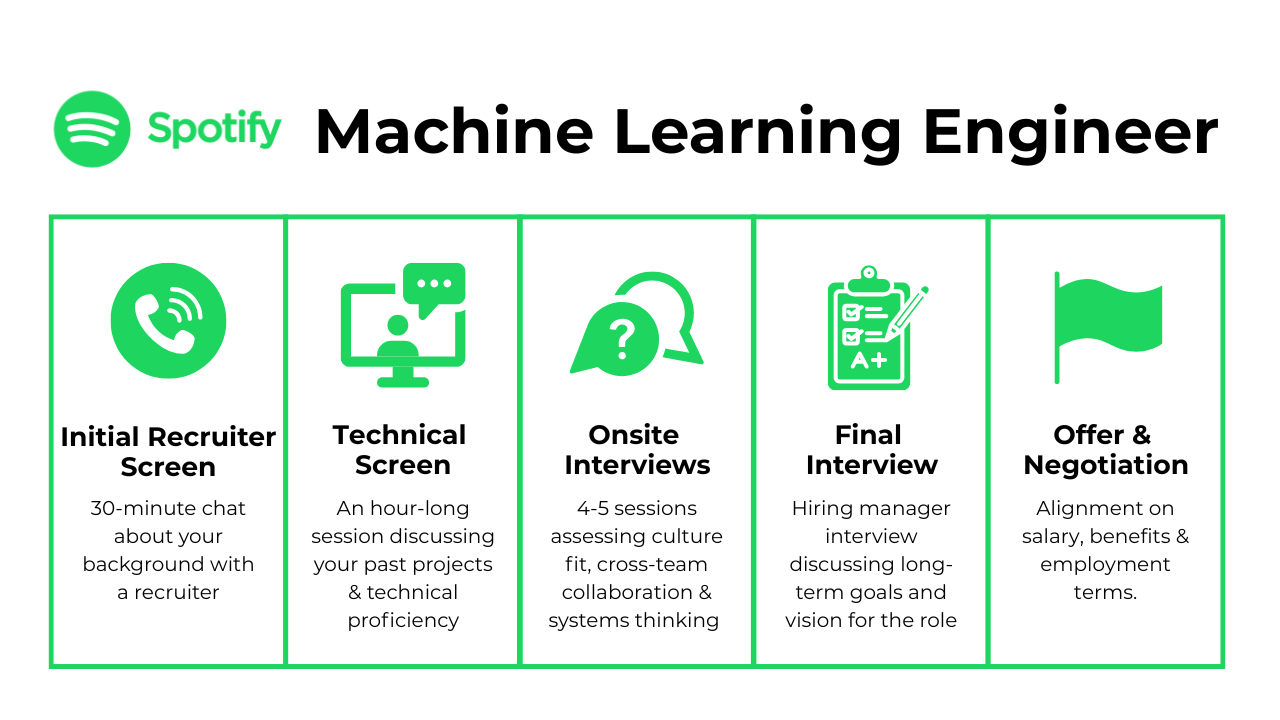
Spotify’s machine learning engineer interview process focuses on two things: how you think and how you collaborate. Engineers are evaluated not just for technical skill, but for creativity, experimentation, and the ability to bring machine-learning ideas to life within Spotify’s fast-moving, cross-functional teams.
1. Initial Recruiter Screen
The first step is a 30-minute call with a recruiter. You’ll discuss your machine-learning background, familiarity with Spotify’s tech stack (Python, Scala, TensorFlow, GCP), and motivation for joining the company. Recruiters also share insight into Spotify’s culture and values.
Tip: Treat this as your elevator pitch. Summarize your most relevant ML projects and briefly connect them to Spotify’s personalization work—think recommender systems, A/B testing, or audio modeling.
2. Technical Screen
Next comes a one-hour technical video interview focused on applied ML. You’ll walk through previous projects, explain algorithms you’ve implemented, and solve coding or modeling problems in real time.
Tip: Review end-to-end ML pipelines. Spotify values candidates who understand the full lifecycle, from data ingestion and feature engineering to deployment and monitoring. Be ready to explain trade-offs between accuracy, scalability, and latency.
Want to see how Spotify evaluates real-world data impact? Watch this breakdown of a Spotify data scientist business case interview to learn how top candidates approach product metrics and experimentation.
3. Onsite Interviews (Virtual or In-Person)
This stage typically includes four to five one-hour sessions with engineers, data scientists, and product managers. Each round explores a different dimension of your expertise:
Technical Depth: Apply ML concepts to Spotify-scale challenges such as playlist ranking or podcast recommendations. Expect hands-on coding in Python or Scala.
Advice: Explain your reasoning out loud; Spotify interviewers evaluate clarity of thought as much as correctness.
Behavioral Fit: Discuss collaboration, feedback, and handling of ambiguity. These conversations test how you operate in Spotify’s autonomous “squad” structure.
Advice: Use specific examples that highlight teamwork, experimentation, and measurable impact.
Product Collaboration: Show how you balance model precision with user experience.
Advice: Reference features like Discover Weekly or AI Playlists to demonstrate awareness of Spotify’s ecosystem.
System Design: You may be asked to architect a scalable ML solution.
Advice: Emphasize modularity, data flow, retraining strategy, and monitoring. Mention tools such as Airflow, BigQuery, or TensorFlow Extended.
4. Final Interview with the Hiring Manager
This conversation centers on long-term alignment and how you’ll grow within Spotify’s ML community and contribute to its mission. Expect questions about leadership, curiosity, and cross-team collaboration.
Tip: Highlight your approach to learning and experimentation. Spotify values engineers who evolve alongside its products and share insights with the broader ML community.
Spotify’s commitment to Equity, Diversity & Impact is woven throughout the process. The company’s inclusive workplace framework promotes belonging and psychological safety, offering reasonable accommodations for candidates. Initiatives like Spotify’s mental-health program further reinforce its belief that innovation thrives through diverse perspectives.
5. Offer and Negotiation
Those who successfully complete the process may receive an offer that reflects Spotify’s global compensation philosophy. Machine learning engineers in the U.S. typically earn between $175 K and $355 K total compensation, with a median around $239 K (Levels.fyi).
Tip: When negotiating, reference market data and emphasize niche skills such as large-scale recommender systems or multimodal ML to support your case.
For more structured prep, explore Interview Query’s Machine Learning Learning Path to simulate real-world scenarios and strengthen your technical fluency.
Challenge
Check your skills...
How prepared are you for working as a ML Engineer at Spotify?
Spotify Machine Learning Engineer Interview Questions
Spotify’s machine learning engineer interviews test how well you apply machine learning to real-world personalization at global scale. Expect questions that blend coding, data systems, and applied ML problem-solving, reflecting Spotify’s focus on recommender systems, experimentation, and production-ready design.
Coding/Technical Interview Questions
In this portion, you’ll face coding challenges that test your ability to manipulate large-scale audio streaming data efficiently. Expect algorithm optimization problems, SQL queries processing millions of listening events, and machine learning case studies involving recommender systems. Interviewers look for production-ready solutions, edge-case handling, and clear technical explanations. Interview Query’s machine learning
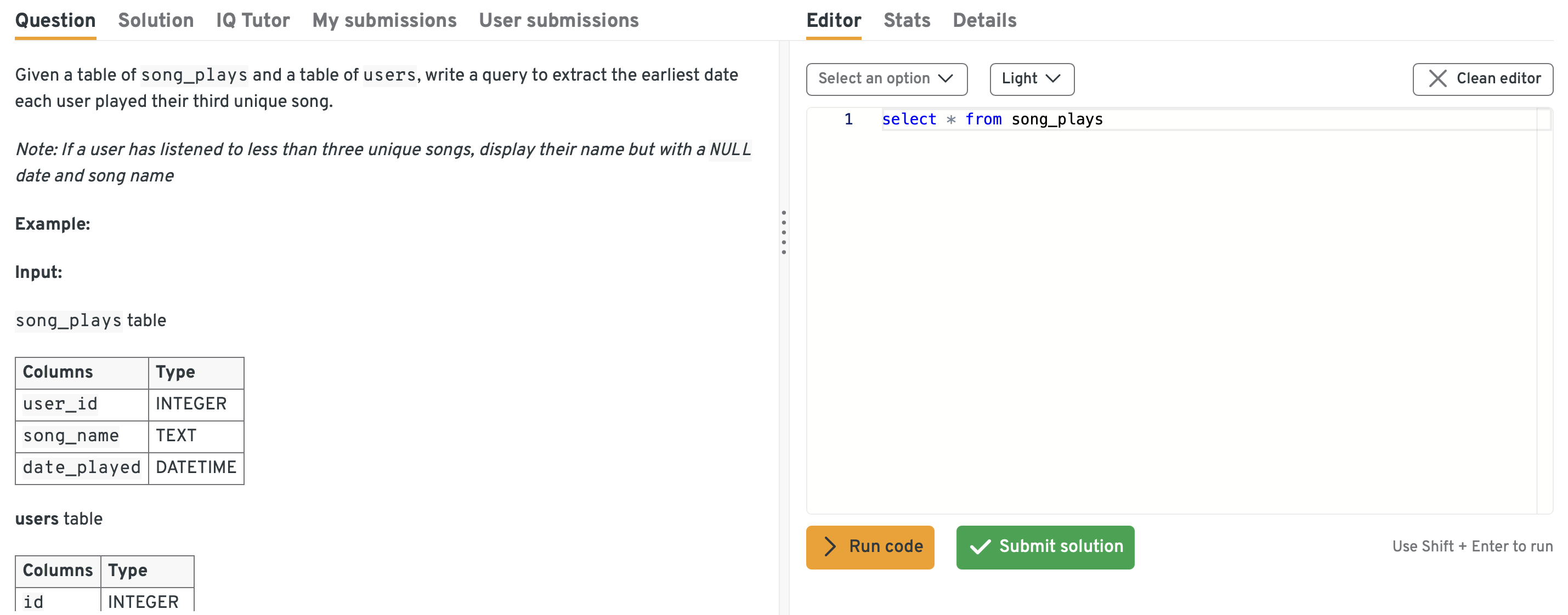
Given
song_playsanduserstables, find the earliest date each user played their third unique song.Use a
ROW_NUMBER()window function on unique(user_id, song_id)pairs ordered by play date, and filter whererow_num = 3.Tip: Explain how this tracks user engagement milestones—important for personalization metrics at Spotify.
~~You can practice your solution to this question and see how others responded in the Interview Query Question Dashboard.~~
Head to the Interview Query dashboard, shown below, to solve this question interactively. You can use the built-in features like IQ tutor to get instant hints and step-by-step guidance on the best way to approach the solution. You can also browse user comments to compare logic, explore alternative solutions, and learn from the community.
How would you design Spotify’s Discover Weekly playlist?
Use a two-stage model: candidate generation (collaborative + content-based filtering) and ranking (XGBoost or neural models using skip and save rates). Add rules for artist diversity.
Tip: Outline how you’d measure success—Spotify values engineers who link model output to user satisfaction.
Detect duplicate songs in Spotify’s catalog with inconsistent metadata.
Combine string similarity on artist/title with audio fingerprinting, duration matching, and ISRC codes. Use LSH for scalability.
Tip: Emphasize hybrid approaches that balance ML precision with computational efficiency.
Handle imbalanced data when training a classification model.
Apply oversampling (SMOTE), class weighting, or threshold tuning. Evaluate with AUC-ROC or F1-score instead of accuracy.
Tip: Tie your answer to Spotify use cases like fraud detection or playlist-abandonment prediction.
Design a data pipeline to rank top artists by country.
Stream data from Kafka, aggregate plays by country in Spark or Beam, rank using
RANK()and store results in BigQuery with Redis caching.Tip: Highlight monitoring—Spotify engineers are expected to ensure real-time reliability and low-latency analytics.
Applied Machine Learning & Modeling Interview Questions
At Spotify, machine learning blends creativity with precision. These questions explore how you design experiments, evaluate results, and iterate on models to deliver meaningful, data-driven personalization.
How would you evaluate a recommendation model’s success beyond accuracy?
Discuss metrics like NDCG, MAP, diversity, and novelty, plus user-centric KPIs such as skip or save rate.
Tip: Tie metrics to listener experience. Spotify rewards models that feel “human,” not just precise.
How would you detect and mitigate bias in music recommendations?
Audit training data for popularity skew, retrain with debiased sampling, and monitor fairness metrics across demographic groups.
Tip: Mention Spotify’s focus on Responsible AI as cultural awareness and inclusivity are core interview themes.
Design an experiment to test a new playlist-ranking model.
Run an A/B test comparing engagement metrics such as completion rate and saves. Use stratified randomization and sequential testing to avoid false positives.
Tip: Show that you understand experimentation velocity because Spotify relies heavily on quick, reliable iteration.
Explain how you’d engineer features for a song-skip prediction model.
Use session-level behavior (time since last skip, song duration, previous engagement) and audio embeddings for contextual signals.
Tip: Spotify values rigor in pipeline hygiene and evaluation so you should discuss how you’d prevent data leakage.
How would you debug a model that performs well offline but poorly online?
Compare feature distributions between training and production data, retrace transformations, and validate serving logic.
Tip: Emphasize real-time monitoring—Spotify engineers are expected to detect drift and maintain model reliability post-deployment.
Want more hands on experience with music machine learning? Check out Interview Query’s Top 10 Music Machine Learning Projects & Datasets to familiarize yourself with the unique challenges being addressed at the cross-section of AI and audio.
Behavioral and Culture-Fit Interview Questions
Spotify’s behavioral interviews focus on how you think, collaborate, and grow within its “band” culture. Expect questions that test adaptability, teamwork, and problem-solving in ambiguous environments. Interviewers look for candidates who reflect Spotify’s five values: innovative, sincere, passionate, collaborative, and playful.
Tell me about a time you faced an unexpected challenge while deploying a model.
Explain how you identified the issue, communicated with cross-functional teams, and resolved it quickly.
Tip: Spotify values engineers who can adapt gracefully under pressure, so be sure to highlight ownership and calm problem-solving.
Describe how you’ve collaborated with non-technical stakeholders on an ML project.
Share an example of translating technical results into product or design decisions that improved user experience.
Tip: Be sure to demonstrate empathy and communication skills—Spotify emphasizes collaboration across disciplines
How do you stay creative when solving repetitive or technical problems?
Discuss techniques such as experimenting with new frameworks, seeking peer feedback, or exploring open-source research.
Tip: Reference Spotify’s “playful” value as creativity and curiosity are encouraged, even in technical roles.
Tell me about a time when your model or idea didn’t work as expected.
Explain what you learned, how you iterated, and what you changed afterward.
Tip: Frame failure as learning. Even better - frame yourself as a lifelong learner. Spotify values experimentation and the courage to take calculated risks.
How do you continue learning and growing as an engineer?
Describe your approach to continuous improvement, whether through online courses, research papers, or mentoring others.
Tip: Mention Spotify’s GreenHouse learning program to show cultural alignment with ongoing professional development.
Spotify fosters a globally inclusive environment through its Equity, Diversity & Impact framework. The company offers reasonable accommodations during interviews and promotes psychological safety through programs like Heart & Soul, its mental-health support initiative. Demonstrating openness and respect for diverse perspectives aligns strongly with Spotify’s hiring philosophy.
Product Experimentation & Analytical Thinking Interview Questions
Spotify’s final interviews often explore analytical reasoning, experimentation design, and how you apply machine learning insights to real product challenges. These questions test your ability to diagnose problems, structure experiments, and communicate trade-offs clearly.
-
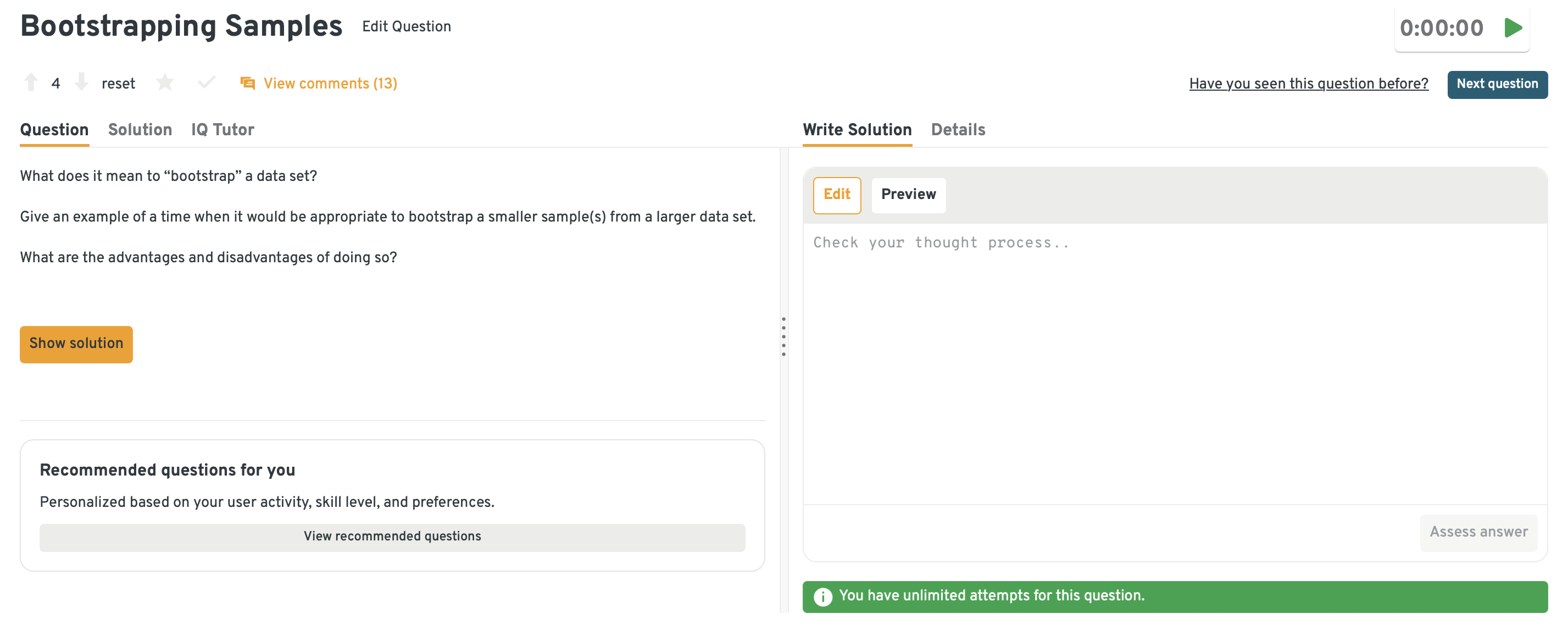
Explain that bootstrapping resamples data with replacement to estimate the variance or confidence intervals of a metric when the population distribution is unknown.
Tip: Relate this to experimentation or A/B testing at Spotify. Bootstrapping helps estimate uncertainty when traffic or sample sizes are limited.
You can practice your solution to this question and see how others responded in the Interview Query Question Dashboard.
Design a podcast search engine using transcript and metadata.
Combine NLP models for transcript embeddings with metadata filtering (episode title, speaker, or topic). Use semantic search or vector similarity for ranking.
Tip: Describe how you’d handle ambiguous queries or unseen terms. Spotify values creative problem-solving grounded in scalable systems.
-
Segment by engagement behavior, analyze DAU trends, and check rollout bugs or UX friction. Run qualitative surveys and isolate whether the drop is causal or correlated.
Tip: Spotify’s experimentation culture values curiosity and thoughtful iteration, not just numbers. Discuss balancing data insights with user empathy to demonstrate a user-centric mindset.
How would you compare two language models using information theory?
Use metrics like cross-entropy or perplexity to evaluate predictive uncertainty. Visualize performance across text lengths or domains.
Tip: Clarify why interpretability and bias assessment matter. Spotify expects engineers to weigh fairness and accuracy when evaluating models.
How would you identify duplicate artists with similar names and overlapping song lists?
Combine metadata matching (name, genre, label) with acoustic similarity or listener co-engagement signals. Use clustering or graph-based disambiguation.
Tip: Stress precision and scalability as Spotify’s catalog spans millions of tracks, so efficient entity resolution is critical.
Access the full Spotify question bank on Interview Query to practice real technical and system design problems reported by candidates.
How to Prepare for a Spotify Machine Learning Engineer Interview
Preparing for a Spotify machine learning engineer interview means mastering both your technical depth and your ability to build creative, data-driven systems that scale. Spotify’s ML interviews emphasize problem-solving, experimentation, and collaboration as much as coding skills. You’ll be evaluated on how you design real-world recommendation models, reason about tradeoffs, and communicate insights clearly across teams.
The following strategies focus your preparation on building systems that personalize, scale, and reflect the creativity at the heart of Spotify’s culture.
- Master Machine Learning & Recommender Systems
- Review collaborative, content-based, and hybrid recommendation models that power features like Discover Weekly and Daily Mix.
- Be ready to discuss past ML projects and explain your reasoning, tradeoffs, and measurable impact.
- Practice algorithm design and model implementation from scratch.
- Sharpen Coding & Technical Assessment Skills
- Practice coding in Python, Scala, or Java using frameworks like TensorFlow and XGBoost.
- Focus on problems involving data manipulation, optimization, and ML system design.
- Use the Interview Query Practice Dashboard to work through Spotify-style ML interview questions.
- Communicate Clearly Across Teams
- Practice explaining complex ML concepts to non-technical stakeholders such as designers and product managers.
- Highlight how your technical choices improve user experience and product outcomes.
- Use structured reasoning (e.g., STAR or metric-driven frameworks) to show clarity under pressure.
- Show Passion for Music & Audio Technology
- Share projects or experiences that connect your technical skills to Spotify’s mission of empowering artists and fans.
- Genuine enthusiasm for music, podcasts, or audio innovation helps you stand out in culture-fit interviews.
- Prepare for System Design & Problem-Solving
- Expect scenarios involving large-scale data systems and personalization pipelines.
- Practice articulating design tradeoffs across scalability, latency, and user impact.
- Review real-time ML architecture concepts relevant to streaming platforms.
- Reflect Spotify’s Values & Culture
- Emphasize collaboration, creativity, and inclusion in your examples.
- Prepare short behavioral stories that demonstrate adaptability, teamwork, and ownership within agile “squad” environments.
- Simulate Real Interview Conditions
- Connect with an Interview Query coach to practice technical and behavioral rounds.
- End each interview with thoughtful questions about the team’s ML challenges, experimentation culture, and growth paths.
By combining technical preparation with strong communication and a clear understanding of Spotify’s values, you’ll stand out as a well-rounded candidate ready to join the band.
Spotify Machine Learning Engineer Salary
Average Base Salary
Average Total Compensation
Spotify machine learning engineers are among the best-compensated in the audio tech industry, reflecting their impact on personalization, recommendation systems, and large-scale data infrastructure. According to Levels.fyi, total annual compensation ranges from approximately 150K USD for entry-level roles to 300K USD or more for senior engineers, with the median total compensation averaging around 250K USD. This includes a mix of base salary, stock options, and annual bonuses that scale with experience and performance.
- Entry-Level (L4 Machine Learning Engineer): ~150K per year (130K base + 15K stock + 5K bonus)
- Mid-Level (L5 Machine Learning Engineer): ~210K per year (160K base + 35K stock + 15K bonus)
- Senior (L6 Machine Learning Engineer): ~250K per year (185K base + 45K stock + 20K bonus)
- Staff/Principal (L7+ Machine Learning Engineer): 300K+ per year (195K+ base + 75K+ stock + 30K+ bonus)
Regional salary insights
While Spotify does not publicly disclose pay by region, U.S.-based roles (New York and Boston) typically align with compensation levels at other large tech companies. Base salaries for these roles average 180K–195K USD, complemented by equity and performance-based bonuses. Roles outside North America often adjust for local market norms but retain Spotify’s generous benefits and equity participation.
Spotify’s compensation philosophy emphasizes flexibility and growth. Engineers receive recurring stock grants and annual performance bonuses, with equity often representing 20–30% of total pay. Benefits include six months of paid parental leave, flexible holidays, remote-work stipends, health insurance, and 401(k) matching, reflecting Spotify’s commitment to employee wellbeing and long-term retention.
Spotify Machine Learning Engineer Interview FAQs
What is the interview process for a machine learning engineer at Spotify?
The process has five stages: a recruiter screen, technical interview, four to five onsite rounds, a final hiring manager interview, and offer discussion. Each phase evaluates technical expertise in machine learning systems and collaboration skills aligned with Spotify’s creative and data-driven culture.
What technical skills are required to work at Spotify?
Candidates need strong programming ability in Python, Scala, or Java, experience deploying large-scale ML systems, and a deep understanding of recommender systems and personalization algorithms. Familiarity with TensorFlow or XGBoost and experience working in agile, data-driven environments are valuable.
What kinds of machine learning problems does Spotify work on?
Spotify ML Engineers build systems powering personalized recommendations (Discover Weekly, Daily Mix), audio understanding, podcast discovery, and Responsible AI features. Work spans recommender systems, large-scale experimentation, and real-time optimization for user engagement and artist visibility.
How can I showcase my portfolio for a Spotify interview?
Highlight end-to-end ML projects showing real-world results—like improving recommendation quality or user retention. Emphasize production deployment, scalability, and metrics-driven impact. Code repositories or case studies on personalization or audio analytics align well with Spotify’s focus areas.
How do I negotiate my offer with Spotify?
Use market data from Levels.fyi to benchmark compensation. If base salary flexibility is limited, negotiate for higher equity, signing bonuses, or professional development perks. Focus on mutual value and your specialized ML experience to strengthen your position.
What is Spotify’s remote work culture like?
Spotify’s “Work From Anywhere” program lets employees choose remote, hybrid, or office setups. Teams operate asynchronously across time zones with strong collaboration support, flexible holidays, and regular virtual events that foster inclusion and innovation.
How long does the hiring process take?
Most candidates complete the process within four to six weeks, depending on scheduling and role availability. Recruiter and technical screens occur in the first two weeks, followed by onsite interviews and a final discussion with the hiring manager.
What is the salary range for Machine Learning Engineer roles at Spotify?
ML engineers at Spotify typically earn between 150K and 300K USD in total annual compensation, depending on level and location. The average base salary is around 180K USD, with total pay averaging 250K USD, including stock and bonuses, according to Levels.fyi. Benefits include six months of paid parental leave, flexible holidays, stock options, and Spotify’s global Work From Anywhere program.
Your Next Step Toward Becoming a Spotify Machine Learning Engineer
Landing a machine learning engineer role at Spotify isn’t just about technical excellence but also about showing how your work can make listening more personal, meaningful, and fun. The most successful candidates combine deep machine learning expertise with creativity, experimentation, and the ability to translate data into real-world impact.
Candidates like Chris Keating, who used Interview Query to move from startup founder to a staff data scientist at Meta, show how the right preparation can open doors to data and ML roles at top tech companies.
Prepare for your interview with confidence by practicing with our AI Interviewer or, scheduling mock interviews for live coaching. You can also explore the Machine Learning Learning Path to build your own momentum. The more real your prep feels, the stronger you’ll perform when it counts. Your Spotify offer could be next.
Spotify Interview Questions
| Question | Topic | Difficulty |
|---|---|---|
Data Structures & Algorithms | Easy | |
You’re given a string that may contain the characters Task: Verify that the string is balanced. A balanced string is one where every opening character, Write a function called Example: | ||
Data Structures & Algorithms | Medium | |
Behavioral | Medium | |
SQL | Easy | |
Machine Learning | Medium | |
Statistics | Medium | |
SQL | Hard | |
Machine Learning | Medium | |
Python | Easy | |
Deep Learning | Hard | |
SQL | Medium | |
Statistics | Easy | |
Machine Learning | Hard |
Discussion & Interview Experiences