
NVIDIA Machine Learning Engineer Interview Guide (2025)


Introduction
As a NVIDIA machine learning engineer, you’ll work at the forefront of innovation in AI, designing scalable ML pipelines and accelerating model performance through GPU-optimized training frameworks. Day-to-day, that means hands-on ownership of MLOps infrastructure, building tools that support everything from generative AI to autonomous driving. You’ll collaborate with researchers, product teams, and hardware engineers to deploy robust ML models in high-performance, production-grade environments. NVIDIA’s culture values rapid iteration, low ego, and technical excellence—decisions are made bottom-up, and good ideas can come from anywhere.
NVIDIA’s impact spans industries: powering breakthroughs in robotics, leading the charge in generative AI SDKs, and enabling mission-critical perception systems in self-driving cars. As a machine learning engineer at NVIDIA, you’ll not only shape the future of AI applications but also benefit from competitive compensation packages (including generous RSUs) and long-term growth across hardware, research, and software orgs. Whether you’re drawn to deep tech or productized ML, this is a chance to work with leaders in the space. In the next sections, we’ll walk through the NVIDIA machine learning engineer interview process, from recruiter screens to technical deep dives.
What Is the Interview Process Like for a Machine Learning Engineer Role at NVIDIA?
Overview of the Interview Process
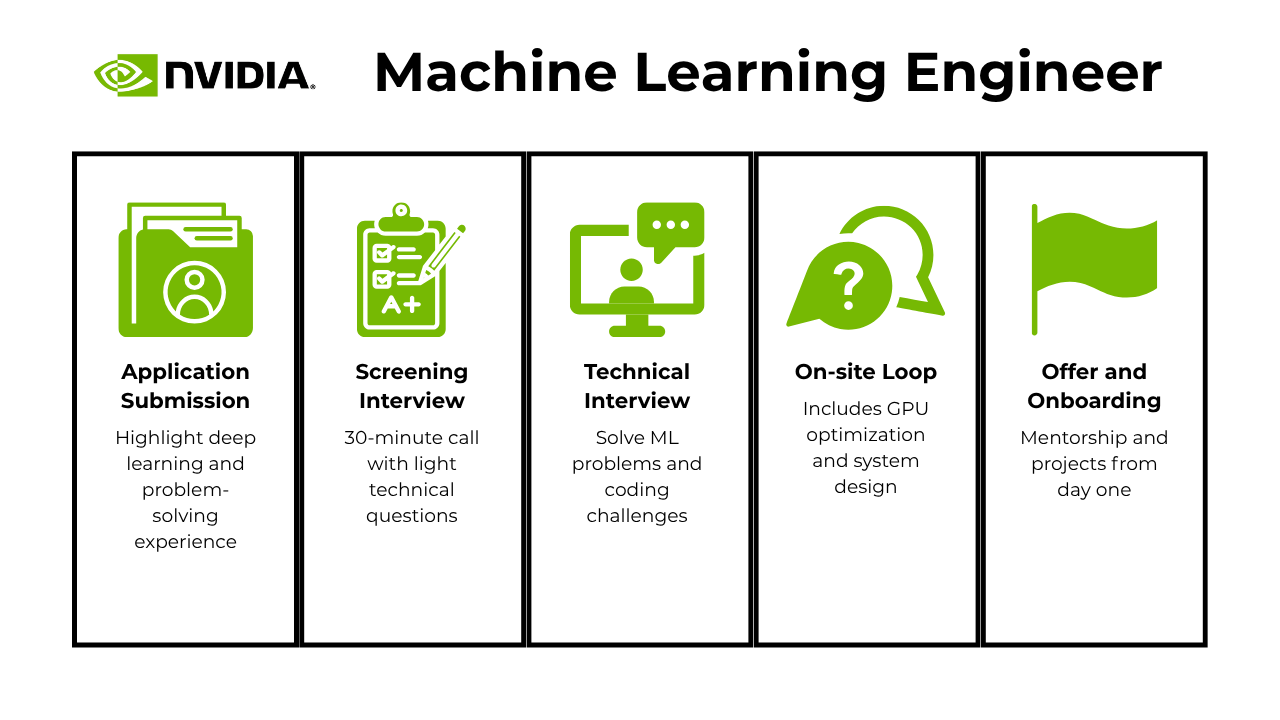
The NVIDIA machine learning engineer interview is designed to assess both technical depth and your ability to thrive in a high-performance, collaborative environment. If you’re preparing to interview a machine learning developer at NVIDIA, here’s how the process typically unfolds:
Application Submission
You’ll apply through NVIDIA’s career portal or be encouraged by a hiring manager to submit your resume. Make sure your application highlights experience in algorithm development, deep learning frameworks, and complex problem-solving in artificial intelligence. Tailor your resume and cover letter to reflect your technical strengths and passion for machine learning.
Screening Interview
Your first interaction is typically a 30-minute conversation with a recruiter. This round covers your background, experience, and technical competencies. Expect a mix of light technical and behavioral questions designed to assess your fit for the role and interest in NVIDIA’s mission.
Technical Interview
If you pass the screen, you’ll enter one or more technical interviews led by senior engineers. These sessions dive into algorithmic complexity, ML model optimization, and coding challenges. You may also receive a take-home assignment that mirrors real-world tasks handled by ML engineers. Show your fluency with ML tools and frameworks as you tackle domain-specific problems.
On-site Loop
The final stage is a series of virtual or in-person interviews with peers, managers, and technical stakeholders. As a NVIDIA ML engineer, you’ll be evaluated on both your technical depth and ability to thrive in a fast-paced, innovative setting. These rounds may include deep dives into GPU optimization, model scaling, or system architecture.
Offer and Onboarding
If successful, you’ll receive an offer to join NVIDIA as a machine learning engineer. This reflects your technical excellence and potential to innovate within one of the world’s leading AI companies. Once accepted, onboarding will equip you with the tools, mentorship, and projects needed to hit the ground running.
Challenge
Check your skills...
How prepared are you for working as a ML Engineer at Nvidia?
How to Prepare for a Machine Learning Engineer Role at NVIDIA
Preparing for a machine learning engineer role at NVIDIA involves much more than just technical study. It requires a balanced focus on algorithmic depth, hands-on fluency, and thoughtful communication. Start by reviewing key mathematical foundations like linear algebra, calculus, and statistics. You should also gain mastery over classic and modern machine learning algorithms, such as decision trees, support vector machines, and neural networks. Deep learning knowledge is especially important. Make sure you understand architectures like CNNs and RNNs, and revisit any relevant content from NVIDIA’s online deep learning courses or assessments. Python is the primary language used, so be proficient with libraries such as NumPy, Pandas, scikit-learn, TensorFlow, and PyTorch. Practice data preprocessing techniques, including handling missing data and feature engineering, to strengthen your pipeline design skills.
Equally important are your soft skills. Practice explaining your thought process and results clearly, especially when your audience might not have a technical background. Structured problem-solving and the ability to apply ML solutions to real-world constraints are also key traits NVIDIA looks for. Understanding how machine learning impacts industries like autonomous driving or healthcare can help you frame your solutions in context. Finally, build a strong portfolio of projects and contribute to the ML community. This shows initiative and signals that you are already aligned with NVIDIA’s mission to drive innovation in AI and deep learning.
FAQs
What Is the Average Salary for a Machine Learning Engineer at NVIDIA?
Average Base Salary
Average Total Compensation
Where Can I Learn More About NVIDIA Interviews?
If you want a full breakdown of how NVIDIA approaches interviews across different roles—not just data science—you can check out our NVIDIA Interview Guide. It covers company-wide insights into the interview structure, cultural expectations, and what makes NVIDIA’s hiring process unique.
Are There Machine Learning Engineer Job Postings for NVIDIA on Interview Query?
Yes! The Jobs Boards hosts recent job postings for different roles at different companies, including the Machine Learning Engineer role at Nvidia.
Conclusion
The NVIDIA machine learning engineer interview is rigorous, testing both your technical depth and your ability to collaborate across engineering, research, and product teams.
Still curious about other relevant NVIDIA interview guides? Here are the links to the software engineer and data scientist positions.
Want to sharpen your skills even further before applying as a NVIDIA ML engineer? Check out our blog for practice prompts, deep dives, and insider strategies to help you get hired.
Discussion & Interview Experiences