
NVIDIA Product Manager Interview Guide (Process, Questions, Salary)


Introduction
NVIDIA stands at the forefront of AI, powering breakthroughs in generative AI, autonomous vehicles, robotics, and advanced graphics through its world-leading GPU and software platforms. As a product manager at NVIDIA, you’ll be responsible for translating high-level customer needs into detailed technical requirements, collaborating closely with engineering and cross-functional teams to deliver market-defining solutions. The NVIDIA product manager interview process is rigorous, typically spanning four to eight weeks and involving multiple technical, behavioral, and domain-specific rounds designed to assess your technical depth, strategic thinking, and cultural fit. Success demands strong technical acumen, data-driven decision-making, and the ability to drive clarity across complex, fast-moving projects—qualities NVIDIA values highly in its product leaders.
Role Overview & Culture
As a NVIDIA product manager, you’ll own the full product lifecycle—start to finish. That means defining strategy, gathering insights from users, setting technical requirements, and making sure everything ships on time (and works). You’ll work hand-in-hand with engineering, sales, marketing, and the Worldwide Field Organization to connect big ideas with real-world execution.
NVIDIA runs on an inventor’s mindset. People here move fast, think deep, and speak up—regardless of title. PMs aren’t just facilitators; they’re strategic operators who bring clarity to chaos and momentum to moonshots. If you like building from the ground up, making decisions with data, and leading without formal authority, you’ll fit right in.
Why This Role at NVIDIA?
Joining NVIDIA as a product manager puts you at the center of technologies reshaping the world—generative AI, autonomous driving, digital twins, and the Omniverse. Your work won’t stay on paper; it’ll move markets, from robotics and cloud infrastructure to healthcare.
But it’s not just about the scope of the products. NVIDIA offers serious upside: competitive RSU packages, a flat org that skips the red tape, and clear growth paths—whether you lean technical or prefer the GM route. It’s that rare mix of speed and stability (and yes, people here actually stay for years).
Let’s break down what to expect in the interview—and how to make your story stand out.
What Is the Interview Process Like for a Product Manager Role at NVIDIA?
Overview of the Interview Process
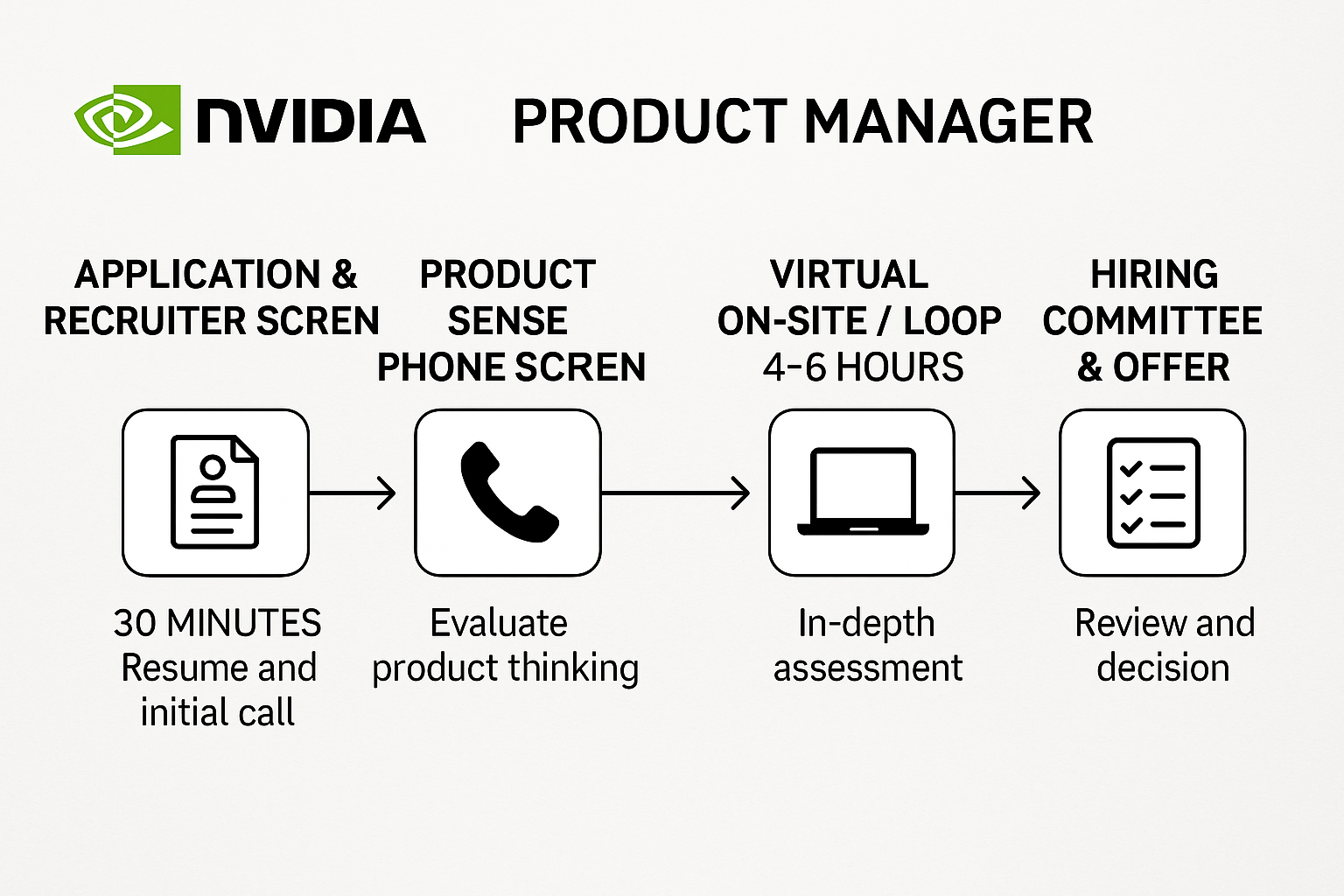
The NVIDIA product manager interview process typically spans 6–8 weeks and includes multiple stages designed to evaluate your technical expertise, product intuition, leadership capability, and cultural fit. While the structure may vary slightly by team and level, most candidates will experience the following stages:
Application & Recruiter Screen
First, you’ll need a resume that balances technical skills with product impact—this is your foot in the door. If shortlisted, expect a 30-minute call with a recruiter to discuss your background, motivation, and basic role alignment. (Sometimes, the hiring manager joins early to speed up the process.)
Product Sense Phone Screen
This round goes deeper. Usually led by a hiring manager or senior PM, it focuses on how you think about products: defining problems, balancing trade-offs, and leading execution. You may also get scenario-based questions or light technical prompts. If you’re applying for a technical PM role, you may be given a short HackerRank challenge or analytics prompt.
Virtual On-site / Loop
You’ll meet with 4 to 6 interviewers across 30–60 minute sessions. Expect conversations with PM peers, engineers, cross-functional stakeholders, and at least one director. You’ll be tested on:
- Product design & strategy (How would you approach building for AI, robotics, or gaming?)
- Execution & delivery (How do you handle scope creep or shifting deadlines?)
- Technical depth (Can you translate product needs into hardware requirements?)
- Leadership & collaboration (How do you influence without authority?)
Some senior-level candidates may also face vignettes testing strategic vision or people-management scenarios.
Hiring Committee & Offer
Once the loop wraps, your feedback is reviewed by a hiring committee—not just your interviewers. If the signal is strong across the board, and an offer.
Challenge
Check your skills...
How prepared are you for working as a Product Manager at Nvidia?
What Questions Are Asked in a NVIDIA Product Manager Interview?
Here are a few NVIDIA product manager questions to help you prepare for the interview:
Product Sense & Design Questions
NVIDIA product manager interview questions often explore your ability to design thoughtful, customer-driven products in high-tech environments like AI, cloud gaming, and autonomous systems.
1. What is your go-to process and method to improve a given product in a given time period?
This question tests if you use a structured, repeatable approach to identifying improvements. You should Discuss frameworks like CIRCLES, usage analytics, and user feedback loops. An example answer would be like: “For improving GeForce NOW, I’d begin with user churn analytics to identify friction points during session setup. After running usability tests with frequent players, I discovered that stream latency caused 40% of early exits. I prioritized reducing click-to-play time and optimizing GPU allocation logic. Post-launch, we saw a 15% lift in session completion rates.”
2. How would you improve the user experience of NVIDIA’s GeForce NOW cloud gaming platform?
Designed o see if you understand and can ideate around real NVIDIA products, this question asks you to anchor your ideas in user personas, performance metrics, and gaming pain points. Proposing features like a performance dashboard or network diagnostics can demonstrate empathy for gamers while showing how your ideas can reduce support tickets and generate structured feedback.
3. What opportunities do you see for NVIDIA to expand into new markets with its AI technology?
This question evaluates your market awareness and strategic thinking. Identify an underpenetrated vertical—like healthcare or agriculture—and show how NVIDIA’s edge AI capabilities could solve real problems. For instance, offering Jetson-powered diagnostic tools to underserved hospitals can open new market channels while advancing public health outcomes.
4. If you were to launch a new product line for NVIDIA, what would it be and why?
NVIDIA wants to see how well you align product ideas with its core strengths in GPU and AI. Propose something both technically feasible and strategically bold—like an edge AI developer kit for smart farming that leverages vision modules, sensors, and pretrained models to address sustainability and efficiency needs in agriculture. An example answer would be like, “I would develop an edge AI developer kit for smart agriculture, including soil sensors, Jetson-powered vision modules, and pretrained models for disease detection. This supports sustainability goals while expanding NVIDIA’s footprint into emerging markets like precision farming, where real-time, low-power inference matters.”
5. Describe an NVIDIA product. How would you improve it?
This question tests your ability to analyze existing products with a critical eye. Choose something like the Jetson Nano and explain where onboarding, accessibility, or integrations could be smoother. For example, a guided web interface with preloaded projects could lower the barrier for entry and widen the user base.
Execution / Metrics Questions
NVIDIA product manager interview processes assess how you define, measure, and execute on outcomes across complex cross-functional teams.
6. How would you measure the success of a new feature launch by NVIDIA?
This question reveals how you define KPIs and track adoption. Discuss primary metrics like feature usage and secondary ones like user retention or error reduction. For example, you can say “For a new model tuning dashboard in Omniverse, I would define success as a 20% increase in active tuning sessions and a 10% reduction in reported configuration errors. I’d use event tracking and feedback modals to measure adoption and satisfaction, respectively. Weekly retention of dashboard users would validate long-term usefulness.”
7. How would you analyze transaction data to understand revenue loss in an e-commerce company?
You’re being tested on your ability to dissect complex business problems with structured analysis. Start by slicing data by product, segment, and time, then use cohort comparisons to isolate anomalies. You can say “I would first group revenue data by product category and compare YoY trends to identify underperformers. Next, I’d drill down into margin shifts, customer segments, and applied discounts. I discovered one category had a 25% drop in revenue due to excessive discounting and declining AOV. This led to a repricing initiative that recovered $1.5M in annualized revenue.”
8. How would you determine if a new delivery time estimate model is better than the old one?
This question assesses your experimentation design. Discuss using A/B testing split by delivery tiers, and metrics like mean absolute error or percent on-time delivery. A well-run experiment might reveal better rural accuracy and drive a measurable increase in customer trust and satisfaction.
9. What metrics would you use to determine the value of each marketing channel?
NVIDIA wants to know if you can tie performance to business outcomes. Talk about ROAS, CAC vs. LTV, and attribution models. By layering in incrementality testing and cohort retention, you could identify under-the-radar channels like influencers that quietly outperform paid search.
10. How would you measure and analyze the success of a new email campaign?
This tests your full-funnel thinking. Define metrics from open rates to downstream conversions and explain how you’d link emails to sessions and purchases using SQL or dashboards. Adding a holdout group might reveal a clear incremental lift, guiding future campaign timing and segmentation.
Technical Depth & AI Focus
Technical depth matters for NVIDIA product managers, especially around GPUs, deep learning, model performance, and data infrastructure.
11. Write a function rotate_matrix to rotate a 2D array by 90 degrees clockwise.
This problem tests basic algorithmic thinking. A simple solution involves transposing the matrix and then reversing each row:
import numpy as np

def rotate_matrix(array):
    array = np.array(array)
    transpose = np.ndarray.transpose(array)
    rotated = np.fliplr(transpose)
    return rotated
12. Write a function shortest_transformation to find the shortest transformation sequence length between two words.
Here, you’re tested on graph traversal under constraints. Use BFS to search through valid word transformations, where each step differs by one letter. Construct a graph dynamically and track visited nodes to find the shortest path efficiently.
13. Explain how GPUs are used in deep learning applications.
This checks your understanding of why NVIDIA hardware matters. GPUs accelerate deep learning by parallelizing matrix operations like forward and backward propagation. CUDA cores, TensorRT, and cuDNN libraries allow NVIDIA to optimize both training and inference at scale—from data centers to embedded systems.
14. What are the key differences between NVIDIA’s RTX and GTX series of GPUs?
This gauges product knowledge. RTX cards support real-time ray tracing via RT cores and include Tensor cores for AI-enhanced rendering. GTX lacks these features, making RTX superior for gaming, 3D rendering, and deep learning applications. Architectural advances also make RTX more power-efficient and future-proof.
15. Write a query to get the top five most expensive projects by budget-to-employee count ratio.
Combining SQL logic with business thinking, you can write:
SELECT
    p.title,
    budget/num_employees AS budget_per_employee
FROM projects AS p
INNER JOIN (
    SELECT project_id, COUNT(*) AS num_employees
    FROM (
        SELECT project_id, employee_id
        FROM employee_projects
        GROUP BY 1,2
    ) AS gb
    GROUP BY project_id
) AS ep
    ON p.id = ep.project_id
ORDER BY budget/num_employees DESC
LIMIT 5;
Behavioral / Leadership Questions
NVIDIA cares deeply about cultural fit, ownership, and how you influence without authority.
16. How would you justify the complexity of a neural network model to non-technical stakeholders?
This tests your ability to bridge technical and business language. Use analogies—like comparing a decision tree to a gourmet recipe—and highlight the payoff in performance. Reassure stakeholders with monitoring tools like SHAP to maintain interpretability and trust.
17. Describe a time when you had to work with a cross-functional team to launch a product.
NVIDIA looks for collaborative leaders. Share an example where you managed dependencies across teams, resolved pushback, and delivered on time—like facilitating weekly syncs to get buy-in from engineering and marketing for a complex AI rollout.
How to Prepare for a Product Manager Role at NVIDIA
To prepare for a product manager role at NVIDIA, begin by learning about the company’s technology and culture. Focus on their core products in AI, GPUs, autonomous systems, and data centers. Read NVIDIA’s blog, annual reports, and employee stories. These will help you understand the “inventor’s mindset” and bottom-up decision-making that shape how product managers operate within the company. You should also know where your target team fits into the larger NVIDIA roadmap, especially with tools like Omniverse and data center strategies.
Next, practice answering common product manager interview questions. NVIDIA typically emphasizes product sense, execution, and technical understanding. You may be asked to design features for AI users or prioritize tools for GPU developers. You should also expect questions about minimum viable products, scaling, and how to resolve technical blockers. Demonstrating an understanding of NVIDIA’s tech stack, like the differences between inference and training or the role of SDKs, will be crucial.
Make sure to think out loud during your responses and ask clarifying questions. This shows how you break down complex problems and reason through trade-offs. For instance, if asked to enhance a self-driving feature, identify whether performance, safety, or energy use is the top priority.
Finally, practice with mock interviews. Feedback from peers, experienced coaches, or former NVIDIA PMs can offer valuable insights and help you refine your answers. Good preparation and feedback will elevate your performance and give you a competitive edge in landing this highly sought-after role.
FAQs
What Is the Average Salary for a Product Manager at NVIDIA?
Average Base Salary
Average Total Compensation
Where Can I Read More Discussion Posts on NVIDIA Product Management?
Feel free to check out the NVIDIA Company Interview Guides to explore.
Are There Product-Manager Job Postings for NVIDIA on Interview Query?
Yes, the latest NVIDIA data analyst jobs are posted on our job portal. However, it will be best to check companies hiring product manager from their official career pages to stay updated on the latest positions.
Conclusion
Navigating the NVIDIA product manager interview process can be both challenging and deeply rewarding.
To boost your prep, explore our full NVIDIA Interview Guide, or check out our role-specific guides for ML engineers and software engineers.
Want more tips? Read our blog for the latest updates.
Nvidia Interview Questions
| Question | Topic | Difficulty | ||||||||||||||||||||||||||||
|---|---|---|---|---|---|---|---|---|---|---|---|---|---|---|---|---|---|---|---|---|---|---|---|---|---|---|---|---|---|---|
SQL | Hard | |||||||||||||||||||||||||||||
Let’s say we have two tables, We are trying to find paired products that are often purchased together by the same user, such as wine and bottle openers, chips and beer, etc.. Write a query to find the top five paired products and their names. Notes:
For the purposes of satisfying the test case, p2 should be the item that comes first in the alphabet.
The Example: Input:
Output:
| ||||||||||||||||||||||||||||||
SQL | Medium | |||||||||||||||||||||||||||||
Analytics | Easy | |||||||||||||||||||||||||||||
SQL | Easy | |
Machine Learning | Medium | |
Statistics | Medium | |
SQL | Hard | |
Machine Learning | Medium | |
Python | Easy | |
Deep Learning | Hard | |
SQL | Medium | |
Statistics | Easy | |
Machine Learning | Hard |
Discussion & Interview Experiences