
Microsoft Interview Questions & Process Guide 2025 | Roles & Prep


Introduction
Microsoft stands as a global technology titan, commanding over 92% of the desktop search market share with Bing, leading the cloud infrastructure space via Azure, and pioneering AI innovation with Copilot across Office and developer tools. For those eyeing careers at Microsoft, understanding the full spectrum of Microsoft interview questions and the comprehensive Microsoft interview process is essential to navigate this competitive landscape. This guide offers a deep dive into the role-specific questions, the interview stages, and preparation strategies, equipping candidates with the insights they need to succeed.
The sections below will walk you through: the compelling reasons to work at Microsoft, an overview of the interview process, role-specific question categories for Software Engineering, Data Science, Data Engineering, Product Management, and Applied Science, along with expert tips on preparation and resources to accelerate your success.
Why Work at Microsoft?
Choosing Microsoft means joining a company that blends industry leadership with a mission-driven culture, offering unparalleled opportunities for growth, innovation, and impact. Here’s why Microsoft continues to attract top talent across the globe:
Industry-leading Compensation & Equity
Microsoft offers competitive, level-based salary bands that scale with experience and responsibility. Employees benefit from annual compensation refreshers and a robust equity program designed to reward long-term contributions. Transparency in leveling and compensation fosters trust and enables clear career progression, encouraging high performers to reach Senior, Principal, and Partner levels.
Mission-driven impact at Global Scale
From powering Windows, Office 365, and Teams to driving enterprise transformation with Azure AI and cloud services, Microsoft’s products affect billions of users daily. This vast scale means every engineering, data, or product decision contributes directly to impactful, real-world outcomes. Candidates exploring questions for Microsoft roles should appreciate how their work can influence global productivity, security, and AI accessibility.
Microsoft Learn & Internal Education Programs
Investing heavily in employee development, Microsoft offers an expansive suite of learning tools and certifications. Within the first 40 words of your preparation journey, explore how microsoft education data science skills programs empower employees to continuously upskill—ranging from Azure certifications to AI and machine learning bootcamps. This culture of lifelong learning ensures you stay at the forefront of technology while advancing your career.
Flexible Work Styles & Career Mobility
Microsoft embraces hybrid work models that support flexibility and work-life balance. Employees can tailor their schedules, balancing in-person collaboration and remote work. The company’s “open growth” framework encourages internal mobility, enabling employees to explore diverse roles, teams, and geographies—cultivating broad expertise and new challenges throughout their careers.
Inclusive, Values-led Culture
Inclusion is foundational at Microsoft. Employee Resource Groups (ERGs) foster communities representing diverse backgrounds, identities, and interests. Mental health resources, paid volunteer days, and support programs enhance well-being and social impact. This commitment to a respectful and empowering workplace means you join a community dedicated to creating clarity, generating energy, and delivering success—not just for customers but within the company itself.
What’s Microsoft’s Interview Process Like?
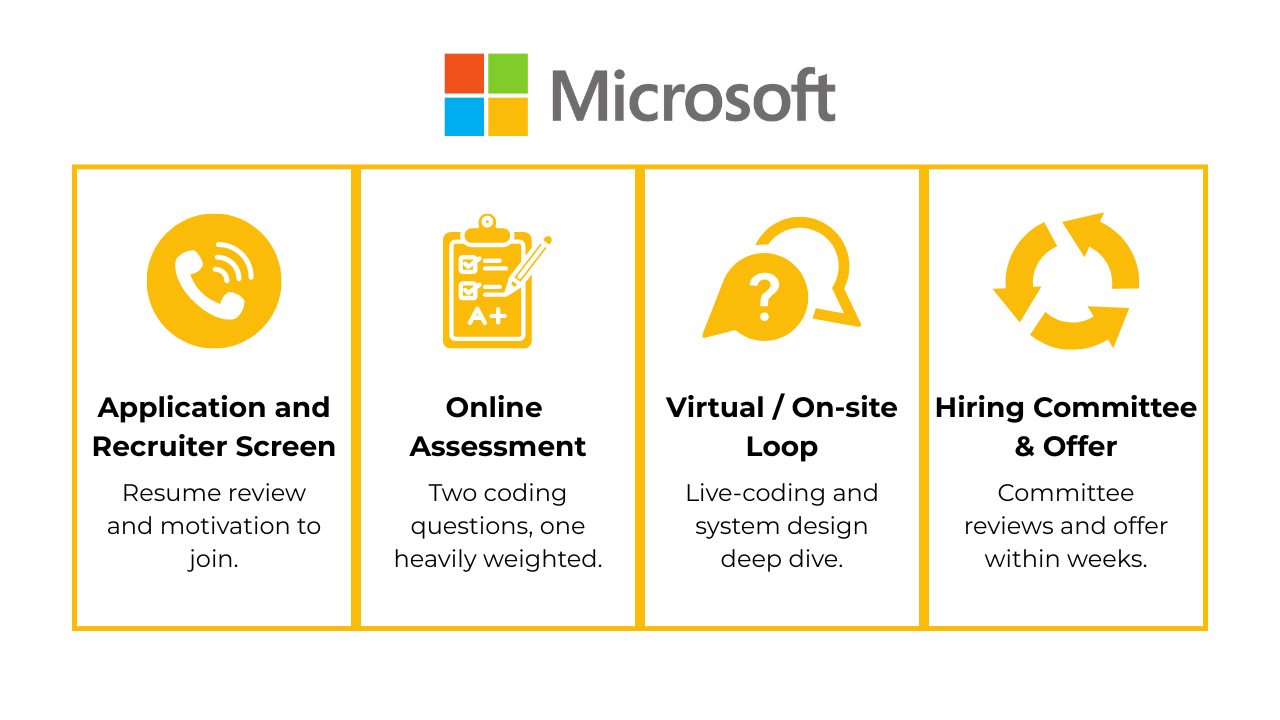
Microsoft’s interview process is structured yet comprehensive, designed to evaluate both your technical expertise and cultural fit across multiple stages. Here’s a breakdown of the typical five-step process you can expect when interviewing for various roles at Microsoft.
Recruiter Phone Screen
Often the first formal interaction, the recruiter phone screen focuses on résumé fit and your motivation for applying. Aligning with the recruitment process in Microsoft company, candidates should prepare to discuss relevant experience succinctly. Recruiters also outline the timeline and next steps, setting expectations for the overall process.
Online Assessment
The online assessment usually involves timed coding challenges, SQL queries, or domain-specific problem-solving tasks hosted on platforms like HackerRank. Auto-scoring provides an initial filter, emphasizing correctness and efficiency. Candidates should expect anywhere from 45 to 90 minutes to complete these tests, which assess foundational skills critical to Microsoft roles.
Technical Interviews
The technical rounds typically include two to four interviews focusing on algorithms, system design, or role-specific domain problems. Early in your preparation, research microsoft technical interview questions to familiarize yourself with common themes and question formats. For detailed preparation, consult role-specific interview guides tailored to Software Engineering, Data Science, or Product Management positions.
Logic & Behavioral Interview
Microsoft interview logic questions form a crucial component of assessing problem-solving approach and cultural alignment. Sample prompts might include:
- Explaining a complex technical concept to a non-technical stakeholder
- Describing a time when you had to make a difficult trade-off
- Walking through your process for debugging a critical production issue
Use the STAR method—Situation, Task, Action, Result—to structure your answers, emphasizing clarity and impact.
Hiring Committee & Offer
After interviews, a cross-functional hiring committee reviews feedback and calibrates candidate levels, ensuring alignment with Microsoft’s high standards. Following executive sign-off and successful background checks, candidates receive offers with a defined negotiation window. This thorough review process upholds Microsoft’s commitment to hiring top talent while maintaining fairness and transparency.
Challenge
Check your skills...
How prepared are you for working at Microsoft?
Most Common Microsoft Interview Questions
When preparing for Microsoft interviews, it’s essential to understand the range of questions you might encounter—from role-specific technical challenges to behavioral and logic-based assessments. This section highlights key question categories and provides pointers on what to expect during your interview journey.
Role-Specific Interview Guides
Microsoft’s hiring process varies across roles, so leveraging tailored resources is crucial. Explore in-depth guides for the following positions:
- Microsoft Data Scientist Interview Guide
- Microsoft Data Engineer Interview Guide
- Microsoft Software Engineer Interview Guide
- Microsoft Machine Learning & Applied Scientist Interview Guide
- Microsoft Data Analyst Interview Guide
- Microsoft Product Manager Interview Guide
Technical Depth Questions Across Roles
Technical interview questions at Microsoft commonly focus on algorithmic patterns such as dynamic programming, graph traversal, and string manipulation. System design questions often revolve around scalable, cloud-native architectures leveraging Azure services. Candidates should be well-versed in distributed systems concepts, data storage strategies, and security considerations. Familiarity with Microsoft’s technology stack and Azure-specific solutions can give you a competitive edge.
Logic & Behavioral Themes
Microsoft logic interview questions test your analytical thinking and problem-solving strategies beyond coding. Interviewers assess your approach to ambiguous problems, your collaboration skills, and how you embody Microsoft’s cultural pillars like Create Clarity, Generate Energy, and Deliver Success. Expect scenarios that challenge your decision-making under uncertainty and your ability to foster teamwork.
Interview Questions & Answers Walk-Through
Candidates benefit greatly from reviewing Microsoft interview questions and answers examples. Here are brief examples:
Coding & Technical Questions
This category tests your proficiency with core algorithms, data structures, and coding best practices. Microsoft expects candidates to write clean, efficient, and production-ready code that solves problems involving arrays, linked lists, recursion, and optimization. These skills are fundamental for building scalable software and systems.
- Implement a basic LRU cache
- Write a function to rotate an array by k positions
- Find the missing integer from an array of 1 to N
- Search for a value in log(n) over a sorted 2D matrix
- Find the total number of unique conversation threads
- Write a function
friendship_timelinethat lists friend pairs with their start and end timestamps. - Write a function rain_days to calculate the probability that it will rain on the nth day after today.
Data & System Design Questions
Here, you’ll demonstrate your ability to architect scalable, reliable data pipelines and systems. Questions focus on designing databases, data warehouses, real-time streaming platforms, and ML infrastructure—often using Microsoft Azure technologies. Strong candidates show strategic thinking about performance, fault tolerance, and operational complexity.
- Say you are tasked with designing a data mart or data warehouse for a new online retailer. How would you design the system?
- Design a system to minimize wrong orders
- Improving the performance of document app’s autosave feature to handle data processing systems
Behavioral & Leadership Questions
Microsoft highly values cultural fit and leadership potential. This section evaluates your communication, collaboration, problem-solving approach, and ability to drive impact. Prepare to share stories illustrating how you navigate ambiguity, influence stakeholders, learn from feedback, and contribute to an inclusive team culture aligned with Microsoft’s leadership principles.
- Tell me about a time when you exceeded expectations during a project. What did you do, and how did you accomplish it?
- How do you prioritize multiple deadlines? Additionally, how do you stay organized when juggling competing projects?
- Describe a data project you worked on. What were some of the challenges you faced?
Structuring your answers clearly, with a focus on impact and process, will resonate strongly with interviewers.
What to Expect in On-Site Loops
In interview questions in Microsoft on-site loops, expect a mix of whiteboard coding sessions and virtual interviews depending on your location and role. Whiteboard rounds focus on problem-solving and system design, while virtual rounds may emphasize collaboration using shared coding platforms. Prepare for multiple interviewers probing your depth, breadth, and culture fit through technical challenges and behavioral discussions.
How to Prepare for a Microsoft Interview
Preparing effectively for a Microsoft interview requires a strategic approach that aligns your skills with the company’s expectations and culture. Here are key steps to help you succeed:
Reverse-Engineer the Job Description
Start by carefully analyzing the job posting to identify the core competencies Microsoft values for your target role. Map these skills to relevant practice problems and interview topics. This focused approach ensures your preparation addresses exactly what interviewers will probe.
Drill Core Computer Science & Data Fundamentals
Solid mastery of algorithms, data structures, and domain-specific fundamentals is non-negotiable. Leverage Interview Query’s dedicated Microsoft tag to access curated questions tailored to Microsoft’s interview style. Regularly schedule timed mock interviews to simulate real test conditions and improve time management.
Craft Concise STAR Stories
For behavioral interviews, prepare Situation-Task-Action-Result (STAR) stories that highlight your measurable impact and learning. Focus on clear, concise narratives demonstrating how you embody Microsoft’s leadership principles like Create Clarity, Generate Energy, and Deliver Success.
Research Microsoft’s Latest Product Launches
Stay informed about Microsoft’s cutting-edge innovations such as Copilot, Microsoft Fabric, and Xbox Cloud Gaming. Understanding these products enables you to align your answers with Microsoft’s business priorities and demonstrate genuine interest during interviews.
Salaries at Microsoft
Average Base Salary
Average Total Compensation
Conclusion
Preparing for a Microsoft interview goes beyond just practicing questions—it requires a deep understanding of the role, Microsoft’s leadership principles such as Create Clarity, Generate Energy, and Deliver Success, and the tangible impact you are expected to make from day one. Whether you are targeting software engineering, data science, or product management, a strategic, role-specific preparation approach will distinguish you from the competition.
We offer detailed learning paths and comprehensive interview guides to support you at every stage—from the initial recruiter screen to the final hiring committee.
Explore our curated guides for Microsoft roles:
- Microsoft Data Scientist Interview Guide
- Microsoft Data Engineer Interview Guide
- Microsoft Software Engineer Interview Guide
- Microsoft Machine Learning & Applied Scientist Interview Guide
- Microsoft Data Analyst Interview Guide
- Microsoft Product Manager Interview Guide
Get inspired by success stories like Jayandra Lade’s, who leveraged focused preparation and grew into a top data analyst role. Begin your journey today with our expert-led learning paths and mock interview sessions designed to propel you toward offer day.
FAQs
How long does the Microsoft hiring process usually take?
The typical timeline ranges from 3 to 6 weeks, though senior-level interviews and principal roles may extend up to 8 weeks due to additional rounds and calibration.
Do I need a CS degree to pass Microsoft’s technical interviews?
While a CS degree can be advantageous, Microsoft values equivalent hands-on experience and strong problem-solving skills. Candidates who demonstrate LeetCode-level proficiency and practical coding expertise are well positioned to succeed.
What are Microsoft’s logic interview questions really testing?
These questions assess your structured problem-solving ability, decision-making clarity, and alignment with Microsoft’s leadership principles such as Create Clarity, Generate Energy, and Deliver Success.
How many interview rounds are there for most roles?
Most candidates go through five major stages: recruiter screen, online assessment, technical interviews, logic and behavioral interviews, and finally, the hiring committee review followed by an offer.
Where can I find official Microsoft prep resources?
Microsoft Learn offers extensive certifications and learning paths. Additionally, Microsoft’s engineering blogs provide insights into company culture and technologies. For curated interview questions and guides, the Interview Query Microsoft library is a valuable resource.
Discussion & Interview Experiences