

CVS Health Software Engineer Interview Questions + Guide in 2025


Introduction
Landing a position as a software engineer at CVS Health means working on mission-critical systems that serve over 90 million patients nationwide. From modernizing legacy pharmacy platforms to securing sensitive patient data, CVS software engineers partner closely with data scientists, product managers, and healthcare experts to deliver reliable, scalable solutions that improve lives every day.
Role Overview & Culture
As a CVS software engineer, you’ll spend your days designing and developing retail-scale applications that handle high-throughput transaction volumes while ensuring HIPAA compliance. You might build microservices for prescription fulfillment, integrate real-time inventory feeds, or optimize cloud deployments—all under a rigorous security framework where a CVS health software engineer mindset is essential. Collaboration is paramount: you’ll work with cross-functional teams to translate clinical requirements into robust code. Midday stand-ups and architecture reviews help ensure alignment and quality, and as a CVS software engineer you’ll be empowered to own features end-to-end. Ultimately, this is the role for anyone who thrives at the intersection of healthcare and high-performance engineering, whether you identify as a front-end specialist or a full-stack software engineer CVS.
Why This Role at CVS?
Joining CVS as a CVS software engineer offers the chance to impact millions by modernizing core systems that power pharmacies, MinuteClinics, and insurance services. You’ll leverage a tech stack that blends .NET, Java, and cloud-native architectures to migrate monolithic applications to microservices, reflecting CVS’s push from on-premise to CVS software-driven cloud environments. With a clear path for career progression—from individual contributor to principal engineer or team lead—and competitive compensation packages, this role not only challenges your technical skills but also accelerates your growth in one of healthcare’s most innovative companies.
What Is the Interview Process Like for a Software Engineer Role at CVS?
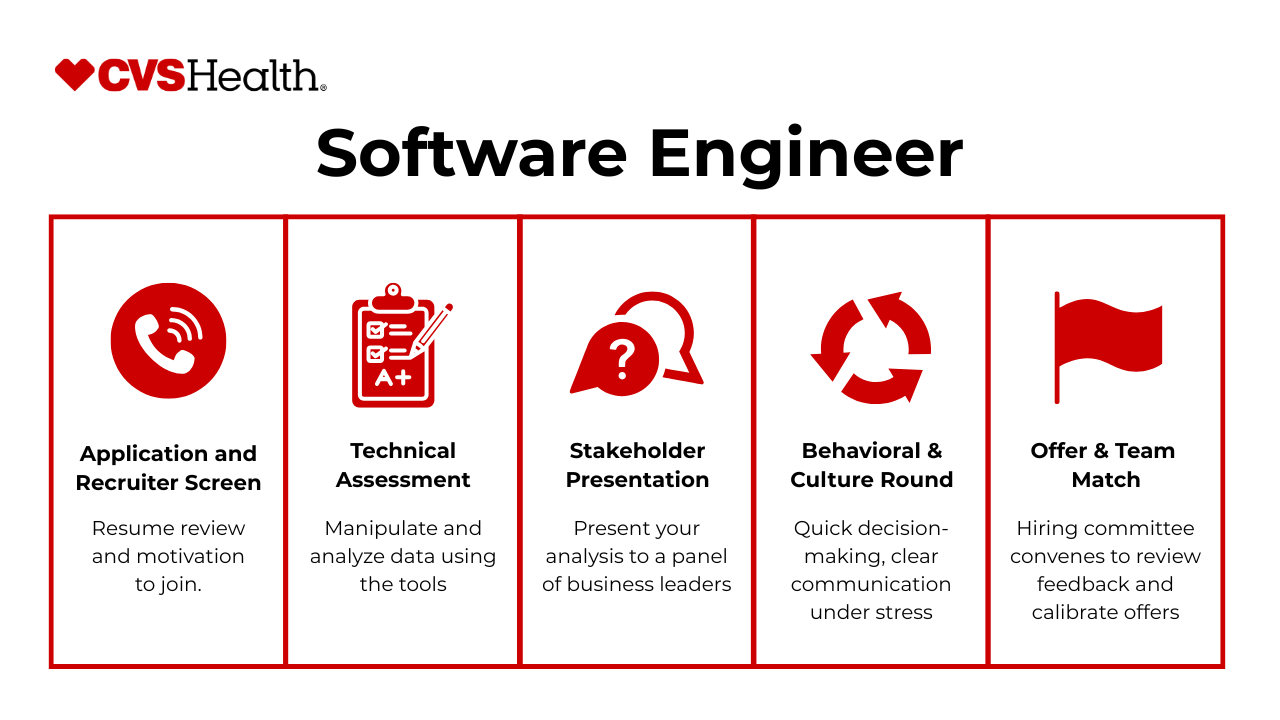
Landing an offer begins with the CVS software engineer interview kickoff, where you’ll have a brief recruiter call to confirm your fit and discuss your background. From there, you’ll tackle an online coding assessment—typically a mix of algorithmic challenges and practical debugging tasks—before progressing to a virtual or onsite loop
Recruiter Call
Your journey starts with a conversation focused on your résumé, motivations, and cultural fit. Recruiters will ask about your experience with healthcare or enterprise software, ensuring that you understand CVS’s mission and can thrive as a CVS health software engineer in a regulated environment. This screen also covers logistical details: preferred locations, compensation expectations, and timeline.
Online Coding Test
Next up is a timed coding challenge, often delivered through a platform like HackerRank. Expect data-structure problems, language-specific tasks (e.g., C# or Java), and sometimes a small take-home component. The goal is to assess your problem-solving speed and code clarity before you invest time in the full interview loop.
Virtual/Onsite Interview Loop
In this stage, you’ll face multiple rounds: two or three live-coding sessions, a system-design discussion to evaluate your architecture skills, and a behavioral conversation that probes teamwork and ownership. Interviewers often reference real CVS use cases, so be ready to explain how you’d handle large-scale data flows or secure PHI in microservices. Behind the scenes, the hiring team consolidates feedback—aligned to the core competencies—and vets candidates against a set of CVS software engineer interview questions that balance technical depth with culture fit.
Offer & Team Match
Successful candidates receive an offer followed by a team-match discussion, where you learn about specific projects and reporting structures. The process moves quickly, with most offers extended within two weeks of your final loop.
Differences by Level
At the intern level, the focus is on basic coding and willingness to learn. Mid-level engineers tackle more complex design problems and demonstrate autonomy in end-to-end feature delivery. Senior candidates must showcase leadership in system architecture, mentoring, and cross-team collaboration—often illustrated through past large-scale projects. Compensation aligns with this progression, with CVS software engineer salary bands reflecting increasing scope and impact.
Ready to see sample questions? Scroll on for targeted coding, design, and behavioral prompts tailored to CVS’s software engineering roles.
Challenge
Check your skills...
How prepared are you for working as a Software Engineer at Cvs Health?
How to Prepare for a Software Engineer Role at CVS
A structured prep plan will help you demonstrate both technical excellence and alignment with CVS’s mission-driven culture. Below are targeted strategies to guide your study and practice.
Study the Role & Culture
Map your past projects—whether building retail-scale services or refactoring data pipelines—to CVS’s healthcare context. Highlight experiences where you ensured data reliability or compliance, showing you can thrive as a CVS software engineer in a regulated environment.
Practice Common Question Types
Allocate your practice time roughly as follows: 40 % on coding problems, 30 % on system-design drills, and 30 % on behavioral STAR responses. Regularly review past CVS software engineer interview questions to internalize formats and expectations.
Think Out Loud & Ask Clarifying Questions
During mock sessions, narrate your thought process and verify requirements before diving into solutions. Interviewers appreciate candidates who articulate trade-offs—such as latency versus compliance—and adjust their approach based on feedback.
Mock Interviews & Feedback
Schedule sessions with ex-CVS engineers or peers through Interview Query’s mock interview platform. Record and review these loops to identify gaps in your reasoning, communication clarity, and cultural alignment.
FAQs
What is the average salary for a CVS Software Engineer?
Average Base Salary
Average Total Compensation
CVS software engineer salary ranges vary by level and location, with base, bonus, and RSU packages reflecting market benchmarks. Entry-level roles in major metro areas receive competitive compensation, while senior engineers command higher bands in recognition of leadership and technical scope.
How many rounds are in the CVS SWE interview?
The typical loop comprises four to five stages: recruiter screen, online coding test, virtual or onsite technical design sessions, and a behavioral panel—collectively forming the CVS software engineer interview . Each round builds on the last to assess both depth and breadth.
Does CVS ask LeetCode-hard questions?
Yes, hard-level problems such as “validate binary search tree leetcode solution” may appear, especially for mid to senior roles. Prepare to solve tree and graph challenges within a 45–60 minute live-coding format.
Which languages/frameworks should I know?
Strong proficiency in Java, Kotlin, or Python is expected, alongside familiarity with front-end stacks like React for full-stack positions. Cloud and data tooling—GCP, Snowflake, or similar—is a plus. Demonstrating quick learning in these areas can set you apart as a CVS software engineer.
Can I re-apply after failing?
CVS enforces a six-month cooldown before re-application. Use this time to address feedback—improve coding fluency, deepen design skills, or enhance domain knowledge—before your next attempt.
Conclusion
With dedicated preparation on CVS software engineer interview questions, you’ll be equipped to navigate CVS’s rigorous process and showcase your ability to build secure, scalable healthcare platforms. For further practice, explore our learning paths, schedule a mock interview, and draw inspiration from success stories like Hanna Lee’s.
Be sure to visit our parent CVS interview hub and related guides for Data Engineer and Data Scientist roles to refine your strategy and land your next role at CVS Health.
Discussion & Interview Experiences