

Capital One Machine Learning Engineer Interview Questions + Guide in 2025


Introduction
Capital One is a leading financial services company and one of the top 10 largest banks in the United States, known for its technology-driven innovation and strong focus on data science. With a mission to “change banking for good,” Capital One leverages cutting-edge machine learning tools, real-time data infrastructure, and agile cloud-based platforms to power its customer-first approach. As part of this vision, the Capital One machine learning engineer interview is designed to evaluate your ability to build scalable models, collaborate cross-functionally, and solve complex problems that create real business value across products like credit cards, savings, and fraud detection systems.
Role Overview & Culture
As a Machine Learning Engineer at Capital One, your day-to-day responsibilities involve building, deploying, and optimizing production-grade ML models that serve millions of customers. You’ll work with large-scale, high-dimensional datasets, develop model pipelines, and partner closely with data scientists, software engineers, and product teams to ensure end-to-end model delivery. Capital One’s AI-forward culture sets it apart—embracing cloud-native tools like AWS, robust MLOps frameworks, and scalable model deployment platforms. The company has invested heavily in real-time ML pipelines and is deeply committed to responsible and ethical AI practices.
This innovative culture fosters an environment where experimentation, end-to-end ownership, and rapid iteration are the norm. ML Engineers are empowered to prototype quickly, push solutions into production, and iterate based on performance metrics and customer feedback. These are key capabilities assessed during the Capital One machine learning engineer interview process.
Why This Role at Capital One?
This role offers a rare opportunity to innovate at scale. Capital One applies machine learning to a wide range of business-critical applications—from detecting fraud in real time to optimizing credit risk models and personalizing the customer journey across digital platforms. Engineers gain access to production-level ML infrastructure, real-time data pipelines, and a cross-functional support system that makes impact at scale achievable. With a deep focus on building responsibly and iterating fast, you’ll have the chance to work on models that shape real financial outcomes for millions of users.
Let’s take a look at what the Capital One machine learning engineer interview process typically looks like.
What Is the Interview Process Like for a Machine Learning Engineer Role at Capital One?
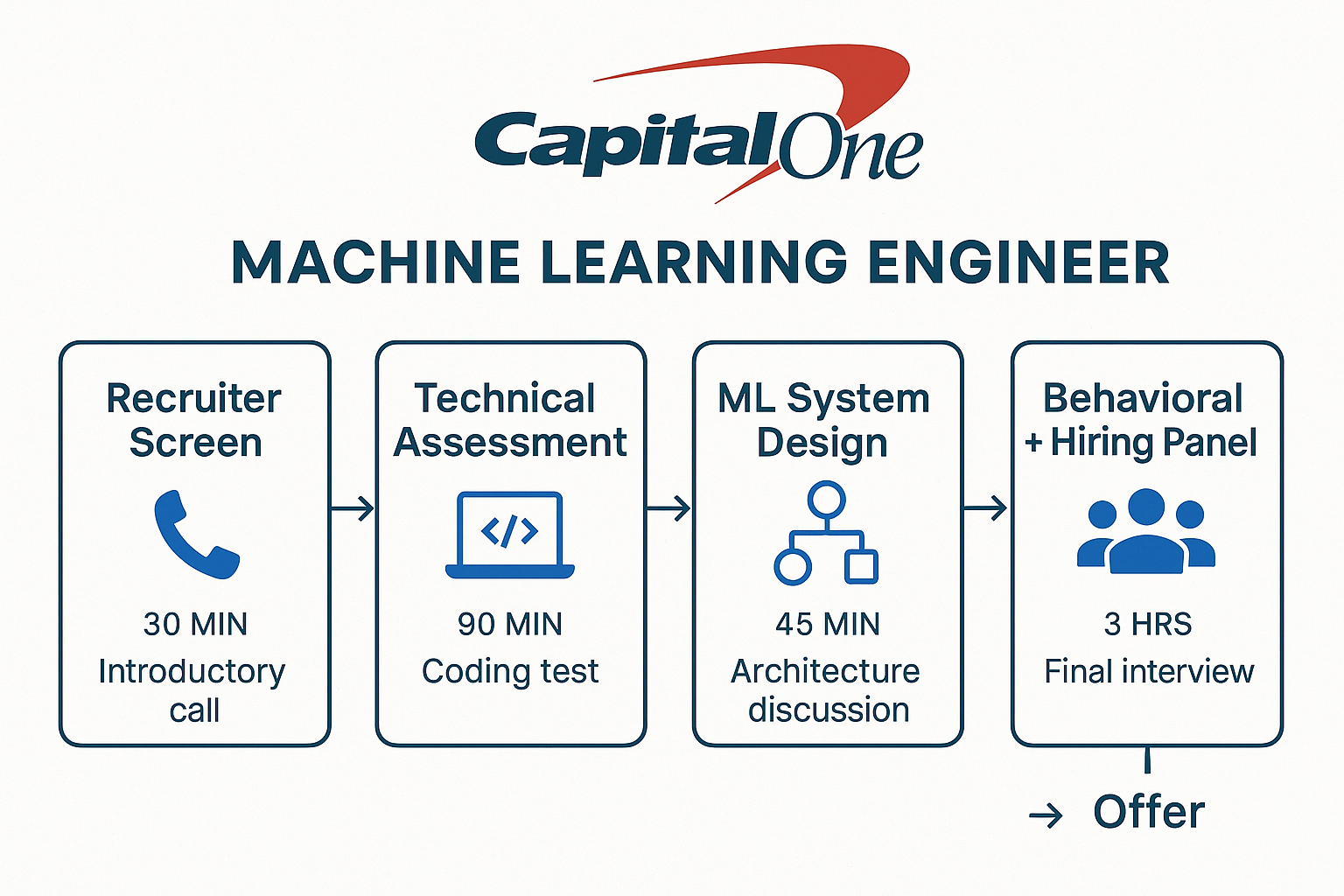
Capital One Machine Learning Engineer interview evaluates your ability to build and scale machine learning solutions that align with business needs, demonstrate strong technical judgment, and communicate effectively with cross-functional teams. Capital One looks for candidates who can balance model performance with interpretability, scalability, and ethical considerations. With a heavy investment in cloud-based architecture and MLOps, you are expected to demonstrate both core ML expertise and a working knowledge of modern infrastructure.
Recruiter phone screen
The first step is a 30-minute call with a recruiter. This round is focused on understanding your background, interest in the role, and alignment with Capital One’s tech stack and mission. You’ll be asked about your experience with machine learning models, Python or cloud tools, and how you’ve deployed ML solutions in the past. It’s also your chance to ask clarifying questions about the team, project scope, or interview logistics.
Take-home or live ML coding challenge (often in Python or Jupyter)
The next round often includes a take-home assignment or a live coding challenge using Python and/or Jupyter Notebook. You’re asked to analyze a dataset, build an appropriate ML model (often regression or classification), and present results along with performance metrics like precision, recall, AUC, or confusion matrix. Some challenges include writing clean, modular code for feature engineering, cross-validation, and error analysis.
In some cases, especially for more senior roles, this task is replaced by or supplemented with a live coding round, where you’ll pair with an engineer to write and explain model-building code in real time.
Technical interviews: model evaluation, system design, ML theory
These rounds dive deeper into your understanding of machine learning algorithms, model deployment, and your ability to design scalable ML systems. You can expect questions like: “How would you choose between models under class imbalance?”, “How do you handle data drift and concept drift in production?”, “How do you monitor models once deployed?”, “Design a fraud detection system with real-time scoring and feedback loops.”
Interviewers want to understand your reasoning, tradeoff analysis, and awareness of real-world challenges, such as latency, interpretability, or fairness. You may also be asked to whiteboard or verbally walk through an architecture or design pipeline, especially for tasks that involve streaming or cloud-based infrastructure.
Final behavioral or cross-functional round
This stage typically involves one or more behavioral interviews with a hiring manager and a cross-functional panel, including members from data science, engineering, and product teams. While your technical skills are assessed in earlier rounds, this final phase is crucial for evaluating culture fit, communication skills, and leadership potential. At Capital One, machine learning engineers are expected to do more than build models—they must collaborate across disciplines, align their work with business objectives, and uphold the company’s values around innovation and responsible AI.
Capital One’s culture emphasizes customer obsession, end-to-end ownership, and agile, mission-driven teamwork. ML Engineers are expected to engage deeply with product managers, analysts, and engineers to ensure the models they develop are not only accurate but also fair, interpretable, and actionable. As such, interviewers use this round to understand how you approach collaboration, how you communicate complex technical concepts to non-technical audiences, and how you navigate ambiguity in fast-paced environments.
Many technically strong candidates struggle in this round if they can’t show that they operate with empathy, humility, and a mindset aligned with Capital One’s values. Thoughtful reflection, honest storytelling, and clear communication are often what set successful candidates apart.
Behind the Scenes
Capital One takes a collaborative and structured approach to hiring. After each round, interviewers submit written evaluations that cover technical depth, communication, business context, and leadership potential. These evaluations are shared during a final hiring panel discussion, where a hiring decision is made based on collective feedback and alignment with role expectations.
Differences by Level
Entry-level candidates (new grads or years of experience) are primarily evaluated on their understanding of supervised learning, common ML frameworks, and ability to apply models to business datasets. Expect focus on algorithm selection, model evaluation, and hands-on coding.
Mid- to senior-level candidates are expected to demonstrate deeper knowledge in system design, MLOps, cloud services (e.g., AWS SageMaker or Lambda), and the ability to collaborate with stakeholders. Emphasis is placed on designing and scaling ML pipelines, communicating with product and engineering leads, and making high-impact business decisions.
Challenge
Check your skills...
How prepared are you for working as a ML Engineer at Capital One?
What Questions Are Asked in a Capital One Machine Learning Engineer Interview?
During the technical portion of the Capital One machine learning engineer interview, you can expect a range of coding and algorithmic questions designed to assess your ability to build, optimize, and explain machine learning solutions in practical scenarios.
Coding / Technical Questions
In the Capital One machine learning engineer interview, you’ll face technical questions that assess your hands-on proficiency with machine learning tools and frameworks, particularly in Python. These questions often simulate real-world scenarios, such as building models from scratch, working with messy or imbalanced data, and optimizing performance under constraints. The goal is to evaluate not just your coding skills, but your ability to think critically about model design, explain trade-offs, and communicate your approach clearly. Expect to demonstrate your end-to-end problem-solving process—from data exploration and feature selection to model evaluation.
1. Transpose a matrix and estimate linear regression weights
Begin by using NumPy or matrix algebra to transpose your feature matrix. Then, apply the closed-form solution of linear regression to estimate weights using the normal equation. Carefully handle edge cases like singular matrices. This question evaluates foundational understanding of regression models and numerical operations.
2. Build a k Nearest Neighbors classification model from scratch
Use Euclidean distance to find the nearest neighbors and predict the class based on majority voting. Consider implementing optimizations like KD-Trees for performance on larger datasets. Discuss bias-variance tradeoff in KNN. This tests your ability to implement fundamental models and understand their tradeoffs.
3. Build a random forest model from scratch to classify movie reviews
Start by implementing decision trees and then ensemble them using bagging. Make sure to incorporate random feature selection at each split. Measure accuracy or F1 score to validate model performance. Random forests are commonly used in industry and this question checks your depth of understanding.
4. Find the nearest common parent node for two given nodes in a binary tree
Use recursion or DFS to traverse the tree and identify the lowest common ancestor. Be sure to account for nodes that may not exist in the tree. Optimize for both time and space complexity. While not machine learning specific, it assesses core tree traversal skills needed in ML system design.
5. Determine if a given binary tree is a valid binary search tree
Apply in-order traversal and check for strict ordering. Alternatively, use recursion with min/max bounds at each node. This is a common interview problem to test data structure fluency. Knowing BST properties is useful for understanding decision tree structures in ML.
6. Convert a sorted list into a balanced binary search tree
Use recursion to pick the middle element as root, recursively applying the same for left and right halves. The resulting tree should be height-balanced. Think carefully about the base case and indexing. Balanced trees form the basis for certain ML data structures like interval or spatial trees.
7. Summarize features for a collaborative filtering recommendation model
Break down user and item interaction matrices, then identify latent features through matrix factorization or embeddings. Describe how to handle cold-start problems and sparse matrices. Mention regularization to prevent overfitting. This question is highly relevant for recommendation engines, common in ML engineering.
System / Product Design Questions
This part of the interview focuses on your ability to design and scale machine learning systems for real-world use cases at Capital One. You might be asked to outline how you would build a fraud detection pipeline, architect a recommendation system, or manage model retraining in the presence of data drift. These questions aim to test your grasp of production-level ML, including how you balance engineering constraints with model performance and business objectives. In the Capital One machine learning engineer interview, showing that you can reason through infrastructure, data flow, model lifecycle, and monitoring will set you apart.
8. Describe the process of building a restaurant recommender system
Start by discussing how to collect and preprocess user, restaurant, and contextual data. Outline both collaborative filtering and content-based filtering options, and consider cold-start scenarios. Emphasize system scalability and explain how to incorporate feedback loops. This question is highly relevant for ML engineers working on recommendation infrastructure.
9. Design a recommendation algorithm for Netflix’s type-ahead search bar
Focus on indexing, user intent prediction, and latency reduction. Highlight techniques such as prefix trees, autocomplete ranking, and ML personalization. Consider AB testing to evaluate search performance. It’s a strong test of both product awareness and ML-driven UX design.
10. Create a recommendation engine for rental listings
Define features for users and listings, and choose a modeling approach like matrix factorization or ranking models. Discuss infrastructure, such as real-time scoring or batch inference. Don’t forget fairness, recency bias, and feedback mechanisms. This is a product-critical system that blends ML design with user personalization.
11. Design a podcast search engine with transcript filtering
Emphasize speech-to-text conversion and indexing transcripts for search relevance. Include semantic search with embeddings or keyword extraction. Talk about latency and storage tradeoffs. This question tests your ability to design multimodal ML systems.
12. Design a classifier to predict optimal moments to insert commercial breaks
Frame the problem as a time-series classification task over video/audio content. Consider segmenting content into scenes or speaker turns for break prediction. Discuss feature extraction and labeling challenges. This problem bridges media analytics and monetization strategies.
13. Design a real-time fraud detection system for credit card transactions
Discuss the pipeline from transaction ingestion to model scoring. Emphasize handling of imbalanced data, latency requirements, and alert thresholds. Include streaming frameworks and model retraining considerations. This is directly aligned with Capital One’s core fraud detection responsibilities.
14. Design a machine learning model to predict loan defaults
Choose interpretable models like logistic regression or gradient boosting with SHAP explanations. Include feature engineering from credit history, transaction behavior, and external data. Talk about fairness, regulatory compliance, and model monitoring. This question mirrors real-world fintech modeling challenges.
Behavioral or “Culture Fit” Questions
Beyond technical acumen, Capital One places a strong emphasis on cultural alignment and collaborative mindset. This portion of the interview evaluates how you navigate team dynamics, communicate complex ideas to diverse audiences, and stay focused on delivering impact through machine learning. You’ll be asked to share stories that highlight your adaptability, problem-solving under pressure, and ability to advocate for responsible AI practices. These questions are an essential part of the overall assessment and reflect Capital One’s belief that the best engineers are those who thrive in cross-functional teams and make thoughtful, ethical decisions in their work.
15. Tell me about a time you failed at a project and what you learned from it
Use the STAR method to walk through a specific challenge, your actions, and the outcome. Emphasize how you took responsibility and improved a technical or interpersonal skill. Capital One values growth and accountability, so reflection is key. Make sure the story ends with a lesson that aligns with their core values like excellence or innovation.
16. Describe a situation where you had to explain a complex machine learning concept to a non-technical stakeholder
Focus on your ability to tailor communication and simplify technical jargon. Highlight the importance of active listening and aligning your explanation with business impact. Use examples like model predictions or metrics that helped drive decisions. This assesses how well you translate technical value into business relevance, a key culture trait at Capital One.
17. How do you stay up to date with new developments in machine learning?
Mention sources like conferences, journals, newsletters, and Kaggle or side projects. Talk about how you apply what you learn to your work. This reveals curiosity, continuous learning, and a passion for growth—all qualities Capital One emphasizes in its tech culture.
18. Give an example of a time you worked on a cross-functional team
Describe the dynamics of collaborating with product, design, and engineering stakeholders. Focus on how you managed differing priorities and communicated effectively. Capital One emphasizes collaboration and diverse perspectives, so reflect on how you contributed to a shared goal.
19. Tell me about a time when you had to push back on a request that didn’t align with ethical or responsible AI practices
Explain the context and the specific ethical concern (e.g., bias, privacy, or explainability). Share how you raised the issue and influenced a better decision. Capital One prioritizes responsible AI and ethical modeling, so demonstrating integrity and care is crucial.
20. How do you handle high-pressure deadlines when working on multiple ML deliverables?
Talk about prioritization, clear goal setting, and seeking support when needed. Emphasize time management strategies and staying aligned with team objectives. Capital One values execution and ownership, especially under complex conditions.
21. Describe a time you improved an existing ML pipeline or process
Walk through the initial problem, your proposed improvement, and how you implemented it. Highlight the impact in terms of efficiency, accuracy, or maintainability. This shows initiative, technical creativity, and a drive for continuous improvement—core values in Capital One’s engineering culture.
How to Prepare for a Machine Learning Engineer Role at Capital One
Preparing for a machine learning engineer role at Capital One means understanding the company’s unique blend of technical rigor, real-world ML applications, and collaborative culture.
Study the Role & Culture
To succeed in the Capital One machine learning engineer interview, it’s crucial to understand both the technical expectations of the role and the company’s values. Capital One is known for applying machine learning across key areas such as fraud detection, credit scoring, and customer intelligence. As you prepare, read blog posts, engineering case studies, and whitepapers published by Capital One to understand how they build and deploy ML solutions in production. Learn about their tech stack, which often includes Python, AWS (e.g., SageMaker, Lambda), Airflow for orchestration, and various MLOps practices. Understanding how Capital One integrates machine learning into business decisions will help you frame your responses with relevance and insight during the interview.
Practice Common Question Types
A well-structured preparation strategy can significantly boost your performance in the Capital One machine learning engineer interview. Allocate your study time intentionally: devote roughly 40% to machine learning coding, 30% to system and product design, and 30% to behavioral or case-style questions. For the coding portion, be ready to work hands-on with Python and scikit-learn. Practice building and tuning supervised learning models like logistic regression, decision trees, and random forests, and understand how to evaluate them using metrics such as precision, recall, F1-score, ROC-AUC, and calibration curves—especially in the context of class-imbalanced datasets, which are common in fraud detection.
Capital One heavily applies machine learning in operational areas such as real-time fraud detection, credit risk modeling, transaction categorization, and customer personalization. This means that your preparation should include an understanding of how to implement and evaluate models in high-stakes, high-throughput environments. For example, in fraud detection, you may need to optimize for low latency and high recall while maintaining explainability and compliance. In credit scoring, your models must be interpretable, fair, and well-calibrated to meet regulatory standards.
Beyond coding, focus 30% of your time on system and product design. Be prepared to explain how you would architect a production-level ML solution, including data pipelines, training workflows, drift detection mechanisms, and retraining schedules. Key topics to cover include MLOps best practices, data versioning, model monitoring, CI/CD for ML, and the trade-offs between batch vs. real-time inference. These are essential because Capital One operates at enterprise scale with an AI-first strategy, investing in cloud-native, highly automated ML platforms. Demonstrating awareness of concepts like feature stores, model lineage, and feedback loops shows that you understand not just the model, but the ecosystem it lives in.
Lastly, you can use Interview Query, LeetCode ML, or end-to-end Kaggle projects to simulate real interview questions and workflows.
Think Out Loud & Ask Clarifying Questions
A critical part of succeeding in Capital One machine learning engineer case style interview is demonstrating your structured thinking and communication process. Interviewers aren’t just evaluating whether you get the “right” answer—they’re listening to how you break down complex problems, how you reason through trade-offs, and how well you collaborate. That’s why it’s essential to think out loud and ask clarifying questions before diving into coding or system design.
One helpful approach is to use a four-part ML problem-solving framework:
- Understand the Problem & Define the Objective – What are we trying to predict or classify? What does success look like (e.g., accuracy, recall, cost savings)?
- Clarify the Data & Constraints – What kind of data is available? Is it real-time or batch? Are there missing values, class imbalance, or latency requirements?
- Modeling Strategy – What models are appropriate for the task and constraints? Should we prioritize interpretability, speed, or raw accuracy?
- Evaluation & Next Steps – How will we evaluate performance? Are there potential failure points like drift or data leakage? How would we deploy and monitor the model?
During the interview, take time to ask thoughtful questions like:
- What are the primary goals of this model—business impact, regulatory compliance, speed, or interpretability?
- Is the data streaming or batch? Is it labeled or partially labeled?
- What are the most important metrics for this use case—precision, recall, F1, AUC?
- Is there a human-in-the-loop system, or does this model make automatic decisions?
- How often does the data change, and do we need to worry about drift or re-training?
Asking these questions upfront helps you frame your solution more effectively and shows that you’re thinking beyond the algorithm—you’re considering the operational context, which is exactly what Capital One looks for in ML engineers. Whether you’re solving a modeling task or designing a full ML pipeline, verbalizing your thought process demonstrates collaboration and maturity, even in a one-on-one interview. Ultimately, the ability to navigate ambiguity with clarity and curiosity is a strong signal that you’re prepared to handle real-world ML challenges at scale.
Brute Force, Then Optimize
When solving a modeling or design problem, begin with a basic, functional solution—a minimum viable product (MVP)—and then discuss how you’d improve it. For instance, if asked to build a recommendation engine, start with a content-based or simple collaborative filtering model before discussing how you’d scale it using deep learning, real-time feedback, or personalization layers. This approach not only mirrors real-world ML development but also reflects how Capital One encourages iteration, continuous improvement, and end-to-end ownership in model deployment.
Mock Interviews & Feedback
Mock interviews are a powerful way to prepare. Practice with peers, mentors, or through mock interview platforms that simulate real Capital One-style questions. If possible, connect with former Capital One machine learning engineers to understand their experience and receive feedback. These sessions will help you refine your answers, improve timing, and get comfortable thinking under pressure.
FAQs
What Is the Average Salary for a Machine Learning Engineer at Capital One?
Average Base Salary
Average Total Compensation
Where Can I Read More About Capital One’s ML Engineering Roles?
To better understand the day-to-day work, interview experiences, and career progression of ML engineers at Capital One, you can explore our Capital One discussion threads and Glassdoor Capital One ML Engineer Reviews – often feature honest, firsthand insights about Capital One’s interview process, team culture, and work-life balance.
Are There Open ML Engineering Roles at Capital One?
Yes—Capital One consistently hires machine learning engineers across teams in fraud detection, personalization, cloud infrastructure, and more. You can explore current openings on Capital One Careers Page and Interview Query Job Board. Check out real job listings and prep with real questions to target roles that match your skill level and interests!
Conclusion
Preparing for the Capital One machine learning engineer interview is a valuable opportunity to sharpen both your technical and strategic thinking. Given the depth and scope of the role—from building scalable ML systems to influencing real business outcomes—it’s important to start early and approach your prep holistically. Focus not only on algorithms and coding but also on articulating your problem-solving process, collaborating across functions, and thinking critically about how your models drive value at scale.
For additional interview prep, check out our Capital One Data Scientist Interview Guide, Software Engineer Interview Guide, and more on Interview Query to explore related roles and sharpen your edge.
Capital One Interview Questions
| Question | Topic | Difficulty |
|---|---|---|
Data Structures & Algorithms | Medium | |
Given an integer Note: Return an empty list there are no prime numbers less than or equal to Example: Input: Output: | ||
Statistics | Easy | |
Data Structures & Algorithms | Easy | |
SQL | Easy | |
Machine Learning | Medium | |
Statistics | Medium | |
SQL | Hard | |
Machine Learning | Medium | |
Python | Easy | |
Deep Learning | Hard | |
SQL | Medium | |
Statistics | Easy | |
Machine Learning | Hard |
Discussion & Interview Experiences