


Meta Research Scientist Interview 2025: Inside the AI Frontier


Introduction
At Meta, research scientists turn bold ideas into products used by billions. As demand for artificial intelligence grows and research roles in computing are projected to expand by about 20% through 2034 according to the U.S. Bureau of Labor Statistics (bls.gov), this role has never been more vital. Your work may involve large language models, multimodal perception, integrity systems, or AR/VR—all areas that shape how people connect and create.
Preparing for a Meta research scientist interview means proving that you can bridge research and application. You will need to show originality, clarity, and measurable impact in both experimentation and communication. This guide walks you through each interview stage and helps you present your research with purpose, precision, and confidence.
Role overview and culture
A research scientist at Meta develops algorithms and models that advance how billions of people connect and create. The role combines scientific exploration with real-world application. You will design experiments, train large-scale models, and collaborate with engineering teams to bring research into production. A typical day involves coding in Python or C++, running training jobs, reviewing ablations, and aligning on metrics with partner teams. You will read and write papers, but also turn them into reusable code, clean datasets, and robust evaluation frameworks.
The culture values openness, speed, and rigor. Research scientists work across areas like recommendation, integrity, generative modeling, and extended reality (XR). Teams are encouraged to share findings transparently, even when results are negative, to accelerate learning. Publication is supported when it protects user privacy and product security, and many projects are open-sourced to contribute to the global AI research community.
Why this role at Meta
Choose this role if you want your research to have visible impact at global scale. As a research scientist at Meta, you will contribute to projects that push the boundaries of AI, from reducing inference latency on massive graphs to aligning generative models with user safety. For instance, research scientists played a core role in developing and refining Meta’s LLaMA models—building training pipelines, optimizing architecture, and publishing open benchmarks that have since guided the broader research community. This reflects how research at Meta moves from experimentation to global deployment, combining academic rigor with real-world application.
Growth paths are clear and flexible. Many researchers advance into technical leadership in areas such as recommendation, vision, or language, while others move into staff roles that define research roadmaps, build evaluation frameworks, or mentor teams. Internal mobility allows you to shift between foundational and product-driven research as your interests evolve, giving you both the depth and breadth to shape Meta’s AI future.
Meta Research Scientist Interview Process
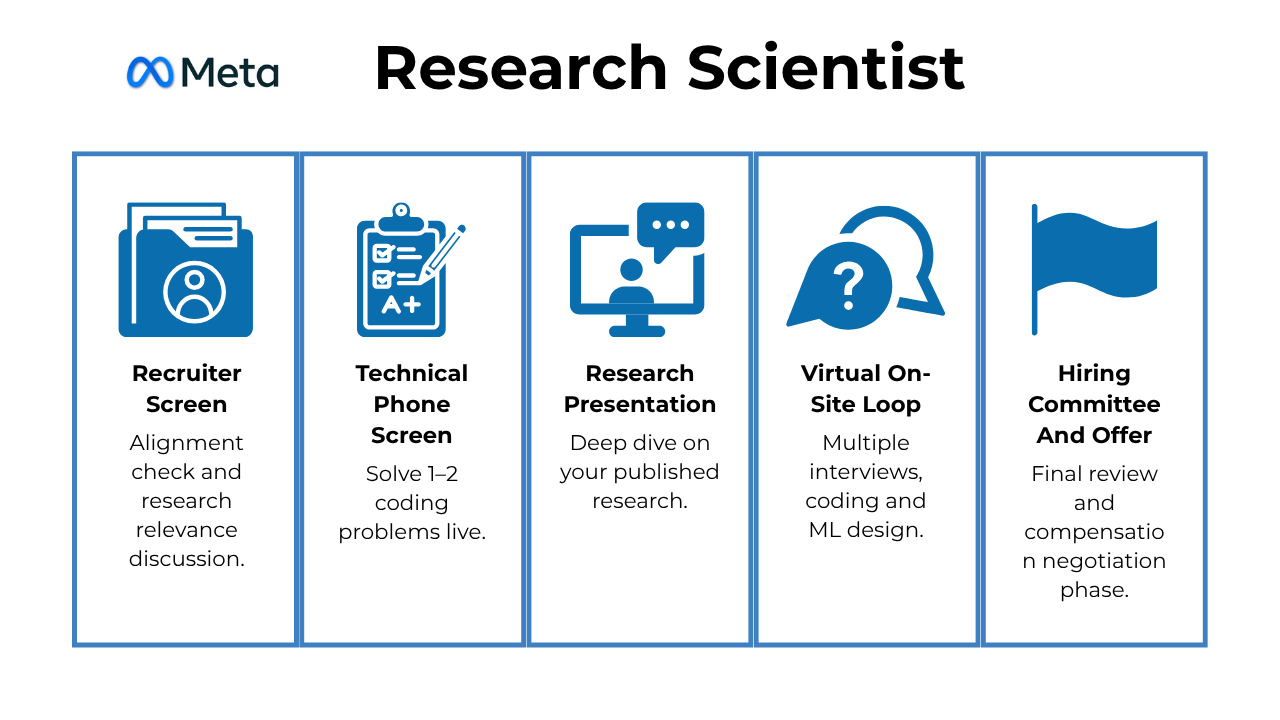
The Meta research scientist interview process is designed to identify candidates who combine deep theoretical understanding with practical application. The company looks for individuals who can both innovate and deliver, bringing research ideas to life in scalable systems. The process usually spans four to six weeks and includes five key stages. Each one builds upon the previous, giving Meta a complete picture of your technical ability, research mindset, and communication style.
Recruiter screen
The process begins with a 30 to 45-minute conversation with a recruiter. This discussion helps Meta determine whether your background aligns with their active research tracks, such as foundation models, computer vision, recommendation systems, or responsible AI. You’ll be asked about your academic background, publication record, and the relevance of your current or past research to Meta’s work.
Recruiters also assess your ability to balance research with real-world application. Expect questions like: “How have you transitioned an idea from theory into something usable by others?” or “Which of your papers or projects best demonstrate practical impact?” This is also your chance to ask questions about specific research teams like FAIR, Reality Labs, or Generative AI.
Tip: Keep your answers clear and structured. Connect your past work to Meta’s goals using examples that show measurable outcomes or open-source contributions. Curiosity and humility go a long way here.
Technical phone screen
The technical phone screen is a coding-based evaluation designed to assess your analytical reasoning and programming fluency. You’ll spend about an hour solving one or two problems in a shared coding environment such as CoderPad. These questions are often algorithmic but grounded in real-world contexts like optimizing model performance, handling large datasets, or improving an inference pipeline.
The interviewer wants to see how you translate abstract logic into clean, efficient code. For research scientist roles, they may include basic machine learning or probability questions, particularly related to model evaluation, complexity analysis, or data preprocessing.
Tip: When practicing, focus on writing code that is both correct and readable. Explain your thought process clearly as you go. Meta values candidates who can communicate their reasoning as effectively as they code.
Research presentation
This stage is often the most defining part of the interview. You’ll deliver a 45 to 60-minute presentation showcasing one of your core research projects or a recent paper. A panel of Meta scientists will attend, representing different domains to gauge both depth and versatility.
You’ll be expected to explain the full life cycle of your research: problem formulation, experimental design, data handling, model architecture, evaluation, and results. Panelists will ask follow-up questions that challenge your choices, assumptions, and generalization methods. They might also ask how your research could scale with Meta’s resources or be applied to its platforms.
Strong presentations are well-structured, visually clear, and balance theory with application. Make sure your slides highlight key insights, not just results.
Tip: Practice your talk with both technical and non-technical audiences. Meta values researchers who can teach complex concepts simply while maintaining scientific precision. Be ready for critical but constructive questions; panelists are looking for how you think under pressure.
Virtual or on-site loop
The virtual or on-site loop is the most comprehensive stage of the process, typically lasting an entire day and consisting of four to five focused interviews. Each session targets a different aspect of your capability, from coding to system design to collaboration.
Coding interview
This interview tests your ability to solve algorithmic problems efficiently. Expect multi-step challenges that involve real-world constraints such as optimizing a function for scalability or managing large input data. Some questions might include topics like matrix manipulation, dynamic programming, or implementing distributed algorithms.
Interviewers assess not only correctness but also how you reason through trade-offs, handle edge cases, and explain your design choices.
Tip: Approach each problem out loud. Start with a brute-force solution, then iterate toward optimization. This demonstrates adaptability and systematic problem-solving, both of which Meta values highly.
Test your skills with real-world analytics challenges from top companies on Interview Query. Great for sharpening your problem-solving before interviews. Start solving challenges →
Machine learning design interview
In this session, you’ll discuss how to design and scale ML systems that could be deployed at Meta’s level of complexity. Scenarios may include designing a recommendation engine, a content moderation model, or a ranking algorithm for billions of data points.
Interviewers want to see whether you can handle trade-offs between accuracy, latency, interpretability, and data quality. You’ll also be asked how you would validate the system’s performance, monitor bias, and iterate over time.
Tip: Use a structured approach: define the problem, identify data sources, outline the model pipeline, and discuss evaluation metrics. Meta interviewers are impressed by candidates who consider practical issues like ethics, fairness, and long-term scalability.
Research deep-dive interview
This round expands on your presentation but focuses on your problem-solving mindset. You’ll be asked probing questions about a specific project or paper you worked on. Interviewers may challenge your assumptions, suggest alternative methodologies, or ask how you’d improve your results with more data or compute.
They are not trying to trip you up; they want to see how you respond to critique, explore limitations, and evolve your thinking. A thoughtful, humble discussion is far more impressive than a defensive one.
Tip: Be candid about what did not work in your research. Meta values honesty and reflection. Show that you can evaluate your own work critically and identify potential extensions or improvements.
Behavioral interview
The behavioral interview evaluates how you collaborate, lead, and handle ambiguity. Meta’s research teams are deeply cross-functional, so you must demonstrate strong communication and empathy alongside technical expertise. Expect questions like, “Tell me about a time you had to align multiple stakeholders,” or “Describe a project where you disagreed with a co-author or engineer.”
Interviewers are assessing self-awareness, emotional intelligence, and leadership potential. They want to understand how you operate within Meta’s culture of openness and debate.
Tip: Use the STAR method (Situation, Task, Action, Result) to structure your answers. Keep stories concise but rich in detail, and highlight what you learned or how you improved a process.
Hiring committee and offer
After all interviews are completed, each interviewer submits detailed feedback within a few days. A hiring committee made up of senior research scientists and managers reviews your full profile from technical scores, research potential, communication skills, and cultural alignment.
If approved, your recruiter will contact you with the offer details. Compensation packages at Meta are competitive and include a mix of base salary, performance bonuses, and equity. Senior candidates may also receive additional negotiation flexibility based on publication record or leadership experience.
Tip: When you reach this stage, be prepared to discuss your career goals and how they align with Meta’s research directions. Clear communication about your priorities, whether it’s open science, mentorship, or applied impact, will help tailor your offer and team placement.
Challenge
Check your skills...
How prepared are you for working as a AI Research Scientist at Meta?
What Questions Are Asked In A Meta Research Scientist Interview?
Meta’s research scientist interview questions test how well you combine deep technical expertise with practical impact. You will face a mix of coding, applied ML, research, design, and behavioral questions that reflect Meta’s real-world challenges. Each question gives interviewers a window into your reasoning, problem-solving process, and how you collaborate across teams.
Coding and applied ML interview questions
These coding and applied ML questions evaluate how well you can translate analytical thinking into practical implementation. You’ll be tested on algorithmic reasoning, data manipulation, and your ability to optimize performance for Meta-scale systems. Each question is designed to reveal how you think, not just what you know.
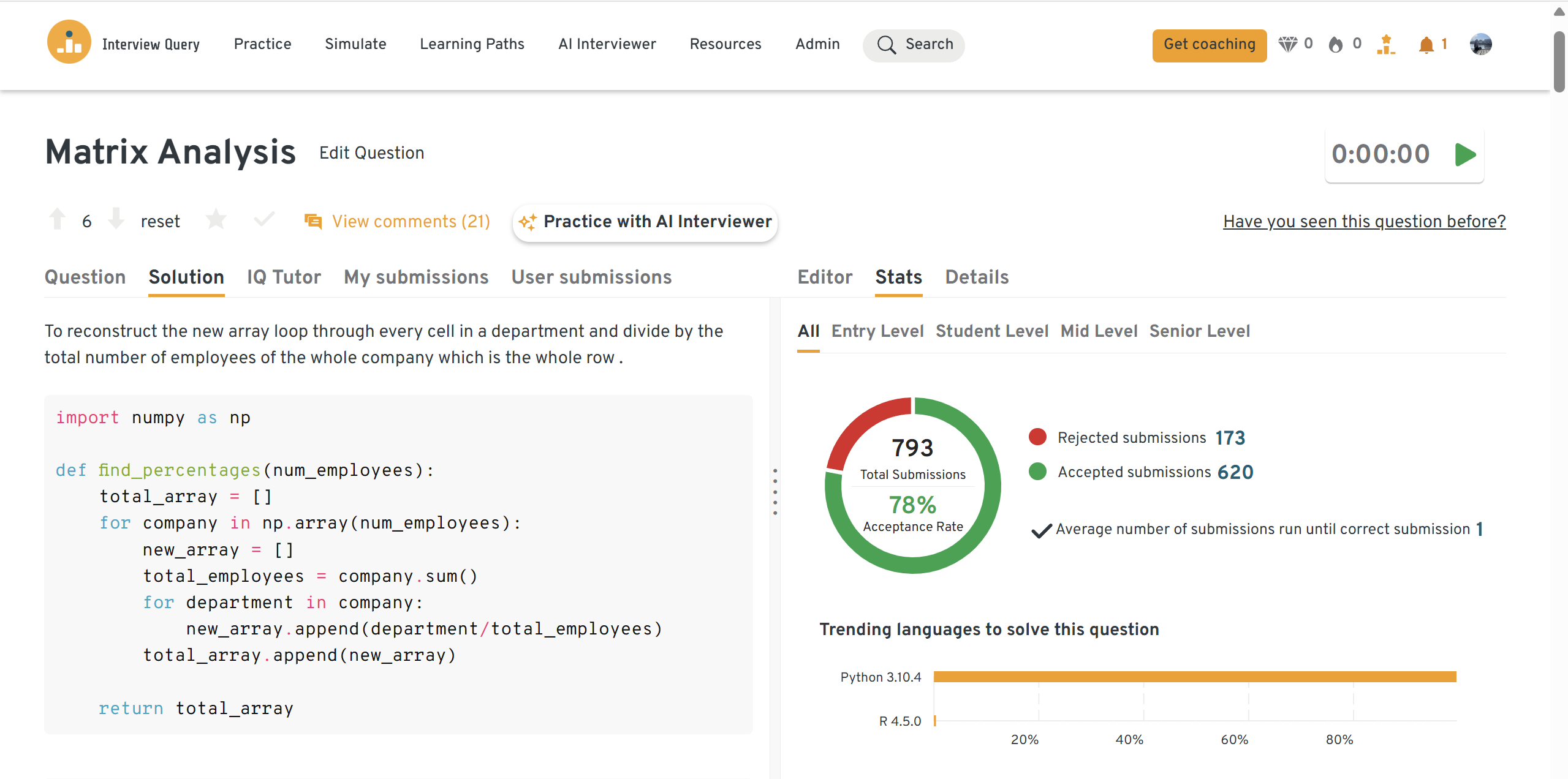
To solve this, you would loop through each company’s data, calculate the total number of employees, and divide each department’s count by that total. This gives a department-to-company ratio that represents workforce distribution. The interviewer is testing your understanding of iteration, aggregation, and precision in calculations. Accuracy and efficiency both matter, especially when scaling to large datasets.
Tip: As you walk through your code, narrate each step clearly. Meta looks for engineers who can think aloud and justify design choices without overcomplicating the logic.
You can practice this question on Interview Query, where you can test SQL, see accepted answers, and get AI-powered feedback on your performance.
2. How would you calculate a 3-day rolling average of user steps?
This question checks your ability to manage temporal data and edge cases. You can use window functions or self-joins to capture each user’s steps over the current day and the previous two days, then divide by three to find the average. Be prepared to handle missing records and explain how your approach maintains accuracy when users skip days. You should also discuss how to optimize your query for large datasets where millions of entries are processed daily.
Tip: Emphasize performance and scalability. Meta’s interviewers want to hear how you’d write efficient code that runs reliably across billions of daily logs.
3. Implementing the Fibonacci sequence: How would you code this using three different methods?
You’ll likely be asked to implement this recursively, iteratively, and using memoization. The recursive version is simplest but computationally expensive, while the iterative and memoized versions are more efficient and scalable. The interviewer wants to understand whether you can identify trade-offs in runtime and memory use. Your ability to explain which method you’d choose in a production environment shows strong analytical judgment.
Tip: Don’t just give the code. Walk the interviewer through why you’d use one method over another depending on system constraints or dataset size.
4. Radix addition: How would you add two numbers represented by linked lists?
To solve this, traverse both linked lists simultaneously, adding corresponding digits while carrying over any remainder. When one list ends, continue adding the remaining nodes from the longer list. If there’s still a carry at the end, create a new node for it. The goal is to test your understanding of linked list traversal and pointer manipulation, while ensuring accuracy and clarity in your logic.
Tip: Think about readability and maintainability. Meta prefers structured logic that other engineers can follow, not just clever shortcuts.
5. What is linear discriminant analysis (LDA) in machine learning, and how is it used in practice?
LDA is a supervised dimensionality reduction technique that projects data into a lower-dimensional space while maximizing class separation. You should describe its key assumptions, including linearity, normal distribution, and equal covariance among classes. Common applications include facial recognition, text classification, and feature extraction for supervised learning models. This question evaluates both your theoretical foundation and your ability to tie concepts to real-world applications.
Tip: Keep your answer grounded in examples. For instance, explain how LDA can reduce model complexity in high-dimensional datasets while preserving predictive accuracy.
6. Why does the k-means algorithm always converge?
To explain this, show that each iteration of k-means reduces the cost function, which is the sum of squared distances between points and their assigned cluster centers. Since the number of possible cluster assignments is finite, and the cost function never increases, the process must converge after a limited number of steps. The interviewer is checking whether you understand the mathematical reasoning behind algorithm stability, not just how to run it.
Tip: Describe convergence in intuitive terms. Talk about how the algorithm “settles” as cluster centers stop moving, which helps communicate your understanding clearly to both technical and non-technical audiences.
Research presentation and deep-dive questions
Your research presentation and deep-dive interviews evaluate how well you combine scientific rigor with practical impact. Meta wants to understand your depth of knowledge, originality, and ability to apply research to large-scale problems. These questions often explore your reasoning process and your ability to adapt when challenged by complex data or ambiguous outcomes.
Start by explaining how you would use simple statistical measures like z-scores, percentile thresholds, or interquartile ranges for univariate data. Then move into bivariate detection, where you’d consider the relationships between two variables, perhaps using multivariate Gaussian models or clustering-based methods such as DBSCAN or Isolation Forest. Discuss visualization techniques that help identify outliers intuitively. Meta’s interviewers want to see how you adapt your methods as data complexity increases.
Tip: Show that you understand evaluation. Explain how you would test your anomaly detection model’s precision and recall to ensure real-world reliability.
When the data does not follow a normal distribution, explain that you would switch to non-parametric tests like the Mann-Whitney U-test or use bootstrapping to resample the data and estimate confidence intervals. Discuss why these methods are robust and how they maintain accuracy without relying on distributional assumptions. You should also mention how you would validate results visually through histograms or cumulative distribution plots. Meta’s interviewers want to confirm that you can handle messy, real-world data appropriately.
Tip: Describe how you would communicate your findings to a stakeholder. For example, explain that instead of saying “the difference is statistically significant,” you would phrase it as “the test variant consistently outperforms the control across 95% of resampled scenarios.”
You can begin by performing exploratory data analysis to check for missing values, outliers, or seasonal effects. Then, discuss smoothing techniques like exponential moving averages or Kalman filters to reduce noise while preserving meaningful trends. Explain how you would benchmark your data against external references or historical patterns to validate consistency. Meta’s large-scale systems often rely on real-time signals, so the interviewer wants to see that you can balance statistical rigor with practical monitoring.
Tip: Highlight how you would automate validation. Mention building scripts or anomaly detection dashboards that flag data integrity issues before they affect model performance.
System and model design questions
System and model design questions test how well you can architect scalable, production-ready systems that operate at Meta’s level of complexity. You’ll need to demonstrate strong technical judgment, awareness of trade-offs, and a balance between innovation and practicality.
1. How would you design a relational database schema for a blogging platform?
Start by identifying the main entities, such as users, posts, comments, and tags. Explain how these tables relate to one another, using one-to-many relationships between users and posts, and many-to-many relationships between posts and tags. Then describe how you would handle indexing for performance and normalization to prevent redundancy. As you scale, consider sharding or partitioning strategies to maintain query efficiency as traffic grows.
Tip: Talk about design clarity before optimization. Meta values engineers who prioritize readability and reliability over premature complexity.
Foreign key constraints ensure referential integrity between related tables, guaranteeing that child records always point to valid parent entries. They help prevent orphaned data and make cascading updates predictable. While adding constraints can slightly increase write-time overhead, they maintain long-term data quality, which is crucial at Meta’s scale. You can also explain how these constraints simplify joins, improve debugging, and enhance consistency across distributed systems.
Tip: Provide a practical example. Describe how missing foreign keys could cause inaccurate user metrics or duplicate content in production dashboards.
3. How would you design a distributed authentication system using facial recognition?
Start by defining the system’s purpose: verifying users quickly, securely, and at scale. Explain how you would use pre-trained facial recognition models fine-tuned with Meta’s internal datasets, store encrypted facial embeddings in a secure database, and perform verification through edge computing to reduce latency. Then discuss non-functional requirements such as fault tolerance, regional replication, and compliance with privacy regulations. Meta wants to see that you understand both the technical and ethical implications of designing biometric systems.
Tip: Always mention fairness and bias. Explain how you would test and calibrate models to ensure consistent accuracy across diverse demographic groups.
Need 1:1 guidance on your interview strategy? Interview Query’s Coaching Program pairs you with mentors to refine your prep and build confidence. Explore coaching options →
Behavioral and collaboration questions
Behavioral and collaboration questions assess how you communicate, lead, and handle ambiguity in Meta’s fast-paced environment. The company looks for researchers who can work across teams, make clear decisions, and stay grounded in data while influencing outcomes.
1. How would you explain your research methods or insights to a non-technical audience?
To answer this effectively, focus on clarity and empathy. Start by understanding what the audience cares about, then adapt your language accordingly. Avoid technical jargon and use analogies or visuals to connect your explanation to familiar concepts. For instance, you can explain clustering models as “grouping similar behaviors” or reinforcement learning as “a process of trial and feedback.”
Sample Answer: In my previous project, I presented a recommendation model to a group of product managers who weren’t familiar with ML terms. Before the presentation, I spoke with a few of them to understand what metrics mattered most: user engagement and time spent. I structured my slides around those metrics and replaced equations with a visual story showing how the model learns user preferences, similar to how a playlist adapts to your taste over time. During the discussion, I used color-coded charts to show how recommendations improved session length by 12% after model deployment. The managers engaged actively, asked fewer clarification questions, and later adopted my visualization format for other projects. What made this successful was preparation and framing where I focused on what they needed to understand, not on what I wanted to explain.
Tip: Practice simplifying your answers until a non-technical listener could explain them back to you. That’s the level of clarity Meta expects.
This question evaluates emotional intelligence and adaptability. Choose a situation where expectations were misaligned or data insights contradicted stakeholder opinions. Walk through how you identified the issue, reframed your communication, and aligned the team on next steps. The goal is to show maturity in navigating tension without escalation.
Sample Answer: In one project, my analysis showed that a new product feature wasn’t improving engagement, but the product team believed it was. Instead of presenting numbers alone, I scheduled a short workshop where we visualized user journeys together. Seeing the drop-off points firsthand helped them realize the issue wasn’t my analysis, it was a UX problem. We collaborated to redesign the feature, and engagement improved by 12% in the next release.
Tip: Focus on how you turned friction into collaboration. Meta values researchers who can influence decisions through empathy and evidence, not authority.
3. Describe an analytics experiment you designed and how you measured success.
This question helps interviewers see how you connect research design to impact. Walk through your hypothesis, experimental setup, and measurement strategy. Be specific about metrics, control groups, and challenges you overcame. Finish by explaining what you learned and how it shaped future work.
Sample Answer: I led an experiment testing how algorithmic ranking affected user satisfaction. Our hypothesis was that introducing diversity in content would increase retention. I built treatment and control groups, then measured changes in session length and user feedback ratings. The results showed a 6% improvement in retention, but only for new users. We refined the feature for that segment and documented our findings for future tests.
Tip: Use data to tell a story of discovery. Meta interviewers want to see that you can design, analyze, and act on insights with a scientific mindset.
4. How do you prioritize multiple deadlines?
At Meta, you’ll often balance research depth with product deadlines. Explain how you prioritize using frameworks like impact versus effort, or urgency versus importance. Talk about communicating early when trade-offs arise and how you maintain transparency with your team.
Sample Answer: When I had to deliver two overlapping experiments, I assessed which one had a higher downstream impact. I created a quick timeline to visualize dependencies, then aligned with my manager and product partner on trade-offs. We agreed to delay the lower-impact task by one sprint. This allowed me to deliver the first experiment on time with stronger results, which in turn gave us credibility to revisit the second one later.
Tip: Show that you balance efficiency with quality. Meta values researchers who can manage their bandwidth strategically, not reactively.
5. Why do you want to work at Meta?
Interviewers ask this to assess alignment with Meta’s mission and curiosity about its research goals. Avoid generic statements about wanting to work at a “top tech company.” Instead, highlight specific research areas that excite you and connect them to your background.
Sample Answer: I’ve followed Meta’s open-source AI research for years, especially the Llama and Segment Anything projects. What excites me most is the balance between frontier science and real-world application. My PhD focused on multimodal learning, and I see clear parallels between my work and Meta’s vision for embodied AI. Joining the team would let me contribute to both technical progress and ethical innovation at a global scale.
Tip: Be genuine and specific. Interviewers can tell when you’ve done your homework on Meta’s research initiatives, and they’ll appreciate thoughtful connections to your own work.
How To Prepare For A Research Scientist Role At Meta
Preparing for the Meta Research Scientist interview means showing that you can think independently, communicate clearly, and connect innovation to scale. Beyond technical mastery, Meta looks for curiosity, collaboration, and a deep understanding of how research becomes real-world impact.
Refine your research narrative
Start by selecting one or two research projects that show your technical depth and creativity. Structure your story so that it highlights the problem, your approach, your findings, and why it mattered. Use this structure to guide how you present your work during the interview: clear and confident, not overly academic. Meta interviewers are interested in how you think and the impact of your work, not just your technical execution. Practice tailoring your story for different audiences, such as scientists, engineers, and non-technical stakeholders.
Tip: Rehearse your presentation out loud to peers from other fields. If they can follow your logic and summarize your contribution, you’re explaining it at the right level.
Strengthen your coding and experimentation mindset
You’ll be expected to code efficiently and experiment intelligently. Practice solving algorithmic problems in Python or C++ under time pressure while explaining your reasoning aloud. Go beyond correctness and talk through how you’d validate your approach with experiments. Meta engineers value candidates who write code that scales across billions of data points and understand how to debug distributed training jobs.
Example: When practicing, simulate a coding prompt like optimizing gradient accumulation for memory efficiency and explain how you’d test its stability across multiple GPUs.
Review Meta’s open research ecosystem
Meta encourages open science, which means you can study much of its work publicly. Explore publications from FAIR, Reality Labs, and the Responsible AI team to understand their priorities such as large-scale pretraining efficiency, cross-modal alignment, and responsible deployment. Referencing a recent Meta paper or dataset during your interview shows you’ve connected your research interests to their active projects.
Example: If your background is in reinforcement learning, you might reference Meta’s work on “Ego4D” and discuss how you’d extend it for real-world embodied reasoning.
Practice applied communication and decision framing
Great research at Meta doesn’t end with good results; it ends with adoption. Practice explaining not just what you found but what decision it enables. Use storytelling to make the “why” of your work come alive. Structure your explanation around trade-offs, metrics, and implications for users or the business.
Pro Tip: Create three versions of your project pitch: a 30-second elevator summary, a 3-minute overview, and a 10-minute deep dive. Adjusting your depth of detail shows awareness of your audience and builds credibility.
Simulate Meta’s full interview structure
Run mock sessions that mirror Meta’s process: a short recruiter screen, a technical coding challenge, a research presentation, and a behavioral round. Treat each as a rehearsal for pacing, structure, and communication. Reflect on your strengths and weak spots after each session and iterate just as you would with a research experiment.
Try this: Conduct one mock session entirely on camera to observe your tone, pacing, and engagement level. Then schedule a Mock Interview with expert feedback to refine your delivery.
Align your motivation with Meta’s research vision
Meta wants scientists who care about the intersection of technology and society. Reflect on how your research supports ethical AI, open collaboration, or scalable deployment. Talk about what excites you about building safe, inclusive, and efficient AI systems at Meta. Passion grounded in understanding often stands out more than credentials alone.
Pro Tip: Keep your “Why Meta?” answer specific and mention a Meta research area or product that aligns with your values or expertise.
Reflect on your motivation and fit
Meta’s research scientist interviews also explore why you want to work there. This is your chance to show that your ambitions align with Meta’s mission and values. Reflect on what draws you to their open science culture, large-scale impact, or AI research direction. Talk about how you see your work advancing Meta’s goal of building safe, inclusive, and groundbreaking AI systems. Authenticity and curiosity leave a stronger impression than memorized statements.
Tip: Prepare a short, genuine answer to “Why Meta?” that connects your personal motivation with their research focus. Passion backed by understanding always stands out.
Average Meta (Facebook) Research Scientist Salary
As of this year, research scientists at Meta earn some of the most competitive compensation packages in the AI and data research industry. Salaries vary by level, experience, and location, but total annual pay typically ranges between $300K and $580K. The national median compensation for Meta research scientists is around $312K per year, according to Levels.fyi.
- IC4 (Mid-level): $300K per year ($160K base + $120K stock + $20K bonus)
- IC5 (Senior): $360K per year ($200K base + $130K stock + $25K bonus)
- IC6 (Staff): $580K per year ($220K base + $310K stock + $50K bonus)
In New York City, research scientists typically earn around $312K annually at the IC5 level, while senior researchers (IC6 and above) can exceed $550K with stock making up a large share of total compensation. Meta’s pay structure emphasizes long-term growth, with equity grants vesting over several years (Levels.fyi).
Average Base Salary
Average Total Compensation
Tip: When negotiating, emphasize the unique value of your research expertise and publication record. Meta is known to match or exceed competing offers for top-tier AI and ML talent, especially for those with strong open-source or academic impact.
FAQs
How many rounds are in the Meta research scientist interview process?
The interview process typically includes five to seven rounds over four to six weeks. It begins with a recruiter screen, followed by a coding interview, a research presentation, and a series of technical and behavioral discussions during the virtual or on-site loop.
What skills does Meta emphasize for research scientists?
Meta values a mix of strong programming skills (Python, C++, PyTorch, TensorFlow), statistical and experimental design knowledge, and experience with large-scale data. Strong candidates also demonstrate collaboration, originality, and the ability to translate research into deployable outcomes.
What is the difference between Meta research scientist and research engineer?
Research scientists focus on conceptual breakthroughs and experimentation, while research engineers concentrate on deployment, scalability, and system optimization. Scientists build the theory; engineers make it production-ready.
What are the most challenging aspects of the Meta research scientist interview?
Balancing theoretical depth with applied reasoning is often the hardest part during an research scientist interview. It’s designed to push you beyond just research depth and see how you think in real-world, product-driven contexts. You’ll get open-ended questions that test how you structure problems, reason through ambiguity, and communicate complex ideas clearly. It can feel tough because you’re expected to switch between being a scientist, an engineer, and a collaborator. But if you approach it as a chance to showcase how you think, not just what you know, it’s actually a really rewarding process. Meta values curiosity, clarity, and impact-driven thinking, so if you focus on those, you’ll do well.
Does Meta hire research scientists without a PhD?
Yes. While many hires hold PhDs, candidates with strong publication records, industry research experience, or equivalent technical achievements are also considered.
Can research scientists at Meta publish papers?
Yes. Meta supports open research and encourages publication when it aligns with privacy and product security policies. Many teams publish in top-tier AI and ML conferences.
Does Meta offer remote or hybrid work options for research scientists?
Yes. Many research scientists work in hybrid or flexible setups, depending on the team. FAIR and Reality Labs have hubs in Menlo Park, New York, London, and Zurich, with remote collaboration common across teams.
How much does a research scientist make at Meta?
According to Levels.fyi, total annual compensation typically ranges between $300K and $580K depending on level and experience.
How can I align my profile with Meta’s research mission?
Show curiosity, openness, and a focus on scalable impact. Meta values researchers who combine technical excellence with a desire to advance responsible, inclusive, and open AI innovation.
Take Your Interview Prep to the Next Level
The Meta research scientist interview is one of the most challenging yet rewarding in the industry. Success depends on showing how your research can scale to billions of users and shape the future of intelligent systems. Focus your preparation on mastering Meta’s interview structure, refining your research presentation, and strengthening your ability to translate theory into practical impact.
Take the next step in your preparation with targeted practice. Explore the machine learning path to build a structured foundation, join a mock interview session for real feedback, or read Meta interview success stories to learn proven strategies from top candidates. Every session brings you closer to thinking like a Meta researcher—curious, precise, and ready to turn innovation into global impact.
Meta Interview Questions
| Question | Topic | Difficulty |
|---|---|---|
Brainteasers | Medium | |
When an interviewer asks a question along the lines of:
How would you respond? | ||
Statistics | Easy | |
Machine Learning | Easy | |
SQL | Easy | |
Machine Learning | Medium | |
Statistics | Medium | |
SQL | Hard | |
Machine Learning | Medium | |
Python | Easy | |
Deep Learning | Hard | |
SQL | Medium | |
Statistics | Easy | |
Machine Learning | Hard |
Discussion & Interview Experiences