
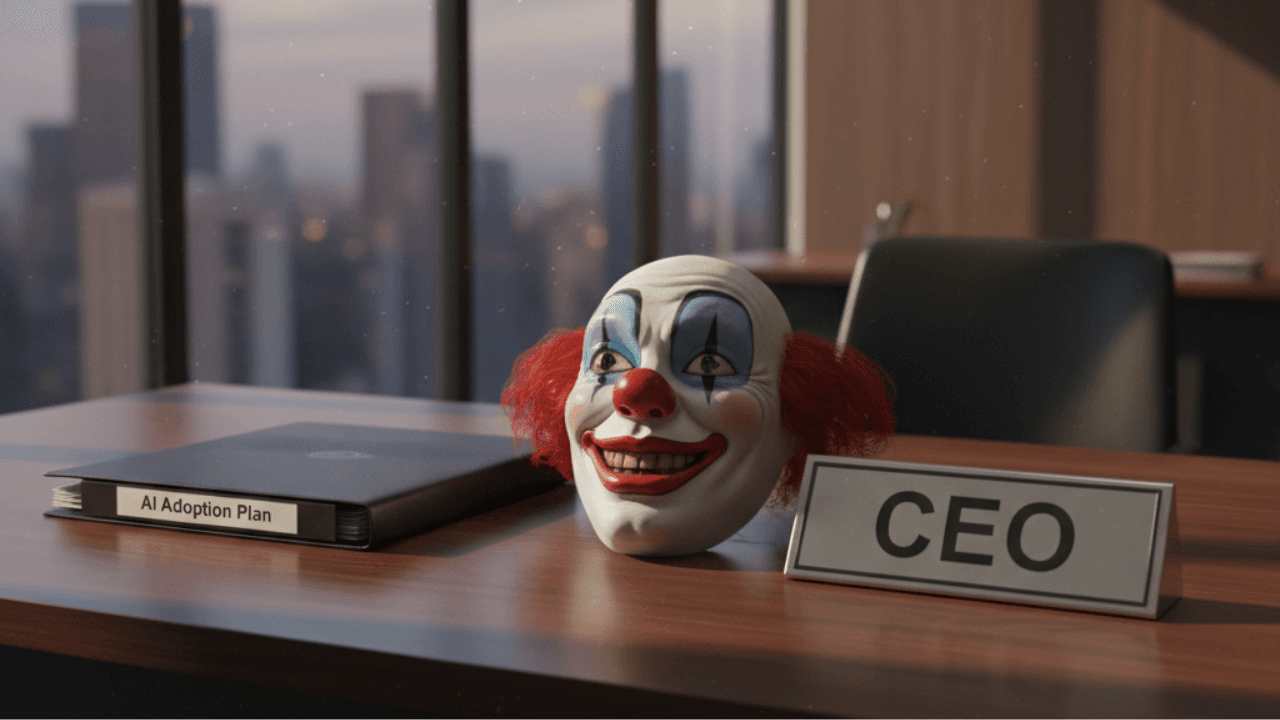
Your Boss Is Faking Their Way Through AI Adoption


The Great Divide in AI Leadership
Every other week, another company brags about “transforming with AI.” But dig deeper, and you’ll find a lot of executives don’t even believe their own pitch. New research shows a massive gap between the promises companies make about artificial intelligence and the reality of its business value.
The Adaptavist Group’s latest Digital Etiquette: Unlocking the AI Gates report surveyed 900 professionals across the U.S., U.K., Canada, and Germany who are responsible for rolling out AI in their organizations. The results underscore the fact that not all AI benefits are made equal.
Some companies fail to transform with the help of AI because of a leadership problem: 42% of respondents admit their companies’ AI claims are exaggerated, while only 36% think their adoption is realistic.
These findings mean that most of the hype isn’t coming from the technology itself. It’s coming from the people at the top.
Leaders Who Hype vs. Leaders Who Build

The report calls this split the “AI fault line.” On one side are the skeptics: leaders who feel pressured to jump on the AI bandwagon, despite having little formal training or support. Unsurprisingly, this group is the most nervous about the consequences of their own decisions.
- 84% of skeptics admit they’re only adopting AI because of pressure, not strategy.
- 65% believe their company’s approach to AI could actually harm customers financially, psychologically, or even physically.
- They’re 3.5x more likely to fear mass job losses and 2x more likely to worry about plagiarism in AI outputs.
On the other hand, the realistic leaders (36%) don’t see their AI programs as exaggerated.
Why? Because they’ve had proper training, actual support, and freedom to experiment. Only 9% of this group report serious concerns about AI, and they’re far more confident about using it to add value rather than just make headlines.
Beyond exposing the gap between realistic and pressure-driven adoption, these leadership and culture differences help shape the outcomes and business value of AI adoption.
Culture Makes or Breaks AI
The divide isn’t just philosophical, as it directly shapes whether AI adds value or becomes another overhyped expense.
Skeptic leaders, under pressure to show quick results, are more likely to roll out half-baked AI projects that burn money and frustrate employees. They tie AI to performance targets but then admit the returns are weak: lower work quality, fewer time savings, and disappointing productivity gains.
Realist leaders, meanwhile, get better results not because they spend more, but because they create cultures where experimentation is allowed and employees are trained to use the tools properly.
The Adaptavist report’s blunt takeaway: big AI promises without cultural buy-in don’t add value. They create waste.
Business leaders must hence recognize the importance of creating a healthier, more realistic culture where actual gains can be unlocked.
Money Doesn't Buy AI Success
One surprising finding from the report is that skeptics and realists alike are spending similar amounts on AI, anywhere from £1 million to £10 million (~$1.3M to $13.4M) annually. The difference isn’t the budget. It’s what leaders do with it.
Companies that simply throw money at AI under pressure end up with wasted projects and disillusioned teams. It is in investing in training, strategy, and experimentation that businesses can actually capture long-term value.

Leaders must also acknowledge the costs of doing it wrong. CNBC recently reported that AI-generated “workslop”—low-quality, auto-generated content—is already costing companies an estimated $9 million in productivity losses every year.
So what can leaders do now to fully harness the potential and benefits of AI?
What Leaders Need to Hear
AI isn’t a magic wand, and employees know when leadership is bluffing. If leaders want real results, they need to stop treating AI like a box to check. Pressure-driven adoption backfires, and can cost companies financial and productivity losses in the long run.
Training and experimentation also remain valuable. Workers need support in developing their skills with the help of AI, not mere hype.
Lastly, companies must consider the human side of AI, which can affect customers, employees, and their overall reputation.

The companies that win with AI won’t be the ones making the loudest claims. They’ll be the ones whose leaders take the time to understand what the technology can and can’t do.
The pressure to adopt AI at all costs creates adverse consequences in the job market, too. Even as leaders trumpet gains in efficiency or “transformation,” many staffers are being laid off, replaced by cheaper software, or relegated to oversight roles that demand less creativity and more surveillance.
This video, “Why AI is ruining the job market,” picks up where our article leaves off by giving you frontline stories, data, and video evidence of how overhyped AI adoption is already hollowing out careers: