

Stanford study finds that AI has already started wiping out new grad jobs


AI Is Not Killing All Jobs, Just Entry-Level Ones
A new study from Stanford economists just confirmed what every anxious new grad already suspects: AI is not replacing all jobs. It is replacing yours.
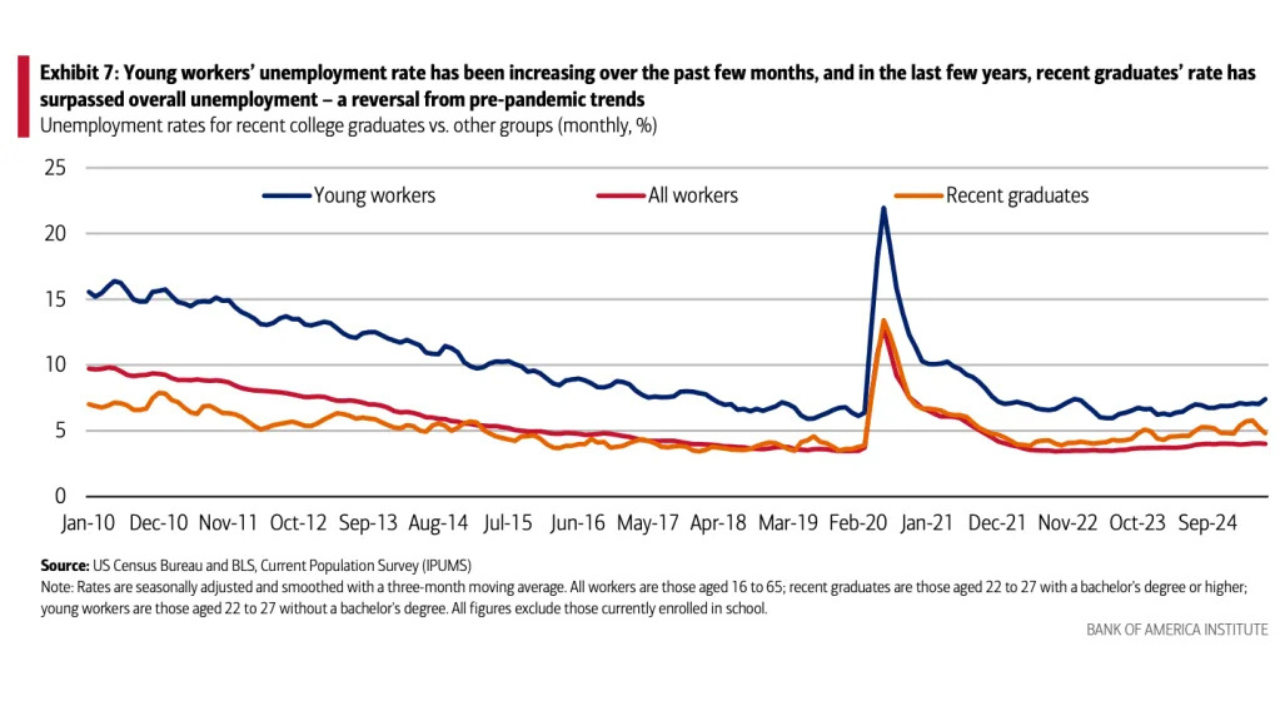
In the first large-scale analysis of real payroll data since ChatGPT went viral, researchers at Stanford and the NBER found that entry-level workers in AI-exposed jobs have seen a 13% drop in employment since late 2022. The kicker? Everyone else is doing fine.

The Jobs Are Still There, Just Not for You
Erik Brynjolfsson, Bharat Chandar, and Ruyu Chen analyzed millions of payroll records from ADP, the largest payroll processor in the U.S. What they found was clear. Jobs in fields like software engineering and customer service are still growing, but not for people aged 22 to 25.
Older workers in the same jobs? Their employment is up by 6 to 9 percent. The same goes for younger workers in fields less impacted by AI, like healthcare. The drop is laser-focused on junior workers in AI-exposed roles.
It is not because the whole economy is slowing down. In fact, employment overall is still rising. It is just rising for everyone except the youngest workers in jobs that generative AI tools like ChatGPT and Claude are now good at.
“AI is not killing jobs,” the data says. “It is killing entry-level jobs.”
Not All AI Exposure Is Equal
The researchers did not stop at job titles. They used real usage data from Anthropic’s Claude chatbot to figure out whether AI was being used to automate work or augment it. The distinction matters.
If AI is helping humans do their job better, jobs are still growing. But in occupations where AI is being used to replace human tasks, like writing boilerplate code or answering support tickets, the job losses are sharpest. Especially for people who just got hired.
This is not hypothetical. Claude and ChatGPT are already being used to automate tasks that used to go to junior developers or entry-level agents. And now, those tasks and those workers are disappearing.
Why Are Young Workers Getting Hit First?
The study offers one possible reason. AI is good at replacing codified knowledge, the textbook stuff you learn in school. It is bad at replacing tacit knowledge, the practical wisdom you build over time.
Young workers are heavy on the book-learning and light on the on-the-job experience. So when AI comes for tasks like writing a simple Python script or answering a customer FAQ, it is not replacing the senior engineer. It is replacing the new hire.
“The AI does not need to intern,” said one recruiter. “It already knows what you just learned in school.”
It Is Not About Wages, It Is About Headcount
Interestingly, wages have not dropped. Compensation across exposed and non-exposed jobs has stayed mostly flat. That is because companies are not slashing salaries. They are simply not hiring in the first place.
This creates a chilling long-term effect. Fewer people get in the door, fewer people build experience, and fewer people move up the ladder.
For one, the video above explains how the increasing adoption of AI is transforming the market for entry-level tech jobs. New grads and career switchers are increasingly finding it more difficult to break into tech and grow professionally as they are required to already have sophisticated AI skills, such as leveraging tools like ChatGPT.
But if you are wondering whether it is just a tech industry thing, it is not. The study excluded tech firms and remote-first jobs just to be safe. The same trend held. It is not about layoffs. It is about a fundamental change in who gets hired.
What This Means for the Future of Work
If this trend continues, we could be looking at a world where companies are staffed by a shrinking pool of experienced workers and armies of AI agents. But no juniors. No pipeline. No training ground for future leaders.
It is the corporate equivalent of skipping leg day. Sure, you can bench more now, but you are not building long-term strength.
Some tech leaders, like AWS CEO Matt Garman, have already pushed back on this logic. In a recent interview, Garman called replacing junior workers with AI “the dumbest thing I have ever heard,” arguing that companies need to invest in young talent, not outsource their future to chatbots.
But for now, the numbers do not lie. The AI revolution may be making older workers more productive. But for the class of 2024, it is already taking their jobs.