

Target Data Scientist Interview Guide: Process, Questions & Preparation Tips (2025)


Introduction: Target data scientist role overview
Preparing for a Target data scientist interview means stepping into one of the most analytics-driven retail environments in the U.S. Target has invested heavily in advanced data science, powering everything from demand forecasting and inventory optimization to personalization and pricing. According to recent company reports, Target’s data and analytics division has grown by over 30% since 2022, with teams driving billions in operational efficiencies across digital and in-store channels.
The company’s current strategy highlights the growing role of generative AI in trend prediction, supply-chain visibility, and merchandising automation, ultimately positioning Target as a leader among retailers leveraging AI at scale.
In this guide, you’ll learn exactly what the data scientist role involves, how the Target data scientist interview process works, and the types of SQL, machine learning, analytics, and behavioral questions you should expect. You’ll also get tailored preparation tips from industry experts, and insights into Target’s culture, so you can walk into every interview round confident and ready.
What does a Target data scientist do?
Target data scientists sit at the intersection of retail, supply chain, and digital innovation. You work with massive datasets, build applied machine learning systems, and collaborate across engineering, product, and operations teams to improve how millions of guests shop every day. The work is hands-on, analytical, and deeply tied to business impact.
You’ll typically spend your time:
- Building forecasting models to support inventory planning, store staffing, and seasonal demand across thousands of SKUs and 2,000+ stores.
- Designing optimization algorithms that improve digital fulfillment routing, last-mile efficiency, and in-store operations.
- Developing NLP and LLM-driven models for Target’s search, browse, recommendations, and personalization systems.
- Exploring messy retail and supply chain data, using SQL, Python, and distributed tools to build pipelines and run experiments.
- Partnering with engineers, PMs, UX, and operational leaders to translate insights into scalable solutions across supply chain, merchandising, fulfillment, and digital product teams.
Across teams like stores & properties, digital fulfillment, and search & browse, you’ll tackle problems that mirror real supply-chain case studies such as forecasting demand, optimizing routing, and reducing out-of-stock risk, making Target an ideal environment for data scientists who want to apply machine learning at true retail scale.
Why this role at Target?
Target operates more than 2,000 stores, a massive national supply chain, and a rapidly evolving digital business, making it one of the few retailers where data science meaningfully shapes both physical and online experiences. Data scientists influence everything from inventory accuracy and price optimization to personalization, AI-powered search results, fulfillment efficiency, and how quickly items arrive at guests’ doors.
Beyond the technical challenge, Target emphasizes a people-first culture built around “care, grow, win together”. Teams value collaboration, clear communication, and solutions that scale responsibly across the enterprise. With strong investment in machine learning talent and a shared focus on customer impact, Target gives data scientists real ownership and the room to build high-leverage systems at retail scale.
What Is Target’s Data Scientist Interview Process?
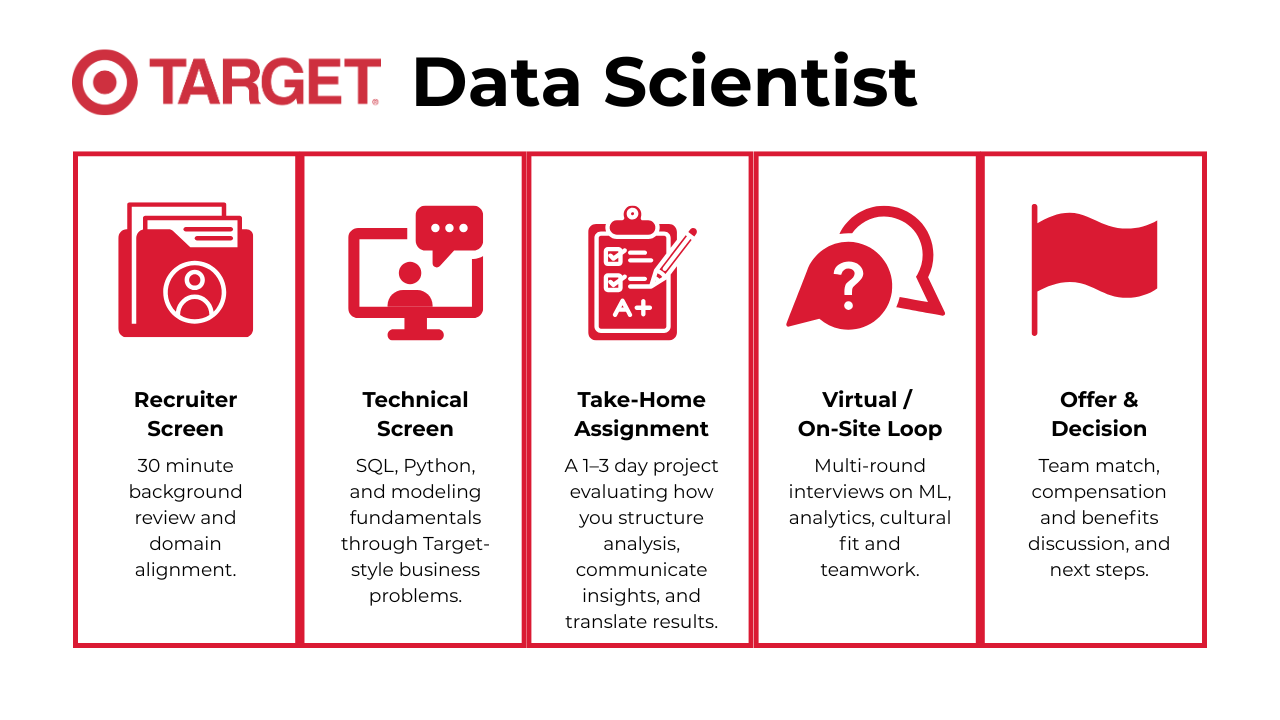
Target’s data scientist interview process is designed to evaluate how well you can apply analytics and machine learning to real retail challenges at scale across forecasting, supply chain, merchandising, and digital experiences for the benefit of its 2,000+ stores. The timeline hiring process emphasizes three pillars: technical depth, business impact, and alignment with Target’s “care, grow, win together” culture. Across teams like Digital Fulfillment, Stores & Properties, and Search & Browse NLP, you’ll encounter a structured set of interview steps that simulate the analytical problems Target solves at enterprise scale. The full process typically spans two to five weeks, depending on team and role level, and includes the following stages:
1. Recruiter Call
Your first conversation with a Target recruiter focuses on domain alignment and role expectations. Recruiters will confirm your preferred focus area (e.g., Forecasting, Search & Browse, Supply Chain Optimization, or Pricing Analytics) and gauge your familiarity with Target’s retail data ecosystem.
Expect broad-fit questions about your analytics background, experience in production ML, and how you’ve applied data science in operational settings. They may also ask about your preferred modeling domains and whether you lean toward experimentation, predictive modeling, or causal inference.
Tip: Bring one Target-relevant example such as a forecasting project, optimization case, or NLP workflow to signal early alignment with their teams. For hands-on prep, browse Interview Query’s Target data scientist practice questions to learn how candidates are tested on SQL, ML, and retail analytics.
2. Technical Screen
The technical interview dives deeper into your analytical and programming fundamentals. It often includes:
- SQL and Python challenges, testing your ability to analyze large datasets and write efficient, production-ready queries.
- Modeling and problem-solving questions relevant to Target’s ecosystem such as forecasting promotional demand, optimizing last-mile routing, or segmenting customers for personalization.
- Applied reasoning discussions, where interviewers evaluate your thought process and trade-offs rather than pure theoretical recall.
For example, you might be asked to walk through how you’d design a model to improve in-stock rates during seasonal events, or how you’d evaluate bias in a product recommendation system.
Tip: Emphasize clarity and operational thinking. Target values pragmatic approaches and explainable outcomes more than academic model complexity so practice explaining why you chose an approach. For example, if you used a random forest model for demand forecasting, explain how it balanced accuracy with interpretability for store-level decisions. Target values this kind of practical reasoning and operational fit over theoretical depth alone. Check out our ultimate SQL cheat sheet to ace your next technical interview →
Take-Home Challenge or Case Study
While the exact format varies across Target’s data science teams, most candidates complete a one- to three-day take-home project designed to mirror real business problems. The goal is to evaluate how you structure an analysis, communicate trade-offs, and translate insights into action.
Common challenge types include:
- Forecasting and Supply Chain Teams: A time-series modeling task predicting demand spikes or in-stock rates across stores.
- Search & Browse or Digital Experience Teams: An analytics case involving user engagement, A/B testing results, or personalization metrics.
- Pricing and Merchandising Teams: An optimization scenario requiring you to balance revenue, margin, and customer impact.
Deliverables typically include a short report or Jupyter notebook summarizing your approach, key assumptions, model results, and next steps. Interviewers expect clarity, interpretability, and business framing — not production-level code.
Tip: Treat this as a consulting-style deliverable. Write a concise executive summary and include visualizations that make your insights actionable for a non-technical stakeholder.
Want feedback on your take-home? Upload your project and get expert insights with Interview Query’s Take-Home Assessment Tool ->
4. Final Onsite (Virtual or In-Person)
The onsite loop usually includes four to six interviews covering:
- Advanced SQL and Python
- Applied machine learning or statistical modeling
- Product and experimentation analytics
- Past project deep dives
- Behavioral and culture-fit interviews
Each round ties back to Target’s operational priorities such as improving forecast accuracy, reducing supply-chain waste, or enhancing the personalization of digital experiences. Interviewers look for a balance between technical expertise and retail domain intuition.
Tip: When discussing past projects, connect measurable outcomes to operational or guest-impact metrics. For instance, describe how your model improved in-stock accuracy during promotions or helped optimize fulfillment routing across regions. Target’s interviewers prioritize results that show business scalability, collaboration across merchandising and tech teams, and clear guest experience impact.
Hiring decision & offer
After the onsite, Target calibrates across interviewers to evaluate your technical strength, communication, cultural alignment, and potential team match. Candidates who demonstrate both strong modeling skills and clear operational thinking tend to rise to the top. If selected, you’ll receive a verbal offer followed by written compensation details, typically including base salary, bonus eligibility, and Target’s strong benefits package.
Tip: Ask which team you’re being placed on as work varies significantly between Forecasting, Digital Fulfillment, and Search & Browse, and clarity helps you negotiate effectively.
If you’d like structured, one-on-one guidance on your interview strategy, Interview Query’s Coaching Program can help you refine your stories, sharpen your technical answers, and prepare confidently for Target’s onsite loop.
Challenge
Check your skills...
How prepared are you for working as a Data Scientist at Target?
What Questions Are Asked in a Target Data Scientist Interview?
Target’s data scientist interview is designed to assess how well you can work with large, complex retail datasets and translate your insights into decisions that improve guest experience, store operations, and digital performance. Instead of purely theoretical questions, Target focuses on practical SQL, Python, and modeling challenges that resemble the forecasting, supply-chain, search relevance, and experimentation problems their teams solve every day.
You’ll see a mix of coding and SQL tasks, applied machine learning questions, analytics, and A/B testing scenarios, retail-focused business cases, and behavioral questions aligned with Target’s values of Care, Grow, Win Together. Each question type reveals how you reason through ambiguity, communicate trade-offs, and build solutions that scale across a 2,000-store network.
The sections below break down the most common categories of Target data scientist interview questions, with examples to help you understand what to expect and how to prepare.
SQL & coding interview questions
Target’s SQL and Python interviews focus on how well you clean, transform, and analyze large retail datasets. Expect multi-table joins, customer or transaction-level analysis, and lightweight Python exercises that mirror real work in forecasting, fulfillment, and digital analytics. Interviewers want to see clear reasoning, efficient logic, and awareness of how your query or code supports a business decision (like reducing out-of-stock events or understanding customer behavior). Below are five Target-relevant SQL & coding interview questions you can practice on Interview Query:
1. How would you calculate the average order value by gender?
Calculating average order value (AOV) tests your understanding of aggregation, joins, and data grain. You’ll need to join the transactions and customers tables on customer_id, group by gender, and compute SUM(order_amount) / COUNT(DISTINCT order_id) or use AVG(order_amount) if data is already at the order level. A strong answer explains how you validate the calculation by confirming the correct grain before aggregation.
Tip: Always check whether the dataset is at the order or line-item level as this is one of the most common causes of inflated AOV in retail analytics.
2. How would you identify customers with more than three transactions in both 2019 and 2020?
This question assesses your ability to apply conditional aggregation and handle multi-year comparisons efficiently. Group transactions by user and use conditional counts like SUM(CASE WHEN year=2019 THEN 1 END) and SUM(CASE WHEN year=2020 THEN 1 END) to isolate customers exceeding three purchases in both years. It evaluates your logic in filtering and combining results accurately within one query.
Tip: Clarify your grouping key (user_id) and ensure consistent date extraction. Small logic errors often lead to off-by-one issues.
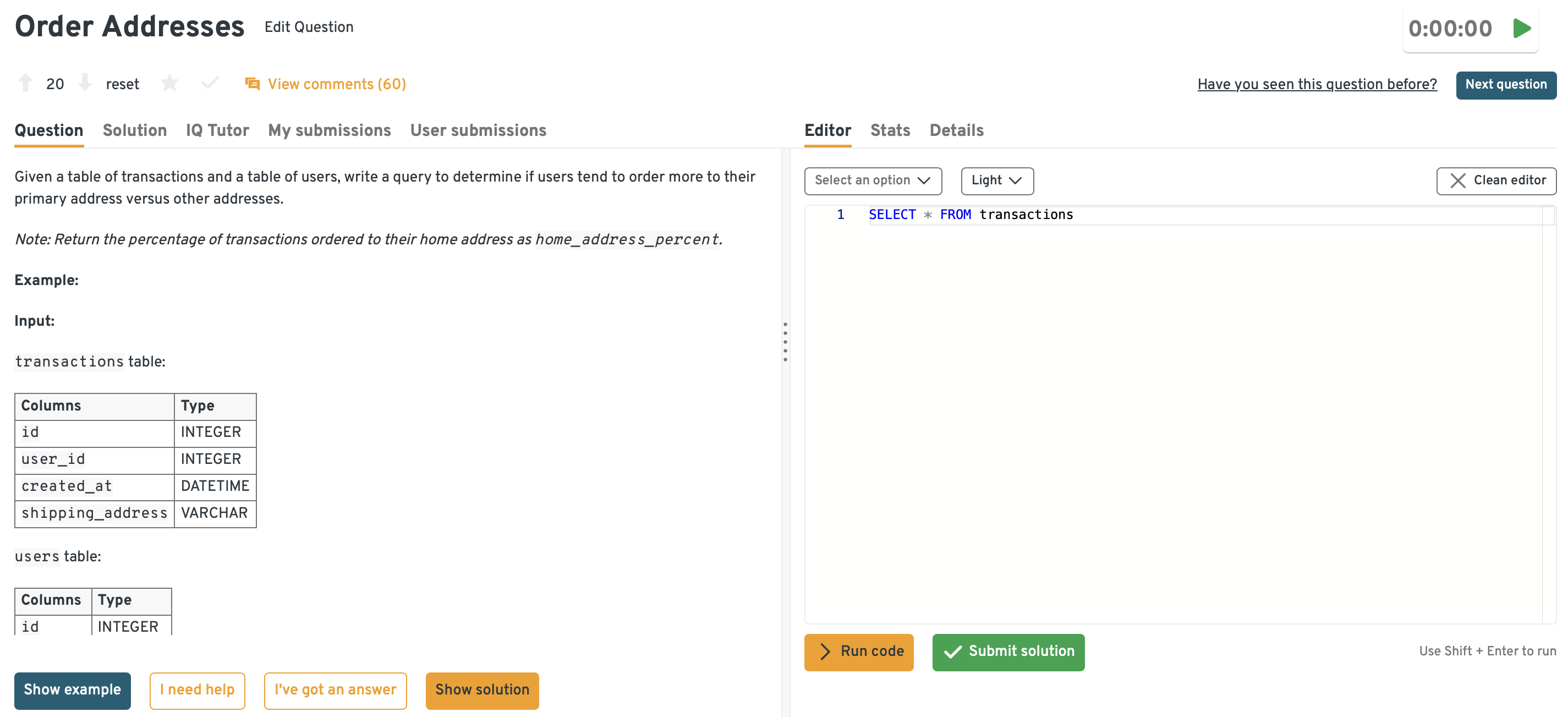
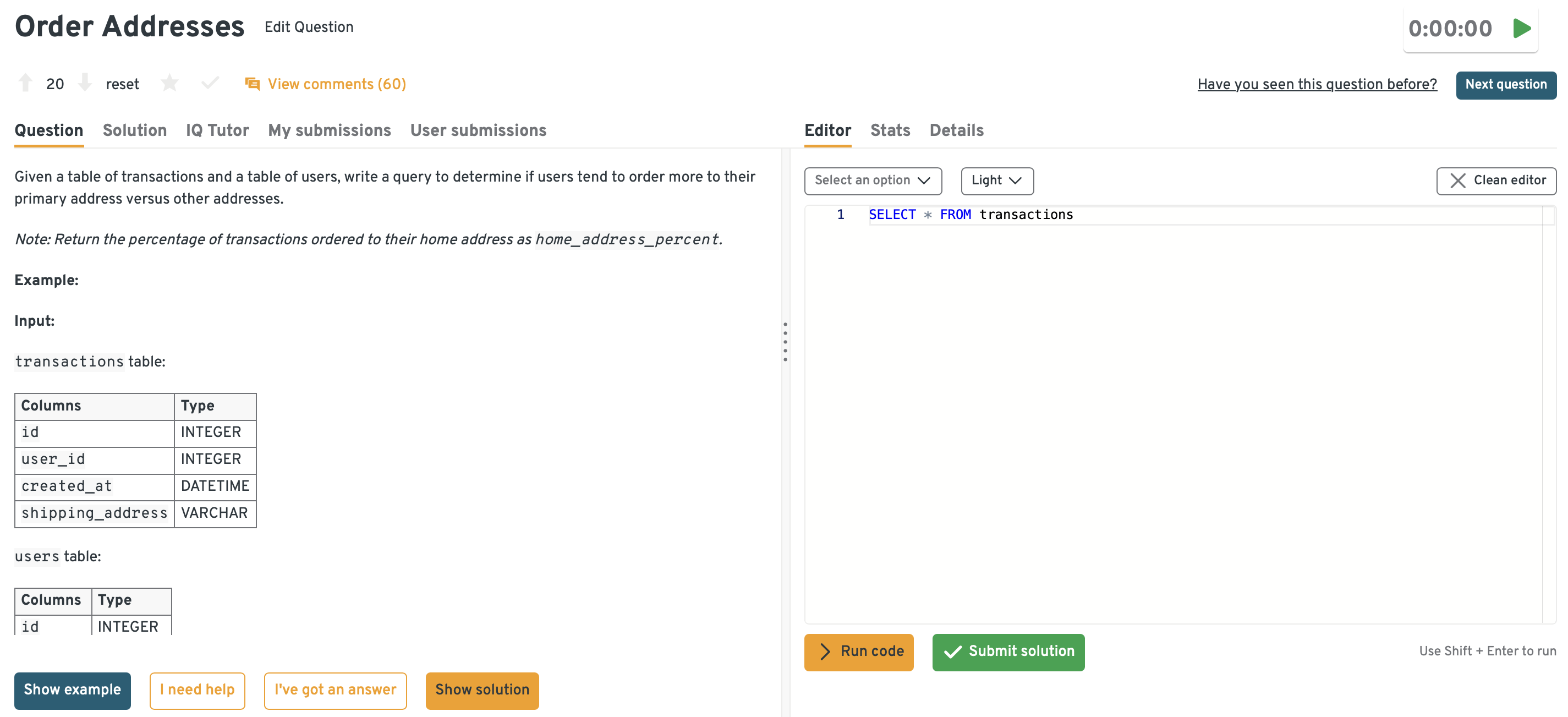
3. How would you determine if users order more from their primary address versus other addresses?
This question checks your ability to join categorical attributes and compare group-level metrics. Join the users and transactions tables, flag addresses as primary or secondary, and aggregate orders or revenue by address_type. Then compare per-user or per-address results to identify behavioral differences.
Tip: Normalize or standardize address strings before grouping because small inconsistencies (e.g., case sensitivity or trailing spaces) can significantly affect counts.
4. How would you return transactions over $100 with total value as a new column?
This question evaluates whether you can compute and filter based on derived metrics. In SQL or pandas, group by order_idto calculate total spend, filter totals greater than $100, and merge back to retain item-level details if needed. Walk interviewers through your logic and mention data validation steps.
Tip: Always verify numeric data types because prices stored as strings are a frequent source of silent calculation errors.
5. How would you find the user with the highest average number of unique item categories per order?
This question tests your ability to perform multi-level aggregation and distinct counting. Start by grouping each order to count unique categories, then group by user to average those values, and finally select the user with the highest result. It demonstrates your understanding of both aggregation hierarchy and efficient query structure.
Tip: Use CTEs or window functions for readability—structured logic communicates mastery better than overly compact syntax.
Practice these SQL and Python challenges with real retail datasets to refine both your reasoning and coding efficiency.
Machine Learning & Modeling Interview Questions
Target’s machine learning interviews focus on how you apply models to real-world retail problems like forecasting demand, ranking products in search, or improving personalization. Expect practical, scenario-based questions that test your modeling intuition, technical depth, and ability to connect models to business outcomes.
1. How would you avoid overfitting in a machine learning model?
Avoiding overfitting demonstrates whether you understand how to balance model complexity and generalization. A strong answer covers techniques like regularization (L1/L2), cross-validation, early stopping, and collecting more representative data. For Target’s large, seasonal datasets, you might highlight steps like preventing a forecasting model from memorizing one store’s unique sales pattern.
Tip: Connect your explanation to a real Target scenario—like avoiding overfitting to holiday spikes or outlier stores—to show applied understanding.
2. How would you forecast Target’s revenue for the next year?
Forecasting revenue tests your ability to design an end-to-end modeling workflow. You’ll discuss exploring historical revenue trends, identifying seasonality, and engineering features like promotions or holidays. Start with a baseline time-series model (ARIMA, Prophet) and progress to ML models like XGBoost or LSTMs. Emphasize validation across time windows and performance metrics like MAPE or RMSE.
Tip: Mention how you’d handle promotion-heavy or anomalous periods—Target interviewers value awareness of retail-specific challenges.
3. How would you build a demand forecasting model for seasonal items?
This question evaluates your ability to integrate domain context into feature engineering and model selection. Outline how you’d identify seasonality, generate lag and rolling features, include store-level attributes, and compare SARIMA, Prophet, and tree-based approaches. Discuss trade-offs in accuracy versus scalability across Target’s thousands of stores.
Tip: Call out the need to forecast at the SKU-store level as this awareness of scale and granularity shows real-world readiness.
4. How would you evaluate an LLM-based search ranking model?
Evaluating ranking models checks your understanding of both offline and online validation. You should reference metrics like NDCG, precision@k, and MRR, along with A/B testing for real-world impact. Include methods to monitor model drift and performance on long-tail queries over time.
Tip: Mention human-in-the-loop evaluation for ambiguous or rare search terms. Target teams increasingly rely on hybrid quantitative–qualitative evaluation.
5. How would you compare gradient boosting models to neural networks for a recommendation system?
This question tests your ability to reason through trade-offs between model families. Explain that gradient boosting models (like XGBoost) are interpretable and strong for tabular behavior data, while neural networks excel when integrating embeddings from text, images, or sequences. Tie your answer back to inference latency, interpretability, and compute cost at Target’s production scale.
Tip: End by summarizing your model choice based on data richness and business constraints. This demonstrates judgment, not just technical knowledge.
Explore similar end-to-end modeling problems and case studies to strengthen your applied modeling skills.
Analytics, experimentation & metrics questions
Analytics and experimentation play a critical role at Target, where even small improvements can impact millions of guests. These questions evaluate how you design A/B tests, define KPIs, reason about causal inference, and interpret noisy, uneven retail data. You’ll be expected to connect metrics to business decisions and explain how you validate impact across Target’s omnichannel ecosystem.
1. How would you evaluate an A/B test that offered free shipping at checkout?
This question assesses your understanding of experimental design, metric selection, and impact interpretation. You’ll start by verifying randomization, ensuring sample balance, and defining primary metrics like conversion rate, average order value (AOV), and fulfillment cost. Then, analyze lift using confidence intervals or Bayesian methods while monitoring for negative side effects, such as increased return rates.
Tip: Frame your answer around both guest experience and cost efficiency; Target values analysts who can quantify trade-offs, not just statistical significance.
2. What metrics would you define to measure improvements in search relevance?
Defining search metrics tests your ability to connect user behavior to business value. Combine engagement metrics (click-through rate, add-to-cart rate, and query reformulations) with relevance measures like NDCG or precision@k. A well-rounded answer explains how these metrics capture both user satisfaction and search efficiency.
Tip: Tie your metrics back to guest friction. For example, “fewer query reformulations” signals customers are finding what they want faster.
3. How would you analyze test results with uneven sample sizes across stores?
Analyzing unbalanced tests evaluates your ability to reason about weighting and variance. You might use stratified analysis, weighted averages, or hierarchical models to ensure fair comparisons across stores. Discuss how you’d normalize by store traffic or apply mixed-effects models to control for variability in region or store size.
Tip: Always mention checking for store-level confounders like fulfillment mode or regional bias as this shows mature analytical thinking.
4. Given a dataset, how would you identify where revenue loss is occurring?
This question measures your problem-structuring and diagnostic analysis skills. You’d segment revenue by dimensions like product category, channel, or region, identify deviations from baselines, and investigate potential causes—such as out-of-stocks, pricing errors, or operational inefficiencies. Use visualizations and correlation analysis to communicate findings effectively.
Tip: In retail, always test for inventory-related issues first; stockouts are one of the most common hidden drivers of revenue loss.
5. How would you explain the difference between variance and bias in a forecasting experiment?
Explaining bias–variance trade-offs tests conceptual clarity and your ability to connect theory to practice. Define variance as model sensitivity to training data and bias as error from oversimplified assumptions. Illustrate with a retail example: a high-variance model overreacts to holiday peaks, while a high-bias model underestimates promotion effects.
Tip: Target interviewers appreciate when abstract concepts are made concrete so you should always ground your explanation in a relatable data scenario.
Behavioral & Target Values Interview Questions
Target places strong emphasis on culture fit, collaboration, and communication. Behavioral questions explore how you lead projects, overcome obstacles, work cross-functionally, and embody Target’s values of Care, Grow, Win Together. Interviewers want to see that you can influence stakeholders, prioritize effectively, and keep the guest experience at the center of your decisions. Strong answers follow a structured storytelling approach (e.g., STAR: Situation, Task, Action, Result) and focus on measurable outcomes.
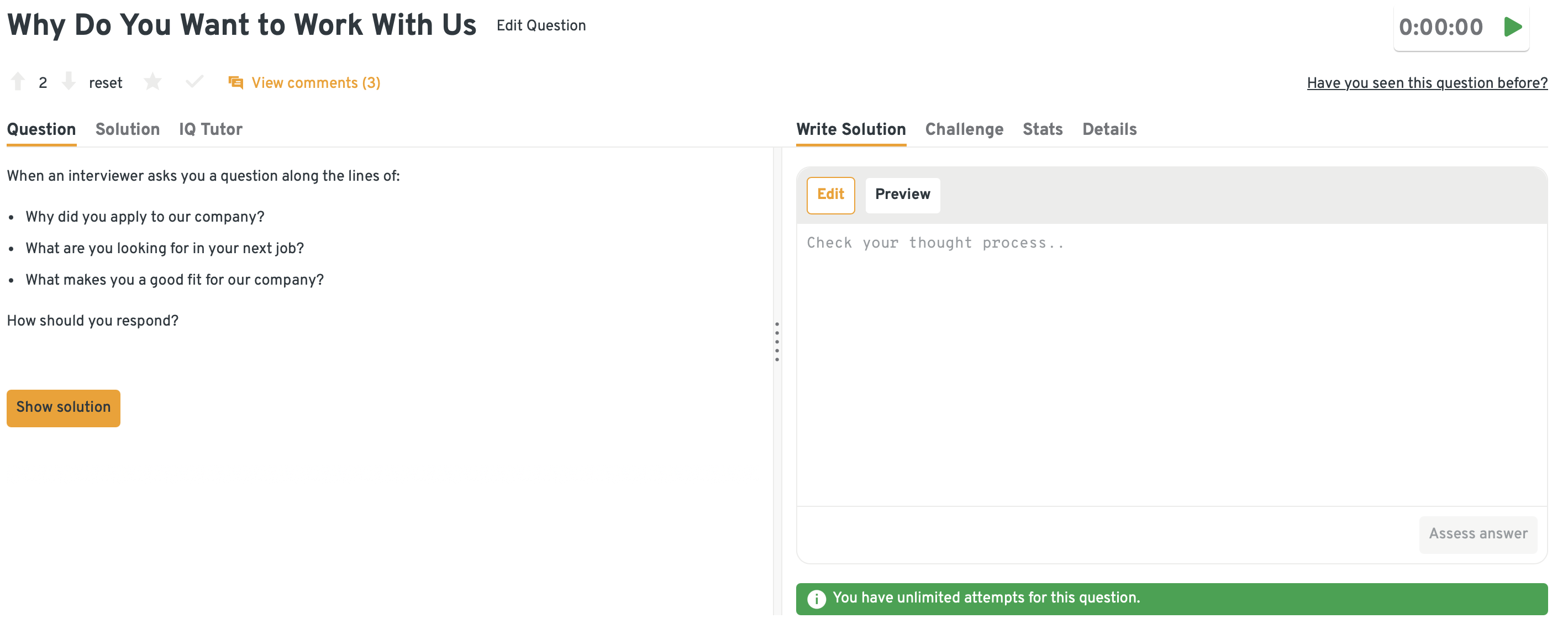
1. Why do you want to work at Target?
What interviewers assess: Your motivation for joining Target, understanding of its mission, and ability to connect your experience to its data-driven culture.
Example answer:
“I’m inspired by Target’s guest-first mission and how data drives decisions across stores, fulfillment, and digital channels. In my previous role, I built forecasting models that reduced stockouts by 15%, and I’m eager to apply that experience to help Target improve availability and enhance guest satisfaction.”
Tip: Connect your past projects directly to Target’s business areas (forecasting, personalization, fulfillment) to demonstrate authentic alignment and impact. You can also mention a specific Target team or initiative to stand out (e.g., supply-chain forecasting or search & browse).
2. Describe a time you influenced cross-functional teams without authority.
What interviewers assess: Leadership, collaboration, and communication, which are all key elements of Target’s Win Together value.
Example answer:
“During a product analytics initiative, marketing and engineering had conflicting KPIs. I created a data visualization showing how both goals could align around guest retention. By focusing the conversation on shared impact, we agreed on a unified metric that improved campaign ROI by 5%.”
Tip: Emphasize how you built alignment and collaboration, not just the technical outcome. Target values empathy and partnership as much as analytical skill.
3. Tell me about a project where you had to clean and organize a large dataset.
What interviewers assess: Attention to detail, process thinking, and how you ensure data quality, reflecting the ”care” value.
Example answer:
“I led a cleanup of transaction data used for revenue reporting. By standardizing schemas and removing duplicates, I reduced processing errors by 30% and improved accuracy for downstream forecasting models.”
Tip: Target cares deeply about consistent, accurate data powering decisions so you can tie this one back to operational reliability, not just a hygiene factor.
4. Share a time you resolved conflicting stakeholder priorities.
What interviewers assess: Decision-making, communication, and ability to manage trade-offs while keeping business goals on track.
Example answer:
“Engineering wanted to launch a feature early, but analytics required more validation. I facilitated a discussion to prioritize based on guest impact, proposing a phased rollout. This preserved launch timelines while ensuring reliable performance data.”
Tip: Highlight how you communicated trade-offs clearly and built consensus as this demonstrates balanced judgment and leadership maturity.
5. How do you prioritize multiple deadlines?
What interviewers assess: Organization, time management, and ownership under pressure, all qualities aligned with Target’s ”grow” value.
Example answer:
“I start by mapping deadlines against business impact and communicate early about dependencies. Using an urgency–impact matrix helped me deliver key metrics for leadership on time while maintaining space for ad hoc analysis.”
Tip: Mention concrete systems (task trackers, planning tools) or frameworks you use because Target interviewers appreciate process discipline and proactive communication.
Practice structuring your STAR responses and get personalized feedback with Interview Query’s Behavioral Interview Coach. You’ll refine clarity, storytelling, and value alignment, which is key to standing out in Target’s behavioral rounds.
How to Prepare for a Data Scientist Interview at Target
Preparing for a Target data scientist interview means combining strong technical fundamentals with a deep understanding of how data drives retail decisions at scale. Target evaluates not only what you know, like SQL, modeling, or statistics, but how you apply those skills to problems that impact millions of guests: forecasting demand, improving search, optimizing fulfillment, and enhancing the overall shopping experience.
The step-by-step guide below walks you through a focused prep path that mirrors how successful candidates build readiness and confidence before the interview.
1. Practice SQL on realistic retail datasets
Target heavily emphasizes SQL in both screening and live interviews, so start by mastering multi-table joins, window functions, and time-based aggregations. Working with realistic datasets helps you think in terms of business context, not just syntax. Try building mock order and store tables, analyzing daily performance, and diagnosing operational patterns.
This practice builds intuition for how Target analysts think: linking queries directly to decisions like improving inventory accuracy or tracking guest behavior.
Tip: Focus on problems like out-of-stock detection, forecast feature creation, customer segmentation, and funnel metrics as these mirror the analytics work Target teams do daily.
2. Strengthen your forecasting, ML, and applied modeling skills
Target relies on applied machine learning for forecasting demand, predicting fulfillment delays, and improving product rankings in search. Strengthen your modeling foundation by revisiting feature engineering, model interpretability, drift detection, and evaluation strategies across large, noisy datasets.
Understanding why a model works and how it impacts operations at scale helps you stand out. You’ll need to show judgment in trade-offs such as choosing between boosting and time-series models or balancing complexity with speed during real-time inference.
Tip: Discuss how you’d handle seasonality, promotions, and regional differences as these are major challenges in Target’s forecasting and personalization work.
3. Deepen your understanding of experimentation and retail analytics
Experimentation is central to how Target measures and optimizes guest experience. Build comfort with A/B testing, power calculations, and uplift modeling, but also learn how to handle real-world data issues like sample imbalance and metric volatility.
When you understand how analytics ties to retail KPIs such as in-stock rate, search-to-purchase conversion, and fulfillment accuracy, you can reason through Target’s case studies with confidence.
Tip: You can review experiments around checkout flow, delivery promises, or free shipping messaging. These reflect Target’s real optimization questions. If you’re newer to the space, practice using Interview Query’s e-commerce and experimentation case studies to bridge the gap.
4. Study Target’s business model and data science teams
Understanding how Target operates helps you tailor your interview answers to the company’s priorities. Learn about Target’s key data science teams (like Personalization, Fulfillment, and Fraud/Risk), their metrics, and the guest-focused initiatives they drive.
When you can naturally mention “Drive Up,” “Safety Stock,” or “Guest Experience Metrics,” you signal that you’ve done your homework and that you understand how your work connects to business impact.
Tip: Review Target’s data science career pages and recent press releases to find examples of how data powers their operations and guest experiences.
5. Work through Target-style business cases
Target’s interview cases often mirror real operational challenges, from diagnosing search conversion drops to forecasting peak-season demand or improving routing accuracy. Practicing structured problem-solving builds confidence in your reasoning and communication under pressure.
The key is to connect every analytical step back to business outcomes such as how your insights improve efficiency, guest satisfaction, or revenue.
Tip: Use Interview Query’s supply chain & operations practice questions to tackle problems similar to what Target asks in interviews.
6. Prepare behavioral stories aligned with Target’s culture
Behavioral interviews at Target are just as important as technical ones. Prepare four to six STAR stories that demonstrate how you’ve partnered with teams, navigated ambiguity, and created impact, all framed through Target’s values of Care, Grow, and Win Together.
The goal is to show that you are not only analytical but also collaborative and guest-centered.
Tip: End each story with the measurable impact on either the guest experience or team efficiency. These are what Target interviewers remember most.
7. Simulate Target-style interviews
After refining your skills, put everything together through realistic mock interviews. Practice thinking out loud, clarifying assumptions, and walking through trade-offs in SQL, ML modeling, or experimentation questions.
Mock sessions reveal your weak spots and build interview composure faster than studying alone.
Tip: Have a friend or coach challenge your assumptions, for example, how your model handles missing store data or Black Friday spikes. For guided practice, try Interview Query’s Mock Interview Tool for SQL, ML, and behavioral rounds.
Salary & compensation at Target for data scientists
Average Base Salary
Average Total Compensation
Target offers competitive compensation for data scientists, reflecting the company’s scale, operational complexity, and emphasis on data-driven decision-making across forecasting, supply chain, fulfillment, and digital experiences. According to Levels.fyi, total compensation for U.S.-based data scientists at Target ranges from the low $100Ks to nearly $280K, with substantial increases at senior and lead levels. Target rewards analytical impact, cross-functional collaboration, and the ability to translate models into operational improvements across thousands of stores.
- Data Scientist (L4): ~$106K total compensation (base salary + bonus)
- Senior Data Scientist (L5): ~$154K total compensation (~$140K base + bonus + equity)
- Lead Data Scientist (L6): ~$186k total compensation (~$158.5K base + bonus + equity)
- Principal Data Scientist (L7): ~$279K total compensation (~$212.8K base + bonus + equity)
Target’s compensation structure reflects its focus on enterprise-scale impact by rewarding data scientists who improve demand forecasting, reduce out-of-stock events, optimize fulfillment speed, and enhance digital search and recommendation quality. Total compensation grows with both technical depth and the ability to influence core business performance.
FAQs About the Target Data Scientist Interview
What technical skills does Target focus on for data science interviews?
Target’s interviews emphasize applied analytics and modeling skills that directly power business decisions. You’ll be tested on:
- SQL for joining and aggregating large store, order, and customer datasets
- Python for feature engineering, forecasting, and exploratory data analysis
- Machine learning foundations, especially time-series and tabular modeling
- Experimentation design and retail metric interpretation
- Communication skills for explaining complex findings to non-technical partners
Tip: Focus on end-to-end reasoning — how your SQL or model choices translate into measurable guest or operational impact.
What types of data science problems does Target test?
Target’s interview questions reflect the company’s scale and retail complexity. Common topics include:
- Forecasting demand and sales across stores or SKUs
- Ranking and search relevance modeling for e-commerce
- Personalization and recommendation system design
- Fulfillment and routing optimization
- Anomaly detection in inventory or pricing data
You may encounter case-style questions asking how you would structure data, choose models, and measure success.
Does Target include a take-home or case study?
Some Target teams include a short take-home assessment focused on data cleaning, feature development, and modeling for a simplified retail dataset. You’ll typically need to produce visualizations, describe modeling steps, and summarize business insights.
Tip: Use Interview Query’s Take-Home Practice Tool to get feedback on project-style problems similar to Target’s case studies.
How does Target evaluate experimentation and metrics experience?
Target values candidates who understand how to design and interpret experiments in messy real-world data. Expect to discuss:
- A/B testing setup, power, and sample balance
- Lift and significance interpretation
- Metric trade-offs between conversion, fulfillment cost, and guest experience
Many candidates are asked to reason through a live scenario, such as testing new checkout messaging or fulfillment incentives.
What machine learning concepts appear most often in Target interviews?
Target’s data science interviews favor applied ML reasoning over abstract theory. Expect questions about:
- Model selection and feature engineering for forecasting or recommendation problems
- Handling data drift across stores, regions, and seasons
- Evaluation metrics (RMSE, precision@k, recall, NDCG)
- Model interpretability and explainability in a retail setting
Tip: Be prepared to explain why a model is appropriate, not just how to build it.
How important is SQL in the Target data science interview?
SQL is one of the most heavily weighted skills across Target’s data science roles. You’ll encounter realistic retail-style questions involving multi-table joins, aggregations, and window functions to analyze transactions, store performance, or customer cohorts.
Tip: Review Interview Query’s SQL Practice Problems for hands-on exercises similar to Target’s analytics rounds.
Does Target use virtual or onsite interviews for data science?
Most interviews are conducted virtually. You may start with a recruiter screen, followed by a technical SQL or analytics round, then modeling and case interviews with Target’s data science teams. Final rounds often include a behavioral interview aligned with Target’s values of Care, Grow, and Win Together.
How many rounds are in the Target data scientist interview process?
The typical process includes four to five stages:
- Recruiter screen
- Technical round
- (Optional) Take-home or team-specific project
- Onsite-interview loop (technical and behavioral)
- Offer
The process usually takes two to five weeks, depending on team and scheduling.
What teams hire data scientists at Target?
Target hires data scientists across a range of teams, including:
- Personalization and Recommendations
- Forecasting and Supply Chain Analytics
- Search and Browse NLP
- Pricing and Promotion Optimization
- Fraud and Risk Analytics
- Digital Fulfillment
Each team focuses on improving decisions across Target’s 2,000+ stores and massive e-commerce network.
Do I need retail experience to get hired as a Target data scientist?
No, retail experience isn’t required, but familiarity with consumer behavior, supply chain data, or omnichannel operations is helpful. Interviewers value candidates who can translate technical insights into practical, guest-facing outcomes.
What is the compensation range for Target data scientist roles?
Compensation depends on experience and level. Most data scientist roles at Target currently pay:
- Associate to Mid-level: $106K–$150K total compensation
- Senior: $160K–$190K
- Lead or Principal: $200K–$280K+ (including equity and bonus)
Strong communication skills and clear business impact examples often help candidates negotiate higher bands.
Step Into a Data Science Career at Target
Target’s interview process is designed to identify data scientists who can think clearly, solve complex problems, and influence meaningful change across a massive retail ecosystem. With focused preparation grounded in retail analytics, forecasting, experimentation, and Target’s values, you’ll be equipped to show how your skills translate into business outcomes. This preparation not only helps you succeed in the interview but also lays the foundation for a high-impact career at one of the largest and most data-driven retailers in the world.
Accelerate your prep by completing the data scientist interview learning path on Interview Query, or getting hands on and test your knowledge in a data science challenge.
The more in-depth your practice, the more confident you’ll be when you’re asked to solve the kinds of problems Target cares about most. Your next conversation could be the one that launches your data science career at one of the most influential retail companies in the world.
Target Interview Questions
| Question | Topic | Difficulty | ||||||||||||||||||||||
|---|---|---|---|---|---|---|---|---|---|---|---|---|---|---|---|---|---|---|---|---|---|---|---|---|
SQL | Medium | |||||||||||||||||||||||
Write a query to identify customers who placed more than three transactions each in both 2019 and 2020. Example: Input:
Output:
| ||||||||||||||||||||||||
SQL | Medium | |||||||||||||||||||||||
SQL | Easy | |||||||||||||||||||||||
SQL | Easy | |
Machine Learning | Medium | |
Statistics | Medium | |
SQL | Hard | |
Machine Learning | Medium | |
Python | Easy | |
Deep Learning | Hard | |
SQL | Medium | |
Statistics | Easy | |
Machine Learning | Hard |
Discussion & Interview Experiences