


Meta Product Manager Interview Questions & Answers: Complete Guide


Introduction to Meta Product Manager Interviews
In 2025, Meta reported that nearly 3.5 billion people actively use its products to connect, create, and build communities. From apps like Facebook to services like Meta AI, behind each feature launch, algorithm improvement, and product pivot stands a product manager balancing user needs and business impact.
Landing a PM role at Meta means proving you can operate in this high-stakes environment. The Meta product manager interview process evaluates three core dimensions: product sense to identify the right problems to solve, execution and metrics to ensure measurable results, and leadership and drive to test whether you can drive teams forward without formal authority. Beyond these skills, you’re evaluated on how well you can align with the Meta company culture—one that prioritizes moving fast, being bold, and focusing on long-term impact over short-term wins.
What makes Meta’s process distinctive? Unlike companies that lean heavily on estimation exercises or purely technical assessments, Meta focuses on realistic product scenarios drawn from their ecosystem—social platforms, AR/VR hardware, AI experiences, and advertising systems.
This guide breaks down what Meta looks for in PM candidates, how each interview round works, and the strategies that help you stand out. Whether you’re already experienced in product management or still new to Meta’s ecosystem, you’ll learn how to showcase the product judgment, analytical rigor, and collaborative leadership that define successful PMs at the company.
Understanding the Meta Product Manager Role
Beyond simply managing features, Meta PMs shape how billions of people communicate, discover content, and create lasting connections through Meta’s products. The role demands operating at two levels simultaneously: driving execution on your immediate product area while understanding how your decisions ripple across Meta’s interconnected ecosystem.
Consider what this looks like in practice. A PM working on Instagram Reels doesn’t just optimize video engagement metrics—they must also consider how Reels affects Stories usage, impacts creator monetization, competes with TikTok, and aligns with Meta’s broader AI content recommendation strategy. Similarly, a Messenger PM balancing new chat features must think about WhatsApp parity, cross-app messaging infrastructure, and Meta’s encryption commitments.
This interconnectedness defines role expectations for Meta’s product managers. You’ll regularly collaborate across product families, balance competing stakeholder priorities, and make trade-off decisions with millions of users impacted daily. The “Move Fast” culture also means you’re expected ship experiments quickly, analyze results in real-time, and iterate based on data, not lengthy approval cycles.
If you want to stand, these are the key product manager skills that Meta is looking for:
- Strategic product vision: You identify high-impact opportunities by combining user research, competitive analysis, and technical feasibility. This means asking “Should we build this?” before “How do we build this?”
- Data fluency at scale: You’re comfortable defining success metrics, diagnosing funnel drop-offs across billions of users, designing A/B tests, and translating statistical significance into product decisions.
- Cross-functional leadership: You drive alignment without authority. As you work in cross-functional teams, engineers, designers, researchers, data scientists, and business stakeholders look to you for direction, prioritization, and context.
- Technical depth: While you’re not writing production code, you need enough technical understanding to evaluate engineering proposals, estimate complexity, spot scalability issues, and have credible architecture discussions.
The career ladder at Meta reflects these expectations. IC3 and IC4 PMs (entry and mid-level) typically own specific features or surfaces. IC5+ PMs lead entire product areas, influence multi-year strategy, and often specialize in domains like AI/ML products, AR/VR experiences, ads and monetization, or integrity and safety systems. Meanwhile, the RPM program serves as an entry point for early-career candidates, offering rotations across three product teams to build breadth before specializing.
Understanding these dynamics helps you prepare strategically and develop the product judgment Meta actually evaluates.
Meta Product Manager Interview Process: Step-by-Step Breakdown
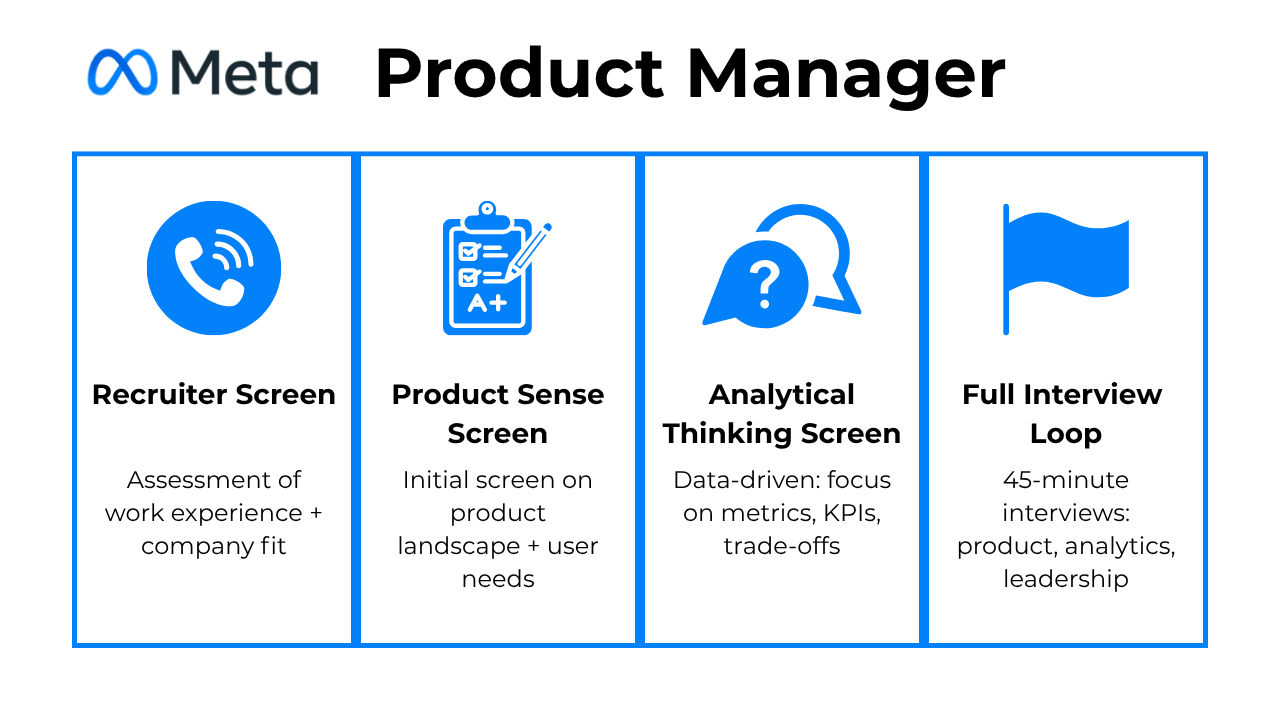
Every stage of the Meta interview process is designed to evaluate how candidates think through problems, collaborate cross-functionally, and make data-driven decisions that align with Meta’s mission.
The PM interview stages typically follow this sequence:
Recruiter Screen
The process begins with the Facebook recruiter screen, where you’ll discuss your background, product experience, and motivation for joining Meta. Expect questions about your previous work on product launches, stakeholder communication, and measurable outcomes. Behavioral questions like “Tell me about a product you’ve built and launched” and “Why do you want to work at Meta?” come up during this round.
This conversation typically lasts 30 minutes and helps recruiters assess whether your experience aligns with Meta’s product management expectations and “Move Fast” culture. Once you get past this round, you can move on to the initial screen interviews.
Tip: Prepare a concise narrative about your product journey and have 2-3 specific metrics-driven accomplishments ready to discuss. Research Meta’s recent product launches and articulate why their mission resonates with your career goals.
Product Sense Screen
One of the initial screens of the Meta interview process for product managers is the product sense round. This 45-minute interview evaluates how well you understand the product landscape, identify user needs, solve problems, and develop solutions and features. Meta values candidates who demonstrate creativity and structured reasoning while considering trade-offs between user value and business impact.
Be ready to answer prompts involving existing Meta products, such as “How would you improve Facebook Groups?” or “What would you build to help small businesses on Instagram?” When offering different solution paths or ideas for building a product from the ground up, walk through your thought process. Hone this skill by using a whiteboard or a piece of paper to practice thinking out loud.
Tip: Practice structuring your answers using a clear framework: clarify the problem, identify the user, brainstorm solutions, and explain your prioritization logic. The key is demonstrating thoughtful trade-offs rather than rushing to a single “perfect” solution.
Analytical Thinking Screen
After demonstrating product vision and user empathy, you move on to another 45-minute screen, which is more analytical and data-driven. Expect this stage to focus on metrics and KPIs that you must define, analyze, and optimize through proposed strategies.
You may be asked to develop the right set of metrics/outcomes to evaluate a product’s success, or fix a problem like a decline in user engagement through data/results. Since Meta reaches billions of users across its product portfolio, it’s important to consider the vast amount of data you’ll be working with in goal-setting, funnel analysis, and experimentation. Ultimately, the goal is to show you can translate insights into actionable product improvements.
If you succeed in making data-driven decisions under pressure, you’ll be invited to the full interview loop that tests your core PM skills in depth.
Tip: Before diving into metrics, always clarify the product goal first. Practice root cause analysis by working through real scenarios where you diagnose metric drops using a structured approach (e.g., segmentation, funnel analysis, external factors).
Full Interview Loop
The full interview loop for Meta product manager roles consists of three 45-minute interviews: product sense, execution, and leadership & drive. The product and execution interviews build upon the initial screens, thus expecting greater depth and complexity in your answers — whether it’s coming up with more creative, impactful products or evaluating trade-offs and risk mitigation.
While the previously mentioned areas are based on hypothetical scenarios, the leadership & drive interview focuses on your past experiences in leading, motivating, and working with cross-functional teams. Expect five to four behavioral questions that hammer down on your capacity for resourcefulness, ownership, accountability, conflict resolution, and willingness to learn. Strong candidates know how to respond to these questions with real-world examples using the S.T.A.R. (Situation, Task, Action, Result) format.
Once you’ve completed the full on-site loop, a committee of interviewers will collectively discuss their feedback and scores before deciding on an offer.
Tip: Throughout the full loop, go beyond surface-level answers by discussing second-order effects, edge cases, and long-term implications. For the leadership round, prepare 5-7 detailed STAR stories that showcase different competencies like conflict resolution and stakeholder management.
Hiring Committee & Offer
Once you’ve completed the full on-site loop, a committee of interviewers will collectively discuss their feedback and scores before deciding on an offer. This committee review process ensures consistency and fairness across all candidates by evaluating your performance holistically rather than relying on individual interviewer opinions. The committee considers your scores across all three evaluation areas—product sense, execution, and leadership—along with qualitative feedback from each interviewer.
If the committee reaches a positive decision, you’ll receive an offer that includes your level designation (typically IC4 for experienced PMs or IC3 for those with less experience), compensation details, and team placement options based on your interests and Meta’s current needs.
Tip: Performance consistency across all three areas matters more than excelling in just one. Aim for solid “hire” signals in product sense, execution, and leadership rather than a stellar performance in one area with weaker showings elsewhere.
RPM Program (If Applicable)
Outside of full-time employment, Meta also offers the RPM program (Rotational Product Manager) for early-career candidates. PMs with less than one year of experience are integrated into three different innovative, high-impact product groups within Meta. This short-term employment program typically lasts 18 months, spanning a four-week training bootcamp, mentorship, and real-world experience.
While it follows a similar format to the Meta PM interview process, it focuses more on learning potential, communication, and adaptability. Annual applications to the RPM program typically open in late summer or early fall.
Tip: If you’re applying to the RPM program, emphasize your learning agility and curiosity over trying to demonstrate senior-level experience you don’t yet have. Meta values candidates who show potential and coachability more than those who try to oversell limited experience.
Meta Product Manager Interview Question Types and Sample Answers
The Meta Product Manager interview is designed to evaluate how candidates think about product vision, execution, analytics, and leadership at scale. Each interview section tests different skill areas — from defining product strategy to making data-driven decisions and inspiring cross-functional teams.
Below are key question examples to help you prepare for the Meta PM interview.
Meta Product Sense Questions
Product sense questions at Meta test how you think about building products that drive both user and business value. Interviewers want to see if you can break down ambiguous problems, define success metrics, and make trade-offs grounded in user empathy and data. The key is to think like a Meta PM who balances innovation with measurable impact across a massive, interconnected ecosystem.
Identify reasons and metrics for decreasing average comments per post on Facebook
Start by exploring whether the drop stems from user fatigue, content changes, or algorithmic ranking adjustments. Use funnel metrics like post impressions, comment conversion rate, and time spent per post. Run experiments or segment by geography to pinpoint patterns. This question tests your ability to diagnose engagement problems through both qualitative and quantitative lenses.
Tip: Meta loves when candidates balance user empathy with data-driven root cause analysis.
How would you prioritize competing product requests from Facebook’s News Feed and Reels teams?
Clarify each request’s impact, effort, and alignment with company goals. Use prioritization frameworks like RICE or impact vs. effort scoring. Discuss trade-offs transparently while keeping the end-user experience central. This measures your judgment and collaboration across product lines.
Tip: Show that you can manage stakeholder expectations and still make data-backed, user-first trade-offs.
What metrics would you track to evaluate the success of a new Facebook Marketplace feature?
Define key metrics such as transaction completion rate, repeat listings, and average selling time. Break down success measurement across acquisition, engagement, and retention. Explain how A/B testing or cohort analysis could validate improvements. This assesses your understanding of data-driven product decisions.
Tip: Always tie metrics back to user value and the overall product goal, not just business impact.
How would you decide whether to integrate Threads more closely with Facebook or Instagram?
Analyze the user overlap, engagement behavior, and cross-platform benefits. Create a decision framework using metrics like retention, session depth, and network effects. Highlight risks such as user confusion or brand dilution. This question checks your strategic alignment skills and ecosystem awareness.
Tip: Meta expects you to think holistically about ecosystem effects and user trust across its platforms.
How would you improve search results on Facebook?
This question tests your ability to enhance discovery while balancing precision and recall. Start by identifying user intents—people, groups, posts, marketplace items, or content discovery—and segment results accordingly. Audit search engagement metrics such as click-through rate, dwell time, and reformulation rate to uncover relevance gaps. Propose ranking improvements and conduct A/B testing to validate algorithm updates and assess user satisfaction.
Tip: Meta values candidates who can connect technical ranking improvements with real user needs—show both algorithmic understanding and empathy for how users search.
If you want to dive deeper into this common product sense interview question, here’s a video on how to approach improving Facebook’s search results with Zarrar Shehzad. It explains how to break down ambiguous prompts and think systematically about relevance, personalization, and user intent.
Meta Execution & Analytics Questions
Execution and analytics questions evaluate your ability to turn strategy into measurable results. Meta looks for PMs who can design experiments, define clear success metrics, and use data to optimize user experiences at scale. Your answers should show structured thinking, attention to detail, and the ability to balance speed with rigor in decision-making.
-
Start by defining your objective—whether it’s cross-app activation, engagement, or retention. Map the user journey from discovery (e.g., in-feed, stories, notifications) to conversion, ensuring minimal disruption to core Facebook experiences. Identify key success metrics like click-through rate, activation rate, and incremental lift. This question evaluates how you think about growth loops, experiment design, and trade-offs in Meta’s interconnected ecosystem.
Tip: Demonstrate sensitivity to ecosystem cannibalization—Meta wants PMs who grow one product without harming another.
How would you measure the impact on teen engagement when their parents join Facebook?
Frame this as an experiment measuring causal impact on engagement metrics such as session time, post frequency, or retention. Define treatment and control cohorts—teens whose parents recently joined versus those whose parents haven’t. Analyze behavioral shifts using pre/post metrics and control for confounders like age and geography. This question tests your ability to apply experimental rigor to social dynamics and sensitive user segments.
Tip: Highlight privacy awareness and the ability to interpret nuanced behavioral changes in sensitive demographics.
How would you measure the success of Facebook Groups and optimize the group-joining funnel?
Clarify the product goal—community growth, engagement, or meaningful interaction—and translate it into measurable KPIs like join conversion, post activity, or comment depth. Map the funnel from discovery to active participation, identifying where friction or drop-off occurs. Recommend experiments to improve each stage while maintaining quality interactions. This tests your ability to blend analytics with product intuition in community-driven growth.
Tip: Meta PMs stand out when they tie quantitative metrics to qualitative meaning—e.g., “value of engagement,” not just volume.
-
Define clear success metrics such as new Watch Party sessions per DAU, average watch time, and social sharing rate. Propose acquisition tactics like personalized notifications, creator partnerships, or in-feed prompts. Use A/B testing to evaluate lift and monitor long-term engagement effects. This question assesses how you connect marketing strategy with metric-driven experimentation to grow new features at scale.
Tip: Show that you understand how social proof and shared experiences drive retention in Meta’s products.
-
Start by segmenting users by engagement level and use cases (personal, group, or business messaging). Identify leading indicators like messages sent per user, active contacts, and 7-day retention. Propose a campaign—such as referral incentives or contextual prompts—and outline how you’d measure success through controlled experiments. This question evaluates your execution mindset and fluency in connecting campaign goals with measurable outcomes.
Tip: Emphasize how even small UI changes or nudges can drive massive global impact in WhatsApp’s scale.
Meta Leadership & Drive Questions
Leadership questions reveal how you influence without authority, communicate across teams, and navigate complex challenges. Meta values PMs who can align stakeholders, champion data-driven storytelling, and maintain clarity under pressure. Strong answers demonstrate ownership, emotional intelligence, and a bias for impact even amid ambiguity.
How comfortable are you presenting your insights?
Share a specific situation where you turned complex data into a compelling narrative for stakeholders. Highlight how you chose the right visuals, simplified key findings, and inspired action from the audience. Emphasize how you handled questions or pushback during the presentation.
Tip: At Meta the ability to translate data into a story that drives product decisions is crucial — show clarity, influence, and impact.
What are some effective ways to make data more accessible to non-technical people?
Describe a scenario where you designed dashboards, visualizations, or processes that democratized insights across a team or organization. Discuss how you ensured usability for different audiences (e.g., product, marketing, operations) and measured adoption or improvement. Mention any feedback loops you used to improve accessibility and trust in data.
Tip: Demonstrating how you make data usable across functions shows your leadership vision in enabling product teams — a key trait for a Meta PM.
-
Start by setting context: the stakeholder(s), their priorities or concerns, and the point of communication breakdown. Explain how you reframed your message (e.g., using business impact, storytelling, or empathy) and aligned the conversation toward a shared goal. End by detailing what changed because of your communication and what you learned.
Tip: At Meta, PMs often navigate diverse stakeholders across product, engineering, marketing, and policy — highlight how you bridge gaps with clarity and respect.
Describe a time you disagreed with a team’s product direction
Share a concise story that highlights your rationale and how you backed it with data or user feedback. Emphasize collaboration and respectful pushback. Show how the discussion led to a better outcome or learning.
Tip: Meta values PMs who influence through clarity and evidence, not authority.
Tell me about a time you had to make a difficult product decision with incomplete data
Start with context—what decision had to be made and why time or data were limited. Discuss how you evaluated risks and used intuition responsibly. Reflect on the outcome and what you’d do differently with more information.
Tip: Show that you can make confident, timely calls while managing ambiguity.
Each of these Meta interview questions is designed to help you think like a Meta PM—balancing data-driven rigor with user empathy and cross-functional collaboration. Review these scenarios to sharpen your product intuition, analytical mindset, and storytelling skills before your next Meta interview.
Preparation Tips for Meta Product Manager Interviews
Meta PM interviews reward candidates who ask sharp questions, challenge assumptions, and defend their decisions with data. Your preparation should mirror this mindset: deliberate practice with immediate feedback loops, not passive reading of generic frameworks. Building habits that reinforce analytical thinking, leadership, and user empathy also ensures you have the same traits Meta values in its product managers.
Build a Focused Study Routine Around Real Meta Products
Don’t just memorize CIRCLES or HEART frameworks—apply them to actual Meta scenarios you’ll encounter. Spend Week 1 on product sense questions for Instagram (Reels, Stories, Explore), Week 2 on execution questions for Messenger (feature prioritization, metric trade-offs), Week 3 on leadership scenarios involving cross-functional tension or resource constraints.
For each practice session, set a 45-minute timer and work through complete answers including: problem clarification, user segmentation, solution brainstorming with trade-offs, metric definition, and next steps. Record yourself or write out full responses—this reveals gaps that mental rehearsal misses. Use Meta’s blog for actual product announcements to understand their current priorities around AI recommendations, creator tools, and privacy features.
Tip: Dedicate each week to a specific Meta product family (Feed products, Messaging, Monetization, AI) and practice questions within that context to build authentic product intuition.
Practice with Peers Who Challenge Your Thinking
Generic mock interviews where someone reads you a question aren’t enough. You need partners who act like Meta interviewers: asking “Why did you prioritize that user segment?”, “What if engagement goes up but revenue drops?”, or “How would you convince an engineering team to deprioritize their pet project?” These uncomfortable follow-ups expose whether you truly understand your reasoning or just memorized an answer.
Interview Query’s PM coaching services connect you with former Meta PMs who know which follow-ups actually come up in interviews and can identify the difference between a structured answer and shallow framework regurgitation. Between coaching sessions, join mock interview groups where you rotate between interviewer and candidate—teaching someone else to evaluate answers sharpens your own judgment.
Track specific feedback themes: Are you taking too long to clarify the problem? Jumping to solutions without considering constraints? Missing obvious metrics? Adjust your approach based on patterns, not one-off comments.
Tip: Seek out mock interview partners who will push back on your assumptions and ask follow-up questions you haven’t prepared for. Doing so simulates the adversarial nature of real Meta interviews.
Craft a Resume That Tells a Compelling Product Story
Meta PMs scan hundreds of resumes, so yours needs to immediately communicate product ownership and impact.
- Weak bullet: “Worked on recommendations feature for mobile app.”
- Strong bullet: “Redesigned home feed ranking algorithm using collaborative filtering, increasing daily active users by 23% and session duration by 8 minutes while maintaining 95th percentile latency under 200ms.”
Notice the difference: the strong version shows technical depth (collaborative filtering, latency constraints), quantified impact (23%, 8 minutes), and awareness of trade-offs (maintaining performance). Every bullet should follow this pattern: problem → solution → impact with metrics.
For your portfolio or case studies, go deeper than results. Document your decision-making process: Why did you prioritize Feature A over Feature B? What user research informed your approach? How did you navigate engineering pushback? What would you do differently?
Tip: Structure each bullet point to answer: What was broken? What did you build? What impact did it have? Use the format: “[Action verb] [specific solution] that [metric improvement] by [percentage/number].”
Learn From Specific Failure Patterns, Not Generic “Mistakes”
Meta candidates typically fail by committing these interview mistakes:
- Solution-jumping: Diving into “We should build X” without understanding why the problem exists or who experiences it.
- Metric-forgetting: Proposing features without defining success criteria or considering how they’ll be measured.
- User-ignoring: Optimizing for business goals without considering user needs or behavior changes.
- Trade-off-avoiding: Suggesting solutions without acknowledging costs, risks, or what you’re not building.
The fix isn’t memorizing better frameworks but catching yourself mid-answer. When you start describing a solution, pause: “Have I defined the user problem clearly? Do I know which user segment matters most?” When you propose a metric, ask: “Is this a vanity metric or does it tie to actual value?” Practice this internal questioning until it becomes automatic.
For behavioral questions, the mistake usually lies in telling stories without demonstrating judgment.
- Weak answer: “I resolved the conflict by setting up a meeting.”
- Strong answer: “I resolved the conflict by proposing we run a 2-week spike to generate data, which gave both teams objective criteria to decide rather than arguing based on intuition” shows product thinking applied to leadership.
Tip: After each practice session, identify your failure mode—are you solution-jumping, metric-forgetting, user-ignoring, or trade-off-avoiding? Focus your next session entirely on fixing that one weakness.
Build a Preparation System, Not Just a Schedule
Consistency matters, but consistency without reflection is just repetition. After each practice session, spend 10 minutes documenting: What question did I answer? What went well? What would I change? What follow-up question stumped me? This creates a personalized curriculum based on your weaknesses, not generic advice.
Review your question bank weekly to spot patterns. If you’re consistently strong on product design but weak on metric diagnosis, shift your practice ratio. If behavioral questions about conflict feel uncomfortable, that’s where you need more reps. Use your prep log to celebrate progress; comparing your Week 1 answers to Week 6 answers builds confidence when interview anxiety hits.
Tip: Create a “question bank” where you track every practice question, your answer quality (1-5), specific feedback received, and follow-up questions you struggled with—this transforms random practice into deliberate skill-building.
What Happens After the Meta Interview: Offers, Negotiation, and Next Steps
Once you’ve completed the Meta product manager interview rounds, the post-interview process typically involves a hiring committee review, where interviewers discuss your performance across product sense, execution, and leadership dimensions. If successful, you’ll move to the offer stage, where recruiters outline the Meta PM offer—including role level, compensation, and start date. This phase can take anywhere from one to three weeks, depending on the number of candidates in review.
On top of staying in professional contact with your recruiter, here are ways to remain informed and ensure the Meta PM role aligns with your career trajectory and overall goals.
1. Decoding the Hiring Committee Process
After your final interview, each interviewer submits detailed written feedback and a hire/no-hire recommendation calibrated against Meta’s leveling bar. The hiring committee (usually 3-5 senior PMs and leaders who didn’t interview you) reviews this feedback in a dedicated meeting, discussing: Did the candidate demonstrate product sense at the target level? Can they execute with data and metrics? Do they show leadership without authority?
Strong product sense can sometimes compensate for a mediocre execution round if you showed enough analytical thinking. Similarly, excellent execution might balance weaker product creativity if your leadership stories were compelling. What kills offers is consistent weakness across multiple areas or a single disqualifying round. For example, being unable to define any reasonable metrics, or showing zero product intuition.
Timeline varies: 3-5 days for strong consensus candidates, 1-2 weeks if the committee wants additional input or is comparing you against other finalists.
Tip: If you haven’t heard back after 7 business days, a polite email to your recruiter (“Checking in on timeline—still very excited about the role”) is appropriate.
2. Negotiating Your Meta Offer With Leverage and Data
When your recruiter calls with an offer, your first response should be: “Thank you, I’m excited. Can I have the full details in writing to review?” Never negotiate on the phone without seeing the complete package: base salary, equity (number of RSUs and 4-year vesting schedule), signing bonus, relocation, and annual bonus target.
Meta’s compensation structure is heavily equity-weighted, which means you receive not only a base cash salary and bonuses but also Restricted Stock Units (RSUs) tied to the company’s performance. The equity number is where you have the most negotiation room, especially if you have competing offers from other tech companies.
Effective negotiation approach:
- Anchor with data: “Based on my research using Levels.fyi, IC4 PMs with my background typically receive salary packages in the $244K to $380K range. Can we discuss increasing the equity component?”
- Leverage competing offers: If you have an offer from Google, Amazon, or another tier-1 company, share the total comp number (you don’t need to share the exact breakdown). Meta will often match or come close as long as you have actual documentation.
- Justify with specifics: “Given my 5 years of experience leading AI-powered recommendation systems, which directly applies to Meta’s Feed ranking work, I believe I’m positioned at the higher end of the IC4 band.”
- Ask about level: If you’re borderline IC4/IC5, ask directly: “Given my background, was IC5 considered? What would it take to re-evaluate at that level?” Sometimes they’ll bump your level, which has more upside than squeezing out another $20K in equity.
Tip: Meta’s compensation bands have built-in flexibility, which is typically 10-20% range for base salary and significant variance in equity. Negotiation isn’t about convincing them to break rules, it’s about justifying where you fall within their existing range.
3. From Offer Acceptance to Day One: Setting Yourself Up for Success
Once you’ve accepted, you’ll receive onboarding logistics: background check (1-2 weeks), equipment shipment, start date (typically 2-8 weeks out depending on your notice period), and benefits enrollment information. For international candidates, visa processing can extend timelines significantly—be transparent about this with your recruiter early.
Below are a few strategic pre-onboarding moves:
- Connect with your hiring manager early: Ask what product area you’ll be working on and what context would be useful to have before starting. They might suggest reviewing specific product docs, understanding a recent launch, or familiarizing yourself with a particular user segment.
- Study the product deeply: If you’re joining Instagram, don’t just use it casually. Analyze Reels recommendation patterns, test creator tools, read their engineering blog posts about ranking algorithms. Show up with informed questions, not basic “How does this work?” queries.
- Review Meta’s internal culture: Read leaked internal memos or public posts about how Meta operates. Assess their approach to written communication, meeting culture, and performance evaluation. Understanding these norms reduces your ramp-up time.
The first 90 days are critical for establishing your reputation. PMs who arrive prepared, ask smart questions, and demonstrate user empathy early build credibility that compounds throughout their tenure. Those who spend their first month figuring out basic product context start behind and struggle to catch up.
Tip: Use the time between accepting your offer and starting to build relationships. Reach out to your hiring manager for a coffee chat. or join relevant internal Meta groups if you have access.
Average Meta Product Manager Salary
Meta product managers are offered one of the most competitive salaries in the tech industry. As of 2025, the total annual compensation for Meta PMs in United States ranges from $172K to $1M depending on role level (L3–L7) and experience. The median yearly compensation package totals $610K. (Levels.fyi)
Here’s a more detailed breakdown for the average compensation by level:
- Rotational Product Manager (RPM) L3: ~$172K (~$131K, ~$28K stock, ~$13K bonus)
- L4 Product Manager: ~$244K (~$173K base, ~$54K stock, ~$17K bonus)
- L5 Product Manager: ~$445K (~$220K base, ~$192K stock, ~$34K bonus)
- L6 Product Manager: ~$560K (~$250K base, ~$276K stock, ~$34K bonus)
- L7 Product Manager: ~$1M (~$296K base, ~$654K stock, ~$84K bonus)
Meta appears to use a location‐tier system where base salary and equity packages are adjusted based on region. Thus, compensation at Meta is higher in high cost‐of‐living and major tech hubs compared to other U.S. regions. For example, the median package for PMs in San Francisco Bay Area is ~$722K, while the median total comp for New York is ~$425K.
Average Base Salary
Average Total Compensation
When negotiating or evaluating an offer, candidates should consider the local market rate, cost of living, and Meta’s reported compensation for their specific region/metro.
FAQs
Preparing for the Meta PM interview can feel complex, especially with multiple rounds and varied question types. This Meta PM interview FAQs section answers the most common questions candidates ask about the process, expectations, and strategies for success.
How many rounds are in the Meta Product Manager interview?
The Facebook PM interview rounds typically include a recruiter screen, two initial screens for product sense and analytical rounds, a full interview loop covering product sense, execution, and leadership with greater depth, and a final hiring committee review. Candidates in the RPM program may have a slightly streamlined process.
What types of questions are asked in Meta PM interviews?
Meta’s interviews often feature product design, metrics, strategy, and behavioral questions. You’ll be asked to evaluate user problems, define success metrics, or propose improvements to Meta products like Instagram or WhatsApp.
How should I prepare for Meta’s Product Sense interview?
For product sense questions, interviewers evaluate your user empathy, ideation, and prioritization. Use frameworks like CIRCLES or AARM to ensure your answers remain organized and user-focused.
What frameworks are recommended for Meta PM interviews?
Popular frameworks include CIRCLES for product design, AARM (Acquisition, Activation, Retention, Monetization) for metrics, and STAR for behavioral responses. Choose one or two and practice applying them consistently. It’s advisable to master one framework deeply rather than spreading yourself thin across many.
What are common mistakes to avoid during Meta interviews?
The most common pitfalls include vague answers, missing metrics, or over-explaining without structure. Avoid jumping straight to solutions before clarifying the problem. While PMs at Meta are not expected to be as technical as PMs at other tech companies, being underprepared to discuss technical trade-offs and software development processes is another common mistake to avoid.
How does Meta evaluate PM interview candidates?
Meta assesses candidates across three pillars: product sense, execution/analytical thinking, and leadership & drive. Strong analytical reasoning and alignment with Meta’s mission often distinguish successful candidates. Meta’s hiring managers also value creative candidates who think outside the box and offer unique perspectives on developing its tech products.
What is the RPM (Rotational Product Manager) program?
The RPM program is Meta’s entry-level track for aspiring PMs, designed to build foundational skills through rotational product assignments and mentorship. It’s ideal for new graduates or professionals pivoting into product management.
What happens after receiving an offer from Meta?
After a successful review, you’ll receive your Meta PM offer, followed by discussions on compensation and start date. The recruiter will guide you through onboarding and next steps.
Are salary negotiations possible at Meta?
Yes — Meta offer negotiation is common and encouraged. You can discuss salary, stock options, and signing bonuses to ensure fair market alignment. As with answering interview questions, approach salary discussions with data-driven confidence.
What resources are best for Meta PM interview prep?
Structured learning tools like Interview Query’s Product Metrics Learning Path and curated Product Manager Question Guide provide targeted exercises to strengthen your product sense, analytical reasoning, and behavioral storytelling. In addition to carefully reviewing Meta’s mission statement, core values, and product portfolio, it also helps to read role-specific books like Cracking the PM Interview by Gayle Laakmann McDowell and Jackie Bavaro, as recommended by Meta itself.
Conclusion
Preparing for the Meta product manager interview is a long-term investment in your product management career. Success in this process isn’t solely about memorizing frameworks. Preparation, structure, and a strong understanding of how Meta drives innovation across social platforms, AI, and immersive technologies is key to acing the interview and landing your dream PM role.
Beyond doing your research through this guide, now’s the time to start practicing key frameworks, refine your product sense, strengthen your analytical storytelling, and practice communicating vision and trade-offs with clarity. Learning from common pitfalls can also aid you in confidently navigating one of the industry’s most competitive hiring processes.
To deepen your preparation, dive into Interview Query’s resources designed for PM candidates. The Product Metrics Learning Path helps you master data-driven reasoning and prioritization, while joining a Mock Interview Session lets you simulate interview scenarios for readiness.
Every mock interview, case study, and practice question brings you one step closer to your goal — landing your Meta PM offer and advancing your product management career path at one of the most influential tech companies in the world.