
Canonical Interview Questions and Hiring Process (2025 Guide)


Introduction
When preparing for Canonical interview questions in 2025, understanding the context of the company’s rapid evolution is key. Canonical, best known for Ubuntu, is now driving innovation across AI infrastructure, edge computing, and enterprise open source solutions. The Canonical interview process is as rigorous as ever, reflecting its commitment to hiring individuals who can thrive in a highly technical, remote-first, and fast-scaling environment.
With a workforce distributed across more than 75 countries and annual revenues estimated between $300 million and $750 million, Canonical has become a serious contender in the enterprise software market. If you’re exploring opportunities here, you’re stepping into a company that launched open-source AI solutions with NVIDIA and developed optimized Ubuntu images for next-gen silicon platforms.
Your preparation isn’t just about coding or problem-solving. It’s about aligning with Canonical’s mission to lead in open technologies. This guide will help you navigate the Canonical interview process and equip you with insights into what truly matters in 2025.
Why Work at Canonical?
Canonical values transparency, collaboration, and purpose. Working on open-source software here means advancing technology that remains free, secure, and globally accessible. This matters because your work directly fuels innovation in critical infrastructure that serves millions, not just the highest bidder.
If you’re wondering, is Canonical a good company to work for? Consider this: it thrives on a fully distributed model across 80+ countries. That means you’ll collaborate globally while working remotely, supported by biannual, company-funded meetups in cities like Prague or Cape Town.
The canonical average salary, ranging from $103,000 to $175,000, reflects market competitiveness. But more importantly, your compensation aligns with impact rather than location. You also get a $2,000 annual learning budget, flexible scheduling, and access to projects shaping global cloud, AI, and edge computing.
While peer-based promotions may challenge some, the rewards for high-impact work are tangible. If you want a career where your code empowers real-world systems and democratizes access to technology, Canonical offers that mission-driven path.
Challenge
Check your skills...
How prepared are you for working at Canonical?
What’s Canonical’s Interview Process Like?
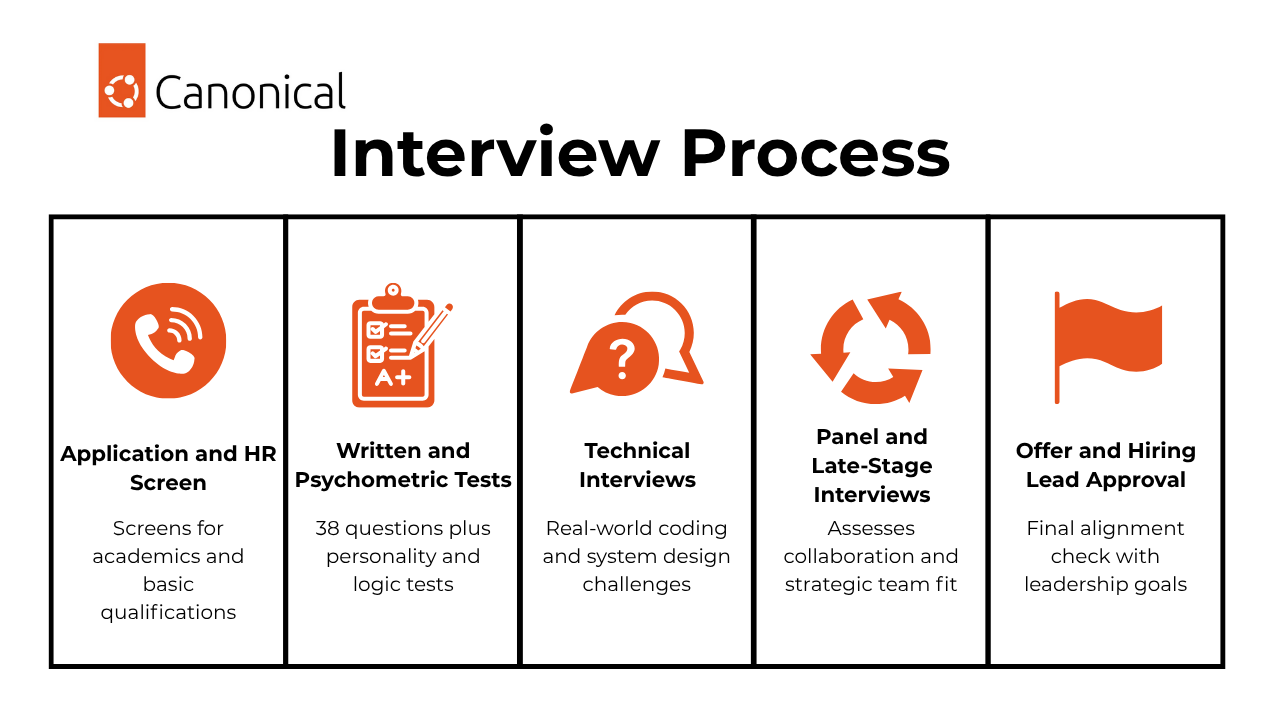
The canonical interview process and canonical hiring process embody one of the tech industry’s most comprehensive talent evaluation systems, designed to identify exceptional candidates across its globally distributed workforce. This multi-stage journey consistently spans 2.5-6 months, with structured phases including application screening, HR contact, written assessment, psychometric testing, multiple technical rounds, panel interviews, and final hiring approval. Here is how it typically unfolds:
- Application and HR Screen
- Written and Psychometric Tests
- Technical Interviews
- Panel and Late‑Stage Interviews
- Offer and Hiring Lead Approval
Application and HR Screen
Your application begins with Canonical’s automated systems processing approximately one million applications annually for 300-400 hires. When you successfully pass the initial screening, you’ll typically receive contact from HR personnel, though the specific source varies. Candidates report receiving initial contact from various team members, including talent acquisition partners, hiring leads, or automated systems, with the communication pattern depending on role seniority and department.
The initial screening phase emphasizes exceptional academic performance and relevant experience, with Canonical explicitly stating that they evaluate high school and university results regardless of role seniority. This approach filters candidates early based on educational achievement patterns. Most candidates (93%) apply through online channels, with the initial screening occurring within 1-2 weeks of application submission. During this phase, expect basic qualification verification and scheduling of subsequent assessment stages.
Written and Psychometric Tests
The canonical written interview and canonical psychometric assessment form one of the most defining stages in the recruitment journey. Candidates often dedicate 6 to 12 hours to complete the two.
The written interview comprises up to 38 detailed questions covering your educational history, personal motivations, technical experience, and alignment with Canonical’s mission. It’s not just about facts—it’s about how you reflect, write, and reason through open-ended problems. Submissions can span 10 to 20 pages, making clarity and depth essential. The psychometric assessment follows and takes about 30 to 45 minutes. It includes logic puzzles, IQ-style problems, and personality profiling to evaluate your thinking speed and work behavior.
Canonical uses these assessments to build a uniform hiring signal across its globally distributed applicant pool. This ensures fairness across cultures and time zones. Your written responses are reviewed not only for content, but also for communication skills, reasoning quality, and how well your mindset fits Canonical’s engineering and cultural DNA.
Technical Interviews
The canonical technical interview is where your domain knowledge and problem-solving abilities are deeply evaluated. Canonical technical interview questions vary widely depending on the role. However, they all share a focus on real-world application over textbook knowledge.
A typical software engineering path includes three to five interviews focused on code quality, architecture, and your contributions to open-source communities. You may be asked to design distributed systems, review code snippets live, or build problem-solving solutions in your preferred language.
The questions test how well you understand performance trade-offs, fault tolerance, and modular design. You should be ready to explain your decisions, demonstrate hands-on expertise, and share your thought process. Interviewers look for clarity, collaboration, and a passion for scalable open technologies.
For infrastructure roles, expect in-depth Linux and cloud-focused assessments. For product-facing roles, communication and customer empathy will also be tested. Technical interview steps differ for data engineers – see the Canonical Data Engineer Interview Guide.
Panel and Late‑Stage Interviews
The canonical late-stage interview typically includes two to three one-hour sessions involving hiring managers and senior leadership. These conversations shift focus from technical competence to strategic fit, long-term alignment, and culture.
You will be assessed on how well you collaborate across time zones, manage asynchronous workflows, and contribute to a globally distributed team. Common topics include your readiness for Canonical’s biannual team “sprints,” which require international travel for in-person collaboration. Expect situational questions around prioritization, leadership, and conflict resolution.
Some roles may require a short presentation or proposal. Hiring managers are keen to understand your potential for impact, not just as a contributor but as a team player in a complex, remote-first organization. The panel format helps ensure multiple viewpoints are considered, promoting diverse and balanced decisions. If you’ve made it to this stage, Canonical already sees your promise. Now it’s about confirming your readiness to grow within their global structure and open-source mission.
Offer and Hiring Lead Approval
The final stage includes the canonical hiring lead interview, which serves as the ultimate decision checkpoint. This conversation is often with a director or department head who confirms the team’s consensus and discusses broader goals. It’s both a validation and a final match exercise—are your capabilities and values aligned with Canonical’s strategic direction? If successful, you’ll typically receive a verbal offer within one to two weeks.
Most Common Canonical Interview Questions
This section explores canonical interview questions and answers across technical, behavioral, and scenario-based formats, with detailed breakdowns available in each role-specific guide below.
Role‑Specific Interview Guides
- Canonical Software Engineer Interview Questions
- Canonical Data Engineer Interview Questions
- Canonical Machine Learning Engineer Interview Questions
- Canonical Data Analyst Interview Questions
- Canonical Growth Marketing Analyst Interview Questions
- Canonical Product Manager Interview Questions
Technical Interview Questions
Canonical technical interview questions often focus on real-world programming, Linux environments, and cloud infrastructure. Canonical Python interview questions are especially common, so prepare for logic-based coding and system design:
1. Write a function to return the optimal friend that should host the party
To determine the optimal host, calculate the centroid of all friends’ locations in 3D space by averaging their (x), (y), and (z) coordinates. Then, find the friend closest to this centroid by computing the Euclidean distance for each friend and selecting the one with the smallest distance.
To solve this, iterate through the friends_removed list and match each entry with the corresponding friendship in the friends_added list based on sorted user_ids. Remove matched entries from friends_added to avoid duplicate matches, and construct the output list with the friendship’s start and end dates.
To solve this, iterate through the words and group them into lines such that their total length (including spaces) does not exceed max_width. Distribute extra spaces evenly between words using a round-robin approach, and handle
4. Find if there is a path from a starting point to an ending point in a walled maze
To solve this, use a depth-first search (DFS) or breadth-first search (BFS) algorithm to traverse the maze. Start from the given starting point and explore all possible paths while marking visited cells to avoid revisiting. If the target cell marked as 2 is reached, return True; otherwise, return False.
To solve this, follow the unlocked doors in the grid starting from the northwest corner. Mark visited rooms to avoid revisiting and increment a counter for each step. If the path leads out of bounds or revisits a room, return -1. Otherwise, continue until reaching the southeast corner and return the counter.
Behavioral and Cultural Questions
Expect behavioral questions that explore your communication style, alignment with open-source values, and how you’d collaborate across Canonical’s globally distributed teams, starting with questions like “what would you most want to change about Canonical?”
To address misaligned communication with stakeholders, identify the root cause of the misunderstanding and adapt your approach accordingly. For example, if the issue stems from overly technical language, pause to clarify and tailor your presentation to the audience’s level of understanding. Reflect on the experience to improve future communication strategies.
7. How comfortable are you presenting your insights?
To answer this question, describe your process for preparing data presentations, strategies for making data accessible, and the tools you use. Highlight your ability to present both in-person and virtually, and provide examples of recent experiences to demonstrate your confidence and adaptability in communication.
8. What are your strengths and weaknesses?
To answer this, focus on strengths that set you apart and can be backed up with examples using the STAR method. For weaknesses, avoid listing insecurities; instead, show how you recognize and manage them effectively, possibly spinning them into strengths without appearing arrogant.
9. Why Do You Want to Work With Us
When asked why you want to work with a company, focus on aligning your values with the company’s values, projects, reputation, and benefits. Research the company’s “About Us” page, job description, and recent initiatives to demonstrate your alignment with their goals and culture. Highlight your passion for the industry and how the company’s offerings will help you excel in your role.
Scenario and Problem‑Solving Questions
These Canonical questions test how you would handle edge cases and production challenges in async teams, with occasional curveballs to assess creative thinking and cultural fit:
10. You’ve contributed to an open-source project that’s now part of Canonical’s product roadmap. A critical security vulnerability is discovered. How do you lead the response while ensuring transparency with the community?
This tests your ability to navigate Canonical’s dual commitment to enterprise stability and open-source transparency. A strong answer would explain how you’d follow a coordinated disclosure process, patch the vulnerability in private branches, notify internal security stakeholders, and issue timely CVEs. You should also describe how you’d manage public communication—perhaps through Launchpad, GitHub issues, or Ubuntu security notices—while collaborating with upstream maintainers and Canonical’s Ubuntu Pro team.
11. During a sprint in Madrid, your team agrees on a new system architecture. Back home, you realize key assumptions were wrong. How do you drive course correction across time zones?
Canonical’s remote-first and sprint-based model makes this a realistic challenge. A solid response should include documenting the updated technical reasoning, proposing a revised architecture diagram, and sharing it asynchronously via an internal doc or Discourse post. You’d follow up by tagging the impacted stakeholders, initiating discussion during the next standup or backlog review, and updating the team wiki or architecture RFC. The goal is to show leadership, technical clarity, and async-first collaboration.
12. You’re working on a Canonical LLM chatbot stack built on OpenSearch, NVIDIA NIM, and Kubeflow. Suddenly, vector search recall drops below acceptable thresholds. What’s your plan?
This tests your understanding of Canonical’s open-source AI stack. Start by explaining how you’d log search queries, test embedding quality (e.g., cosine similarity vs. ground truth), and verify if drift occurred in LLaMA 3 embeddings. Mention you would validate the RAG pipeline’s chunking strategy and memory constraints in KServe. You might also propose reindexing in OpenSearch and compare retrieval precision before and after. Emphasize reproducibility using containerized experiments and documenting all findings for your team.
Preparation Strategy for a Canonical Interview
The canonical interview experience is one of the most distinctive in tech—highly structured, remote-first, and designed to evaluate not just your technical skill, but your written communication, collaboration style, and commitment to open-source principles. Here are seven strategic ways to prepare effectively for Canonical’s 2025 hiring process:
Study DevSkiller-Style Assessments
Many candidates begin with a timed coding challenge, often using DevSkiller or a similar platform. Expect multiple-choice questions alongside real-world coding problems, such as implementing basic encryption or string manipulation. Practice solving problems in browser-based editors and get comfortable without IDE support. Focus on core concepts like data structures, algorithms, and language-specific quirks (especially Python, Go, or C). Keep in mind that your code may be reviewed later in live interviews, so emphasize readability and clear documentation.
Practice Remote Whiteboarding
Since Canonical is a fully remote company, technical interviews often include screen sharing, whiteboarding sessions, or architectural discussions done over video calls. Use digital tools like Miro, Google Jamboard, or VS Code Live Share to rehearse live problem-solving. Practice clearly explaining your logic, sketching systems, or reviewing code while narrating your thought process. Success in remote whiteboarding isn’t about speed—it’s about clarity and collaboration in a virtual environment.
Run Mock Interviews
Simulate full interview sessions with a peer or mentor. Include both technical challenges and behavioral questions. Record the session if possible, and critique your communication style, pacing, and structure. Focus on answering questions in a way that demonstrates both competence and curiosity. Use real-world examples from past projects, and make sure your stories highlight autonomy and adaptability—two traits that Canonical values in remote employees.
Align Answers with Open-Source Values
Canonical doesn’t just hire engineers—they hire contributors to the open-source ecosystem. Whether you’re writing about your background in the written interview or responding to live questions, find ways to show that you care about transparency, community collaboration, and long-term software sustainability. Even small open-source contributions, involvement in tech forums, or GitHub activity can signal alignment with Canonical’s mission to democratize technology.
Prepare for Behavioral and Cultural Fit Questions
Expect questions about how you’ve handled distributed teamwork, conflict resolution, asynchronous communication, or working independently. Use the STAR (Situation, Task, Action, Result) method to structure your responses. Canonical also values self-awareness and growth mindset—be ready to reflect on past mistakes or decisions. You may even face cultural ice-breakers like the so-called “wedding questions,” meant to gauge creativity and interpersonal instincts. There are no right answers—just insight into how you think and interact.
Research Canonical’s Teams and Projects
Before your interviews, study Canonical’s work through their GitHub repos, Launchpad projects, recent blog posts, and social media presence. Look up your interviewers on LinkedIn and see what technologies they work on. Explore discussions in Ubuntu forums or subreddits like r/Ubuntu to understand user pain points and Canonical’s roadmap. Mentioning a recent product launch or a security update during your interview shows initiative and industry awareness.
Embrace the Remote-First Mindset
Canonical operates in over 80 countries with a 100% remote workforce. Demonstrate that you can work effectively across time zones, manage your own workload, and communicate asynchronously. Highlight experiences where you’ve taken initiative without micromanagement, contributed to documentation, or managed projects independently. Mention tools you’ve used in distributed teams—like Slack, Zoom, Git, Trello, or Notion—and how you keep team alignment strong even without a shared office.
Salaries at Canonical
Average Base Salary
Average Total Compensation
Conclusion
The Canonical interview process in 2025 is both rigorous and deeply intentional. From written assessments to technical rounds and late-stage evaluations, each step is designed to surface candidates who thrive in remote-first, open-source-driven environments. If you’re serious about joining, build your readiness with our complete Canonical ML Engineer Learning Path to sharpen skills aligned with the company’s stack. For inspiration, check out Jayandra’s success story that breaks down how he navigated the multi-stage process. And when you’re ready to dive into preparation, explore our full collection of Canonical SQL interview questions covering behavioral, technical, and scenario-based prompts.
FAQs
How long does the Canonical interview process take?
The canonical recruitment process typically spans 2.5 to 6 months. It includes application review, a written interview, psychometric and technical assessments, panel interviews, and final hiring lead approval.
Is Canonical a good company to work for?
Yes, if you thrive in a remote-first, open-source-driven environment. Canonical offers flexibility, global collaboration, and mission-driven projects, though reviews note that the promotion process can be challenging.
Does Canonical use psychometric or aptitude tests?
Yes, the canonical aptitude test is part of the written and psychometric stage. It includes cognitive, personality, and logic assessments, typically lasting 30–45 minutes.
Who decides the final offer at Canonical?
The final decision is made during the canonical talent interview by a hiring lead or department director. This stage confirms team alignment and strategic fit before an offer is extended.
Discussion & Interview Experiences