

Does Interview Prep Actually Work? What 1,313 Alumni Outcomes Show


How Interview Prep Impacts Job Placement
TL;DR
Our analysis of 1,313 alumni from a leading U.S. school reveals four consistent patterns:
1. Interview preparation correlates with elite placement.
44.8% of Interview Query users reached elite or top-tier employers, compared with 36.1% of non-users.
2. The effect is consistent across cohorts.
The placement gap appears in every graduating class from 2018 through 2025.
3. Engagement intensity matters.
Alumni who completed 50+ Interview Query sessions achieved outcome scores 21% higher than non-users.
4. Active practice predicts stronger outcomes.
Challenge completion shows the largest outcome gap (+0.68), suggesting applied problem-solving is particularly valuable.
Executive Summary
Does structured interview preparation actually improve career outcomes or does it simply make candidates feel more confident?
To explore this question, we analyzed career outcomes for 1,313 alumni from a Master of Quantitative Management (MQM) program at a leading U.S. business school who graduated between 2018 and 2025.
Among these alumni:
- 370 (28.2%) used Interview Query
- 943 (71.8%) did not
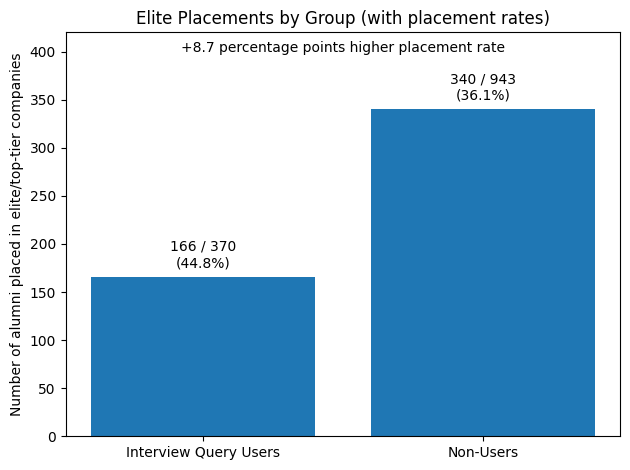
Alumni who used Interview Query landed roles at Elite and Top Tier companies at a rate of 44.8%, compared to 36.1% for non-users. This 8.7 percentage point difference represents a 43% relative increase (from a 36.1% baseline) in the probability of reaching the most selective employers.
Importantly, the pattern appears across every graduating cohort in the dataset, across all five academic tracks, and shows a clear dose-response relationship: alumni who engaged more deeply with interview preparation tools achieved stronger career outcomes.
This analysis does not claim causation. Students who choose structured preparation may differ from others in ways that also affect outcomes. However, the consistency and magnitude of the observed effect across eight graduating classes and more than a thousand alumni make the signal noteworthy. For students preparing for quantitative and analytical careers, the data suggests a simple conclusion: how you prepare matters.
The Dataset
This analysis examines 1,313 alumni from a Master of Quantitative Management (MQM) program at a leading U.S. business school graduating between 2018 and 2025.
Students in the program specialize across five academic tracks:
- Finance
- Risk Management
- Strategy
- Healthcare
- Technology
Of the alumni studied:
- 370 (28.2%) were identified as Interview Query users
- 943 (71.8%) were non-users
Interview Query usage was determined through platform engagement data, while career outcomes were sourced from public LinkedIn profiles.
To compare outcomes across industries and roles, each alumnus was assigned a composite outcome score based on two factors:
- Company prestige tier (scored 1–5, where 5 represents elite firms)
- Role seniority level (scored 1–4)
These metrics were combined and normalized to a 0–5 scale, enabling consistent comparison across companies and career paths. Elite-tier companies in the dataset include organizations widely recognized for their competitive hiring processes, including:
Google, Meta, Amazon, Microsoft, Apple, McKinsey & Company, Boston Consulting Group, Goldman Sachs, JP Morgan, Two Sigma, Citadel, and other firms with similarly selective recruitment pipelines.
The Core Finding: +8.7 Percentage Points in Elite Placement
Across the full dataset, Interview Query users were significantly more likely to land roles at Elite or Top Tier companies.
| Placement Outcome | Interview Query Users | Non-Users |
|---|---|---|
| Elite / Top Tier Companies | 44.8% | 36.1% |
The 8.7 percentage point difference translates into a 43% relative increase in the likelihood of reaching elite employers.
Put another way:
If 100 students applied to elite firms, the data suggests that structured preparation on Interview Query was associated with roughly nine additional students reaching that top tier. In a cohort of 150–200 students, that difference represents a meaningful shift in outcomes. What makes this finding particularly compelling is its consistency over time.
A Consistent Pattern Across Eight Graduating Cohorts
The difference in placement rates persists across every graduating cohort between 2018 and 2025.
The stability of the gap across cohorts is significant. If the difference were primarily driven by career tenure, for example, older cohorts having had more time to reach prestigious roles, we would expect the gap to shrink in more recent graduating classes.
Instead, the 2024 and 2025 cohorts show nearly identical placement differences to the earliest cohorts in the dataset. This suggests the signal reflects placement-time differences rather than long-term promotion effects.
Practice Intensity Matters: A Dose-Response Relationship
The binary comparison between users and non-users tells only part of the story. When alumni are grouped by level of platform engagement, a clear dose-response pattern appears.
Outcome Score by Level of Practice
| Interview Query Sessions | Average Outcome Score | Change vs No Practice |
|---|---|---|
| 0 sessions | 3.08 | — |
| 1–10 sessions | ~3.2–3.3 | +0.1 to +0.2 |
| 10–50 sessions | ~3.4–3.5 | +0.3 to +0.4 |
| 50+ sessions | 3.72 | +0.64 (+21%) |
Alumni who completed 50 or more practice sessions achieved an average outcome score of 3.72, compared to 3.08 for non-users, a 21% improvement. The steady progression across engagement levels suggests that depth of preparation, not just participation, correlates with stronger outcomes.
This pattern also carries a practical implication: the data does not show a plateau in benefits at low levels of engagement. Instead, outcome scores continue to improve as preparation deepens.
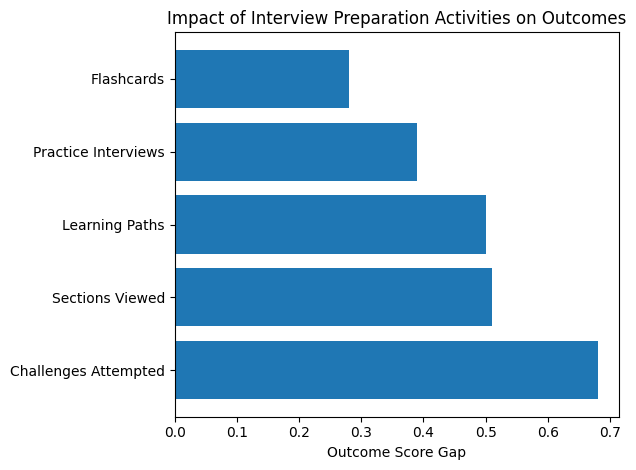
Which Preparation Activities Matter Most?
Interview Query offers several types of learning tools, including:
- technical challenges
- structured learning paths
- practice interviews
- flashcards
- topical content sections
When alumni outcomes are compared by feature usage, clear differences emerge.
| Feature Used | Outcome Score Gap | |
|---|---|---|
| Challenges Attempted | +0.68 | |
| Sections Viewed | +0.51 | |
| Learning Paths | +0.50 | |
| Practice Interviews | +0.39 | |
| Flashcards | +0.28 |
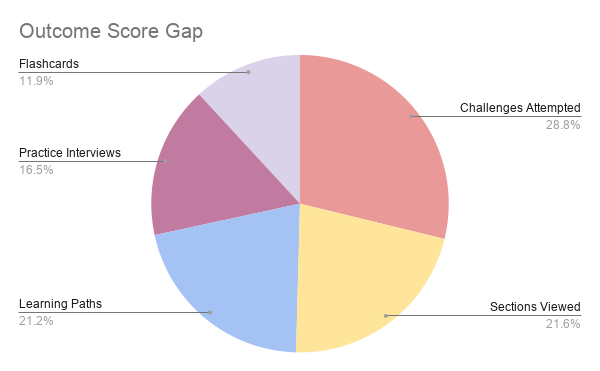
Among all engagement modes, Challenge completion shows the strongest association with elite placement. Challenges involve open-ended analytical problems requiring candidates to write and execute code under realistic conditions. This format closely mirrors technical interview tasks used by firms such as Google, Two Sigma, and McKinsey.
Sections Viewed and Learning Paths also show strong correlations, suggesting that structured content consumption contributes meaningfully to preparation quality.
Flashcards, while still positively correlated, show the smallest outcome difference. This aligns with broader learning research: passive recall strengthens recognition but may translate less directly to the generative problem-solving required in technical interviews.
Variation by Academic Track
The impact of Interview Query usage varies across academic tracks.
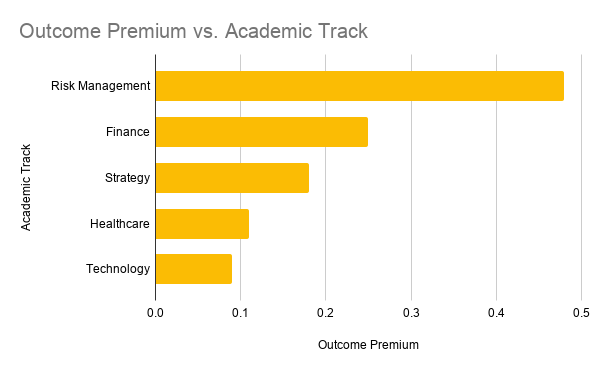
The strongest effect appears in Risk Management, followed by Finance.
These roles typically involve highly quantitative interview processes, including SQL analysis, probability questions, and statistical reasoning, areas where Interview Query’s practice content aligns closely with interview requirements. The smaller effect observed in the Technology track likely reflects the stronger technical backgrounds many students in that track already possess.
What This Means for Students
Several practical insights emerge from the data. Preparation gaps matter. ****Alumni who reached firms such as Google, Goldman Sachs, McKinsey, and Two Sigma were not uniformly more talented than their peers. Many simply engaged more deliberately in structured interview preparation.
- Depth of preparation appears to matter more than breadth.
- Students completing 50 or more practice sessions saw the strongest outcomes.
- Active problem solving is more strongly correlated with outcomes than passive review.
- Challenges and Learning Paths outperform flashcards by a significant margin.
The return on structured preparation appears highest in quantitatively demanding fields, particularly Risk Management and Finance.
For students currently in quantitative programs, the implication is clear: sustained, structured preparation can meaningfully influence career outcomes.
Honest Limitations
This study is observational rather than experimental.
Students were not randomly assigned to use Interview Query. Those who chose to use the platform may differ from non-users in several ways, including motivation, prior experience, or professional networks.
Self-selection bias is therefore a legitimate concern.
Additionally:
- Company prestige tiers involve human classification, which introduces some subjectivity.
- LinkedIn data may contain gaps, as not all alumni maintain current profiles.
Despite these limitations, the consistency of the observed pattern across 1,313 alumni, eight graduating cohorts, and five academic tracks suggests the findings are meaningful and worthy of further study.
Looking Ahead
This report represents an initial step in understanding how structured interview preparation correlates with career outcomes. Future work may explore similar analyses across additional universities and programs. For students and job seekers, however, the takeaway is immediate. The alumni who reached elite employers did not rely solely on coursework or passive preparation. They invested time in structured practice, realistic problem solving, and sustained preparation.
The data suggests that preparation is not simply a confidence exercise. It is a skill-building process, and one that appears to correlate strongly with career outcomes. Interview Query is a data science and analytics interview preparation platform used by students and professionals preparing for roles at top companies worldwide. This report was compiled using alumni outcome data sourced from LinkedIn and Interview Query platform engagement records. For questions or feedback: **team@interviewquery.com