

NBER: CFOs Plan 9x More AI Layoffs in 2026, But the Productivity Gains Haven't Arrived

AI Layoffs Are Surging in 2026
The global tech sector has eliminated nearly 60,000 jobs in less than three months of 2026. Amazon cut 16,000 workers while reporting record revenue of $716.9 billion. Block slashed 40% of its workforce and CEO Jack Dorsey said outright that the move was not driven by financial difficulty. Atlassian cut 10% of its staff while posting 26% cloud revenue growth. The pattern is consistent, with companies in strong financial shape cutting jobs and citing AI as the reason.
A working paper published March 24th by the National Bureau of Economic Research puts numbers to the trend. Based on the Duke CFO Survey conducted in partnership with the Federal Reserve Banks of Atlanta and Richmond, 44% of CFOs from 750 U.S. firms report plans for AI-related job cuts this year. The researchers calculated that amounts to roughly 502,000 roles across the broader economy in 2026, about nine times the 55,000 AI-attributed layoffs recorded in 2025.
But the productivity gains justifying those cuts have not materialized yet. Goldman Sachs said in early March that it “still does not find a meaningful relationship between productivity and AI adoption at the economy-wide level.” Companies are cutting jobs based on expected efficiency improvements, and those expectations are running ahead of reality.
Nearly 60,000 Tech Jobs Gone in Under Three Months
Layoff tracker TrueUp recorded 171 separate workforce reduction events in 2026 through late March, affecting 59,121 workers at a rate of roughly 704 jobs per day. That pace runs ahead of 2025, when 245,953 workers were let go across the full calendar year. If the current rate holds, total cuts could reach 265,000 by December.
Amazon tops the list with approximately 16,000 cuts this year, framed internally as a push to flatten management layers and accelerate decision-making. Block cut 4,000 role, which is nearly 40% of its entire workforce. Atlassian cut 1,600 jobs, with co-founder Mike Cannon-Brookes describing the move as one that would “self-fund further investment in AI and enterprise sales.” Reuters reported in mid-March that Meta is planning layoffs that could affect 20% or more of the company.
The revenue picture makes these decisions harder to explain on traditional grounds. These are not distressed companies. They are profitable, growing organizations making deliberate bets on AI-driven operating models.
One in Five Layoffs Explicitly Attributed to AI
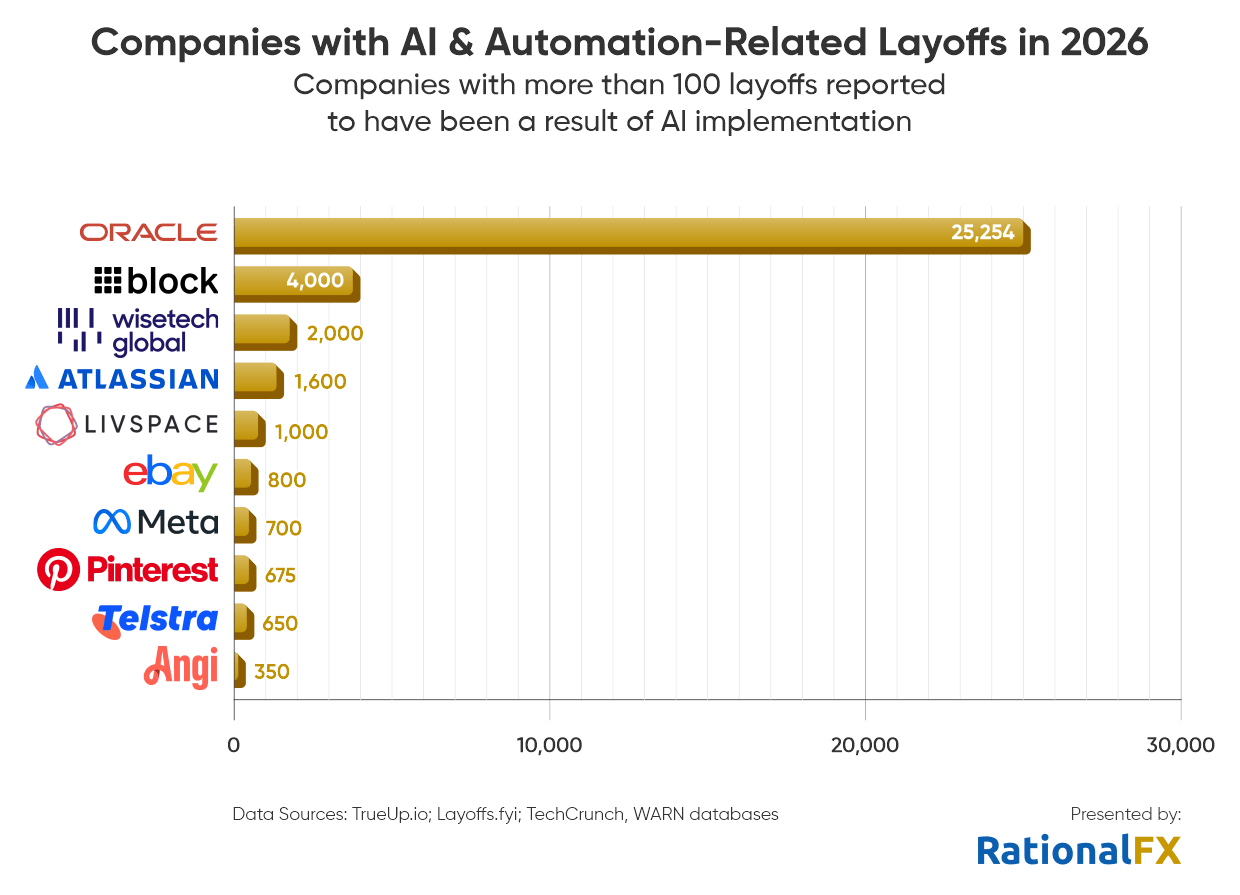 Source: RationalFX’s Tech Layoffs 2026 report
More than 9,200 of the layoffs recorded in 2026 are directly attributed to AI adoption and automation by the companies themselves, according to UK-based research firm RationalFX. That number represents roughly one in five of all tech job cuts this year. That level of candor is new. In previous years, AI restructuring was often obscured behind broader “efficiency” language.
Block’s Dorsey was among the most direct: “This is not driven by financial difficulty, but by the growing capability of AI tools to perform a wider range of tasks,” he wrote in a company-wide memo. That kind of statement would have been unusual two years ago, but now it reads as a template that other executives are quietly following.
The NBER study, led by Duke’s John Graham, finds that this transparency extends beyond public statements. In private CFO surveys, 44% of respondents confirmed AI-related headcount plans, suggesting that public announcements represent only part of the story.
The Productivity Story Hasn't Caught Up Yet
The same NBER paper that quantifies planned AI layoffs also identifies a significant gap between perceived and actual productivity gains. CFOs believe AI is boosting productivity more than the data supports. The researchers suggest this reflects a delay in realized returns, a lag that economists have a name for.
Solow’s paradox, named for the observation that computers appeared everywhere except in productivity statistics, seems to be applying to AI. Goldman Sachs senior economist Ronnie Walker noted in early March that amid widespread AI investment, the bank “still does not find a meaningful relationship between productivity and AI adoption at the economy-wide level.” In other words, the tools are being deployed; the gains have not shown up in the numbers yet.
Workers are experiencing this directly. One analysis cited by Fortune found that time spent on some job responsibilities has increased by up to 346% as workers manage AI tools alongside their existing workflows. AI is, in some cases, adding work rather than removing it. A multi-month study by UC Berkeley researchers found that AI was contributing to a phenomenon called workload creep, where productivity gains get absorbed into task expansion, raised expectations, and increased multitasking.
For candidates in active job searches, this gap matters. It means companies are cutting based on expected AI efficiency, not realized efficiency. The reduction in open roles is real and happening now. The productivity gains driving those reductions may arrive later, or may require significant course correction.
What This Means for Candidates Right Now
The job market has tightened in measurable ways. Fewer open roles, more applicants per position, and longer hiring cycles at companies that have recently restructured. Layoff.fyi data shows that as of late March 2026, 102 distinct layoff events have affected 51,686 workers in the U.S. alone this year. Candidates competing for data, engineering, and technical roles are doing so in a smaller pool with more competition.
The interviews that do happen are evolving. Companies cutting on AI efficiency grounds are simultaneously running technical screens that probe AI fluency. Candidates who can demonstrate they work effectively with AI tools (not just that they use them, but that they produce better output with them) have a differentiated profile. Interviews now test for this directly in some loops, often through case work or system design discussions.
The NBER paper’s headline finding that AI job cuts will be nine times higher in 2026 than last year is striking, but the researchers themselves caution against reading it as catastrophe. “It’s not the doomsday job scenario that you might sometimes see in the headlines,” Graham told Fortune. That framing is accurate but cold comfort if you’re currently in a search. The cuts happening now are real, regardless of whether the long-term displacement story plays out as advertised.
The Bottom Line
Companies are cutting jobs citing AI gains that, by most economic measures, have not arrived yet. That is an unusual moment: the displacement effect is running ahead of the productivity story. Sixty thousand jobs gone in less than three months, from profitable companies with growing revenues, with AI cited as the rationale. Meanwhile, the economy-wide data shows no meaningful productivity signal.
For job seekers, the practical reality is tighter competition for open roles. The companies most actively restructuring are still hiring in specific functions, such as AI infrastructure, applied ML, data engineering, where the work directly supports the AI investment thesis. The candidates who get those offers tend to be the ones who prepared for both the technical bar and the newer interview formats that have emerged alongside AI adoption.
The productivity gains will eventually arrive, or the companies that over-cut will rehire. Either outcome creates opportunity for candidates who stay sharp now.